 →
→ 

Simple Sourdough Discard Toasting Bread
 By Alexandra Stafford
—
Last Updated: 02/23/2026
By Alexandra Stafford
—
Last Updated: 02/23/2026
This post may contain affiliate links. Please read my disclosure policy.
The best way to use up your sourdough discard? In more bread, of course! This recipe will show you how to make the simplest of simple bread recipes using your sourdough discard, and it will produce a soft but sturdy loaf, great for toast and sandwiches. 🍞🍞

There are countless recipes well-suited for using sourdough discard in place of some of the flour and water, but my favorite way to use it is as follows: in any bread recipe. My family subsists on toast and sandwiches, so I often use my discard in this favorite simple sandwich bread recipe or in this even simpler toasting loaf (recipe below), which is soft but sturdy, excellent, of course, for toast, but also great for sandwiches when freshly baked.
Whereas the sandwich bread recipe calls for milk and melted butter, this one calls for water alone, plus a small amount of honey, which lends the subtlest sweetness, promotes browning, and helps keep the bread soft. It can be omitted if you prefer. Find step-by-step instructions below.
How to Make Simple Sourdough Discard Toasting Bread, Step by Step
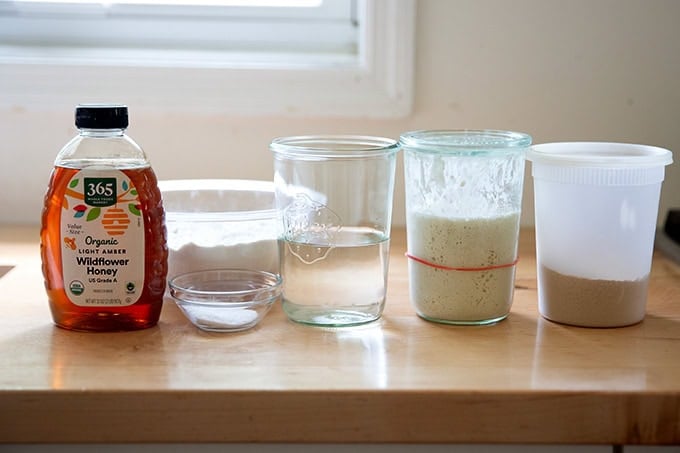
Gather your ingredients: flour, water, salt, sourdough discard, instant yeast, and, optionally, honey (or other sweetener).
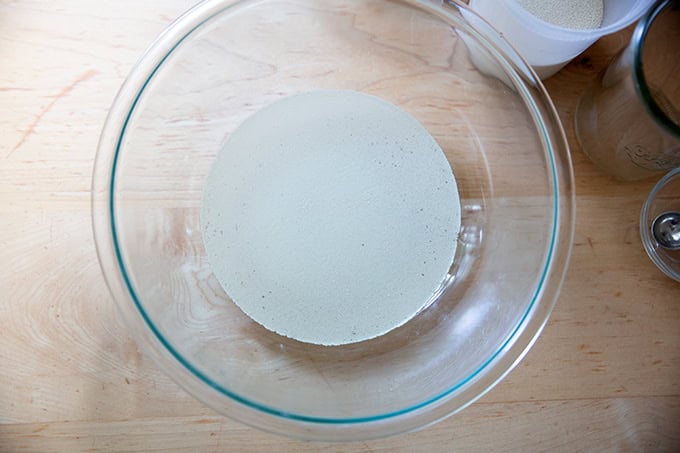
In a large bowl combine the water, honey (if using), salt, and instant yeast.
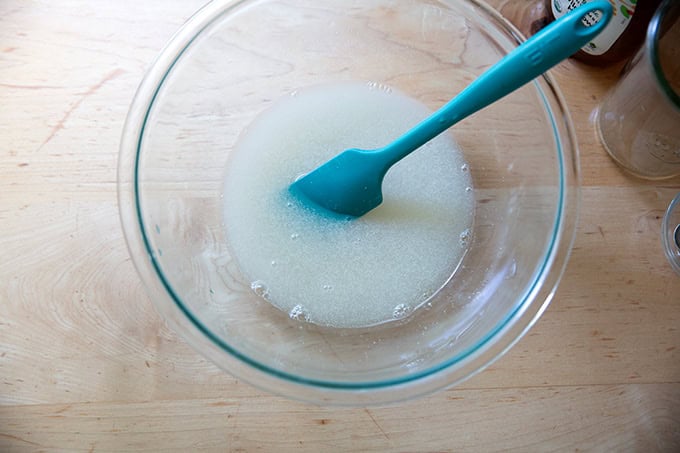
Stir to dissolve the salt and honey.
Add 200 grams of sourdough discard (see recipe box if you’d like to use less).
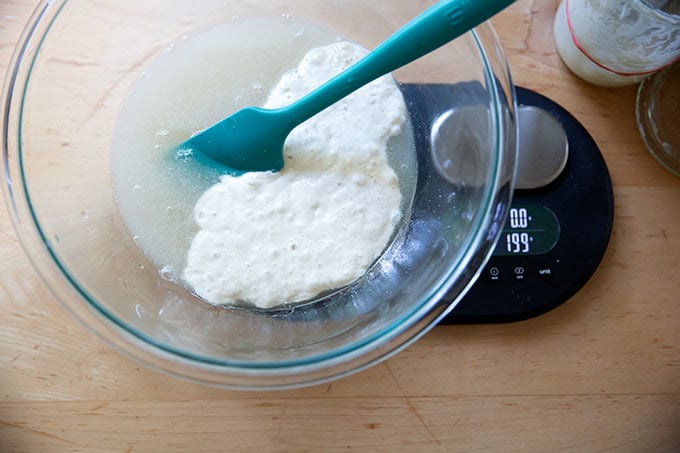
Stir to combine.

Add the flour.
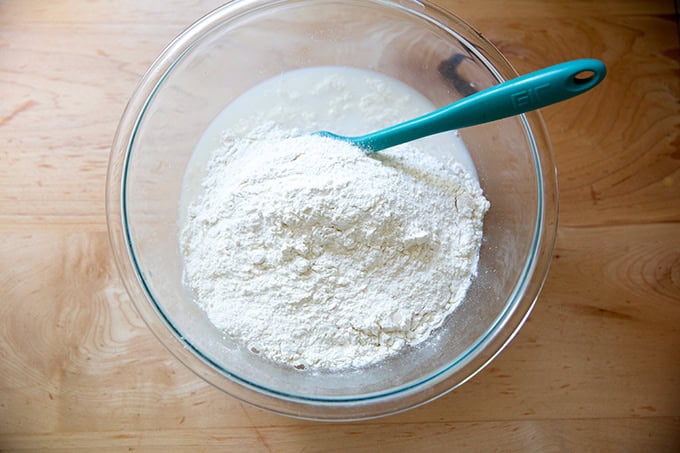
And stir until you have a wet, sticky dough ball. Cover the bowl and let rest for 30 minutes.
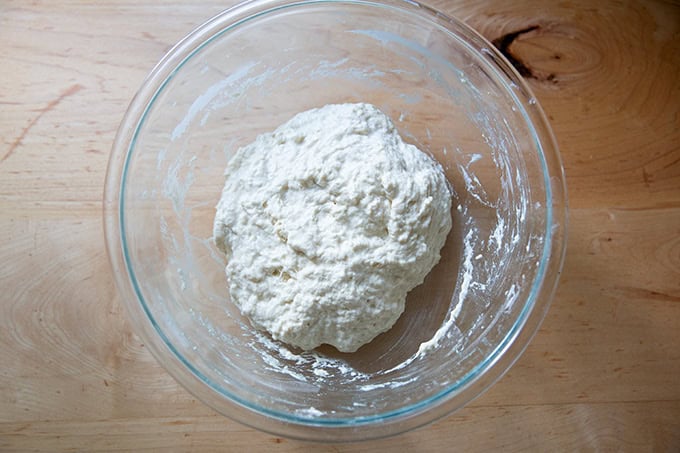
Then perform a series of stretches as folds using a wet hand. Here’s video guidance:
Cover the bowl again and let the dough rise …
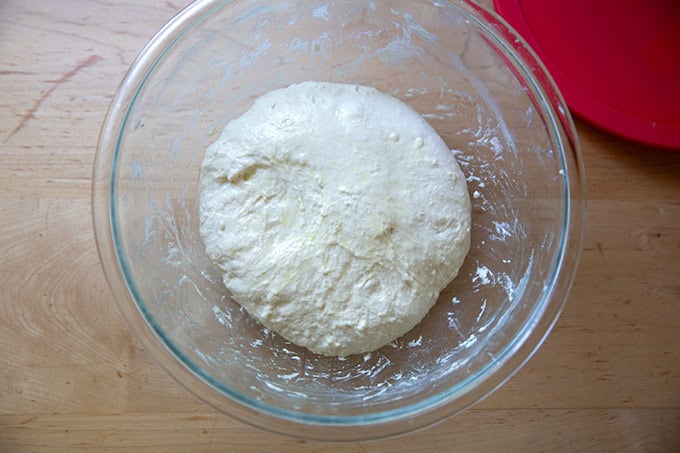
… until it doubles in volume.

Using a flexible bowl scraper, deflate the dough by pulling it from the sides of the bowl and into the center. Turn the dough out onto a floured work surface and roll into a coil. Here’s video guidance:
Deflated dough:

Turned out dough:
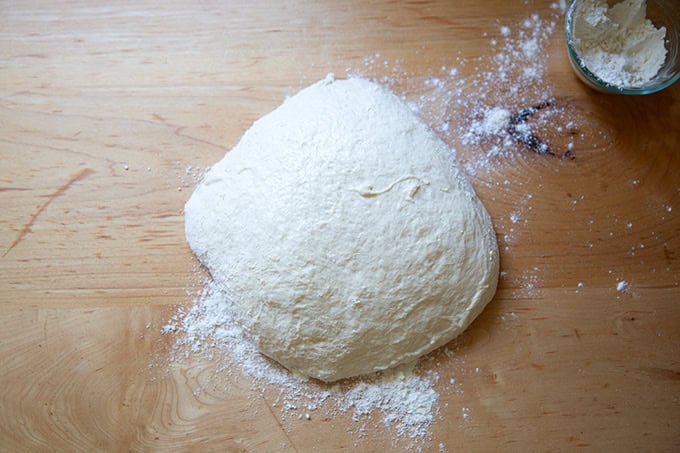
Rectangle:

Drizzle the loaf lightly with olive oil, and rub to coat.

Let rise until the dough crowns the rim of the loaf pan.
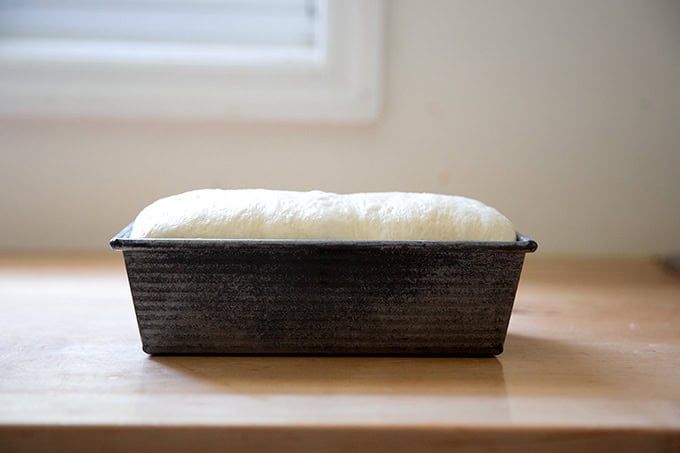
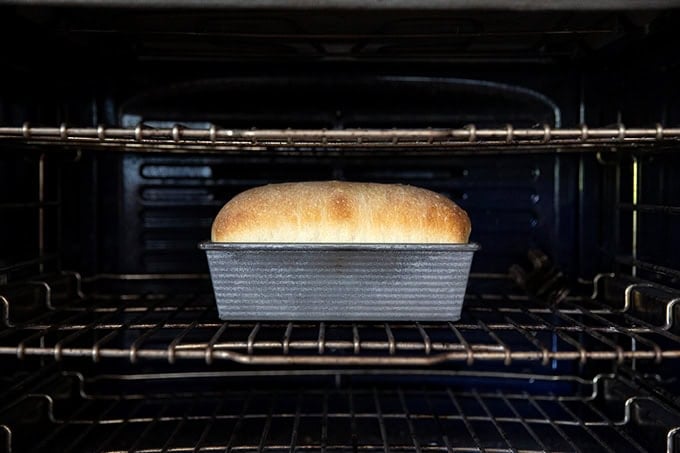
Bake at 375ºF for 45 minutes.
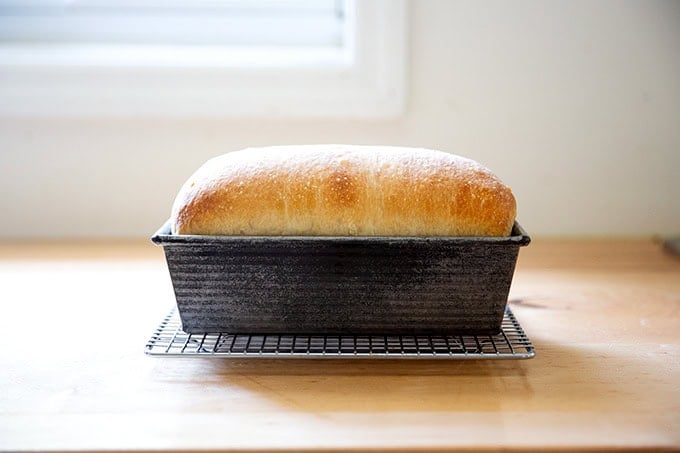
Then turn out onto a cooling rack.
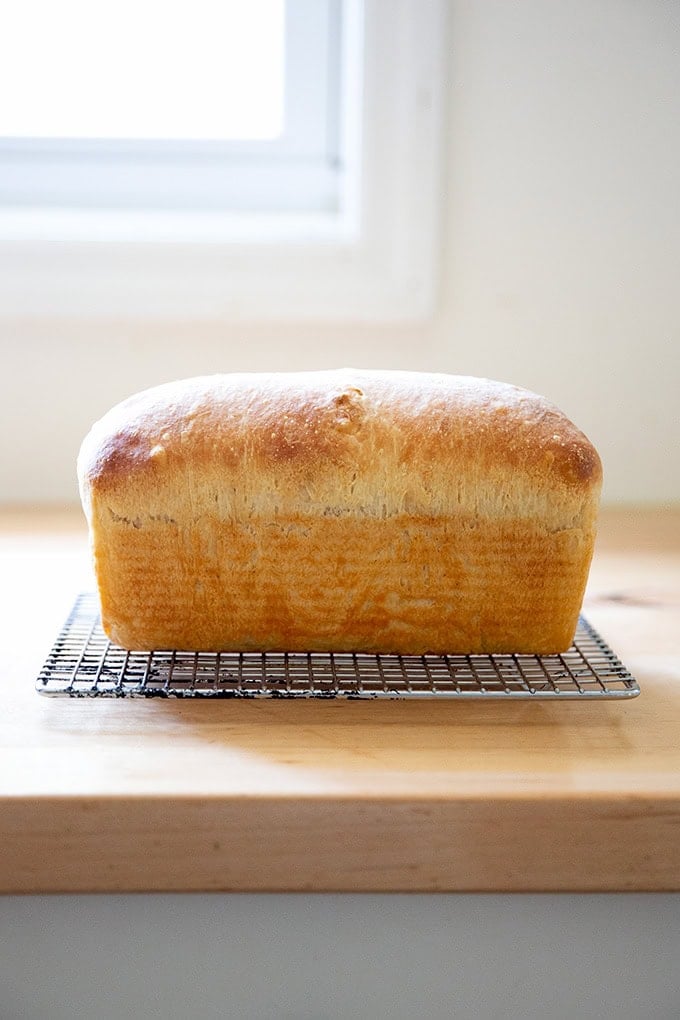
Let cool for at least 30 minutes before slicing.
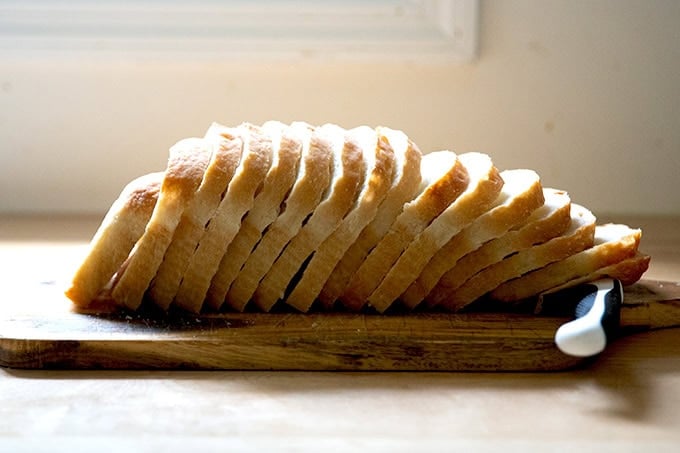
This bread freezes beautifully.
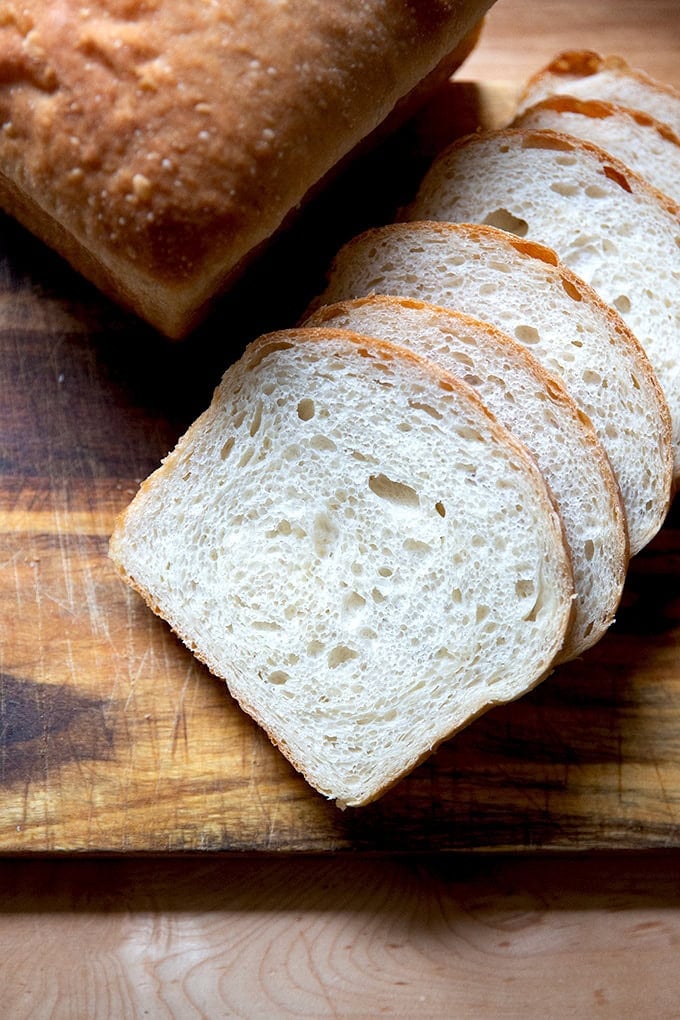
It’s great for sandwiches when freshly baked:
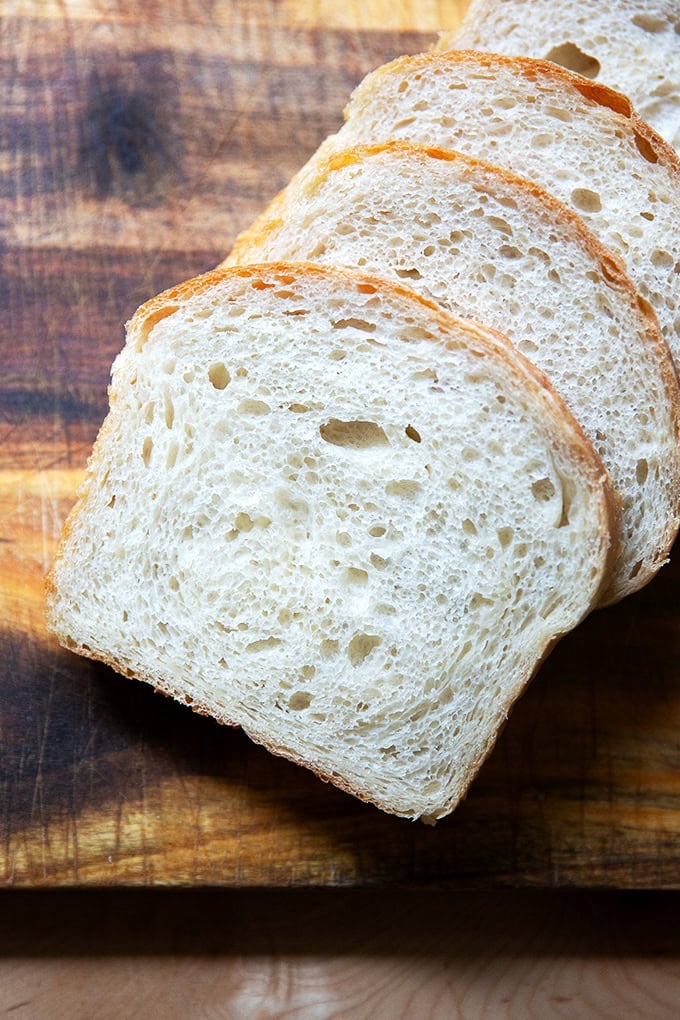
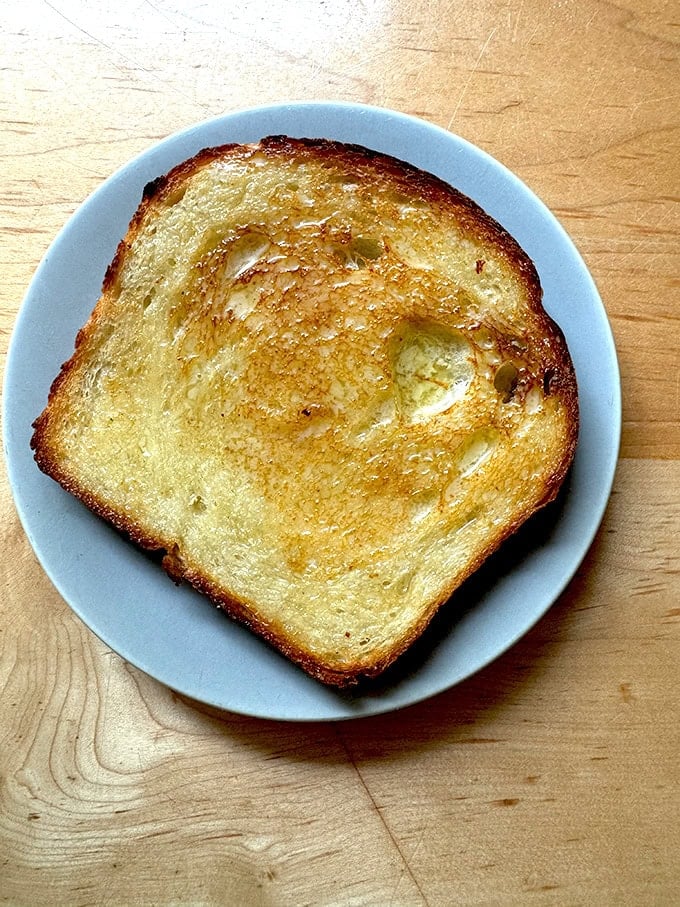
And, of course, makes excellent toast:
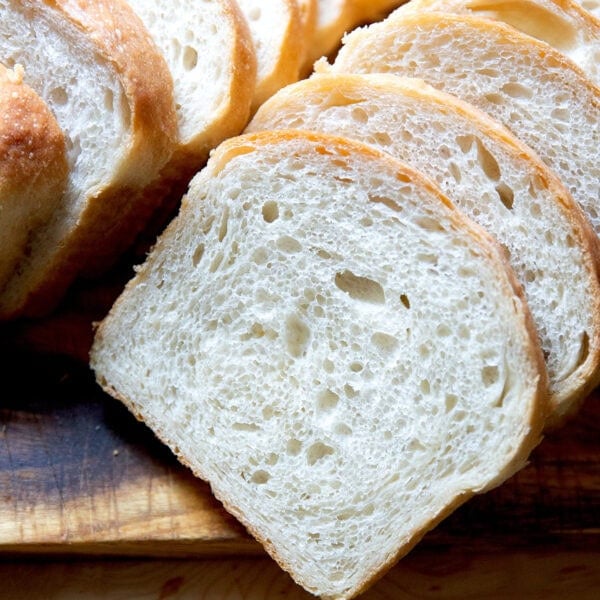
Simple Sourdough Discard Toasting Bread
- Total Time: 3 hours 45 minutes
- Yield: 1 loaf or 14 slices 1x
Description
This recipe will show you how to make the simplest of simple bread recipes using your sourdough discard, and it will produce a soft but sturdy loaf, great for toast and sandwiches. 🍞🍞🍞
Notes:
- For best results, please use a scale to measure.
- Yeast: SAF instant yeast is my preference. If you are using active dry yeast, sprinkle it over the water and let it bloom for 15 minutes before proceeding.
- Salt: The rule of thumb with bread is that the weight of the salt should be 2 to 3% the weight of the flour. For this recipe that is 10 to 15 grams. I always use 15 grams of salt, and I do not find the bread to be too salty, but, as you know, I have a high salt tolerance. Use an amount appropriate to your tastes and preferences. Finally, I always use Diamond Crystal kosher salt, but you can use fine sea salt or whatever salt you like.
- Sourdough Discard: You can use either freshly discarded discard (as in from a room-temperature feeding of your starter) or you can use discard you’ve had in the fridge (ideally not older than 2 weeks). Ideally, you are feeding your starter at 100% hydration, meaning equal parts by weight flour and water, which is the hydration of the starter I use in all of my sourdough bread recipes. You can use as much or as little sourdough discard here as you like but adjust the recipe accordingly: if, for example, you want to use 100 grams of discard, use 350 grams of water and 500 grams of flour.
- The pan: I am using this 9×5-inch USA pan. You could use a 10×5-inch loaf pan here as well. An 8×4-inch pan might be too small here.
Ingredients
Please read all notes above before proceeding:
- 300 grams (about 1 1/3 cups) water, cold or room temperature
- 4 grams (1 teaspoon) instant yeast
- 10 to 15 grams (2 to 3 teaspoons) salt
- 21 grams (1 tablespoon) honey or other sweetener, optional
- 200 grams (about 1 cup) sourdough discard
- 450 grams (about 3.5 cups) bread flour, plus more for dusting
- softened butter for greasing
- olive oil for drizzling
Instructions
- Mix the dough: In a large bowl, combine the water, instant yeast, salt, and honey (if using). Stir to dissolve the salt and honey. Add the sourdough discard and stir to combine. Add the flour, and stir until you have a wet, sticky dough ball. Cover the bowl and let it rest for 30 minutes.
- Stretch and fold: Fill a small bowl with water. Using a wet hand, stretch and fold the dough by grabbing an edge and pulling it up and towards the center. Repeat this stretching and folding process, moving your hand around the edge of the dough with every set of stretches and folds. As you stretch and fold, you should feel the dough transform from being sticky and shaggy to smooth and cohesive. Find video guidance here.
- Let it rise: Cover the bowl and let the dough rise at room temperature until it has doubled in volume, roughly 2 to 3 hours. Note: Depending on the temperature of your kitchen and the time of year, this may take more or less time. Rely on the visual cues (doubling) more than the timing.
- Prepare a loaf pan: Grease a 9×5-inch loaf pan with softened butter.
- Coil up your dough: Deflate the dough using your hand or a flexible bench scraper, then turn the dough out onto a lightly floured work surface. Pat it into a rectangle roughly 8 by 16 inches (Note: the length isn’t as important as the width: don’t go much wider than 8 inches or you will have to squish it into your loaf pan). Starting at the small end, roll the dough into a tight coil. Transfer it to your prepared pan. Pour 1 teaspoon of olive oil over the surface and rub to coat. Find video guidance here.
- Final rise: Let the dough rise until it crowns the rim of your pan, roughly 1 hour. When your dough begins approaching the rim (or roughly 30 minutes after you place the dough in the loaf pan), preheat your oven to 375ºF.
- Bake it: Bake for 45 minutes.
- Turn out onto a cooling rack and let cool completely (if you have the patience) before slicing — it is much easier to slice the bread into thin, uniform slices when the bread has cooled completely.
- Store the bread in an airtight bag or vessel at room temperature for 3 to 4 days or freeze for up to 6 months.
- Prep Time: 3 hours
- Cook Time: 45 minutes
- Category: Bread
- Method: yeast, sourdough
- Cuisine: Amerian
This post may contain affiliate links. Please read my disclosure policy.





52 Comments on “Simple Sourdough Discard Toasting Bread”
Hi Ali! Another keeper as per usual! I made a few tweaks to the base recipe simply because I ran out of time last night. My first change was subbing 50 g local whole wheat stone milled bread flour for the white (so 400 g white bread flour + 50 g whole wheat bread flour for a total of 450 g). Secondly, my first rise took 3 hours and it was already 11p, so I decided to go ahead and follow the instructions of coiling the bread and placing it in the loaf pan, but stopped at the final rise. Instead I just covered the loaf pan and placed it in the fridge overnight. I accidentally slept in this morning and found the loaf had crowned the pan a little more than I would like, but I went ahead and let it sit on the counter for 20 minutes while the oven preheated. When it came out of the oven, it was still perfect and delicious an hour later when we sliced into it. My husband and boys LOVED it! Thanks so much for the recipe! Your blog brings me so much joy!
Hooray! I’m so happy to hear this, Ashley. Thanks for writing and sharing these notes. I feel like I should add notes about using the refrigerator as needed in every bread recipe because it’s such a life saver when the timing doesn’t work with bed time 🙂 Thank you for your kind words… so glad your family approved 💕💕💕
I made this today and we LOVED it. I make peasant bread weekly and now I’ll be throwing this in rotation as well. Huge win!
Great to hear, Christine! Thanks so much for writing 🙂
Oh wow!! Can’t stop making this bread! Did a loaf for my neighbor yesterday who is using it for her burgers today :). I have another loaf in the oven now (it’s 95 degrees out!) so I can be done baking :). I use agave in place of the honey – and love the amount of discard it uses….beautiful recipe!
Great to hear, Cheryl! Thanks so much for writing and sharing your notes. Stay cool!!
So good! And easy 👍 a great way to use up sourdough discard. I made this along with your sourdough pancakes yesterday! Both fantastic.
Great to hear, April! Thanks so much for writing and sharing this 🙂
Against my better judgement, I hauled my homemade starter, Sourpuss, from Washington state to Washington DC during a cross country move. I needed to strengthen her up once I arrived and this recipe was perfect use of the discard. I’ve been eating on this loaf all week – cheese toast and tomato sandwiches especially. Another winner, as always. Thank you! In other news, I just made a batch of peasant bread to make both fresh and dried breadcrumbs with to keep on hand. Keep the amazing recipes coming!
Great to hear, Kristen! Thanks so much for writing and sharing this.
PS: Hauling Sourpuss across country = great judgement.
PPS: Sourpuss = best sourdough starter name.
Bravo on all accounts 👏👏👏👏
I’ve been trying to achieve a lighter 100 % whole wheat loaf without success, so to try something new I used half KA Golden Wheat flour and half KA bread flour in this recipe, left out the honey, and added an extra 23g of water to get the desired dough consistency – and it turned out spectacularly well! I will keep increasing the whole wheat percentage to see how close to 100% I can go, but this recipe is definitely a keeper. Thanks Ali!
Oh great to hear, Alyce! Thanks so much for writing and sharing this. And keep me posted on your next attempts. I, too, have tried to create a 100% whole wheat loaf without success.
This is a great bread! So easy, and so much better than discarding the discard. Perfect for sandwiches. Hint: after it cooled, I partially froze it, making it so much easier to slice. Then the slices went back into the freezer.
SMART! Great tip. Thanks for writing and sharing this 🙂
This turned out fabulous and seems really forgiving!
My starter is usually ~30% WW and I used white 00 Caputo flour as I don’t have bread flour in the pantry. I thought it might be a disaster as I initially forgot to add the salt, but did my best to incorporate it afterwards during the stretch and fold process. I also thought I might be in for a disappointment because my dough didn’t look much like the video but I’m so glad I carried on as it came out beautifully!
Despite my oopsies, this is one of my favorite loaves I’ve made. Thank you so much!
Great to hear, Kailey! I find this one to be very forgiving as well… every time I make it, the mixing order changes, and it always turns out just fine 🙂
One of the best breads I’ve ever made, just what I like, a no knead, no nonsense recipe, in fact I think that’s what I’ll call it “No knead, no nonsense” bread!! Turned out exactly like your pics, I only had 150g of discard, so I increased the yeast a little and kept all the other quantities the same, resulting in a super bubbly, and light as a cloud, dough. I’m already thinking of ways to use this dough for other bakes, I think it would make great cinnamon rolls and pizza rolls, as I think it’s truly a multi purpose dough. I’ve yet to master a true sourdough bread, despite trying your sandwich loaf a few times, I just think I need to be more patient with the second rise. And FYI your brownies are another fantastic recipe.
So nice to read all of this, James! I think this dough would take very well to all the things you mention, cinnamon swirl bread, too 🙂 Patience is definitely key with sourdough, but I don’t think there’s anything wrong with using a little bit of yeast here and there for consistency purposes… plenty of acclaimed bakers and pizza makers do this in their dough recipes. Thanks for writing. Great to hear about the brownies, too 🙂
I have used this recipe now several times and have gotten great results each time. I’m wondering if you have nutritional info available?
I don’t, Jean! Sorry. Try using something like this site for that.
my dough was sticky, even so, turned out amazing. perfect for kids!
Great to hear, Joey! Thanks for writing 🙂
We are loving sour dough bread making. Love the discard toasting bread but my dough is always super sticky and never forms a cohesive ball. What am I missing? We live in Payson AZ, elev. 4500 – 5000 ft, dry usually (humid now thanks to hurricane weather passing through AZ). BTW, my neice turned me on to your site and I’m enjoying your recipes. Thank you.
Hi! You could try reducing the water. You are using a scale to measure, correct? And are you using bread flour?
Yes to both.
It sounds as though you could try holding back 50 grams of water. Try that, and if it is still too sticky, you could reduce it by a little more next time around. Keep in mind it is a wet and sticky dough upon mixing. You should see the dough transform from wet and sticky to smooth and elastic, however, after the stretches and folds.
I have been making this bread every week-it has become our favorite sandwich bread! I made it once without the honey and it didn’t brown as well, so I am back to using it. I love having a use for the sourdough discard. Thank you!
Great to hear, Amy! Thanks so much for writing and sharing your notes 🙂
I am having the same issue as other reviewers, with the dough being too sticky and wet., even with using a scale use and precision to the instructions. I scooped it into the loaf pan and said a prayer that I didn’t just waste my bread flour.
What is really interesting is that somehow, it still came out delicious and completely usable for sandwiches, toasting, and whatever else. No one in the family can resist fresh baked bread, it turns out…so the family gobbled it up and it sliced beautifully and the crumb was delicious.
I am going to try and withhold 50g water like you suggested and maybe use some stone milled flour too.
Out of curiousity, which of your bread recipes do you make the most often?
I make focaccia a lot and I make the simple soft sandwich bread recipe a lot, my mother’s peasant bread, of course, Jim Lahey’s no-knead bread, and this sourdough discard bread a lot, because we love it for both toast and sandwiches.
Amazing!! I just started making sourdough. I tired this recipe with my discard and I’m amazed! I’m 59, I’m not a baker, never made a loaf of sandwich bread in my life. This turned out unreal!!!!! Thank you soooooooo much!!!! I’m so happy!! So is my husband!!!!!
Awwww, Lisa!! It’s so nice to read this. Thanks so much for taking the time to write and share this. You’re a baker now!!
Can I use AP flour instead of bread flour? And is the yeast necessary? Can I use actual active starter instead of the yeast?
Yes, you can. The dough might be slightly wetter but it should not be unmanageable. And yes, you can omit the yeast. The first rise will take much longer, so just rely on the visual cues.
Thanks! This is an amazing loaf 🙌🏼 I made this yesterday for the first time and my husband couldn’t believe it wasn’t store bought! 😬 my discard was about 4 weeks old but it was pretty bubbly; I only added half the amount of the yeast and it still rose pretty well and turned out so light and airy. French toast with it this morning was delightful 😋 thank you for the recipe and all the notes and advice 🙏🏼
Great to hear, Pooya! Thanks so much for writing and sharing all of this. Love that you made French toast with it 🙂
I have made this recipe several times now and not only is it the BEST toasting bread, but it’s a great way to use up discard. I grew up in the Midwest where “toasting bread” (perfectly crunchy and chewy when toasted) was readily available in the grocery store. I now live in the southeast and haven’t been able to find the store brands I loved and missed from the Midwest. THIS is the perfect substitute and is even better! I’m so happy to have a way to enjoy my beloved toasting bread again – yum!!
Great to hear, Andrea! Thanks so much for writing and sharing this. This is one of the breads I make most often because I hate to waste a drop of discard. So glad you like it, too 🙂
Hi Ali! I have been using your yeast breads (no knead) and focaccia, plus sweet breads exclusively since Covid times, and have shared them with my friends and family. The cinnamon roll focaccia I’ve made 3times in December. This morning my daughter made French toast out or the leftovers and it was the best we’ve ever had.
My son in Texas sent me a small amount of his awesome sourdough starter, which I have only been feeding and discarding due to lack of time. I’m having trouble getting my timing right. I just now was looking again at your website and saw your recipe for discard bread. My son had recommended just keeping a very small amount of starter, so I hadn’t used any discard. Now I’m going to try your recipe which I’m sure will be awesome. I really need to figure out how to get my timing organized or I will have to give up on sourdough again.
Thamnk you for all your fabulous recipes and suggestions!
Awww, Barbara! It’s so nice to read all of this. Thank you 🙂 I LOVE that your daughter made French toast from the leftover cinnamon-sugar focaccia: that’s brilliant.
Regarding sourdough, it does take some practice to get the timing right. Just know that the refrigerator is your friend: any time you feel you need to leave the house for a few hours or go to bed, just stick your vessel of dough (covered) in the fridge and pick up where you left off when you have time.
hi it is possible to use discard only without yeast for this recipe? thanks.
It all depends on the state of your discard… if it’s fresh as in from a recent feeding of your starter, it will likely work but the rise will take much longer. If the discard has spent any time in the fridge, I would caution against using it as I’m just not sure it will work out and I’d hate for you to waste ingredients. Keep in mind you can use as little as 1/4 to 1/2 teaspoon instant yeast here… the rise will be very long, but it will work.
I love this bread! I actually like it better than my usual all sourdough loaf at this point. I make it with molasses instead of honey. It’s so easy to make a double batch as well. And it makes a great gift for family/friends.
Great to hear, Priscilla! Thanks so much for writing and sharing your notes 🙂 Molasses sounds lovely.
Thanks so much for this recipe. I can’t wait to try it. Please clarify if the recipe calls for only 1 set of stretches and folds OR should it be repeated 3 more times for a total of 4 sets of stretches and folds during the first two hours. I am used to making your Simple Sourdough Ciabatta Bread and Simple Sourdough Bread recipes and they both call for 4 sets of stretches and folds in 2 hours.
Thank you in advance for your help and Thank you for these amazing recipes.
Hi Pam! Just one set of stretches and folds 🙂 Thank you for your kind words… means a lot.
Love this simple sourdough sandwich bread recipe – I’ve been making it weekly!
I’m wondering about refrigerating the dough overnight – at what step in the process would it be best to put the dough into the fridge … before or after the first rise?
Great to hear, Jackie 🙂 Thanks so much for writing. I would refrigerate it after the first rise: deflate it/ball it up, then transfer it to the fridge — you can keep it in the mixing bowl, just be sure to cover it so that the dough doesn’t dry out. If you need to place it in the fridge during the first rise, however, you absolutely can do that — the fridge is a bread baker’s best friend!
Even though I overproofed the dough it still turned out beautifully! Great recipe.
Great to hear, Cecelia! Thanks for writing 🙂
This recipe is fabulous! I have made 2 loaves most weeks since finding it online and our family of 4 devours them within 2 days!
I usually do 2-3 rounds of stretch and folds or coil folds just because I like a smooth dough. It doesn’t affect the outcome, though. The bake always comes out fantastic.
I have made it with 1/3 KA whole wheat or golden wheat with 2/3 KA bread flour with great results.
I love your recipes!
Great to hear, Karen! Thanks so much for writing and sharing your notes. So helpful for others 🙂