 →
→ 

How to Build a Sourdough Starter from Scratch
 By Alexandra Stafford
—
Last Updated: 01/28/2026
By Alexandra Stafford
—
Last Updated: 01/28/2026
This post may contain affiliate links. Please read my disclosure policy.
This post outlines how to build a sourdough starter from scratch simply and quickly. In less than a week, with minimal effort, you will have a bubbly, active starter on your hands to use in all your favorite sourdough recipes.
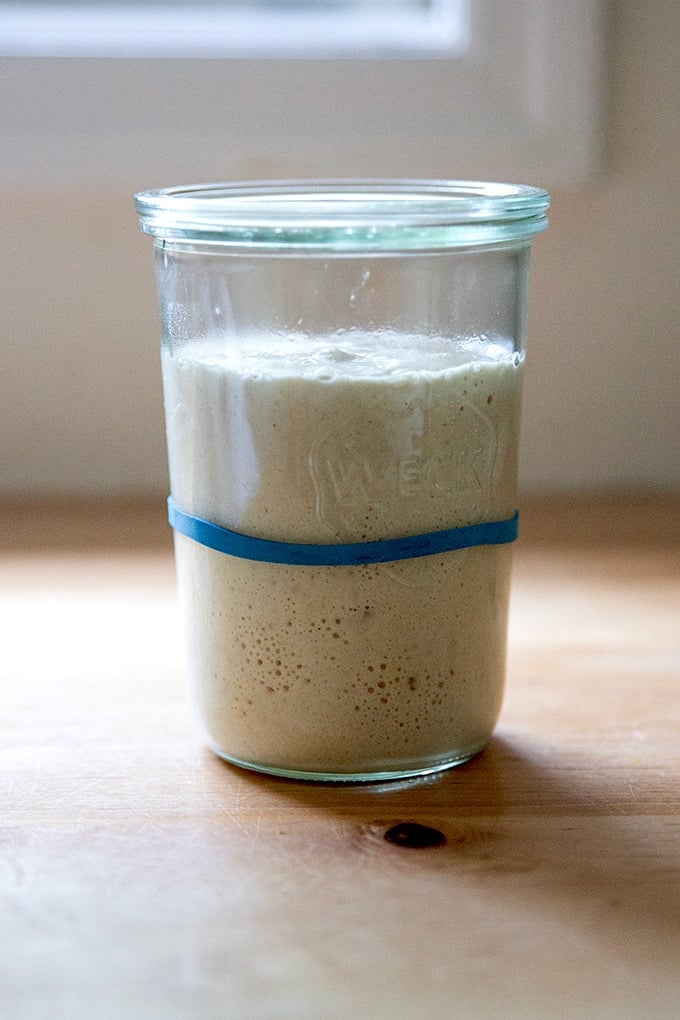
A sourdough starter is a fermented mixture of flour and water that contains wild yeast and bacteria. It both leavens and flavors sourdough bread.
How? It’s time for a science lesson.
Wild yeasts and bacteria exist everywhere, namely in flour, but also in the air and on your hands. When we mix flour and water and let it sit, wild yeasts begin searching for food, which they find in the flour: they convert the starch in the flour into sugar. As they digest this sugar, they produce two things: carbon dioxide, which makes the starter rise, and alcohol, which the wild bacteria drink up and in turn produce various types of lactic and acetic acids — these acids are what give the bread the sour flavor.
Cool, right? The wild yeasts and bacteria work symbiotically to both leaven and flavor our starter and ultimately our bread.
3 Tips For Success
Because wild yeast and bacteria are the backbone of a sourdough starter, it is crucial that these microbes are happy for your starter to thrive: the happier they are, the more they multiply, the more powerful the starter you create.
Building up a colony of happy microbes takes time and care. Here are three tips for success:
Tip #1: Use Pineapple Juice: Using pineapple juice in place of water initially can shorten the overall timeline for building a sourdough starter from scratch. This is because wild yeast cells prefer a somewhat acidic pH (which pineapple juice is) in which to grow.
Tip #2: Keep Your Starter Cozy: Ideally, you’ll attempt this project while it’s hot outside — I find 80ºF (26ºC) to be ideal. If you’re building your starter when it’s cold outside, find a place to keep it warm. See recipe box for some ideas.
Tip #3: Use Good Flour: Use freshly milled, stone-milled flour because the added minerals and nutrients provide better food for the microbes (yeast and bacteria) to thrive. If you have a local source, use it! Health food markets, co-ops, and stores like Whole Foods often carry freshly milled flour. See recipe box for a few online sources I love.
How to Build a Sourdough Starter From Scratch, Step by Step
Day 1: Gather your materials: flour and pineapple juice. (If possible, pick up a bag of freshly milled stone-milled flour; see the recipe box for sources.)
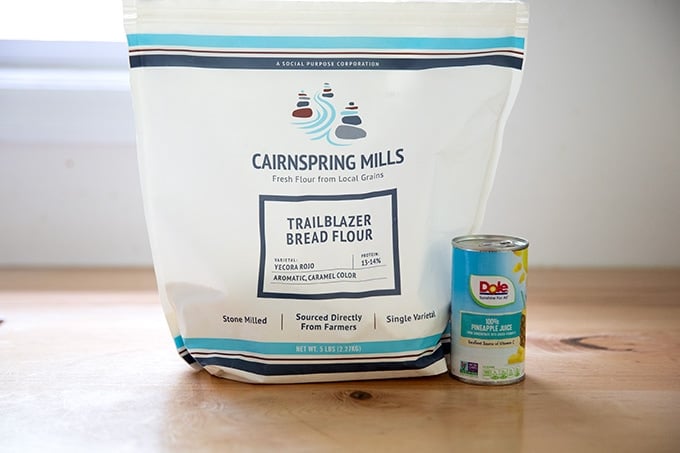
Pour the can of juice into a large bowl or ideally a straight-sided vessel on a tared scale.
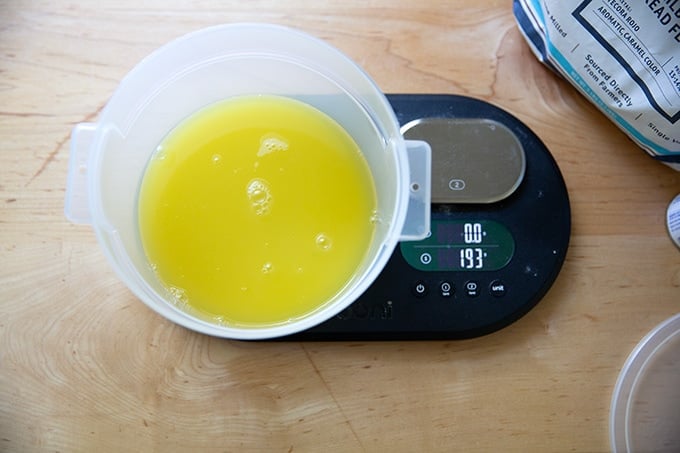
Add an equal amount of flour by weight. It should be about 192-193 grams of juice and flour each.
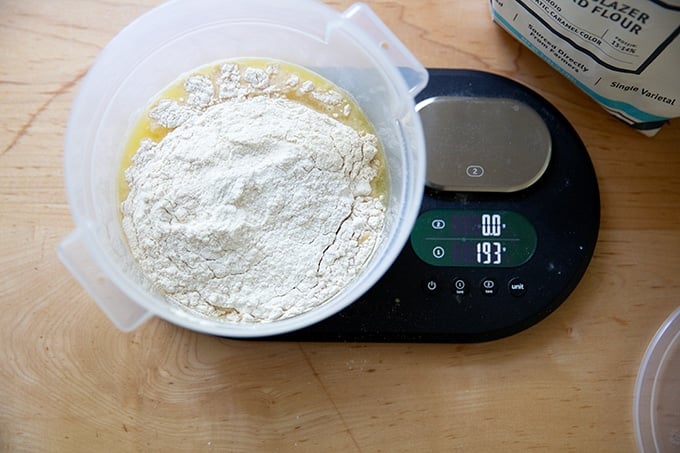
Stir the flour and juice together until the flour is absorbed.
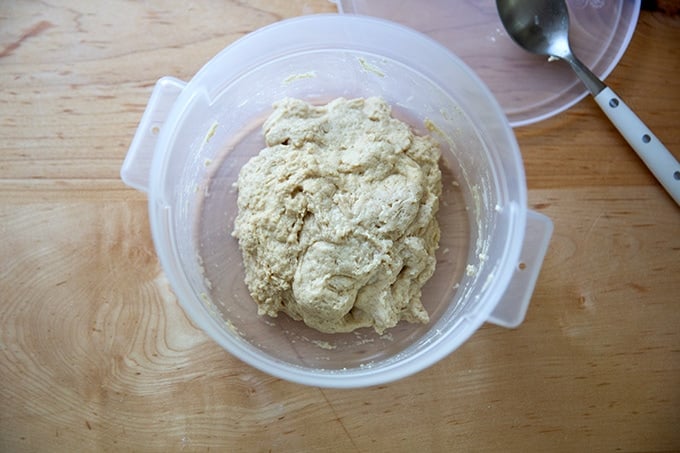
Cover the vessel. Record the date, time, and measurements — you will forget which day you started if you don’t. Let it sit at room temperature for 24 hours.
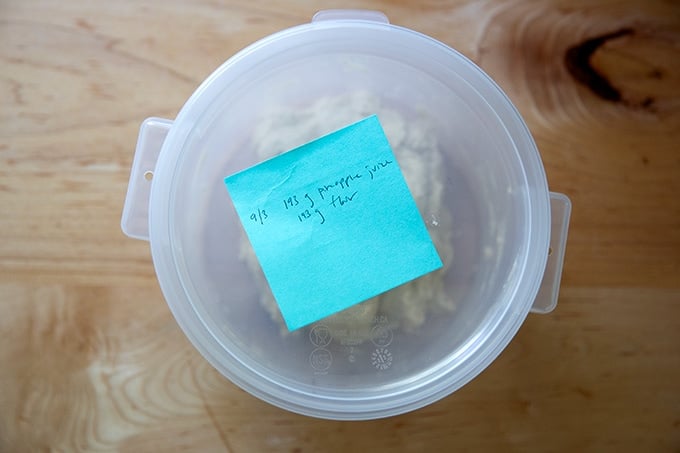
Day 2: Uncover the vessel and…
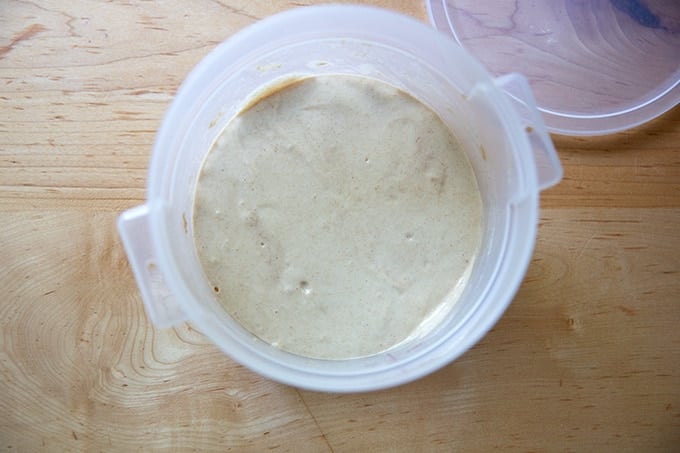
… give it a stir.
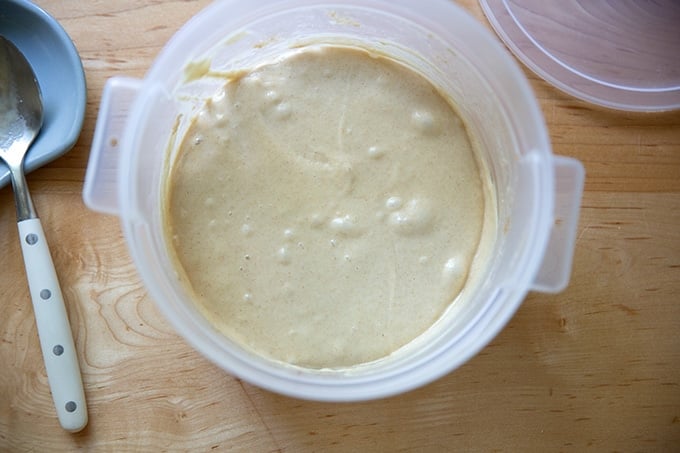
Re-cover the vessel, and record your work. Let it sit at room temperature for another 24 hours.
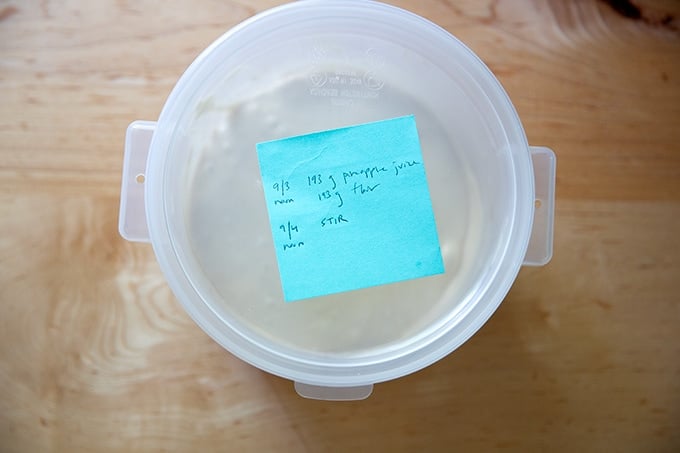
Day 3: Uncover the vessel.
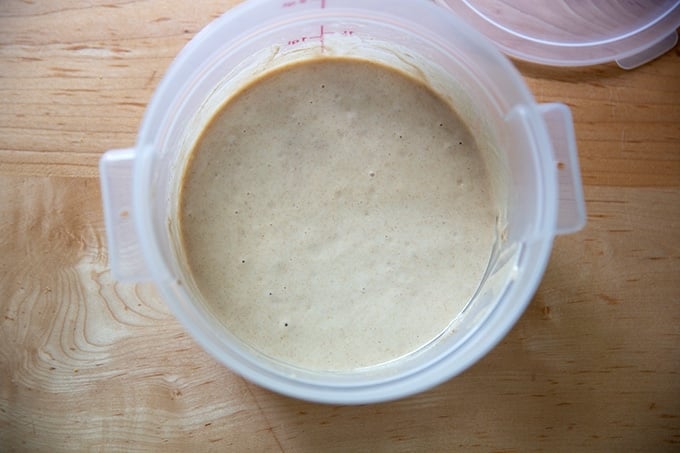
Measure out 128 grams (about 1 cup) of flour and 128 grams (about 1/2 cup) of water:

Add them to the vessel.
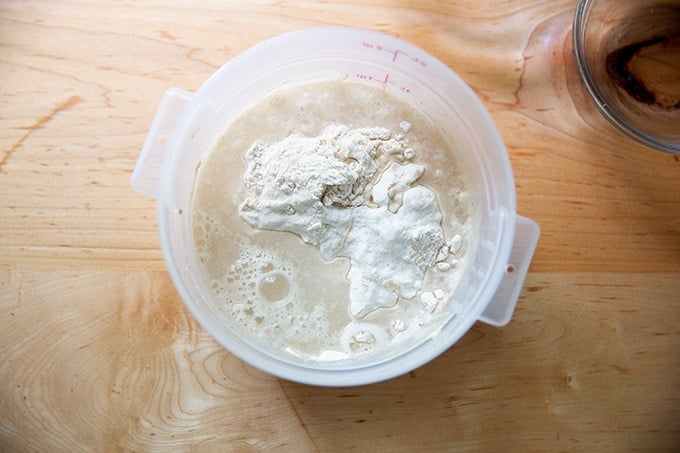
Stir to combine.
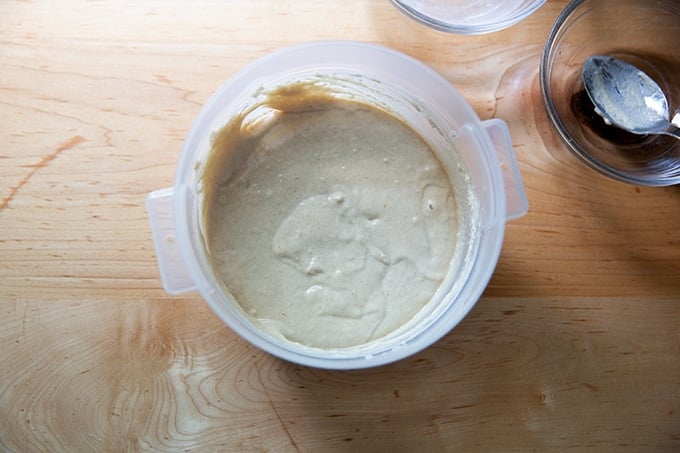
Cover the vessel and record your work again. Let it sit at room temperature for 24 hours, stirring once or twice.
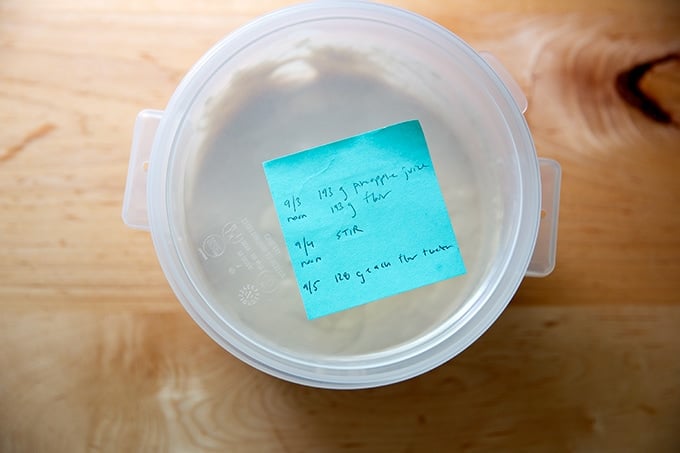
Day 4: Uncover the vessel. You should see a little action (bubbles). Measure out 128 grams (about 1 cup) of flour and 128 grams (about 1/2 cup) of water:
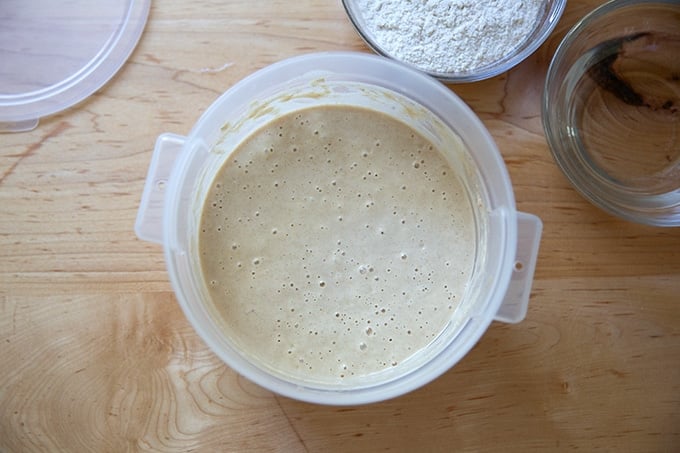
Add them to the container.
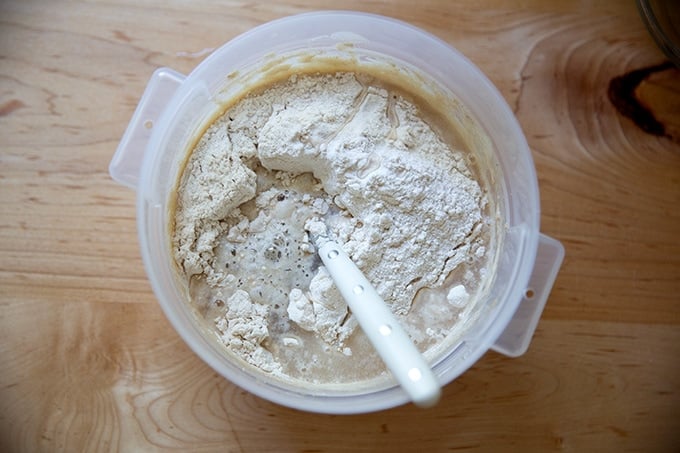
Stir to combine.
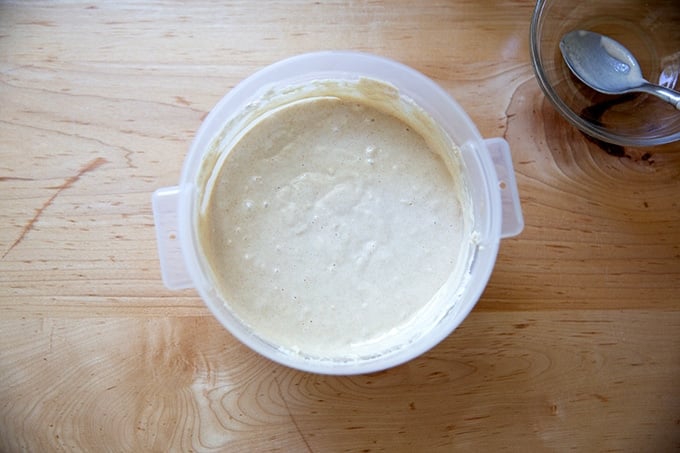
On this day, record your work again, and mark the height of your mixture with tape on the side of your vessel. Let it sit at room temperature for 24 hours, keeping a closer watch this time around.
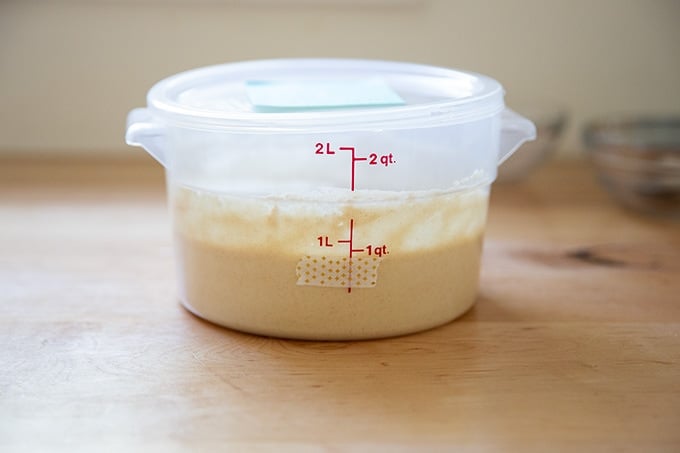
You will likely see some action…
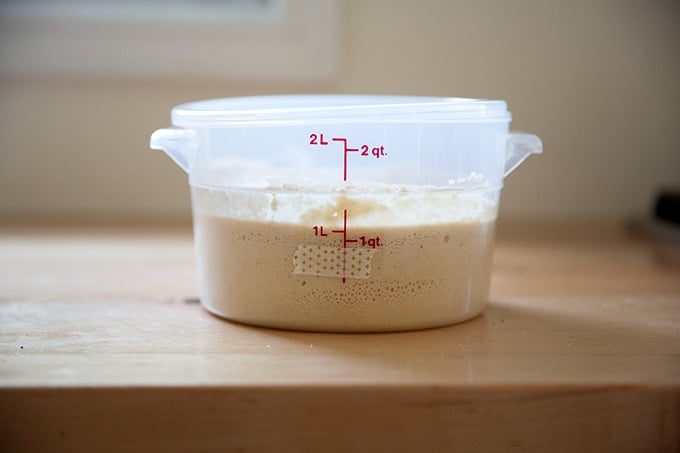
The mixture might even double in volume.
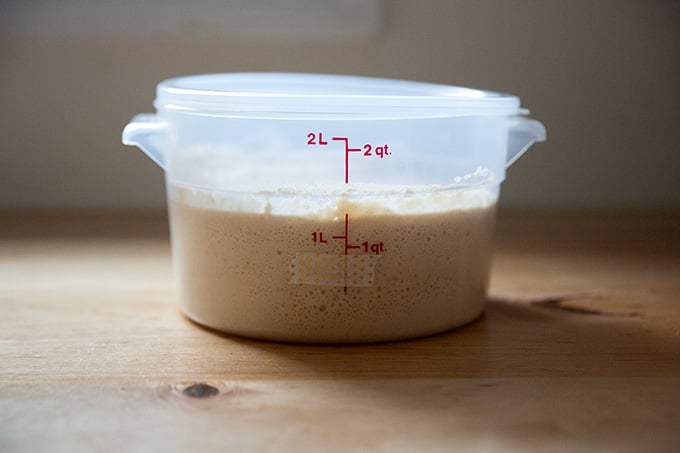
And you should see lots of bubbles on the surface.
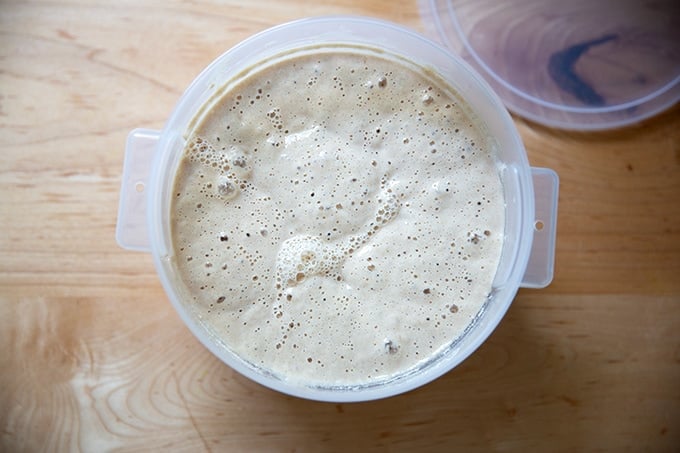
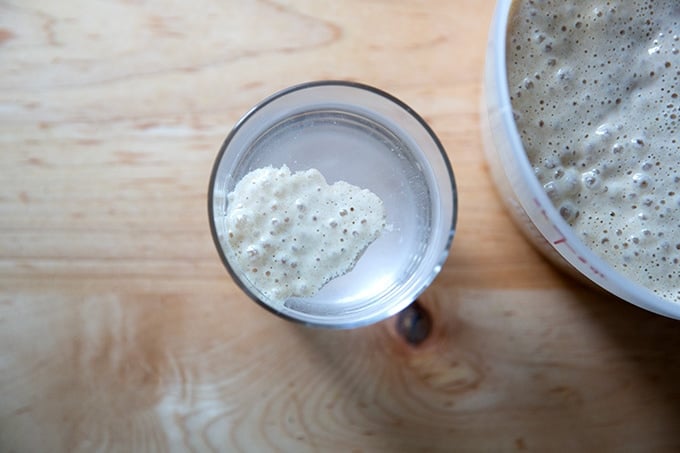
If your mixture is in fact rising, let it rise until it nearly doubles in volume; then drop a spoonful of it in water. If it floats, you’re in business. Note: Your starter might rise (and maybe fall) while you are sleeping — don’t worry if you don’t “catch” it at its peak. Continue on with the process that follows.
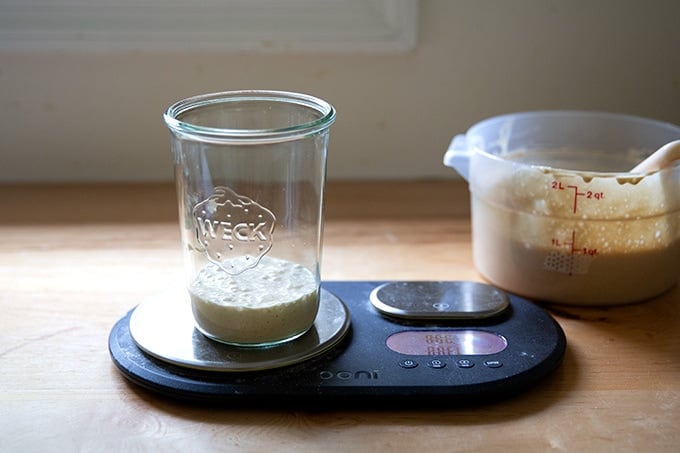
Spoon 128 grams of the starter into a new vessel.
Measure another 128 grams of flour and water each.
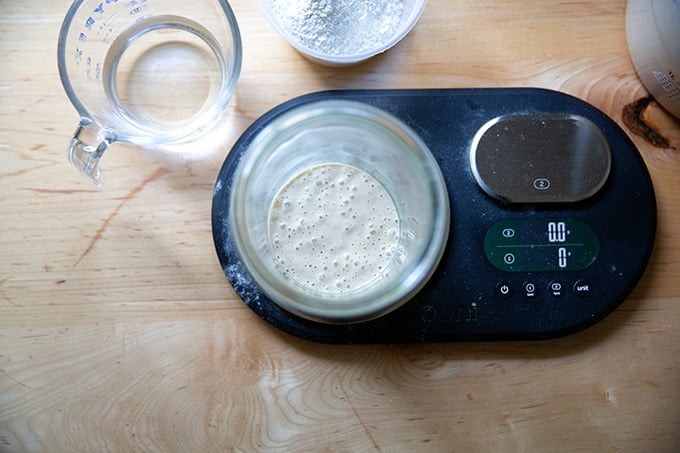
Add the flour and water to the starter.
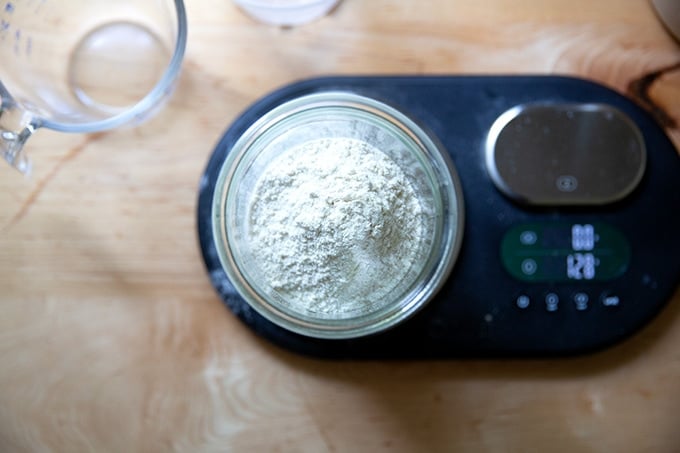
Stir to combine.
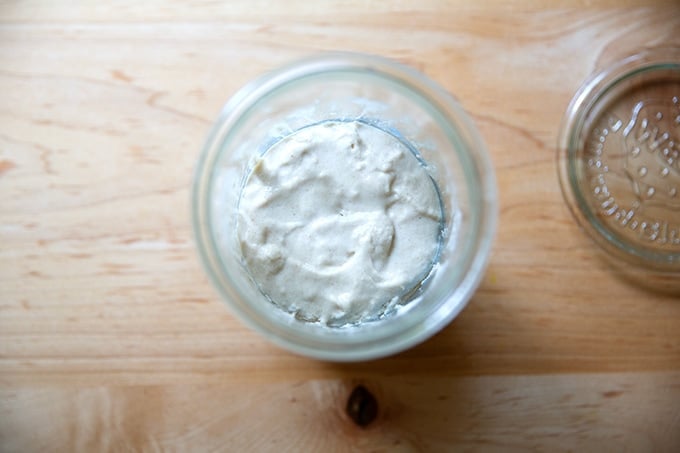
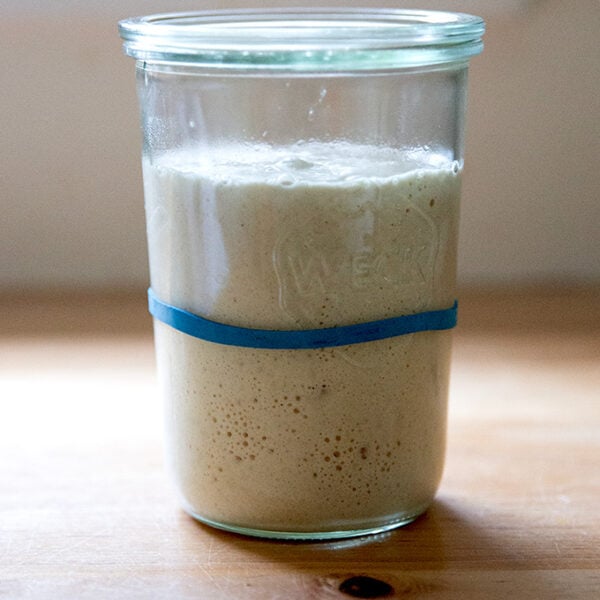
Mark the height with a rubber band.
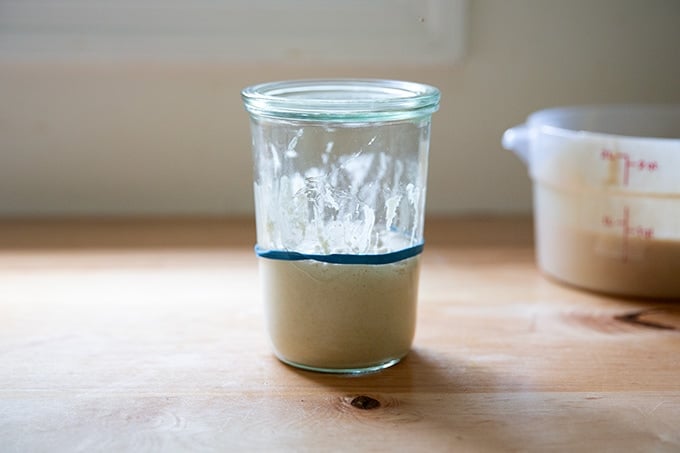
This original vat of sourdough starter is now your discard bucket. Transfer it to the fridge or use it in one of your favorite sourdough discard recipes: tortillas, crackers, pancakes, soda bread.
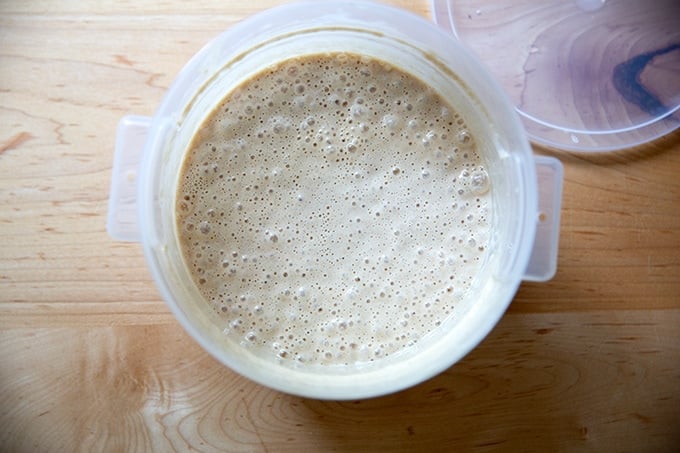
Day 5: When your starter doubles…
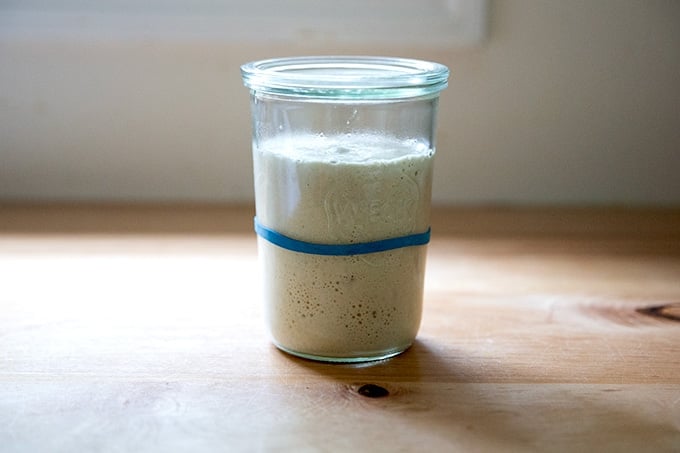
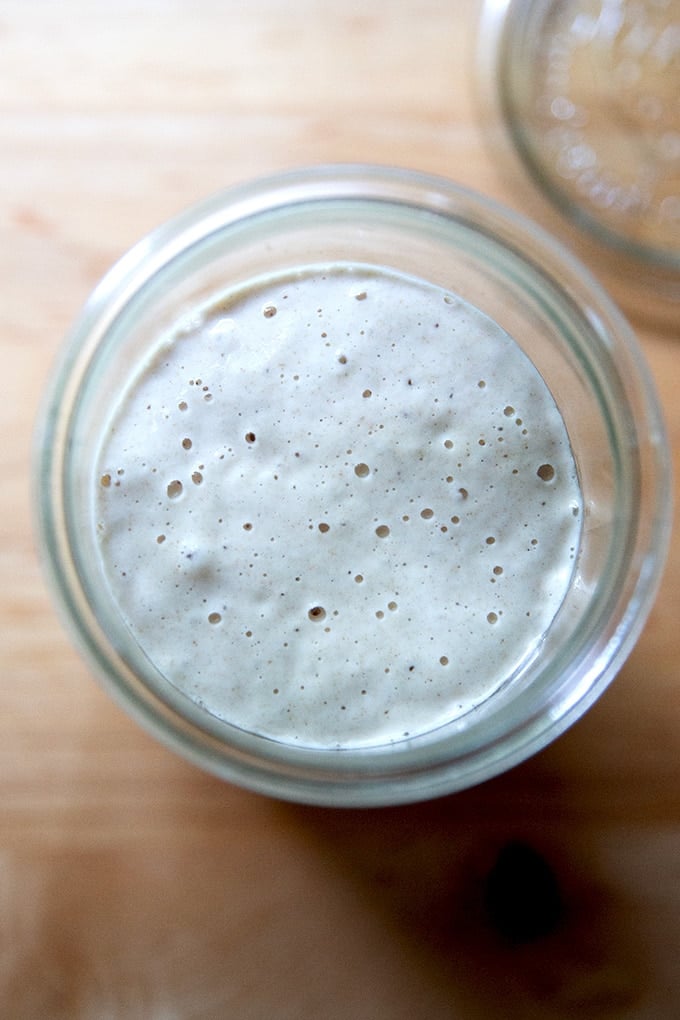
… and floats…
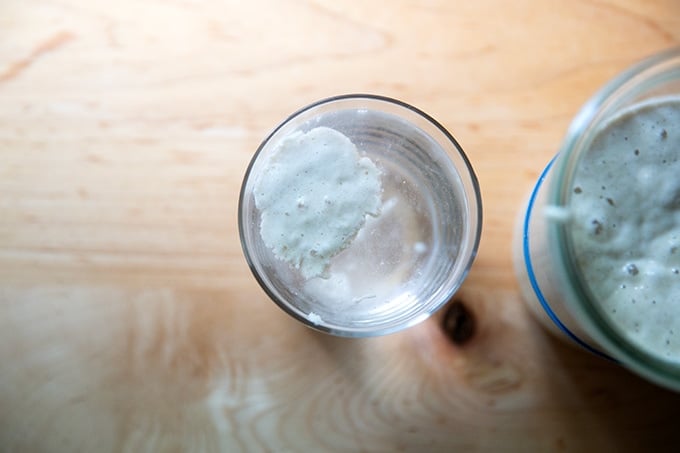
…you can do one of three things:
- Repeat this process: spoon 128 grams of starter into a new vessel and add 128 grams each flour and water. (Transfer the remaining starter to your bucket of discard.) Let the new starter rise until it doubles. Your starter will get stronger with every feeding.
- Transfer it to the fridge if you need to take a break from the process. You can pick up where you let off when you are ready.
- Test it out…
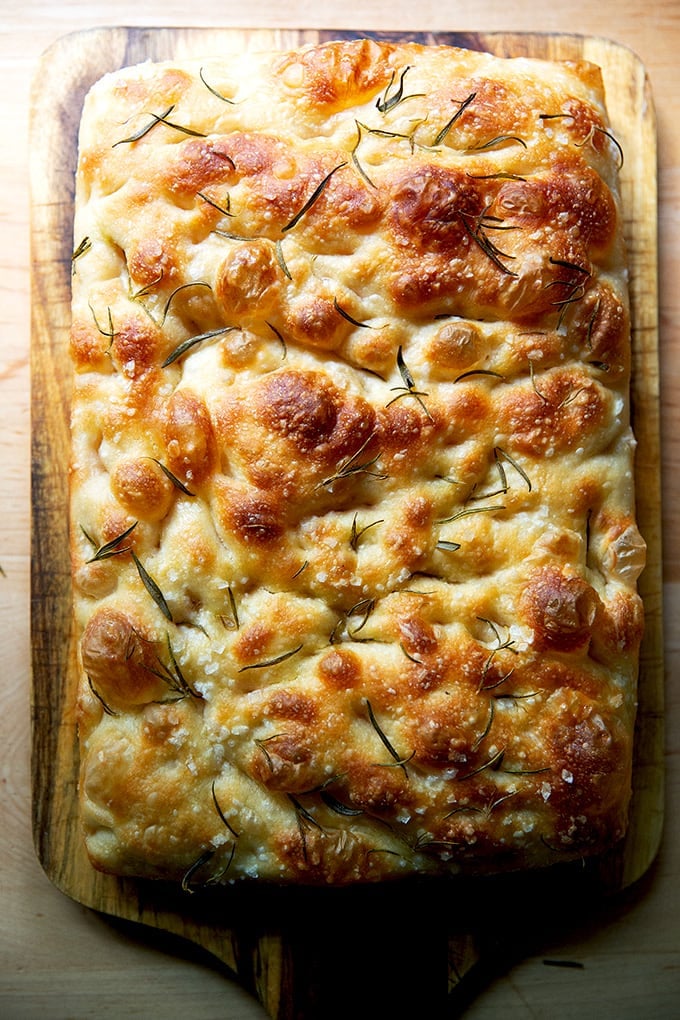
… in a sourdough bread recipe. I recommend starting with…
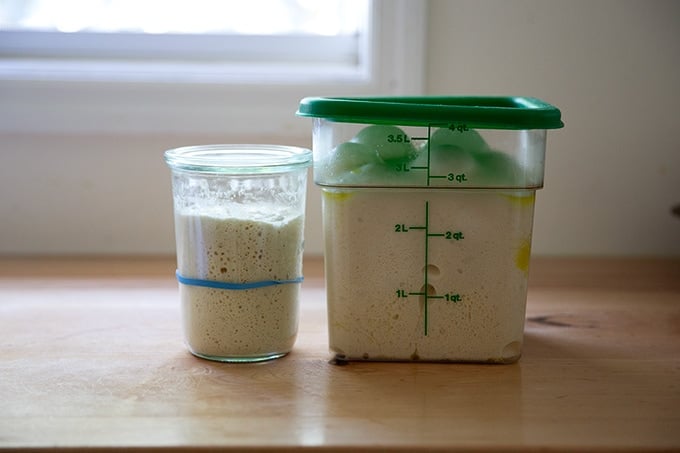
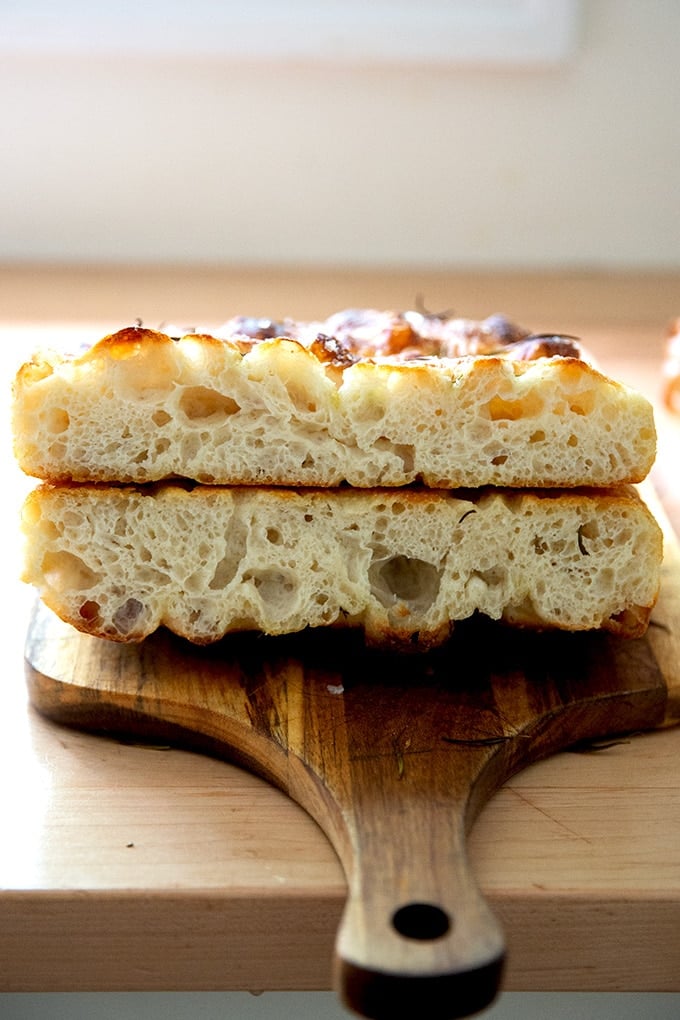
… focaccia, one of the easiest breads to make.
How to Build a Sourdough Starter from Scratch
- Total Time: 5 days
- Yield: 3 cups 1x
Description
This post outlines how to build a sourdough starter from scratch simply and quickly. In less than a week, with minimal effort, you will have a bubbly, active starter on your hands to use in all your favorite sourdough recipes.
Notes:
Adapted from Peter Reinhart’s method, outlined in Perfect Pan Pizza (and many of his other books as well).
If you are looking for guidance on how to feed, maintain, and store your already strong starter, see this post: How to Feed, Maintain, and Store a Sourdough Starter.
5 Tips for Success
- Use a scale to measure. It is the only way to measure accurately.
- Use a straight-sided vessel, which will help you more accurately see how much your starter is growing.
- Attempt this project while it’s hot outside or create a cozy place for your starter to rise:
- Find a warm place in your kitchen (like on top of your refrigerator) to let it rest.
- Invest in the Brod and Taylor Sourdough Home: I do not own this, but it gets good reviews should you have the space for it
- Build your own “sourdough home“: one of you ingeniously made a homemade proofing box by placing a seed heating pad in a box and covering it with a towel.
- Try the warm oven trick: turn your oven on for 1 minute (at any temperature) and then turn it off. It likely won’t get above 100ºF — it will just create a cozy spot for your dough to rise. Consider sticking a post-it note to the oven to remind you that you have a starter in there so that you don’t accidentally preheat your oven and kill your starter. (Note: I do not recommend using the oven with the oven light on, because I discovered the hard way that the oven light can actually be too hot and cause your starter or sourdough bread to overferment.)
- Start with pineapple juice.
- Use freshly milled stone-milled flour. If you have a source local to you, use it! Health food markets, co-ops, or markets such as Whole Foods often carry freshly milled flour. Here are a few mail-order options:
Pineapple Juice: My small cans of pineapple juice are labeled as 6 ounces (177 ml), but when I actually weigh the juice inside, it always weighs around 192 grams. The important thing is to use an equal amount by weight of flour and pineapple juice.
Pineapple Juice Alternatives: Orange Juice or Water
Water: I have no trouble using tap water when building a sourdough starter or when making a sourdough bread recipe. If you have concerns about your water, you can:
- Use water that you’ve left out overnight to ensure any chlorine has evaporated.
- Buy spring water. In some places, letting water sit out overnight will not be effective, and your tap water may kill your starter.
Discard: At the end of the first four days of the process, you’ll be left with a decent amount of sourdough discard, which you can use in countless recipes. Here are a few of my favorites:
Ingredients
- 1 small can (192 grams) pineapple juice, see notes above for alternatives
- stone-milled flour, see notes above
- Room temperature water, see notes above
Instructions
- Day 1: Pour the can of juice (roughly 192 grams) into a large bowl or ideally a straight-sided vessel on a tared scale. (A straight-sided vessel allows you to truly see how much your starter is growing. I’m using this Cambro.) Add an equal amount of flour (roughly 192 grams) by weight. Stir the flour and juice together until the flour is absorbed. Cover the vessel. Record the date, time, and measurements — you will forget which day you started if you don’t. Let it sit at room temperature for 24 hours.
- Day 2: Uncover the vessel. Stir the mixture. Re-cover the vessel, and record your work. Let it sit at room temperature for another 24 hours.
- Day 3: Uncover the vessel. Add 128 grams (1 cup) flour and 128 grams (about 1/2 cup) water. Stir to combine. Cover the vessel and record your work again. Let it sit at room temperature for 24 hours, stirring once or twice.
- Day 4: Uncover the vessel. You should see a little action (bubbles) and it should smell pleasant, not unlike a fruity yogurt. Measure out 128 grams (about 1 cup) of flour and 128 grams (about 1/2 cup) of water. Add them to the container. Stir to combine. Cover the vessel. On this day, record your work again, and mark the height of your mixture with tape on the side of your vessel. Let it sit at room temperature for 24 hours, keeping a closer watch this time around. You may see action — rising and bubble formation — within a few hours. If your mixture is in fact rising, let it rise until it nearly doubles in volume; then drop a spoonful of it in water. If it floats, you’re in business. Note: Your starter might rise (and possibly fall) while you are sleeping — don’t worry if you don’t “catch” it at its peak. Continue on with the process.
- Day 5: At this point, you should be observing some activity in your starter, meaning the starter should have risen slightly (perhaps doubled but perhaps not) and fallen with bubbles transforming from big to small. You’ll now take a small portion of this mixture and build a new starter: Transfer 128 grams of the starter to a new jar or vessel, and add 128 grams (about 1 cup) of flour and 128 grams (about 1/2 cup) of water. Stir well to combine, then cover the jar. Mark the height with a rubber band. Let sit at room temperature. Transfer the remaining starter to the fridge — this original mixture is now your sourdough discard and can be used in all sorts of recipes, see notes above. When your new starter doubles in volume, you can do one of three things:
- Repeat this process: spoon 128 grams of starter into a new vessel and add 128 grams each flour and water. (Transfer the remaining starter to your bucket of discard.) Let the new starter rise until it doubles. Your starter will get stronger with every feeding.
- Transfer it to the fridge if you need to take a break from the process. You can pick up where you let off when you are ready.
- Test it out in a sourdough bread recipe.
- Maintaining your starter: Once you have a strong, active starter on your hands, follow the steps in this post: How to Feed, Store, and Maintain a Sourdough Starter.
- Category: Bread
- Method: Stir
- Cuisine: American
This post may contain affiliate links. Please read my disclosure policy.









446 Comments on “How to Build a Sourdough Starter from Scratch”
Things are looking good and bubbling, but I’ve got a bit of a stringy white stuff growing on the sides of my vessel above my mixture. Is this a mold? If so, I’m assuming I need to toss and start over? And if it’s mold, what might I have done wrong?
It might just be dried starter, which is fine! If you want to take a photo and email it to me, I’ll take a look: alexandra@alexandracooks.com
I just emailed you the pictures! Thank you so much!
Hi- my starter came out great! So I was anxious to use up all of this discard. Yesterday I made the waffles and they were yummy, froze the rest. Today I set out to make two loaves of the discard sandwich bread. I just started, and am waiting to do the set of stretch & pulls. At what point can I refrigerate this & pick it back up tomorrow as I am realizing it’s way too late in the afternoon to have started this! Any recommendations would be helpful, thx!
Great to hear! You can put the bread in the fridge at any time! As soon as you do the stretches and folds, which I think you’ve done at this point, cover the bowl and stick it in the fridge. You can pick up tomorrow when you have time 🙂
Thank you for your quick response. Just checked my starter and did the float test and it floats! What are my options? Should I bake with it, perhaps the foccia or feed it again to make it stronger or just put it in the fridge ?
thank you so much
Congrats!! You can do any of those options. If you want to try for a loaf of bread, make the focaccia, then feed your starter one more time. If you want to strengthen it one more day, feed it once or twice more. If you are ready for a break, store it in the fridge at its peak.
One more comment to add. Once again it did not double in size. Perhaps I should feed it? It is much warmer today.
Yes, sorry just seeing this comment… I would feed it once or twice more before using it in the focaccia recipe.
Hi Ali. I was hoping my starter would rise and I wouldn’t have to ask anymore questions, but I do. I am starting day 5 and I just have bubbles, a silkiness to the dough and a great smell, but no rising after day 4. It’s been cool here and my starter was in a plastic container so I didn’t want to put it in the oven. I started day 5 by taking a few tbsp of the starter and adding the flour and water. It is warmer outside than in my house, what do you think of me putting it on my porch, where it is warmer for the day (sun or not in the sun)? Nobody has talked about that. Thanks for fielding all of our questions. It has been a big help knowing you are there to ask. Once we all get it right, we will be so happy!! Lisa
Lisa, hi! I think outside in a warm place would be great! If it gets above 85ºF outside, I’d consider moving it into the shade or back inside, but otherwise, I think it’s a great move. Keep me posted. Do keep in mind it can take as long as 2 weeks to see consistent rises… the pineapple juice is supposed to shorten the process but other variables (cool temps) can thwart that effort 🙂
I finally figured out how to ask a question…lol my starter has not really doubled at all does that mean it’s a dud and I should start over and throw away the discard? Or can i still use the discard?
Hi! What day are you on? Don’t discard the discard! There are so many great ways to use it up, namely these waffles: Simple Sourdough Discard Waffles
So I am on Day 9 at this point. I fed it last night and placed it in the oven and it still isn’t moving, it just has some bubble on the top. If you say use the discard I will try to make something with it. I might have missed this in the j stations but how long is the discard good for?
I would try to use the discard within 2-3 weeks. Do you still have the links to the to other discard recipes from the email? They are also included in the post above but the sourdough discard bread recipe is only available from the email.
Keep in mind it may take as long as 2 weeks to start doubling consistently. The pineapple juice is meant to shorten that timeline, but other elements (cool temps) can counter that effort.
What type of flour are you using? Finally, you could try using spring water if you are worried about your water source. But I do think the biggest key to success is finding a cozy place for your starter to rise.
Ok so I will continue with this and yes I have the other emails..you are a folder in my email😊. I am using just AP organic flour. I have a water filtration system.
OK, great re flour and water (and folder in email :)). I think the key will just to be patient: keep it cozy, try feeding it every 10-12 hours: discard all but a couple of tablespoons of it; feed it with fresh flour and water.
Hello again,
We just got a boil water order for my town. Is it safe to use my starter or should I throw it away and start new when it is cleared?
I think it should be fine. What day are you on? On day 5 and beyond, you start discarding most of it leaving just a few tablespoons of starter behind and feeding it with fresh flour and water, so I think as long as you use boiled water or spring water moving forward it should be fine.
I have been doing your “sourdough starter from scratch” challenge. On Day 4, when I went to do my second stir before bed, I found my starter bulging over the top of my 2L container only held in place by the plastic I had covering it! Needless to say it was a messy recovery after that. I stirred it down and transferred what was left into another 2L container and put it in the fridge so I wouldn’t have a repeat of this disaster overnight. Do I just carry on now with the Day 5 instructions?
Sorry about the mess, Cathy! But this is a great sign that things are really happening. Out of curiosity and so I can help others: where are you located and what type of flour did you use?
Yes, carry on with day 5!
I am in southern Ontario just east of Toronto and I am using plain ol’ all purpose white flour. We’re in a bit of a heat wave now – the house got up to 79 degrees yesterday! – so I imagine that had something to do with my overexcited starter.
I fed the 128g offshoot starter at 8:30 this morning, and 2 hours later it has risen about 30%! If it keeps going at this rate, I’ll have another overflow! What to do?
Is your jar large enough for it to double? This is great news! Let it go as high as the jar will allow; then repeat the process: discard most of it; feed it with fresh flour and water.
Thank you! So appreciate it. I do think WARMTH is the key to success 🙂
Day 6 for me and still only bubbles and a failed float test. In reading thru your earlier instructions, you put a cloth cover on your starter not an air tight lid like you are doing in this challenge could that be making a difference? Thanks!
Barb, I don’t think so! I don’t use the cloth cover any more and I haven’t for years… I need to edit that instruction… thanks for bringing it to my attention.
I think you should push on with the feedings: it may take as long as 2 weeks to start doubling consistently. The pineapple juice is meant to shorten that timeline, but other elements (cool temps) can counter that effort.
Are you using the warm oven trick to keep your starter cozy? What type of flour are you using? Finally, you could try using spring water if you are worried about your water source.
I think the biggest key to success is finding a nice warm spot for your starter 🙂
Ok, pour planning on my part. I’m on Day 6 with my starter rising well but not doubling, but we leave town in the morning. Will it be ok to feed the starter in the morning (Thursday) and then refrigerate it until I get back on Sunday evening?
Yes! Hope I’m catching you in time 🙂
I am just on day six. I’ve been using King Arthur bread flour the entire time, and my starter is rising extremely well! However, mine is very sticky and dough-like, but yours looks more silky and fluid-like. Should I give up and start over? Also, how long is the discard good for in the refrigerator and should it be stirred daily? Thank you!
That’s great! Don’t start over: rising extremely well is what you want! Dough like is great, too! No need to stir the discard. Try to use it up within 2 – 3 weeks.
My starter and discard are in the refrigerator.
How often do I need to feed the refrigerated starter?
Do I need to allow it to come to room temperature before using it in a recipe?
Does it need to be recently fed before using it?
How long does discard keep?
Does discard keep longer if I continue to add to it or should I dump it at some point and stay a new discard bucket?
Does discard need to come to room temperature before using?
Thanks for all the help.
How often do I need to feed the refrigerated starter? I leave it in the fridge for months without feeding… you don’t need to feed it regularly for it to survive.
Do I need to allow it to come to room temperature before using it in a recipe? Yes. And you need to feed it. Remove it from the fridge, discard most of it, feed it with 75 grams (or so) each flour and water, let it rise till it doubles; then either feed it again (if it has been in the fridge for a long time) or use it in a recipe.
Does it need to be recently fed before using it? You can keep it in the fridge for months. When you are ready to use it, I recommend feeding it at least twice before using it.
How long does discard keep? 2-3 weeks
Does discard keep longer if I continue to add to it or should I dump it at some point and stay a new discard bucket? If you think you’ll use up all of your supply in less than 3 weeks, then you can keep 1 bucket. If you don’t, I would start multiple buckets and date them.
Does discard need to come to room temperature before using? No.
Hi Ali,
Should I be concerned that my sourdough hasnt risen a whole lot? I live in Florida and its warmer outside than in my actual house. I started putting it outside and its risen more. should i make it an even smaller and feed it again to see? My discard is great when I made your waffles. I did your sandwhich bread but while great its a bit “damp”. Is there something I have done incorrect that it came out that way?
Please let me know.
Thank you.
Great to hear that the outside temps are giving you better results! No, you should not be concerned. Keep in mind it may take as long as 2 weeks to get the starter doubling consistently. Yes: continue to feed it every 10-12 hours by discarding most of it and feeding it with fresh flour and water. For the bread, it sounds as though it’s just a little too high hydration. With sourdough discard recipes, I often find I need to sprinkle in a little more flour to get the dough to form a ball. Next time, just toss in a little more flour to eye and stir with your spatula, adding more flour as needed, until the dough forms a ball.
Hi Allie – for the first time in my life I am actually going to do this (have followed along but not done yet for a host of reasons but I’ve kept all your videos).
I have a question: you say to use pineapple juice as the first liquid. I have a close friend who is deathly allergic to pineapple and I would like her to be able to eat my bread. Is there another liquid you could recommend – is it just for the sugar?
Peter Reinhart, who is the baker I learned the recipe from, recommends either orange juice or water in place of the pineapple juice. Pineapple juice is used for the acidity — wild yeasts prefer a somewhat acidic environment. Orange juice has a similar ph to pineapple juice. Hope that helps!
Hi, my name is Ana and i’m on my 3rd. Day doing my sourdough started. As i woke up on 4th Day, half of the mix has fall from the bowl. Is the starter spoil? Do i have to start again? I’m from Puerto Rico and maybe our climate or me was the cause of this. Please let me know my next step. (Sorry for my english)
Thanks
Ana hi! Don’t start over. Did the starter spill over the sides of the bowl or did it just collapse back down? Regardless, just stir whatever amount of starter you have in your vessel and proceed with the instructions. What size vessel are you using?
Hi there- I just listened to the entire recording of your recent Zoom session. It was SO informative – thank you!! This will definitely help me nurture my starter, which is now a combination of one I received in 2020 plus the one I made with you using pineapple juice. I was so excited to have double the amount of starter I’ve ever had—until I realized that when feeding it, I’ll need to discard all but 2T of it. Oh, well – at least it will be stronger now. Thanks again, Louise:-)
I know! It is so hard to get used to the whole “discarding most of it” part of the process. But once you build up your arsenal of discard recipes, it doesn’t feel so bad. I’m so glad the Zoom was helpful, and I’m so glad your starter is thriving!
My mixture is not doubling, what did I do wrong?
Hi! What day are you on? And do you live in a cool environment? What type of flour are you using?
My guess is that you are doing nothing wrong! Keep in mind it can take as long as 2 weeks to see consistent rises… the pineapple juice is supposed to shorten the process but other variables (cool temps) can thwart that effort 🙂
Hi Ali-
Today is Day 5 for me and my starter hasn’t budged from Day 4. Do I still proceed with creating the offshoot for Day 5 or should I wait to see if it grows? Thanks so much!
Yes! Apologies for the delay here. At this point you do want to be working with a smaller quantity of flour and water, and you want to get into the routine of feeding it 2x a day or roughly every 10-12 hours. Have you noticed any progress? Is it cool where you are?
Still no movement but I am feeding it twice a day. It’s around 70 here – maybe that’s too cool? There are bubbles on top, just no growth.
If it continues to be a stagnant and I can’t feed it for a couple days do I just stick it in the fridge until I can get back to it?
Bummer! I would try the warm oven trick: preheat your oven for 1 minute; then shut it off. It will only get to 100ºF and will cool down from there, but that brief blast of heat will help it. You can do that a few times throughout the day (if you are home) or whenever you are able — just don’t walk away from the oven while you do it.
Yes: when you need a break, stick it in the fridge.
Hi Ali. I have another sourdough question and I can’t remember if we touched on this. You said we could keep the discard for 2-3 weeks, but can we freeze it? I am leaving for a trip tomorrow (although not that long), but I have so much of it, I thought that maybe I could freeze it. Your help would be greatly appreiated and I could put it in the freezer tonight. Thanks!!
Shoot, I’m likely too late here, but yes, I do think you could freeze it since you are not using it for leavening purposes.
Hi Ali,
I’m only on Day 3 but I have a question. The only pineapple juice I could find was 256g, so I added the same amount of flour. Now I’m wondering if I should change the amount of flour and water today that you instruct us to do (128g each).
Also, I goofed and used AP white flour instead of the freshly milled white wheat that we have. Should I switch now and add that instead of the AP white?
Please advise. I REALLY appreciate your excellent instructions! Thanks, Nancy
Hi! I think 256 is close enough to 190 that you don’t need to adjust the amount of flour and water — 128 grams of each is fine. I would use some of your freshly milled wheat flour for the next two or three feedings; then you can switch back to ap flour.
Thanks so much! I appreciate your quick response! I’m LOVING your website…I made the focaccia a few weeks ago (using some starter a friend gave me) and it was to die for. I also made my first beautiful loaf of sourdough per your instructions and now I’m addicted to sourdough baking AND eating! But on my most recent loaf, I used up all my starter so that’s why I’m making new starter now from scratch. Your video series came just at the right time.
It’s so nice to read all of this, Nancy! Thank you for your kind words and good luck building this new starter… try to keep it cozy — that’s the biggest tip I have for success 🙂
I am on day 5 though and noticed my starter is not quite as bubbly as yours is at this point.
It did go a bit over the tape line but just barely. Should I leave it here and feed it / stir it for another day and assess again before making an offshoot or just go for it?
Thanks!
Just saw you answered this question to someone else previously so looks the best is to go for it 🙂 I will keep the smaller portion cozier to help it grow better.
Glad you found your answer… correct: proceed with the smaller offshoot. Do keep in mind it can take as long as 2 weeks for it to start rising consistently. Keeping it cozy is key!
Ali I got up to date 6 about 10 days ago and stashed both starter and discard in the fridge while I went away. Is it able to be revived and if so how? I am very keen and grateful for your help!! Judy Stewart
Yes! Keep your discard bucket in the fridge. Remove your starter, discard most of it down to a tablespoon or two, then add 100 grams each flour and water. Repeat this feeding every 10-12 hours if possible.
My apologies if you answered this question already. Making the starter from scratch worked out great! I took a break from the feedings. Now I’m taking it out of the fridge and do I discard most and feed it about 45 g water and flour right away? Or let it come to room temp first before discarding and feeding? Then feed tomorrow morning again before I start a breaf recipe? Thank you!
Hi Julie! No need to let it come to room temperature first; discard most of it, then feed it with fresh flour and water. Let it rise until it doubles, then repeat. When you feed it the following morning, you may want to use more than 45 grams each, so that you have enough for whatever recipe you are using and enough left over to feed again to build back up your supply.
I am so excited to get started on the Sourdough Starter Challenge.
I have a simple question: Is the pineapple juice just used at step 1 of building the starter or do I use it every time I feed the starter?
Best regards,
Emelia
Just in step 1!
Love yr enthusiasm about baking bread, focaccia etc .
Can I use stone milled whole wheat flour instead of bread flour.
Also I am having a hard time finding a small can of pineapple juice .
Thanks
Hi! Yes, you can use stone milled ww flour to start here. I’d consider switching to bread flour around day 5, when you build the smaller offshoot. If you can’t find pineapple juice, you can use orange juice or water.
Good morning.
What size is the glass container you are starting the offshoot in?
Emelia
Slightly less than a quart.
Hello Ali. I have some dried starter my brother sent me from the Bay area. I used half of them and completely failed to build a starter. Can I just add these dried chips to the pineapple juice, or should it be in a different step or method? I would appreciate any help you can provide, and thank you.
Hi! I think you definitely could, but I also think you might be able to just get away with using water. When you tried reconstituting them previously, how did you do it? I would try putting the dried chips in a vessel, pouring water over them just to cover, and letting them sit. When they reconstitute, stir them to make a paste, adding more water if necessary. I’d let that sit for 10-12 hours; then add equal parts by weight flour and water: 75 grams each or so.
Thank you Ali. I did this the first time, but assuming I lost the starter because I didnt know what I was doing. I will follow your directions this time. Thanks again.
Thank you for all of your fabulous recipes. I have followed you for years. I have a couple of questions. Why do you switch to bread flour will building the sourdough starter? Also, is there a reason you no longer cover the starter with cloth? Thanks again.
Thank you, Robin!
I switch to bread flour for a few reasons, mostly to conserve my good stone-milled flour (even though I really try hard to always use the discard in some sort of recipe) but also because I find the strength of bread flour (meaning the strong gluten structure bread flour creates) to be helpful with these nascent starters that need all the help they can get to leaven… hope that makes sense.
I stopped using cloth covers because I found too often a crust would form on the top of my starter and also when I used a cloth, it would attract more fruit flies. I find a glass lid rested on top (not clasped) or the plastic lid of a deli container pressed on top work really well.
Hi Ali!
I’m on day 5 of the starter challenge and things are looking good. However, the 24 hour timing is mid-day for me, so to follow-up on the 12 hour feeding after is well past my bed time. Do I wait for the following morning? Or can I speed it up? Any advice would be much appreciated!
You can do either! It’s very forgiving. Apologies for the delay here… what did you end up doing?
I ended up switching to the twice a day feeding later that day. Thanks for the advice!
Great to hear 🙂
Hey Ali!
I’ve been baking sourdough for a couple of years now but still consider myself a beginner. I have my own starter that I made awhile back but I wanted to try yours!
Here’s what happened this week: first, let me explain my kitchen’s atmosphere—we have geothermal heat/cooling. The house feels very cold and our counters also pull heat away from food very quickly. It’s technically 72 degrees but feels much cooler.
I have a Brod & Taylor proofing box (not the starter making unit, the big box), and I thought I should control the temp of my new starter in that. So I set it for 80 degrees but the starter was sweaty and it felt like o was rushing it. By day three I set it on the counter instead. It was bubbly from day 2! But today when I went to portion out the new starter, I saw fuzzy mold at the top of my discard container 😩😭.
I’m starting over. Should I use the proofing box again but maybe at a lower temp? Or should I just keep the new batch on my less hospitable counter, since this is my kitchen’s actual climate?
Thank you for your help! I have your pizza night cookbook and I love it. 😍
Im about to start on day 5 because i forgot about this for a couple days after signing up. So last night and today my lid popped off a couple times without me realizing it for a while each time. I checked it just now and it hasnt risen past my tape line. It still has some bubbles and has a decently strong fruity smell. My question is, do i need to start over or is my starter salvagable?
It’s salvageable! At this point, you should be following this process every time you feed your starter: discard most of it, leaving just a tablespoon or two behind (no need to measure the amount you leave behind in the jar). Add 100 grams each flour and water. Stir. Let it rise in a cozy place. Repeat 12 hours later.
It sounds as though your conditions are prime for starter building… lids popping off = action 🙂 Good luck! Keep me posted.