 →
→ 

How to Make Homemade Detroit-Style Pizza
 By Alexandra Stafford
—
Last Updated: 08/30/2025
By Alexandra Stafford
—
Last Updated: 08/30/2025
This post may contain affiliate links. Please read my disclosure policy.
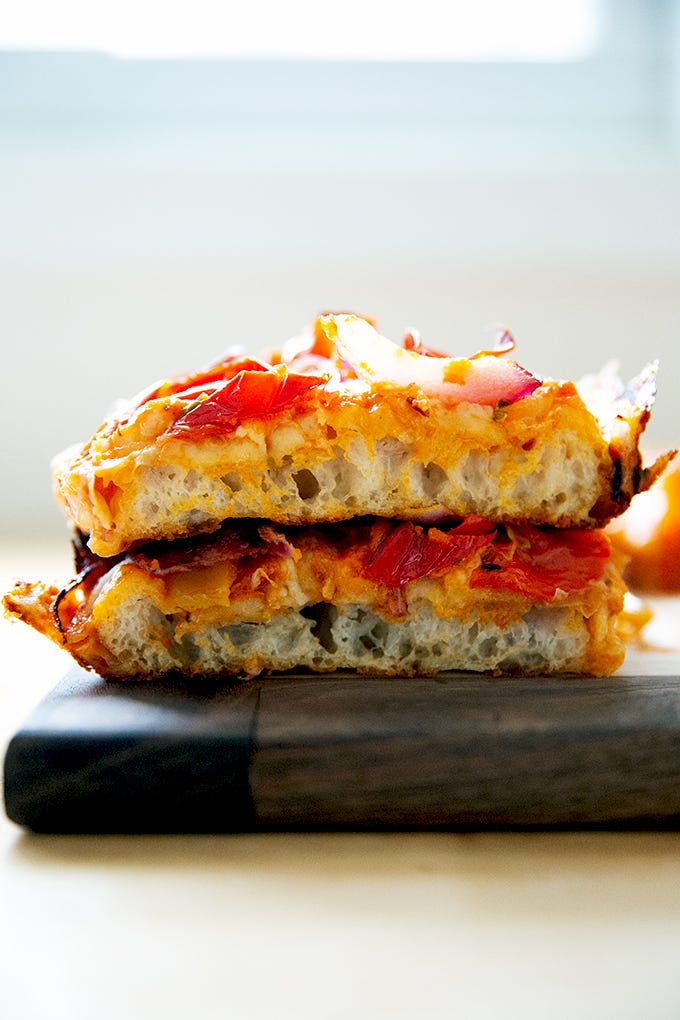
Detroit-style pizza is not unlike a cheesed- and sauced-focaccia. It is heavenly and is great for feeding a crowd. Read on to learn the secret to baking a Detroit-style pizza with a light and airy crust with an irresistible cheese frico crust.
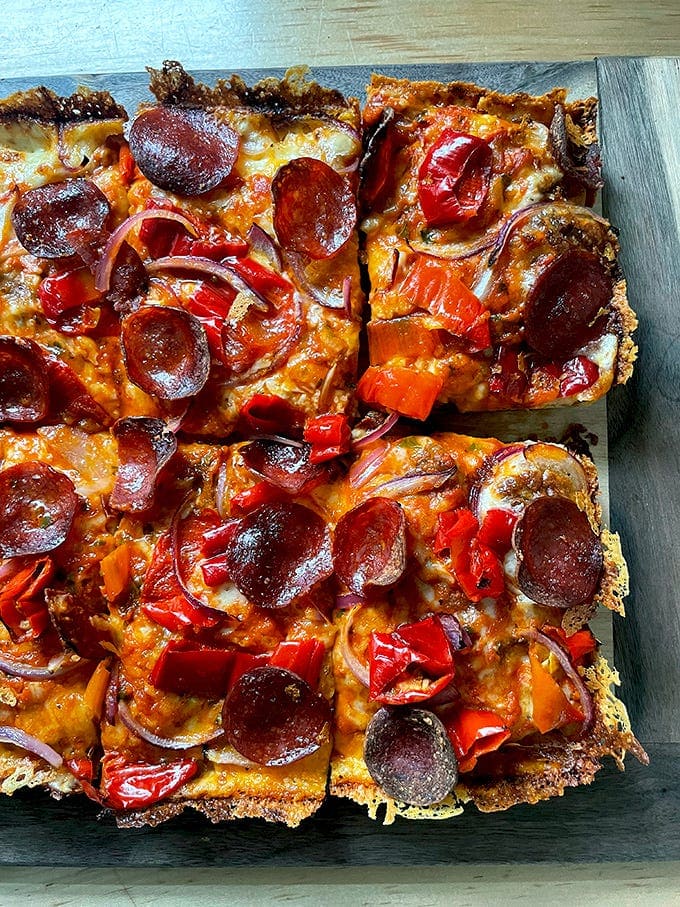
My introduction to Detroit-style pizza came by way of Matt and Emily Hyland, the couple behind Pizza Loves Emily, whose New Haven-style pizzas are near and dear to my heart, and whose Emmy Squared slices follow close behind.
At the height of the lockdown, longing to eat something from beyond my 5-mile radius, I splurged on a trio of pizzas from Emmy Squared via GoldBelly. When the world opened up, I experienced their delicious pan pizzas, topped variously with everything from pickled jalapeños and banana peppers to Calabrian chilies and smoked gouda, at their Brooklyn brick-and-mortar.
These experiences left me determined to make Detroit-style pizza at home. Guess what, Friends? Homemade Detroit-style pizza is as dreamy as imagined. Can I tell you the best part? You can complete so much of the prep — from mixing the dough to parbaking it — days in advance. Read on to learn how to make excellent Detroit-style pizza at home with a light and airy crust and an irresistible cheese frico crust.
PS: How to Make Homemade Sicilian-Style Pizza
Detroit-Style Pizza: A Few Notes and Rules
Of all the pizza styles out there, Detroit-style is perhaps governed by the most rules. Let’s explore them:
- The dough of Detroit-Style pizza, DSP for short, should be high hydration, and the baked crust should be light and airy, similar to focaccia. Traditional DSP is not parbaked.
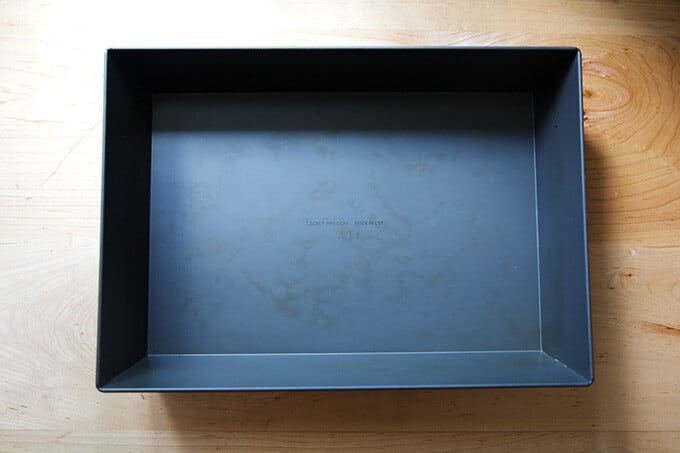
- The story of Detroit’s Buddy’s Pizza, the “original” Detroit-style pizza, is that the owner used his mom’s Sicilian pizza recipe, but placed the dough in rectangular blue steel pans — these were “scrap” pans from the nearby auto plants. Lloyd Pans is a company that makes, among many things, Detroit-style pizzas pans — they arrive already seasoned, and they truly make a beautiful crust.
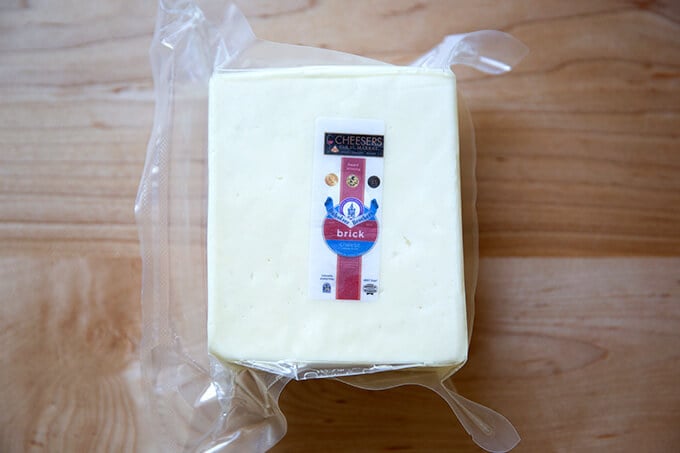
- The cheese, Wisconsin Brick Cheese, which is derived from white American cheddar but has a higher fat content, is traditional. In DSP, cheese goes on the dough before the sauce and is spread edge-to-edge. This method allows the cheese’s fat to pool at the pan’s edges and fry the dough, creating a cheese frico crust (see below).
- The sauce, a cooked tomato sauce, is applied last, often in dollops or two or three “racing” stripes. DSP is not super saucy.
Wisconsin Brick Cheese:
2 Tips for Success
- As noted above, the crust of a DSP should be light and airy. To achieve this, plan ahead, and allow your dough to cold proof, which will make for a lighter, airier dough. I get the best results when I bulk ferment at room temperature for 10 to 12 hours; then transfer the dough to the fridge for 24 to 48 hours. The longer the dough ferments, the more gas bubbles are produced, and when those gas bubbles hit the hot oven, they expand, creating a light, porous crust.
- Break from tradition and parbake your crust. Read on to learn why.
Why Parbake Your Crust?
For two reasons:
- If you have struggled to get your bottom crust to cook completely before your toppings burn, parbaking is the solution.
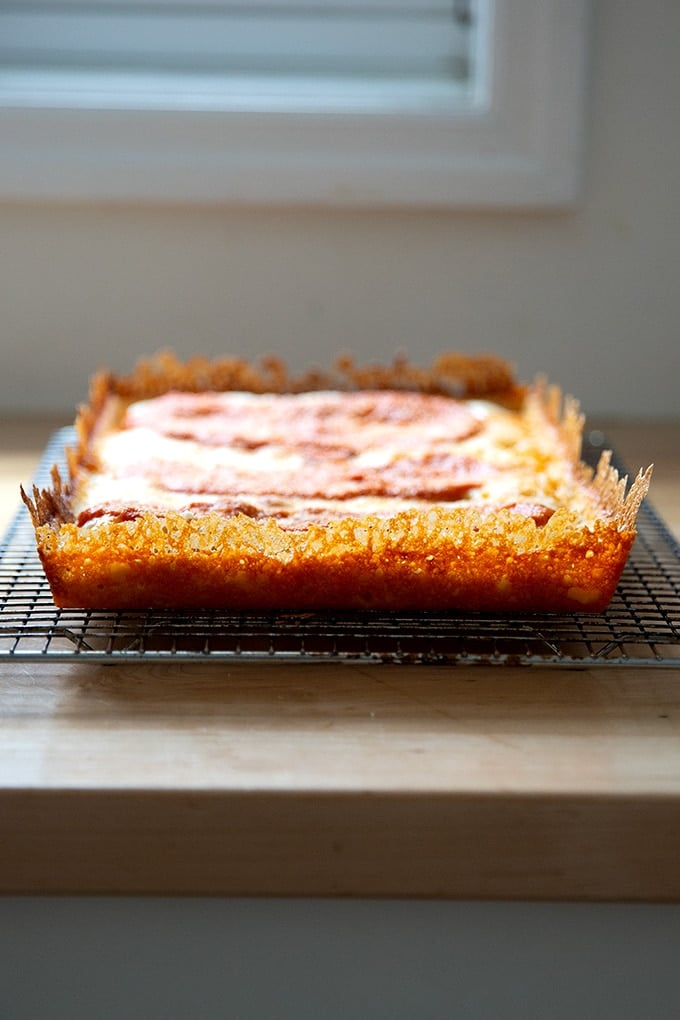
- If you’re looking to create a dramatic cheese frico crust, the parbake is essential. During the parbake, the dough will shrink from the sides of the pan ever so slightly, creating a space for cheese to wedge itself into and ultimately build into a tall, lacy cheese crust.
How to Make Detroit-Style Pizza, Step by Step
Gather your ingredients: bread flour, salt, cold water, and instant yeast, SAF is my preference. (Find instructions for using a sourdough starter in the recipe box.)
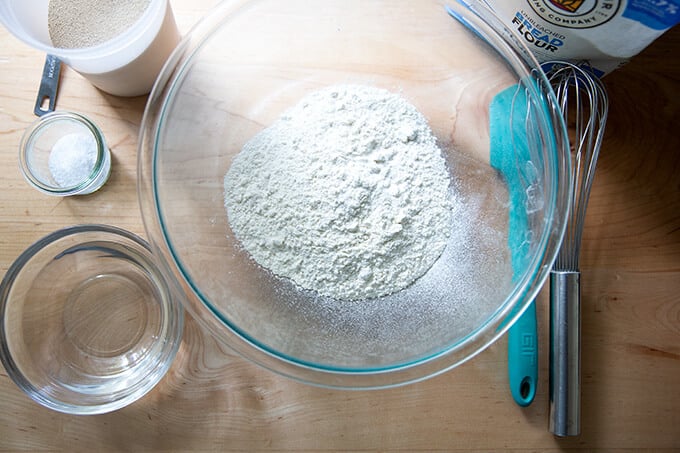
Whisk together the flour, salt, and instant yeast:

Add cold water.
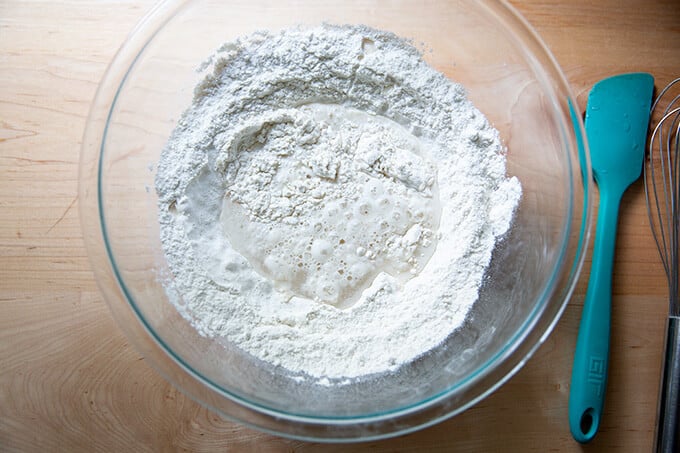
And stir to form a sticky dough ball. Cover the dough with a teaspoon of olive oil. Cover with an airtight lid or plastic wrap and let sit at room temperature overnight or for 10 to 12 hours.
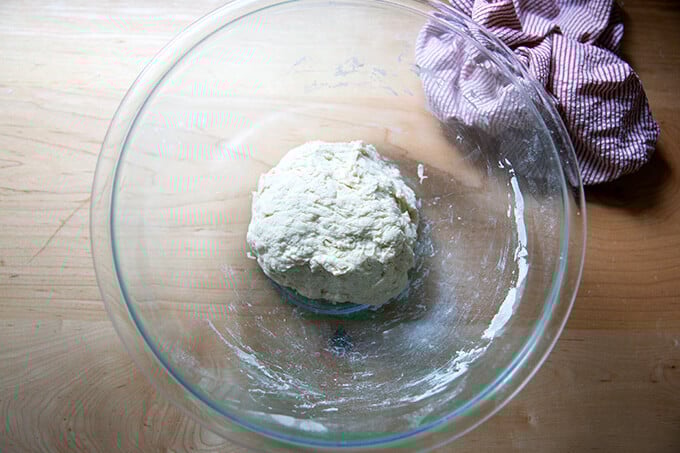
The following morning, remove the lid.

Deflate the dough. I like to use a flexible dough scraper for this. At this point you can transfer the dough to the fridge and let it rest for as long as week. I find 2-3 days to be the sweet spot.
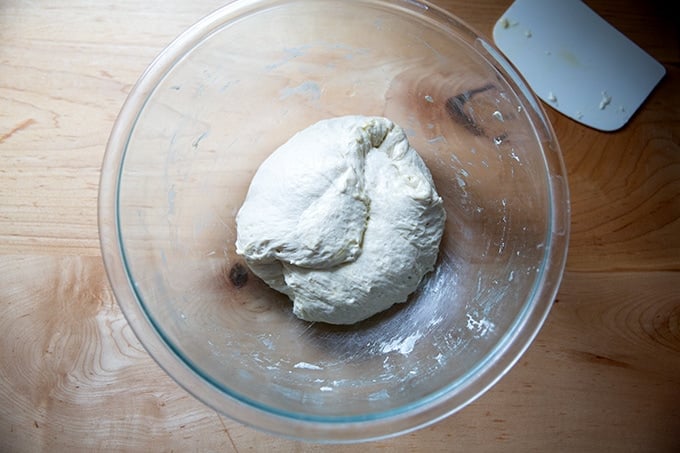
Or you can proceed: place it in your prepared pan: a buttered Detroit-style pizza pan with 1 teaspoon of oil in the center:

Let the dough rise for 3 to 4 hours.
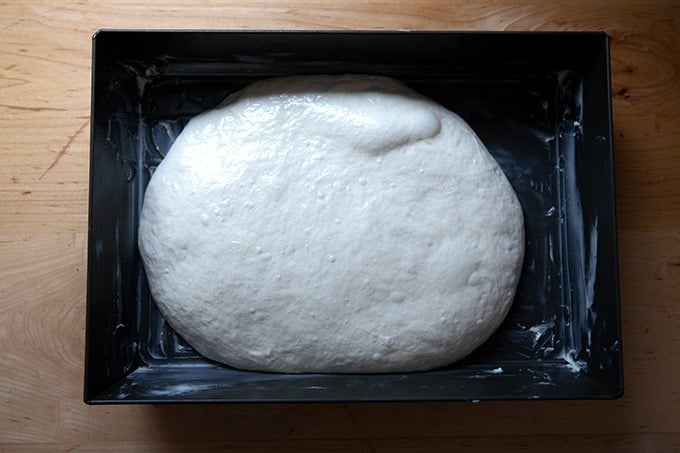
Then dimple and stretch the dough to the edges.
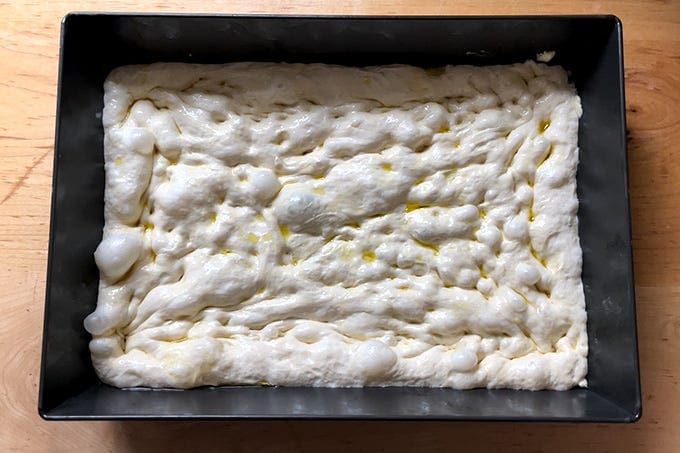
Let it rise for another hour, then parbake it for 8 minutes at 500ºF:
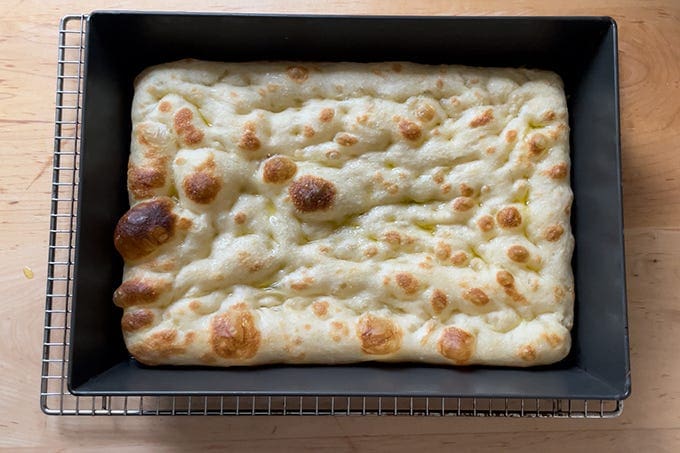
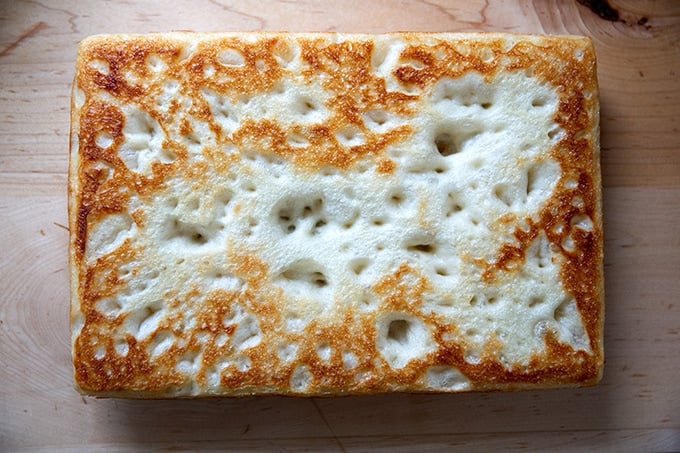
Remove the parbaked crust from the pan and let it cool upside down on the rack:
Meanwhile, gather your toppings:

Return the parbaked crust to the pan, then top it as desired:
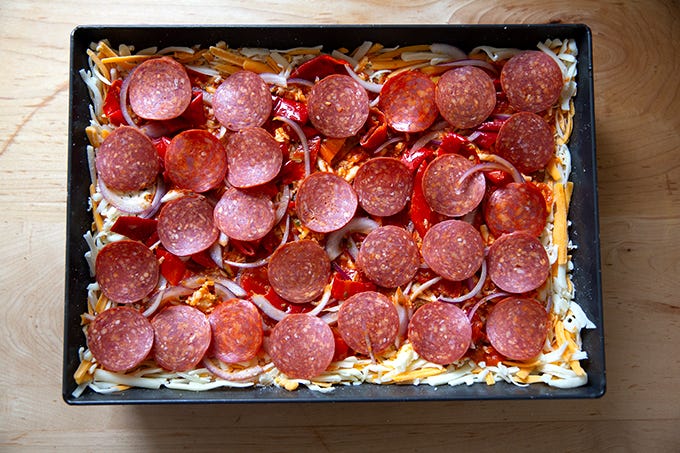
Return to the oven at 475ºF and bake for 10 minutes.
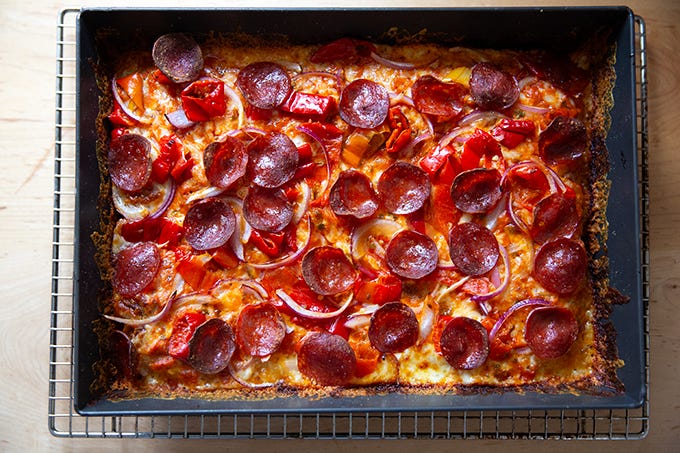
Let cool for 5 minutes in pan, then transfer to a board to cut and serve.
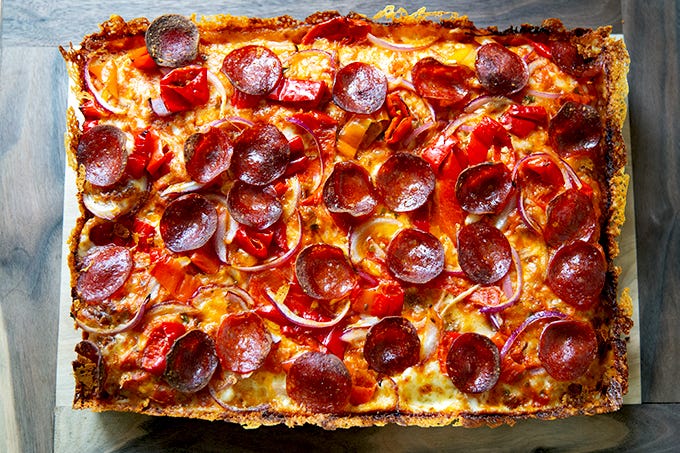
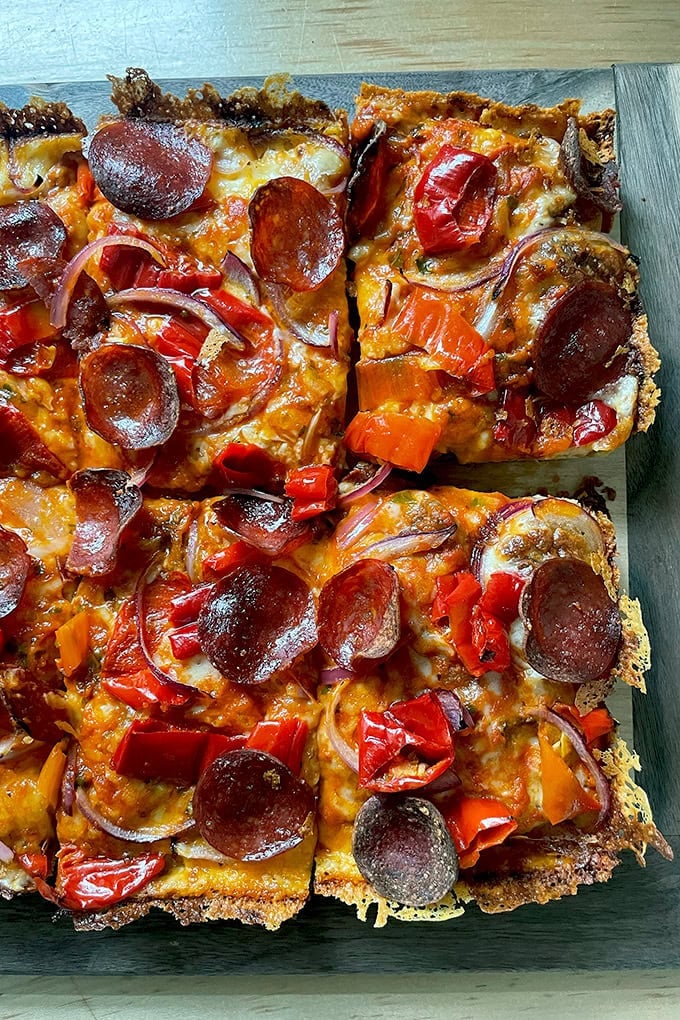
Frico crust:

Crumb shot:
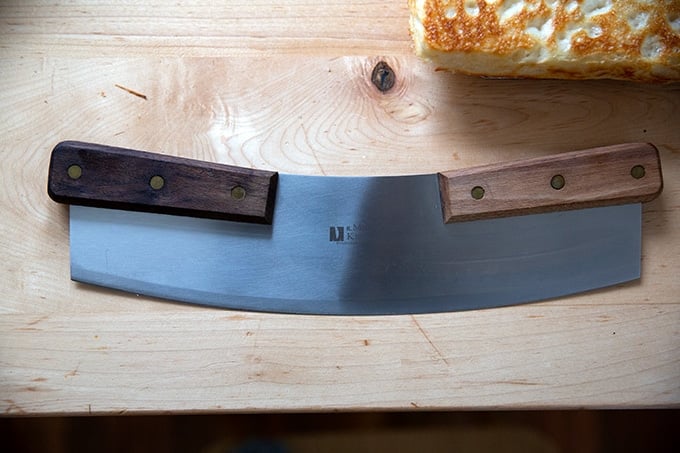
In closing, this is a nice tool to add to your arsenal of pizza-making gear: a mezzaluna. I love this one:
How to Make Homemade Detroit-Style Pizza
- Total Time: 24 hours 15 minutes
- Yield: Serves 6
Description
Detroit-style pizza is not unlike a cheesed- and sauced-focaccia. It is heavenly and is great for feeding a crowd. Read on to learn the secret to baking a Detroit-style pizza with a light and airy crust with an irresistible cheese frico crust.
**Attention Pizza Fans**: My pizza cookbook is here! Get your copy: Pizza Night.
UPDATE 2/10/2023: I have updated the original yeast-leavened recipe by increasing the hydration and adding a parbake. Find the original recipe here.
Notes:
As always, for best results, please use a digital scale to measure everything. Volume cups simply are not accurate.
Flour: I have had success using all-purpose flour, but if you can get your hands on bread flour, that is ideal, especially if you live in Canada or abroad. Moreover, if you live in Canada or abroad, you may need to reduce the water amount. Consider holding back some of the water (25 grams or so) during the mixing process to ensure you don’t end up with a soupy mess. You can always add it back in slowly if the dough is too dry.
Cheese: Wisconsin Brick cheese is traditional but it can be hard to come by if you live in the Northeast. A mix of whole milk mozzarella and Cheddar or Monterey Jack works great for the interior surface. I love using Calabro for the interior.
Pre-shredded Cheese: The starches in pre-shredded cheese prevent the cheese from clumping and melting too quickly. They are essential for creating a dramatic cheese frico crust on the perimeter.
Sauce: I love a vodka sauce on pizza, such as this one or this one. This is my favorite fresh tomato sauce recipe. Of course, use your favorite tomato sauce here. I love all of the Rao’s brand sauces.
Pan: I hate to encourage spending money on yet another piece of equipment, but a Lloyd Detroit-Style pizza pan does make a difference. I love my 9×13-inch USA pan, but a Lloyd Pan truly creates a crisper, more golden bottom. Furthermore, if you have a Baking Steel or pizza stone, baking the pizza on it will encourage even better browning, and if you don’t have a Lloyd pan, I suggest using the Baking Steel, which will help crisp up the bottom.
Timeline: Plan ahead. I like to mix the dough in the evening, let it rise overnight, then bake it the following day.
The toppings: The pickled jalapeño and pepperoni pizza below is inspired by “The Colony” served at several of the Matt and Emily Hyland pizza restaurants, the recipe for which also can be found in their book, EMILY: The Cookbook.
Ingredients
For the yeast-leavened pizza dough:
- 288 grams (2.25 cups) bread flour
- 6 grams (1.5 teaspoons) kosher salt
- 2 grams (1/2 teaspoon) instant yeast, SAF is my preference
- 240 grams (about 1 cup) cold water
For the sourdough pizza dough:
- 255 grams (1.75 cups + 1 tablespoon) bread flour
- 6 grams (1.5 teaspoons) kosher salt
- 100 grams (1/2 cup) active, bubbly sourdough starter
- 185 grams (3/4 cup) water
For each pizza:
- 1 tablespoon (14 g) softened butter
- 1 teaspoon (5 g) olive oil
- 6 ounces pre-shredded Cheddar (for the cheese frico crust)
- 4 ounces pre-shredded low-moisture, whole-milk mozzarella (for the cheese frico crust)
- 6 ounces hand-grated low-moisture, whole-milk mozzarella for the interior surface (Calabro is my favorite)
- 2 ounces thinly sliced pepperoni, I love Applegate
- 1/2 cup thinly sliced red onion
- 1/4 cup pickled jalapeños or other pickled peppers (such as Mama Lil’s), or to taste, optional
- 1/2 cup tomato sauce, such as this one or this one, or your favorite jarred sauce
- light drizzle honey, optional
Instructions
To make the yeast-leavened pizza dough:
- In a large bowl, whisk together the flour, salt, and instant yeast. Add the water. Using a rubber spatula, mix until the water is absorbed and the ingredients form a sticky dough ball. Cover the bowl, let the dough rest for 30 minutes, then stretch and fold it: using a wet hand, grab an edge of the dough and stretch it up and in. Repeat this 8 to 10 times, grabbing a different edge each time, ultimately shaping the dough into a ball. Slick the dough with a teaspoon of olive oil. Cover the bowl with an airtight lid. Let rise overnight or for 10 to 12 hours at room temperature.
- Using lightly oiled hands or a flexible bowl scraper, deflate the dough by releasing it from the sides of the bowl and pulling it towards the center. Shape it into a rough ball. At this point, you can transfer the dough to the fridge for up to a week. I find the sweet spot to be 2-3 days. Alternatively, you can skip to preparing the pan.
To make the sourdough pizza dough:
- Place the water in a large bowl. Add the starter and stir with a spatula to combine. Add the salt and stir again; then add the flour. Mix again until the flour is mostly incorporated. Use your hands if necessary to briefly knead in the last bits of flour. Cover vessel with a tea towel or cloth bowl cover and let stand for 30 minutes.
- After 30 minutes have passed, reach into the vessel and pull the dough up and into the center. Turn the vessel quarter turns and continue this pulling 8 to 10 times. Let the dough rest for another 30 minutes; then repeat the stretching and folding. After these two sets of stretches and folds, you should see a difference in the texture of the dough: it will be smoother, stronger, and more elastic.
- If you have a straight-sided vessel, transfer the dough to it; then cover it with a tea towel or use a lidded vessel — I love this 4-quart Pyrex bowl + lid set, and set aside to rise at room temperature (70ºF/21ºC) for 4 to 8 hours (the time will vary depending on the time of year, the strength of your starter, and the temperature of your kitchen) or until the dough has roughly doubled in volume. (A straight-sided vessel makes monitoring the bulk fermentation especially easy because it allows you to see when your dough has truly doubled.)
- Turn the dough out onto a work surface and shape into a rough ball. I like to do this without flour, but use flour as needed — the dough will be sticky. Use the pinkie-edges of your hands to pinch the dough underneath to create a ball. Skip to preparing the pan.
Prepare the pan:
- Grease a 10×14-inch pan with the tablespoon of softened butter. Pour 1 teaspoon of olive oil into the center. Place the dough ball in the pan and turn to coat. Let rest for 3 to 4 hours. With lightly oiled hands, stretch the dough to fit the pan. Let the dough rest again for 1 hour.
Parbake the dough:
- Preheat the oven to 500ºF.
- Dimple the dough one last time with lightly oiled hands taking care not to dimple the perimeter. Transfer the pan to the oven for 8 minutes.
- Remove the pan from the oven and carefully transfer the dough to a cooling rack. Let it cool upside down on the rack for 20 minutes. Do not wash the pan.
- Once the dough is cooled, you can transfer it to an airtight storage bag for 1 to 2 days at room temperature or up to 3 months in the freezer.
Top the pizza:
- Preheat the oven to 475ºF. If you do have a Baking Steel or pizza stone, place it on a rack in the middle or lower third of the oven while it preheats.
- Return the parbaked crust to its pan (bottom side down).
- Combine the two pre-shredded cheeses for the frico crust in a medium bowl. Spread this cheese around the perimeter of the dough pressing it into the sides of the pan.
- Sprinkle the hand-grated mozzarella over the interior surface of the dough.
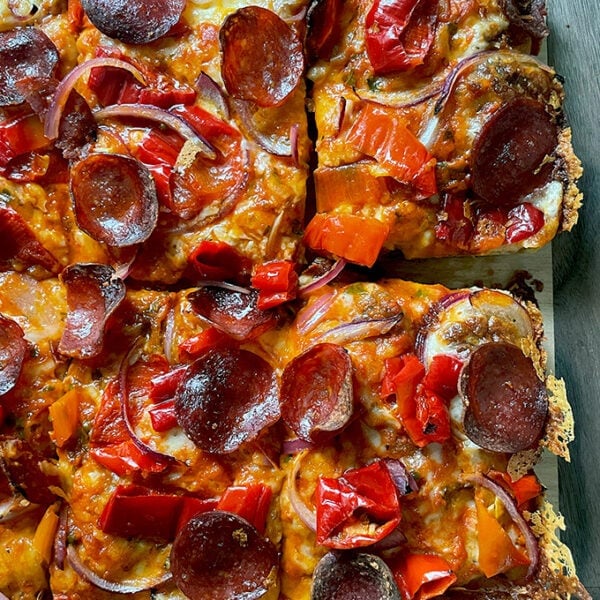
- Finish topping the pizza: spread the 1/2 cup of tomato sauce evenly over the top. Spread the pepperoni evenly over the surface, followed by the red onion. If you are using pickled jalapeños, scatter them evenly over the pizza, keeping in mind heat tolerance — they make the pizza very spicy.
Bake the pizza:
- Transfer pizza to the oven for 10 minutes or until the edges are caramelized to your liking. Remove the pan from the oven and let the pizza rest for 5 minutes in the pan. Carefully run a paring knife or spatula around the pan’s edges. Then, carefully remove the entire pizza from the pan, transferring it to a cutting board. If you are using the honey, drizzle it over top. Cut the pizza into 12 pieces and serve.
- Prep Time: 24 hours
- Cook Time: 15 minutes
- Category: Dinner
- Method: Oven
- Cuisine: American
This post may contain affiliate links. Please read my disclosure policy.







345 Comments on “How to Make Homemade Detroit-Style Pizza”
When baking this pizza, which rack (middle, upper middle, bottom, etc) do you place the baking steel?
Great question! I’ve been placing it in the lower-third of the oven for this one. Will edit the recipe now. Thanks!
JUST FINISHED READING WHAT YOU POSTED…………… AND WATCHING VIDEOS.
YOU COVERED IT ALL SO DARN GREAT. I WILL STUDY WHAT YOU WROTE AGAIN WHEN I AM READY TO MAKE IT. MY MOUTH WAS WATERING………. AND YES I’m drooling 🙂
THANK YOU FOR WRITING UP THIS FABULOUS RECIPE …. BOTH KINDS……. LIKE YOU WERE SITTING NEXT TO ME………. AND SHOWING ME EXACTLY WHAT TO DO.
I LOVE ALL YOUR OPINIONS………… YOU ARE ONE VERY SPECIAL COOK………… AND TEACHER. SO GLAD I FOUND YOU. SOON I’LL BE IN HEAVEN EATING TOO MUCH OF THIS RECIPE HAAAAAAAAAAAAAAAAAAAAAAAAAAAAAAAAAAAAA <3 <3
Oh my goodness you are too sweet 🙂 🙂 🙂 Thank you, Louise. Hope you love it!
What size of pan did you use for this amount of dough? 8×10 or 10×14?
I used this 10×14-inch Lloyd pan. You could also use a 9×13-inch pan, but I do highly recommend the Lloyd pan for the beautiful, crisp crust it creates.
Yup, I have a Lloyd pan, but important to know your size if I want the same height. Thanks!
OK, wonderful! Great to hear re Lloyd pan … love mine so much! Adding a link to the specific pan I have because I realized my previous link was a little unclear: 10×14-inch Detroit Pan
What size pan are you using? Looks like Lloyd sells several different sizes.
Is is still worth trying without the special pan – maybe in my aluminum 9×13?
Hi! I’m using this 10×14-inch Lloyd pan. Yes, definitely worth trying without the special pan. Do you have a Baking Steel or pizza stone?
Hi Ali,
I can’t wait to make this pizza. I do have a question about the pan. I have a Lloyd’s Grandma Style pan that is 10X14 by 1” high. The Detroit style pan is 2.5” high. Do you think mine will work for this recipe?
Thanks in advance for your help.
Hi Bruce! Yes, absolutely. The pizza at its thickest is no higher than one inch, so the amount of dough will definitely fit. Thank you for asking this… I’m realizing that others may have been asking the same thing and I was vague in my response because I didn’t realize there were two heights available for these 10X14-inch pans. Hope you love the pizza!
Hi Ali! I’m chuckling over the brick cheese availability in the NE. Seldom do I read a recipe with a note like that – it’s usually me and my neighbors having to go online for an ingredient. I’m hoping no cheese monger in the NE reads this note and decides to try and corner the market on brick cheese!!! 😂😂😂
Cheers!
That would be kind of amazing 😂😂😂😂😂 Better: it would be amazing if someone decided to MAKE brick cheese locally. I’ve got sources for local feta and gouda and just about everything else… would be so nice to add local brick cheese into the mix!
Thank you! Your recipe, comments and personal adjustments are spot on. Especially regarding the toppings. The crust looks heavy and greasy but it’s truly light and airy and buttery.
Having grown up in the Detroit area, I’ve been eating Buddy’s for close to 50 years. We moved a few years ago, over 2 hours away from any Detroit style pizza, so I’ve had to learn to recreate it. My recipe/method is super quick and simple, is very close and does the trick. But this? Amazing! I’ve been on the fence about the pan and have been using cast iron skillets. After reading this, I just might get one.
Definitely trying the honey!!
So fun to read all of this, Kelli! I’m dying to visit Detroit to taste the real deal. I’m sure your cast iron skillets work beautifully. If it ain’t broke, don’t fix it 🙂 🙂 🙂 Thanks so much for writing!
Can’t wait to try this! We have to eat dairy-free cheese in my family. I’m planning to use our favorite shredded cheese and I’m wondering if there are any others changes you might recommend to compensate for the lack of milk fat in the cheese. A drizzle of olive oil w/the cheese? Some butter? (Thankfully, butter still works for us.)
Hi Nolo! Great questions. I don’t know how to advise as my experience with non-dairy cheeses is limited, but I think your instincts are great: a little extra olive oil never hurt anything! I would try that first; then, based on your experience, adjust with more or less next time around. Thanks for writing!
Thank you! I’ll give it a go after I get the pan and report back.
Please do!
Hi Ali!
So I started my dough Friday, I’ve got it out of fridge ready to top… I was going to use just a rectangle 9 x 13 baking pan since I don’t have the Lloyd’s pan but I do have a 12 inch round carbon steel very well seasoned frying pan I’m thinking about doing it in that instead? What do you think? I have a pizza stone I will heat up as well. Obviously round is not traditional Detroit style but I am feeling hesitant about using my baking pan in a 500° oven.
Hi! I think the carbon steel pan sounds perfect! Hope you love it 🍕🍕🍕
Yay! i will report back!
Please do!
holy pizza, this was amazing….since i used a 12″ round carbon steel fry pan my crust was a bit thicker so cooking time was closer to 30 mins. but it was still oh so good and light and fluffy and we couldn’t stop eating it! I took it out after 18 mins, cut it in half and noticed it was still a little bit doughy so i slid it back in the pan and baked for another 10 or so, i just watched carefully. i did set it on a pizza stone and my oven was at 500 at least.
the combo of salty pepperoni, spicy jalapeños and sweet honey was insane!
So, i’ve got another batch of dough in the fridge cause now i want to experiment using a 9×13 aluminum baking pan and maybe add some walla walla sweet onions and mushrooms. x
Yay! So nice to hear this, Jill! Thanks so much for writing back and sharing your results … I was wondering if the 12-inch pan might make it a little thicker (but math isn’t my strong suit, so I didn’t dare try to calculate the area of the pans :)). Yay for having more dough in the fridge. Love the idea of adding onions and mushrooms. Thanks again for writing!
I forgot to rate! 😋🍕
Thanks, Jill! 🍕🍕🍕🍕🍕
What or other pan can I use to make pizza with this recipe.
Do you have a 9×13-inch pan? Or a cast iron skillet? And do you have a pizza stone or Baking Steel?
I cannot wait to try this – I LOVE this style of pizza and being in LA, I’ve been blessed with many places selling this type. Unfortunately my favorite spot closed a few years ago but haven’t quite found the new favorite. I might have more luck making it!
My question is, would tip 00 flour work for this recipe? I find myself with some excess bags and was curious 🙂
Thank you!!
Yay! And yes, absolutely 00 flour will work. Are you using a scale to measure? My only thought is that you may need to reduce the water slightly, but I would suggest trying it as written once first. Good luck!
Looks amazing and VERY similar to King Arthur Baking’s recipe of the year that we discovered during the pandemic: https://www.kingarthurbaking.com/recipes/crispy-cheesy-pan-pizza-recipe I haven’t compared the amounts of ingredients, but I’m intrigued both by your recipe making a larger size and leaving it in the fridge for longer than overnight. I usually double the KA recipe and make half in my cast iron skillet and half in a 9×9 aluminum baking dish. Our family thinks it’s better than any pizza we can buy where we live.
Thanks for another great recipe! Happy August!
Kristen, I can’t believe this, but I’ve still never made KAF’s recipe of the year. I remember first seeing it and thinking: why would anyone need to do all of those stretches and folds? And 2 years later, after getting super into sourdough, it doesn’t feel so much like a chore. I’ll have to try that recipe soon to compare. Based on the photos, it looks a bit thicker than this recipe, but photos can be misleading. Thanks for reminding me about this one! I’ve been meaning to make it since Food52 featured it, too.
I definitely want to make yours to compare. It does look thinner (though I wonder if I just use a larger pan with the KAF recipe if it would be nearly the same). Either way, it’s glorious to have delicious pizza I can make at home!
Absolutely!
I was thinking the same about the King Arthur’s pizza of the year, which I make frequently. I make it in a cast iron pan and it is so fluffy and a winner in my family. This recipe reminds me of it – I want to try it and compare. Thank you Ali!
Hey, Alex
My dough has been in the fridge cold proofing for 48 hours but my pan won’t be delivered until tomorrow so it will be close to 72 hours before I can put in pan. Do I need to change the amount of time it proofs in pan? Is 72 hours too long. Thanks for all you do. Your videos and recipes are so helpful and your recipes always delish!
Hi! Apologies for the delay here … 72 hours should be just fine! Once it’s in the pan, you can get away with sticking it in the fridge for 3 hours at a minimum, but up to 24 hours if need be.
Good luck! Hope you love it. Yay for the pan arriving soon… I love mine so much. Thank you for the kind words 🙂 🙂 🙂
Alex!
This was so delicious!! Curious if you have used the Loyd pan for anything else or just pizza?
So great to hear this!! We used the pan to make roasted red potatoes while we were renting a house this summer … I had brought the pan to experiment with pizza, but it came in handy with the limitedly supplied kitchen. The potatoes turned out great! But that is as far as my experiments have gone. I think it will be great for things like brownies, lemon bars, lasagna, stuffing … anything really that calls for a 9×13-inch pan.
I followed directions to a t. I weighed my ingredients. Did the slap and pull. Put it in the refrigerator for 48 hours. Purchased a Lloyd pan to cook it in. It tasted good but my dough did not rise and get puffy. I know my yeast is good since I recently bought it and have been using it successfully. At a loss.
Sharon, hi! Question: what kind of yeast are you using? Active dry or instant? Did the first rise go OK? As in: did it double in volume within 2 hours or so?
SAF Instant
OK, and did the first rise go OK? Or did you never get a good rise from the start? What type of flour are you using?
I didn’t see much of a first rise. I’m using King Arthur Flour (red bag). I’m going to try it again. My kitchen may have been too cold. I’m on a mission.
OK, that’s helpful! If your kitchen is cold, definitely use lukewarm water. That will help the dough rise. Once it doubles (and this may take longer than the 1.5 hours noted in the recipe), deflate it, ball it up, and get it into the fridge.
Fingers crossed it works better the second time around! I hate when recipes don’t work out. Let me know if you have more questions along the way.
Wow! This was a home run for my family of large, college-age fellows! I have to say, you “quarantine taught” me to make bread (peasant bread, sourdough focaccia, hot cross buns, cinnamon rolls, etc) and I have never been disappointed. This pizza was no exception. Your videos are so easy to follow and incredibly helpful. Thank you so much for enhancing my cooking life!
Oh yay! So nice to hear all of this, Beth 🙂 🙂 🙂 Truly it means so much: nothing making me happier than when people have success with the bread recipes because (for me at least) they seem to bring about the most joy. Thank you so much for taking the time to write!
Did you use table salt or kosher salt?
kosher salt! Great question … will edit the recipe 🙂
What size pans do you use?
Hi Kelly! It’s this 10×14-inch pan. You can use a 9×13-inch pan, too, and I definitely recommend baking on Baking Steel or pizza stone. Just updated the post with the correct pan link … thought I had already done that.
Hi Ali! Hope all is well with you and your family. Made this dough, and because of impending hurricane Henri my plans have changed. I’m going to freeze the dough. When I go to use it, should I defrost in fridge or freezer? Can’t wait to try out the Emmy Squared version!
Oh Sara, hope you aren’t being hit too hard down there! We’ve been spared up here … just a lot of rain.
You can thaw it overnight on the countertop if you think you’ll be able to get the dough in the pan in the morning. Otherwise, I would thaw it in the fridge; then proceed with the recipe once it’s thawed.
I am so excited to try this! We’re in St. Louis, and local (not chain) Detroit style is just now making an appearance. The Detroit style we’ve had frequently is from the chain, Jet’s, and it’s good. We love the style, so I’m very excited to try out your instructions! (love your book and recipes!) I am ordering our pan, and we’ll give it a go next week!
You mentioned “I loved the idea of making one large pizza in one vessel, presenting it to the family, and then: turning the oven off! (I’ve gotten used to never sitting on pizza night.)“ I agree with the sentiment. I used to make pizza on a pizza stone one at a time, then popping each one in to quickly reheat before serving them all at once. It was time-consuming and a lot of juggling. Relaxing and stressful at the same time! However, while I still make them that way occasionally, I almost exclusively make your peasant pizza (standard recipe but increased by a third), using the skillet method. And I make 4 at once! All 4 are prepped in the pans, at your leisure – no need to jiggle the peel to make sure the dough isn’t sticking – or any other fiddling. And, best of all, all 4 are ready at the same time! I use 2 – 10 in Lodge standard skillets, a 10 in sideless skillet, and an 8 in. I found there is a trick to making it work – prep the pizzas in the pans on top of each of the range burners, then fire them up for a couple minutes before transferring to the 550 oven. The quick preheat gives the cast iron a jumpstart, so they bake just as well as if you were doing one or two at a time. I bake for about 5 minutes, then rotate the upper and lower pans (placed in the top and bottom third of the oven). Our favorites are white sauce jalapeño and your recipe for onion and bacon.
Thank you so much for your recipes!
Elizabeth, hi! And thank you for all of this. I LOVE your method of starting the skillets stovetop… brilliant! And how nice that they all finish cooking at the same time. So appreciate you writing and sharing all of your notes — so helpful for others (and me!).
I totally agree with this statement: “Relaxing and stressful at the same time!” I truly do love pizza night whether I am sitting or not — cooking and feeding others is therapy — so the idea of making pizzas being both stressful and relaxing at the same time really resonates.
Anyway, I hope you love the Detroit style! Thanks so much for the kind words… means a lot 🙂 🙂 🙂
I’ve tried home made pizza before, but this recipe is by far the best! I had one in the fridge snd cooked it tonight when family came over. They all said it was some of the best pizza they’d ever had, cheesy snd bubbly with beautiful crispy edges. I will never go back to my old recipes or trying to roll out dough. Thank you.
So nice to hear this, Karen!! Thanks so much for writing 🙂 🙂 🙂 Great to hear the family approved, too. This has become a family fave, too.
This was DELICIOUS. LOVE the pickled japs and honey. I followed the yeast recipe, made the dough Thurs morning and put in the fridge. Made the pizza Friday morning and baked it on Friday night, crust turned out light and delicious. Next time will try to make dough Weds night and pizza Thurs night for Friday baking. I used a 9×13 pan so may have been on the thicker side. Baked on a Baking Steel which you inspired me to buy years ago when my cheap pizza stones kept cracking. I think I’ll make a triple recipe next time and freeze 2 batches for later! From the freezer, should I immediately turn into greased pan and let rest for 30-60 mins before stretching out or let rest longer? This might be my new go-to for pizza night – I’ve been making Lahey dough based on your advice but like you say, its hard to sit down plus there is flour all over the kitchen. Thanks, you’re the best!
Yay! So great to hear this, Shelley! Thanks so much for writing.
Regarding your question: “From the freezer, should I immediately turn into greased pan and let rest for 30-60 mins before stretching out or let rest longer?”
I would let the dough sit at room temperature in its vessel overnight to thaw; then transfer it to the baking vessel; then let it rest as long as needed to allow you to stretch it out. It may take 30 minutes, but as noted, if the dough resists, let it rest for 5-10 minutes; then stretch it again.
Hope that helps! Let me know if you have any other questions.
Hi Ali,
I finally was able to make the pizza this past week. I think I need to make some tweaks because the interior pieces were cooked but the crust was too soft. The edge pieces were great and I loved the flavors of the peperoni, jalapeno and honey. I drained and dried the pickled jalapenos before using. I used a mix of Monterey jack and low moisture, whole milk mozzarella for the cheese. My sauce amount were a bit more than your recipe called for.
My Lloyd’s pan turned out to be there 16X20 so I scaled the dough up based on volume difference with 10X14. Bake time was increased by 3 minutes and pizza was baked on baking steel that had been heated to 500 degrees for 1 hour.
Any tips for better execution on my part and crisper crust throughout would be greatly appreciated.
Thanks for all your hard work on putting this recipe together.
Hi Bruce! Great to read all of this. Thanks for giving it a go, and thanks for reporting back.
Regarding the crust, I think it might just be a matter of cooking it longer. Now, if cooking it longer would potentially make the top overcooked, you could try lowering the oven temperature (to 450 or 475) and cooking the whole thing for 5 to 10 minutes longer.
Another thought: Did the pizza feel saucy? If you reduce the amount of sauce slightly, it might help reduce the overall wetness of the pizza, and might help the bottom brown more.
Finally: did you use both butter and olive oil to grease the pan?
We’ll get to the bottom of it! I think I have that Lloyd pan, and I can experiment when I get home … I’m visiting my family in CT for the long weekend, but will be back tomorrow!
Hi Ali,
Thanks for taking your time to give me such a thoughtful reply.
I think your suggestion for a longer bake with a lower temperature for the extra time might just be the key. My sauce is fairly low moisture but I will probably cut it back some next time.
I did use both the oil and butter in the pan.
I am looking forward to my next try and will let you know how it goes.
Ok, great to hear! Quick question: is this the pan you have?
Hi Ali,
Yes. That is the pan I have.
Bruce
Hi Bruce,
I just wanted to touch base. I recently re-made the sourdough version of the Detroit-style pizza, and I made a video of the process, which I added to the post… this won’t really help you because you have the larger size pan. I have yet to try the Detroit pizza in the larger pan, but what I did do recently was make pissaldière in the same pan you have, and I used my sourdough focaccia recipe for that. I made a video of the sourdough pissaladiere — it’s probably a little too thick, but I just wanted to send it along as a reference. As soon as I make the Detroit pizza in the larger (“gramma-style” pan), I will be in touch!
Hi Ali,
Thanks for the info on your recent videos for sourdough pissaladière and Detroit pizza.
I am currently in Wisconsin and am looking forward to trying your recent postings including the baked feta with tomatoes.
I did have a question. Would it be worth it to find some brick cheese for the Detroit pizza while I am here or are you just as happy with your cheese combination.
I really appreciate your thoughtfulness in reaching out with information and help
Bruce
Definitely! It’s next to impossible (for me at least) to find it without mail ordering it. What was interesting to me was that I didn’t love it when I sliced it uncooked, but it was really good when all melty on the pizza. It’s fun to try. So, if you have room to bring some home, go for it. Hope you love the baked feta! Will be experimenting with the “gramma” pan soon.
Hi Ali.
I became interested in Detroit Pizza a few months ago. Tried a recipe and it was fine. However, you, as always, make things better. 🙂 I was excited when I saw your post for DP. I used the yeast recipe. The directions were perfect and the results were fantastic! As usual, the video always helps. Thank you.
Ps…. If you haven’t bought Ali’s book yet… what are you waiting for? It’s a must for any collection with great recipes.
Awww, Sherry, thank you 🙂 🙂 🙂 This means the world (re book AND pizza :)). I’m so happy you had success with this one. It’s become such a staple around here. Thanks so much for writing!
im making this recipe today and I’m noticing some discrepancies; in the blog post it mentions letting the dough rest out of the fridge 45 minutes before baking the instant yeast version, but it doesn’t mention that step for the sourdough version, or in the ‘jump to recipe’ part. Based on past experience, I’m assuming that 45 minute rest is important – I’m looking at my dough in the fridge after having it in overnight and it’s very very flat.
Hi Anna! Are you making the sourdough version? I’m gathering you are. I’m trying to figure out where you are in the process? Is the dough topped and in the pan? Or are you removing the dough from the fridge for the bulk fermentation.
As far as the discrepancy goes, I’ll try to find the error in the blog post — sorry! I’m looking at the recipe now, and for both the yeast/sourdough recipes, the pan should sit at room temperature for 45 minutes before baking, though I have let it rest for less than 45 minutes, and it has been just fine.
Let me know how it turns out!
yes! I made the sourdough version. The pizza was topped with cheese and in the fridge overnight, it didn’t really rise at all. I left it out for 45 minutes and it still didn’t rise. It was basically just thin crust pizza. Still delicious, but I definitely did something wrong. All your other recipes have been major hits, including your focaccia, so I’m determined to make this work!I know that I accidentally started using AP flour before realizing and switching to bread flour, so maybe that was it. Also it’s gotten much colder this past week, and so far I’ve only done sourdough in summer, so maybe I just have to adjust somehow for that. I’m going to try again with bread flour and if that doesn’t help maybe I’ll top it with everything, including the cheese, after rising in the pan overnight bare?
OK! We’ll get to the bottom of it. I just fed my starter, and with any luck, I’ll have a video to share by Friday… I’ve been meaning to do a video of the sourdough version of this recipe for weeks.
Is the dough feeling on the wet side for you? Did the dough double in volume (or increase by 50-75%) during the bulk fermentation before going into the fridge?
I don’t remember how the dough felt the first time, but I just started a second batch (gotta use up that pepperoni and cheese!!) and it’s not at all wet, it’s very stiff even after the 2 stretch and folds. I remembered to use the bread flour this time at least! I also can’t recall about the volume of the dough during bulk fermentation, but I assume that it did increase, because I’ve done other sourdough baking before I know what to look for with that. I’ll keep an eye on that with this batch; this time I used warmer water, and it’s in my oven with the light on. I thought maybe the temperature might be part of the issue since it’s getting colder here now, and we keep all our windows and balcony doors open so there is quite the draft. I’ll keep you posted! You’re so very sweet for being so personally attentive with your messages! ❤️
OK, interesting! If the dough feels too stiff, you can be sure to really wet your hands during the next few sets of stretches and folds (should time permit).
One note of caution: the oven light in some ovens is surprisingly powerful! I did this once, and I didn’t realize how hot my oven would get, and my dough over fermented. I always give people this warning with all of my bread recipes, sourdough in particular because it’s a little more fragile, because the oven light has caused many a baker’s dough to over ferment. So, check it soon to see the temperature. If it feels like it’s warming up a lot, turn off the light and maybe consider removing the bowl from the oven.
Thank you for your kind words! I will report back as well as soon as I have a video up.
Anna, hi! I’ve created a video for the sourdough version of the Detroit Style Pizza. It’s up above in the post or you can watch it on YouTube. I hope it helps. I also slightly changed the recipe: upped the flour from 250 grams to 255 grams, and I used 100 grams of sourdough starter as opposed to 50 — I felt like there needed to be a bit more dough in the pan, and this worked.
Let me know if you have any questions after watching the video!
I love this recipe and had to purchase 2 pans so I could make enough for my family! My only problem is the dough does not seem to be as open/airy as yours, but rather dense. I am doing the 48 hour bulk ferment.. Any ideas how to improve? I do live in the Northeast and it has been quite humid! Thank you.
Hi Monie! So great to hear all of this. Question: you’re doing the yeast-leavened one, right? Are you finding the dough to be on the wet side? You could definitely cut back on the water by 50 grams or so to see if that makes a difference.
I am doing yeast leavened recipe. Yes I would say dough is sticky compared to your video. Ok next time I will reduce water. Thank you!
Ali, thank you so much for your detailed instructions and beautiful photos, because they inspired me to purchase the Lloyds pan and make the most delicious pizza I have ever had!
Oh yay! Wonderful to hear this, Lin! Thanks so much for writing 🙂 🙂 🙂 I am so, so happy with those Lloyd baking pans.
This was delicious. I made the sourdough version with my discard. I didn’t use pickled jalapenos as I didn’t know how it taste and was afraid my husband would not like them.
The crust was soggy though. It could be because I used more sauce than called for since I used a bigger pan.
Is there a way to make the crust crispy?
Hi! OK, Great to hear the pizza was delicious, bummer about the soggy crust. Question: What type of pan are you using? And are you using it in combination with the Baking Steel? I do think using too much sauce could have caused the crust to get soggy — I’ve made the mistake of overloading my pizza, and the result was sloppy and soggy, so there’s definitely a balance in regard to the topping.
One other thought: if you live in a humid environment or if you found the dough to be on the wet side, you could try reducing the amount of water next time around.
Why do you ball the dough before putting it in the pan? What hydration starter are you using?
Balling it up helps get the dough into an even shape that will then distribute more evenly when you are ready to spread it out. It’s a 100% hydration starter.
Loved this recipe. Was expecting a heavier, “breadier” crust, but baked up fairly thin and crispy. Fabulous way to serve pizza to a crowd. I made one in the Lloyd’s pan (my favorite) and another in my 14″ cast iron (dough didn’t fill the entire pan). I first put the cast iron skillet on the gas stove on high for a couple of minutes before I put it in the oven and then found that the bottom crust wasn’t quite brown enough so finished it off for a minute on high on the gas stove to get the same bottom browning as the Lloyd’s pan. Worked great.
Wonderful to hear this, Gretchen! How great is that Lloyd pan? Thanks so much for writing and for sharing your notes re cast iron skillet — I find I have to do the same when I make skillet pizzas.
Have you tried to make a Sicilian pizza or a “Grandma” pizza? Both are rectangular using a sheet pan – and I suspect the dough is similar to your foccocia or even this detroit-style pizza – just not sourdough? Sicilian pizza is one of my alltime faves – so would love to try your recipe if you have one that you’ve perfected or one that you recommend.
Thanks!
Hi John,
I’m actually working on a Sicilian pizza recipe now … hoping to finish in the next few weeks. It’s based on the yeasted recipe here (and there will be a sourdough version, too). Just trying to get the amount of dough right for the pan.
Stay tuned!