 →
→ 

How to Make Fresh Homemade Ciabatta Bread
 By Alexandra Stafford
—
Last Updated: 02/23/2026
By Alexandra Stafford
—
Last Updated: 02/23/2026
This post may contain affiliate links. Please read my disclosure policy.
This post will teach you how to make a crusty, open-crumbed loaf of ciabatta bread. Below you will find a detailed guide full of tips and tricks to help you make a loaf of ciabatta bread with a crisp, golden exterior and a light, airy crumb. Find video guidance below, too!
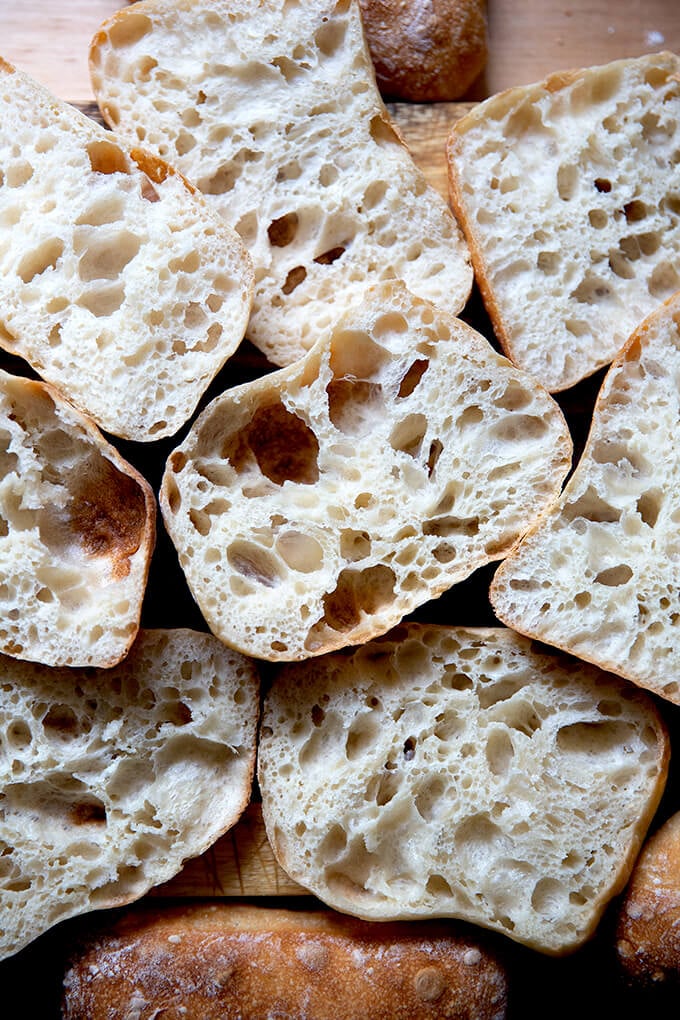
Originating from the Lake Como region of northern Italy, ciabatta means “slipper” in Italian and is characterized by a crusty exterior and a porous, chewy crumb. Traditionally, ciabatta is made with a poolish or biga, which is a small amount of flour and water mixed with a leavening agent, left to ferment for a short time. Ciabatta dough is wet and sticky, with hydration levels often 80% or higher.
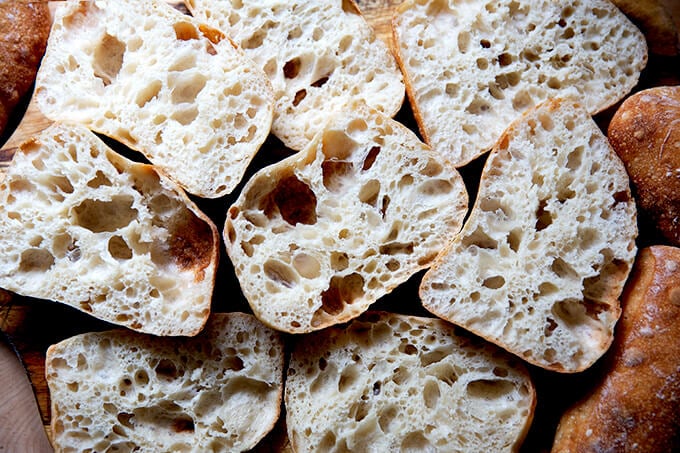
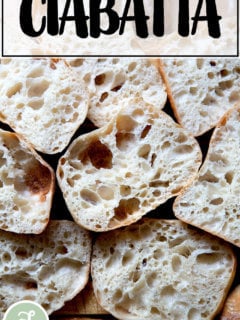
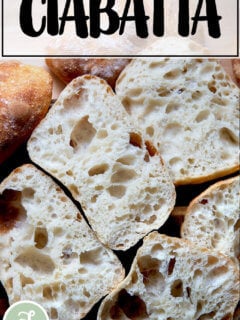
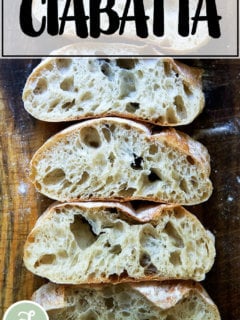
The recipe below is made in this traditional style, using a poolish that ferments for 3 to 4 hours and has an overall hydration of 82%. A few sets of stretches and folds make the dough completely manageable to work with, and the loaves emerge from the oven with a light and airy crumb full of amorphous holes.
This bread is perfect for halving and sandwiching with fillings of all kinds; its crustiness ensures it won’t get soggy if you pack it for the beach or a hike. It’s also, of course, an excellent dinner bread, served alongside a pool of olive oil to dunk into at will.
How to Make Ciabatta Bread, Step by Step
The first step of the recipe calls for making the poolish. To do so, gather your ingredients: flour, water, and instant yeast. SAF is my preference.
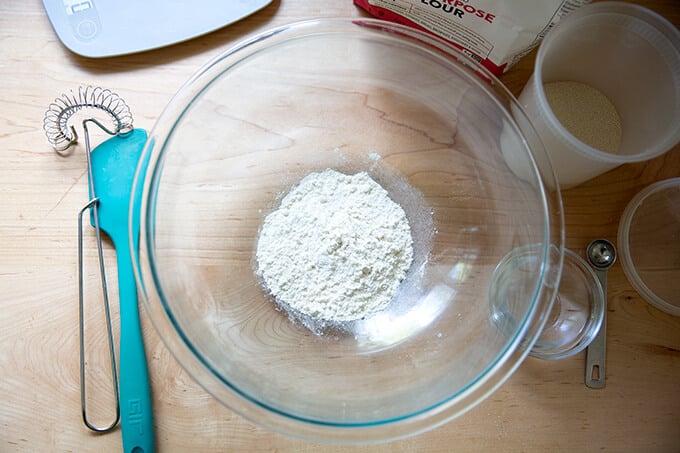
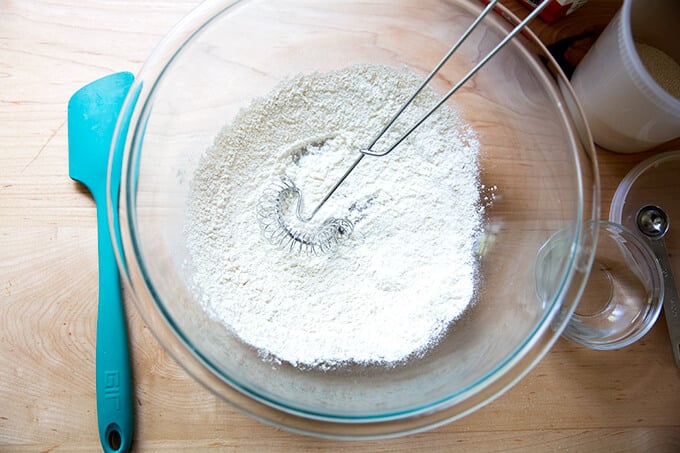
Whisk together 50 grams flour and 1/2 teaspoon instant yeast.
Add 50 grams water.
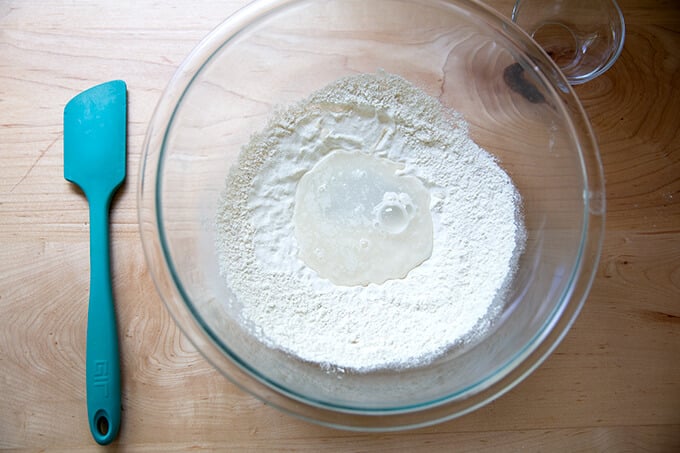
Stir to combine. Cover the bowl and let sit for 3 to 4 hours or until…
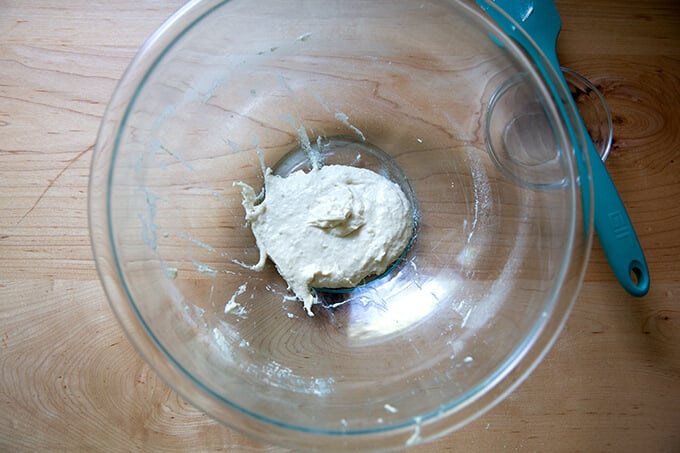
… the surface of the dough is dimpled with air pockets.
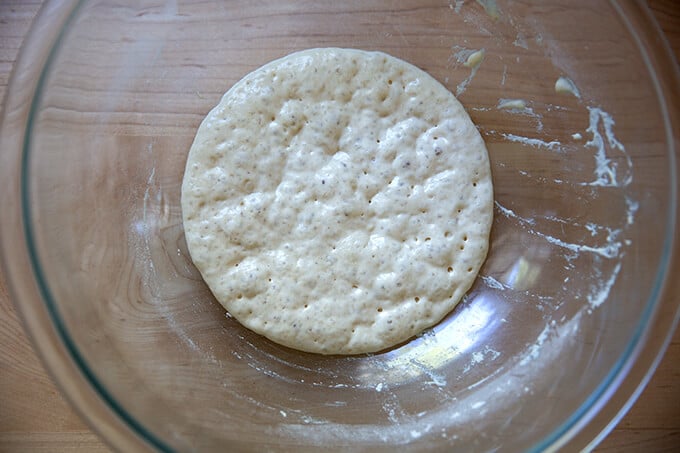
Add 360 grams water. (This part is really fun … the poolish bubbles up as a unit and floats on top of the water… it really feels alive!)
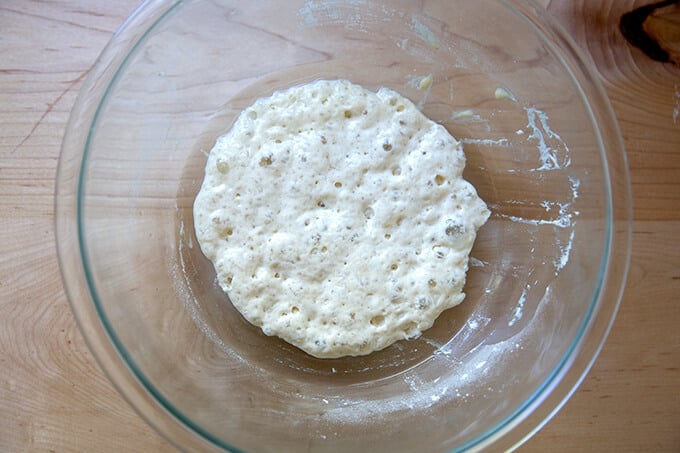
Stir to combine; then add 12 grams salt and stir again to combine.
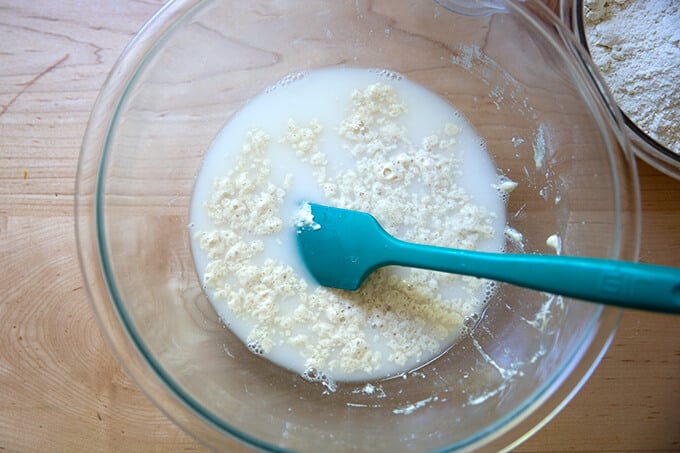
Add 450 grams flour, preferably bread flour.
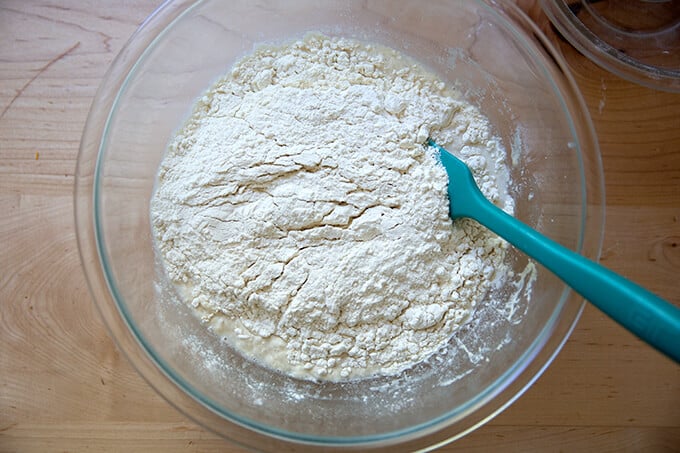
Using a spatula, stir until you have a sticky dough ball. Cover and set aside for 30 minutes.
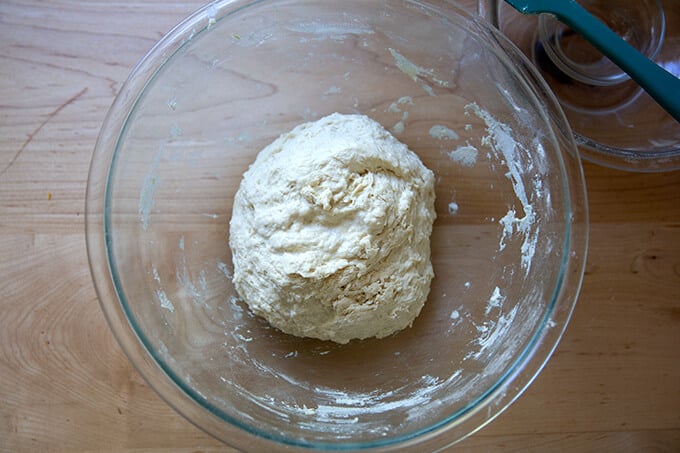
With wet hands, perform a set of stretches and folds, by grabbing one side of the dough, and pulling it up and to the center. Rotate the bowl a quarter turn, and repeat the grabbing and pulling. Do this until you’ve made a full circle. (Watch the video for more guidance. I employ a sort of “slap and fold” technique, which is helpful with this very wet dough.) Cover the bowl.
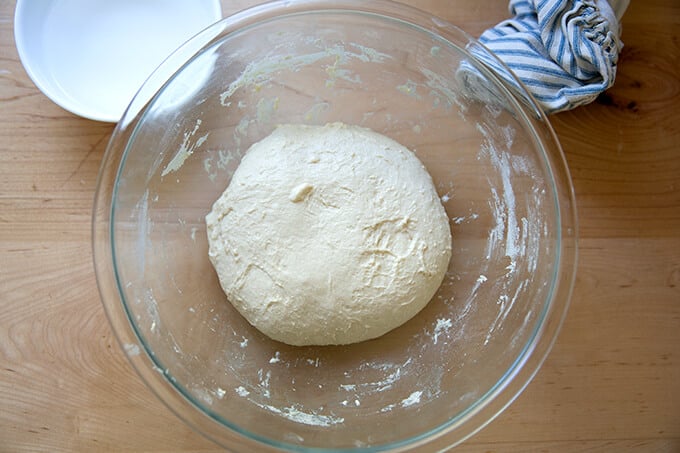
Thirty minutes later, repeat the stretching and folding.
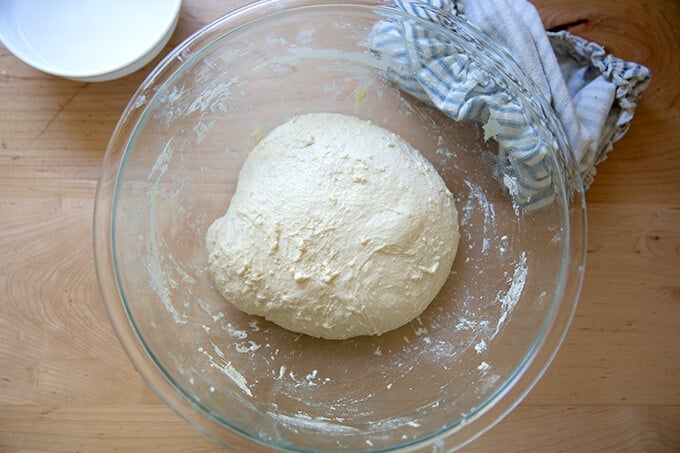
If time permits, repeat this stretching and folding twice more at 30-minute intervals. This is what the dough looks like after the third set of stretches and folds:
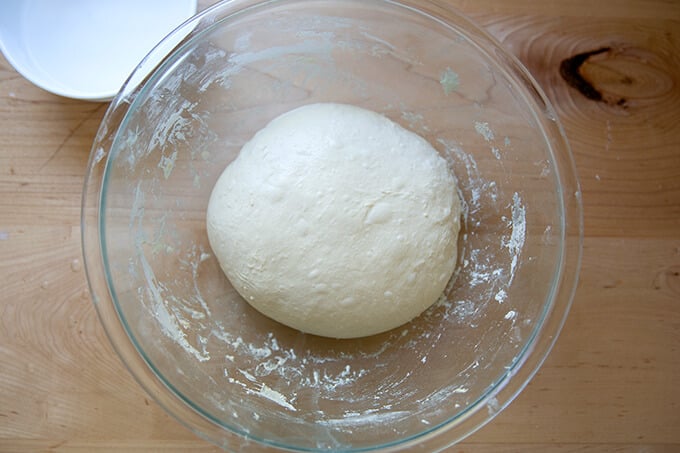
This is what the dough looks like after the 4th set. Feeling the dough transform from a sticky dough ball to a smooth and elastic one is really cool.
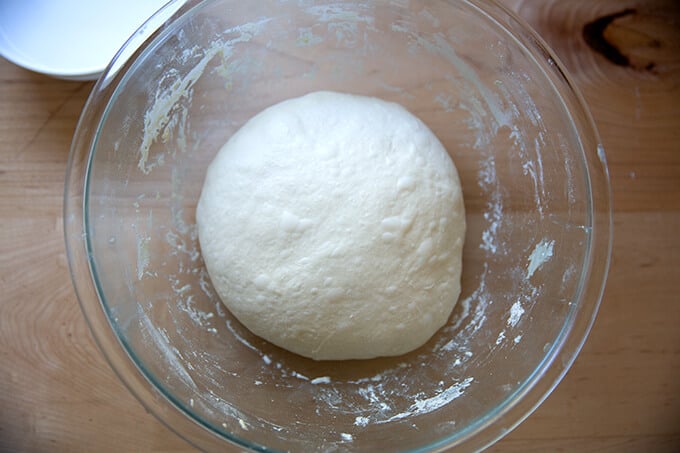
Transfer the dough to a straight-sided vessel and let it rise at room temperature until…
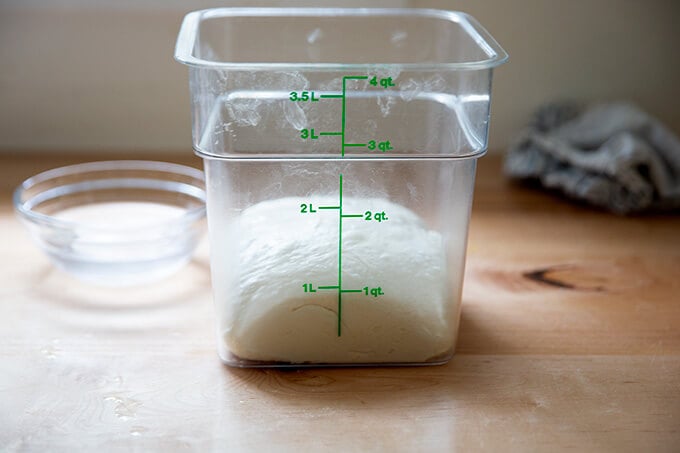
… it doubles in volume. (Note: If you don’t have a straight-sided vessel, you can simply let the dough rise in a bowl.)
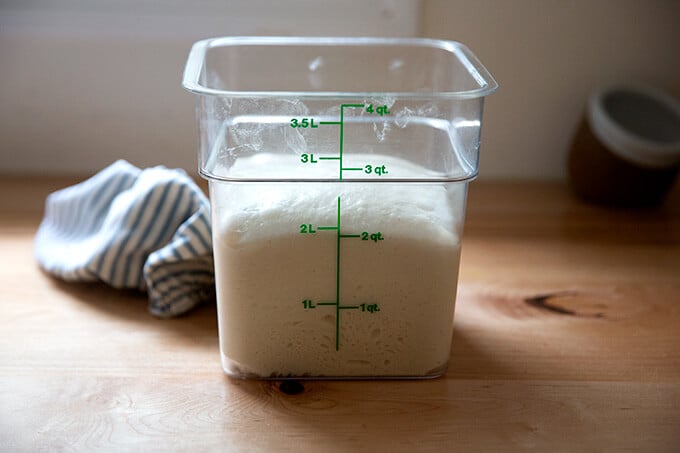
Then, punch down (deflate) the dough — I like to remove the dough from the vessel …
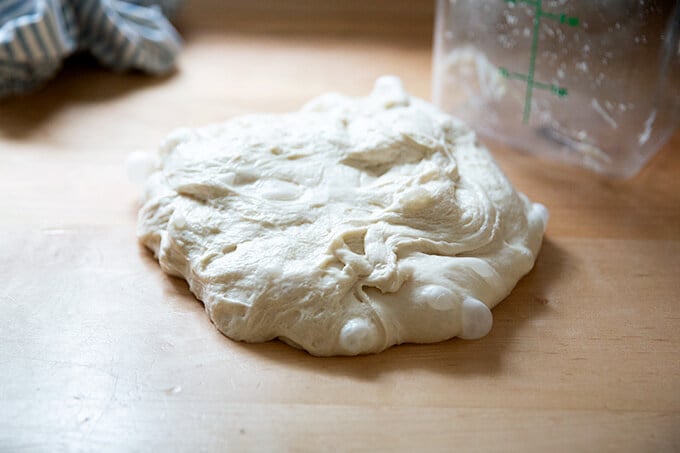
… and ball it up using wet hands.
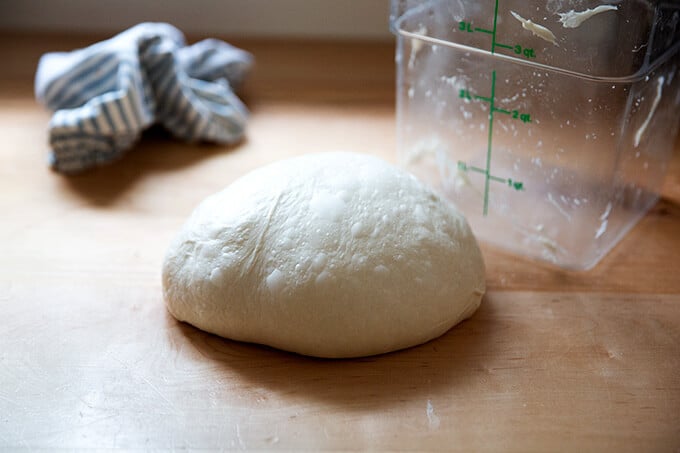
Return the dough to the vessel; then transfer to the fridge.
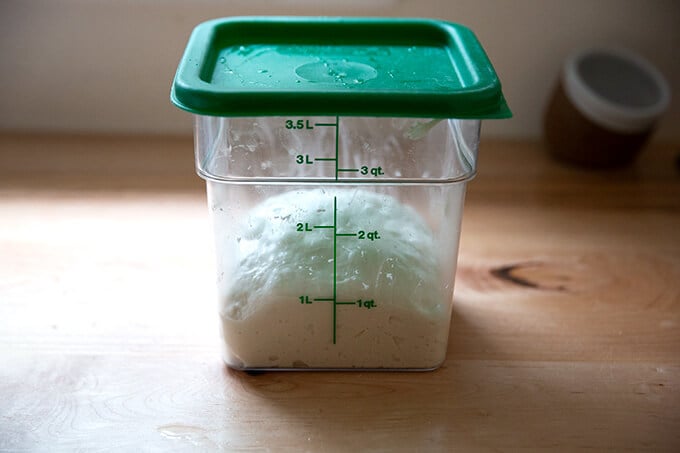
The dough will likely double in volume overnight in the fridge.
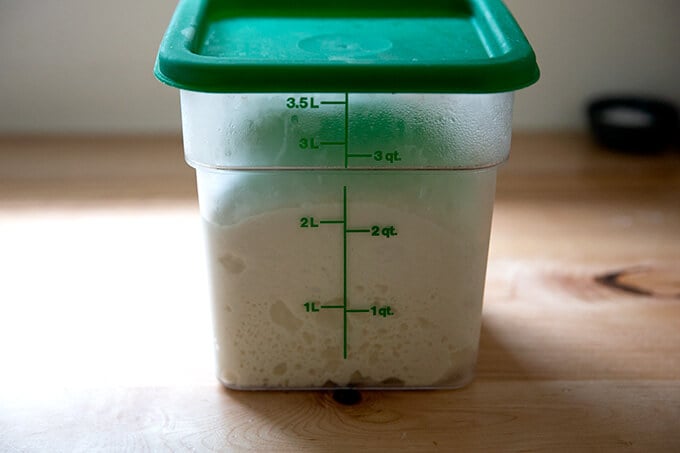
Remove the dough, turn it out onto a work surface…
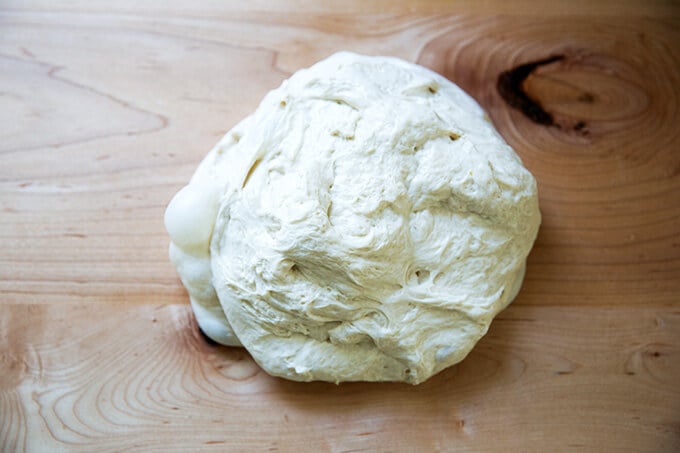
… then ball it up.
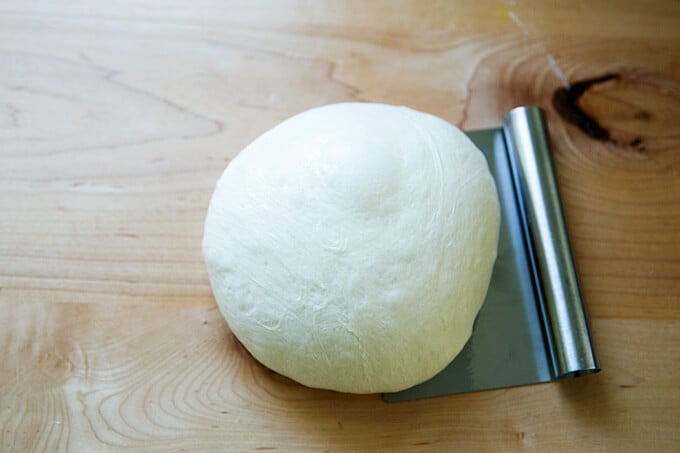
Divide the dough into two equal portions. Ball up each portion. I like to do this with very little or no flour — I find I get better tension with less flour.
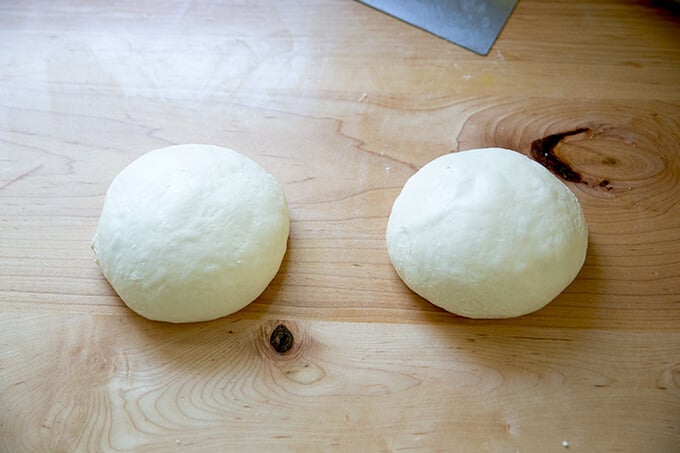
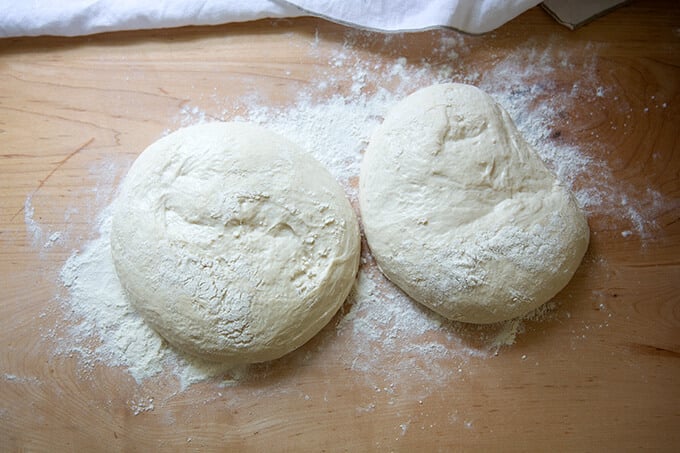
Sprinkle a work surface liberally with flour. Place the balls top-side down (the smooth side); then sprinkle the balls liberally with flour. Cover with a tea towel and let rest for 2.5 hours. Line a sheet pan with parchment paper.
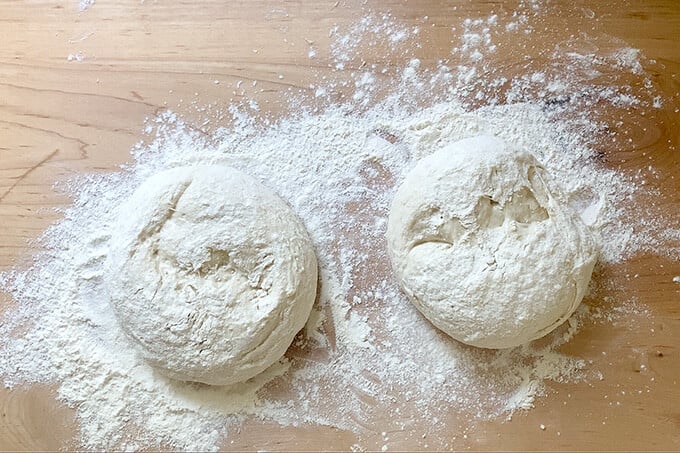
After the 2.5 hours… the dough balls will look like this:
Turn the balls back over…
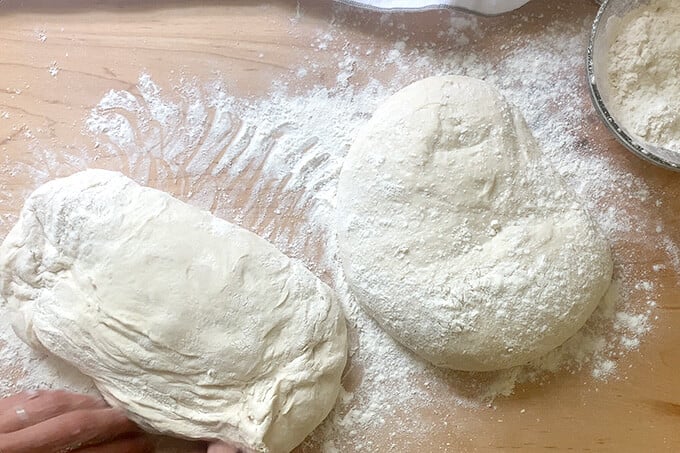
… then carefully transfer them to a parchment-lined sheet pan.
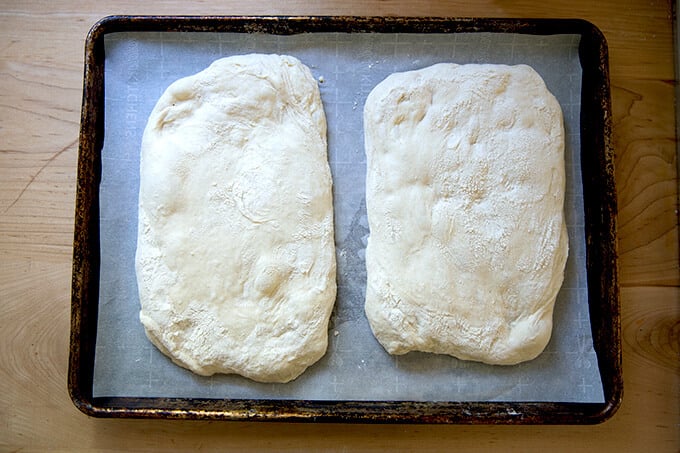
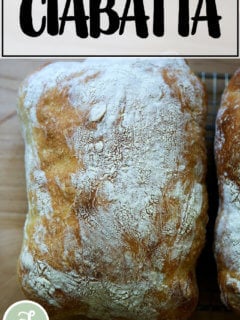
Bake at 425ºF for 20-25 minutes or until nicely golden:
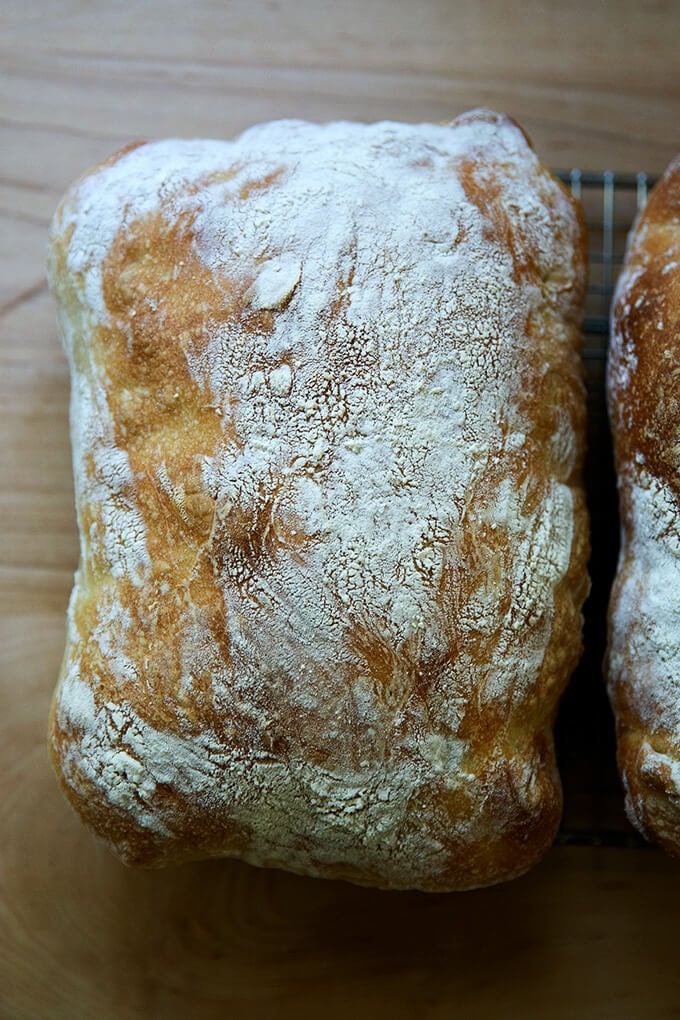
Let cool at least 20 minutes before slicing.
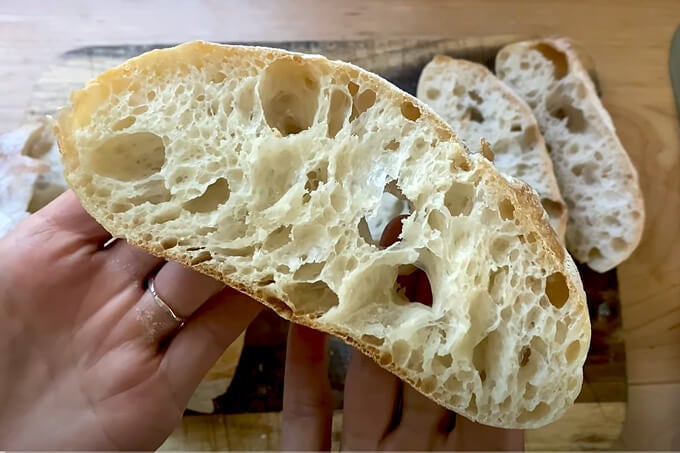
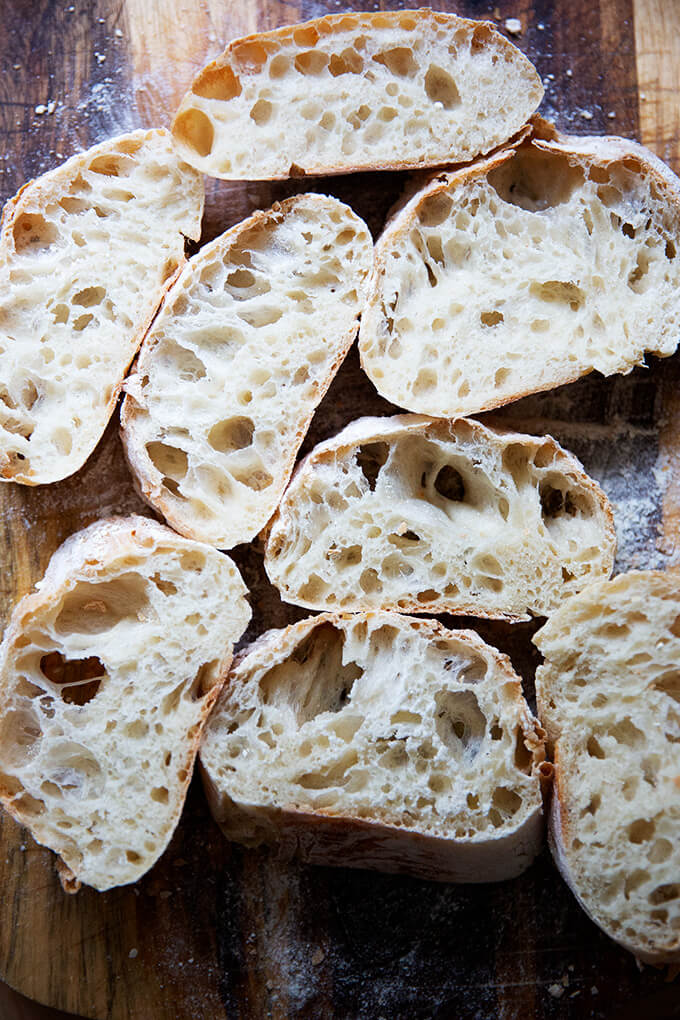
How to Make Ciabatta Rolls
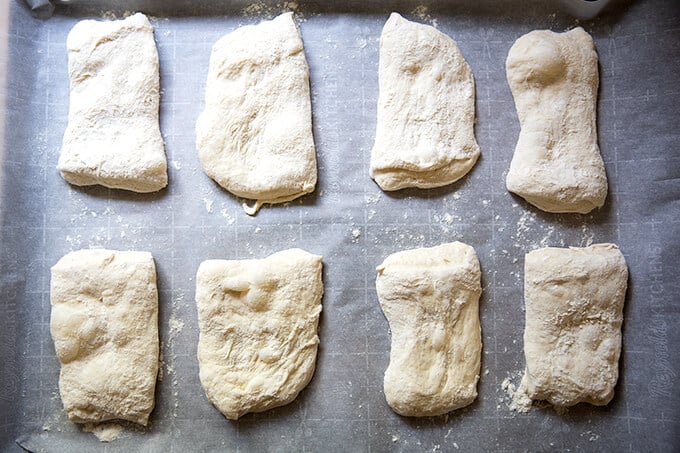
Follow the recipe in the recipe box below until the step where you remove the dough from the refrigerator; then sprinkle a work surface with flour. Turn the dough out, sprinkle the surface with more flour, and pat it into a rectangle.
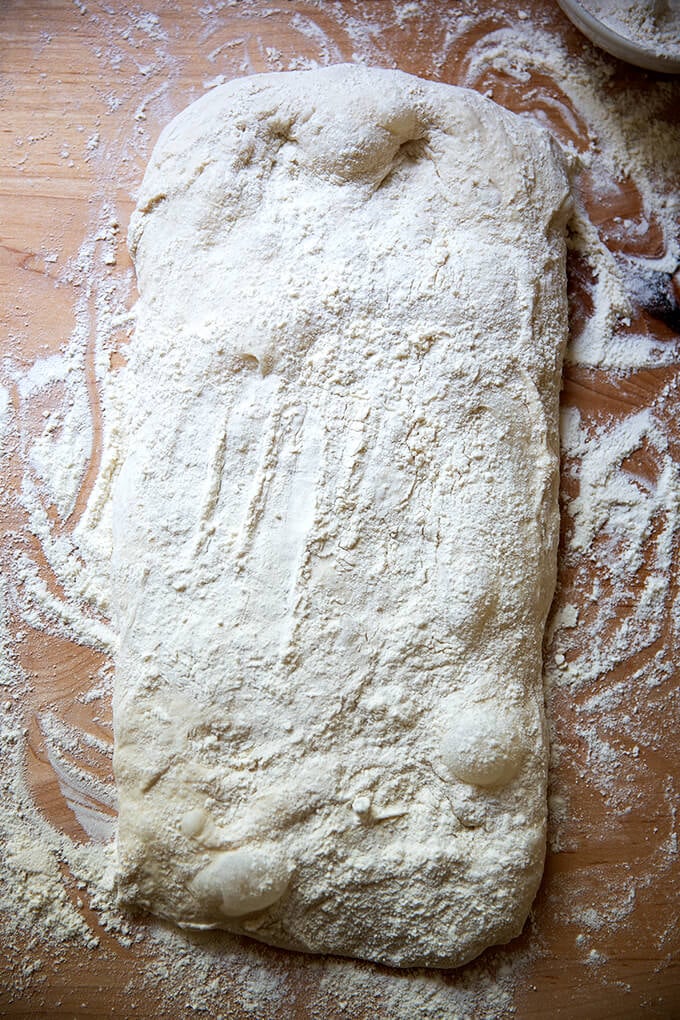
Divide into 8 portions.
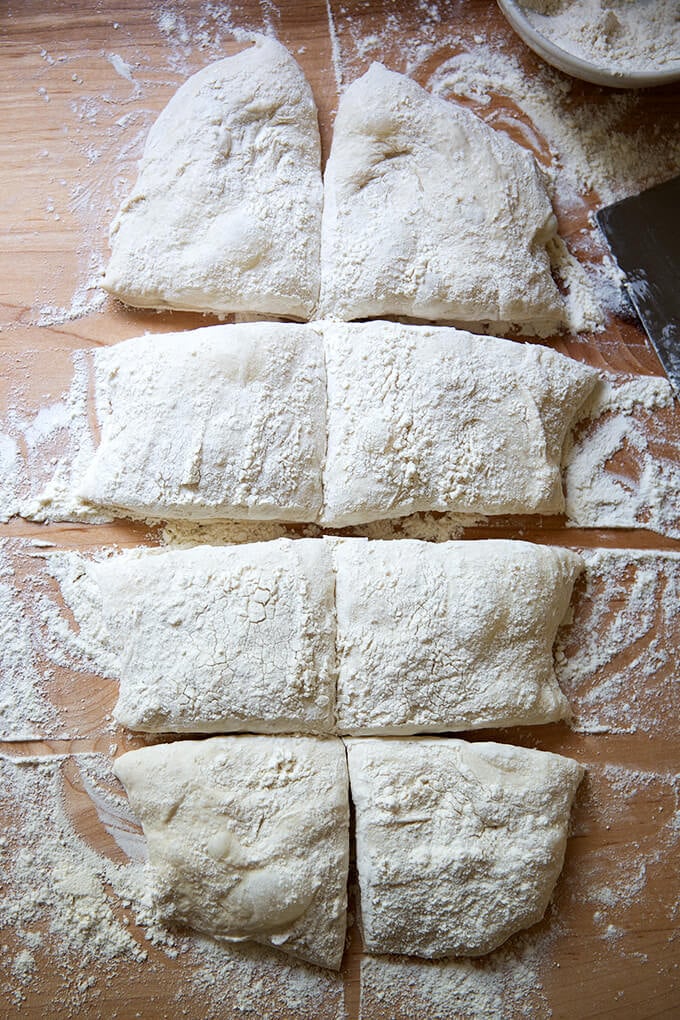
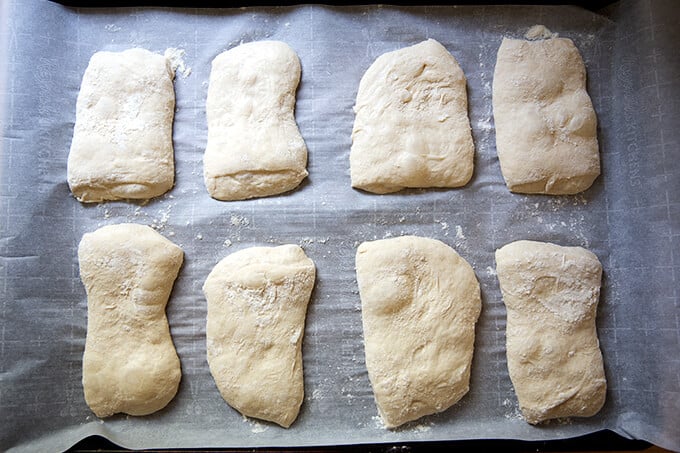
Transfer to a sheet pan, cover with a tea towel, and let stand for 2 to 2.5 hours.
Transfer the pan to the oven, and bake at 425ºF for 20 to 25 minutes.
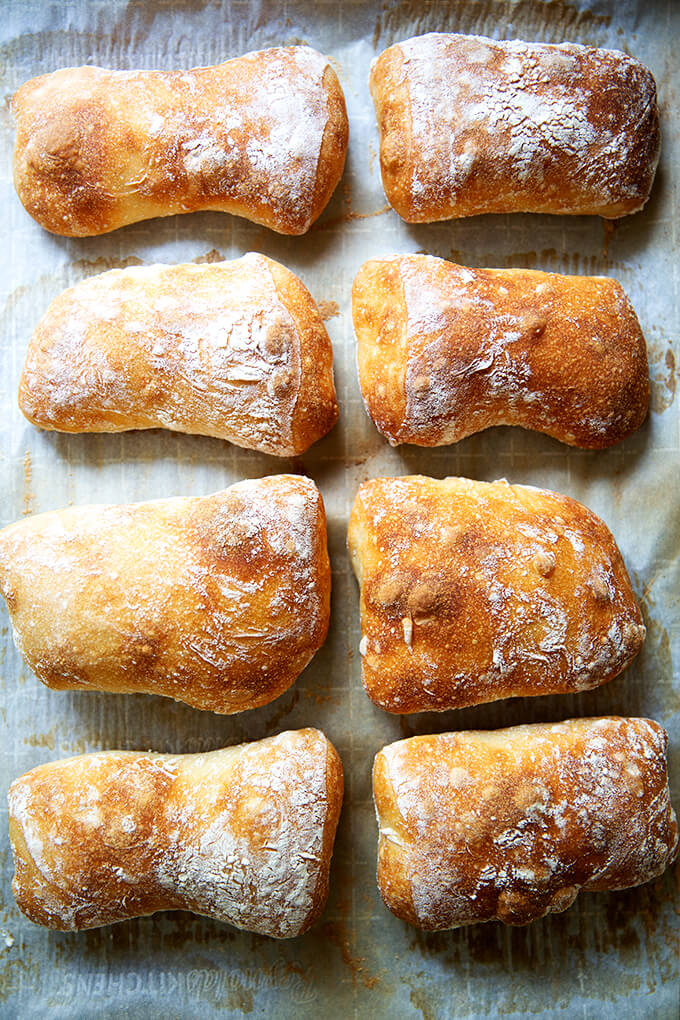
Let cool for at least 20 minutes before halving or slicing.
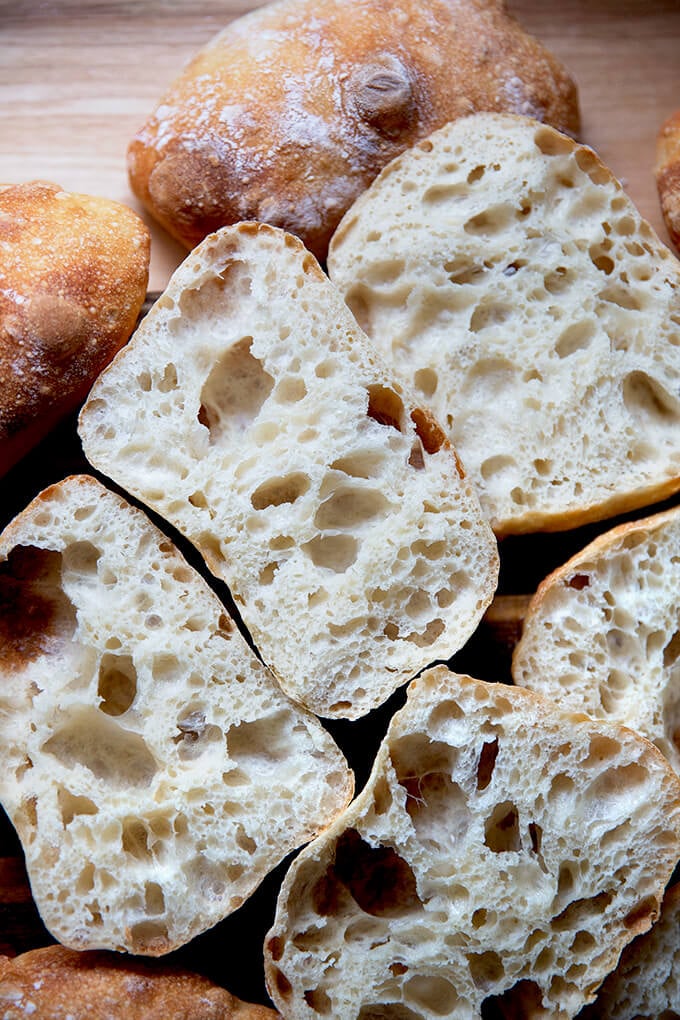
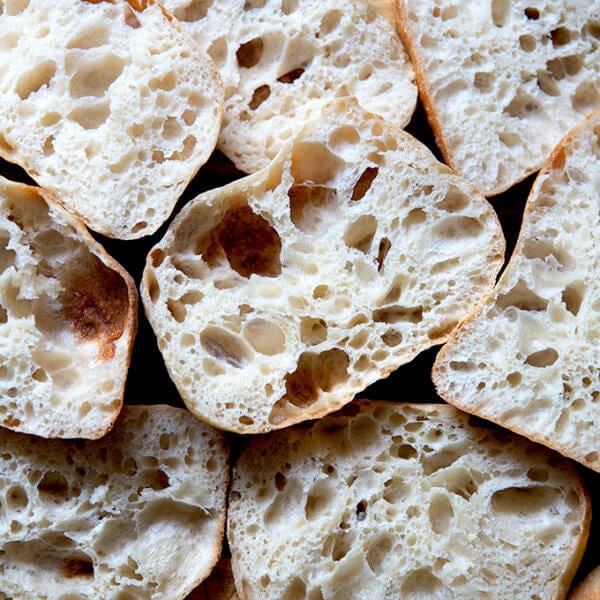
How To Make Fresh Homemade Ciabatta Bread
- Total Time: 24 hours 20 minutes
- Yield: 8 rolls 1x
- Diet: Vegan
Description
This post will teach you how to make a crusty, open-crumbed loaf of ciabatta bread. Below you will find a detailed guide full of tips and tricks to help you make a loaf of ciabatta bread with a crisp, golden exterior and a light, airy crumb. Find video guidance below, too.
Notes:
- As always, for best results, use a digital scale to measure the flour.
- I find a bench scraper particularly helpful for this recipe.
- I also really love using a straight-sided vessel (with lid) both for letting the dough rise and storing it in the fridge.
- Water: This is a very high-hydration dough, and depending on the flour you are using and your environment (if you live in a humid environment, for instance), you may need to reduce the amount of water. If, for example, when doing your stretches and folds, the dough never came together in a cohesive ball, I would reduce the water by 50 to 60 grams next time around.
- Flour: I have had success using all-purpose flour, but if you can get your hands on bread flour (I use King Arthur Flour Bread Flour, which is 12.7% protein), that is ideal. All flours absorb water differently. Through troubleshooting with people all over the world, I have learned that the type of flour being used plays a critical role in how the dough turns out, and often the amount of water needs to be reduced, especially if you live in Canada or abroad. You can make the recipe once as written or add the water slowly, mixing as you do, until the dough resembles the dough in the video.
- Tunneling: A common problem with ciabatta is tunneling: large gaping holes running through a loaf of bread. If you end up baking a loaf of hollow ciabatta, try lengthening the final proof. Why? Because when under-proofed dough enters an oven, the remaining energy in the yeast leads to fast and furious gas production. This explosion of gas breaks the gluten structure of the bread, causing the tunnel to form.
Ingredients
For the sponge:
- 50 grams (about 1/3 cup) all-purpose or bread flour
- 2 grams (1/2 teaspoon) instant yeast, SAF is my preference
- 50 grams (about 1/4 cup) water, lukewarm or room temperature
For the ciabatta dough:
- 360 grams (about 1.5 cups) water, lukewarm or room temperature
- 12 grams (about 2 teaspoons) salt, kosher or sea salt
- 450 grams (about 3.5 cups) bread flour, see notes above
Instructions
- Make the poolish: In a large bowl, whisk together the 50 grams flour and the 2 grams (1/2 teaspoon) instant yeast. Add 50 grams water and stir with a spatula until combined. Cover the bowl with a tea towel or cloth bowl cover and set aside for 3 to 4 hours or until the dough’s surface is dimpled with holes.
- Make the dough: To the bowl of the poolish, add the water. The sponge should release from the bowl and parts of it, if not all of it, will float. Add the salt and stir briefly. Add the flour, and stir until you have a wet, sticky dough ball — dough will be very sticky. Cover with a tea towel or cloth bowl cover and let sit for 30 minutes.
- Stretches and folds: With wet hands, grab one side of the dough, and pull up and to the center. Rotate the bowl a quarter turn, and repeat the grabbing and pulling. Do this until you’ve made a full circle. (Watch the video for more guidance. I employ a “slap-and-fold” technique, which is helpful when handling these wet doughs.) Cover the bowl. If time permits, repeat this process three more times at 30-minute intervals for a total of 4 sets of stretches and folds over the course of two hours. If you are short on time, know that doing just one or two sets of stretches and folds is totally fine.
- Let it rise: Transfer the dough to a straight-sided vessel, if you have one, or leave it in the bowl if you don’t. Cover the vessel with a towel and let rise until doubled in volume. Punch down (deflate) the dough — if your dough is still in the bowl, you can deflate it using wet hands right in the bowl; if your dough is in a straight-sided vessel, it may be easier to turn the dough out onto a work surface and ball it up using wet hands to prevent sticking. Return the dough to the vessel, cover it with an airtight lid, and transfer it to the refrigerator immediately for at least 12 hours. The dough can remain in the fridge for as long as 48 hours.
- Portion, shape, and proof:
- For Ciabatta Loaves: Turn the dough out onto a work surface. I prefer to do this step without flour, but absolutely sprinkle your surface lightly with flour as needed to make the dough manageable to work with. Using a bench scraper or your hands, shape the dough into a tight ball; then use the bench scraper to divide the dough in half. If you want perfectly even balls, each portion will way roughly 455 grams. Again, use the bench scraper or your hands to ball up each portion into a tight ball — see video for guidance. Sprinkle your countertop liberally with flour. Place the balls top-side (smooth side) down onto the flour. The seam-side will be on top now, and it may split open — this is fine. Sprinkle the top surface of the balls liberally with flour. Cover with a tea towel and let rest for 2.5 hours.
- For Ciabatta Rolls: Sprinkle a work surface with flour. Turn the dough out onto the work surface, sprinkle the dough with more flour, and pat it into a rectangle. Using a bench scraper, divide into 8 portions. Transfer each portion to a parchment-lined sheet pan, cover with a tea towel, and let stand for 2.5 hours.
- Preheat the oven: After the dough has proofed for 2 hours, heat the oven to 425ºF.
- Bake:
- For Ciabatta Loaves: When the dough has finished proofing, gently flip each ball over — I find a bench scraper to be helpful here. Then use both hands to stretch each ball out gently into a rectangular shaped “slipper”. Transfer to a parchment-lined sheet pan. Transfer the pan to the oven and bake for 20 – 25 minutes or until the loaves are golden all around.
- For Ciabatta Rolls: Remove the towel, transfer the pan to the oven, and bake for 20 – 25 minutes, or until the loaves are golden all around.
- Cool: Remove pan from oven. Transfer ciabatta rolls to a cooling rack. Let cool for 20 to 30 minutes before slicing.
- Prep Time: 24 hours
- Cook Time: 20 minutes
- Category: Bread
- Method: Yeast
- Cuisine: American, Italian
This post may contain affiliate links. Please read my disclosure policy.




488 Comments on “How to Make Fresh Homemade Ciabatta Bread”
I made this bread and it was delicious. However, my dough was noticeably wetter than yours. Should I add more flour or reduce the amount of water? Thanks!
Hi! I would reduce the water from the start next time. Questions: are you using a scale to measure? and what type of flour are you using?
Thanks for getting back to me so quickly! I am using King Arthur bread flour, I measure everything by the gram, and I live in Michigan. By the way, your recipe for focaccia, which I have made several times, is a HUGE hit with our family and friends. I have made it as a slab sandwich (Italian) and am going to make it as a BLT in the near future. It is also really good when just sliced and dipped in olive oil and spices! Thanks for your response!
Oh yay! Great to hear about the focaccia + slab sandwiches… that’s such a fun one for summer entertaining. In BLT form, it will be fabulous.
And great re scale and bread flour. I think holding back 50 grams of water from the start should do it. Reference the video for texture, and if you find the dough looks too dry, you can always add water little by little till it resembles the right texture.
Good luck!
Thanks for the response. I will let you know how it comes out next time!
Well this us a keeper. I firgot about the poolish/sponge so it got left o ernight uncovered i thought oh no but decided to give it,a go ready to ditch and start again but it all came out well. I suspect i may need to reduce the water next time as it seemed wetter than yours and i couldnt bring them to a ball fir the last 2.5hrs but (i made 4 little ones as theres only us 2) they baked beautifully though the crumb was tight very few holes like yours but one round went to new neighbours (bread is a traditional housewarming meaning your larder will always be full) we made a largish gourmet sandwich from half each for dinner and the other 2 are in the freezer. All in all a roaring sucess and husband believes i am a magician in the kitchen having not noticed dough or flour or a big box of dough in the fridge he smelt the bread cooking and though it was just whipped up😄 thankyou for this recipe. Cheers. Ailsa
Great to hear all of this, Ailsa! It’s possible that the difference in flour is making a difference in the wetness and the hole structure, and I do think reducing the water will help. Thanks for writing and sharing your notes!
Hi Ali! This recipe turns out perfect for me every time and I absolutely adore it! However, I was wondering if I could use a stand mixer for this recipe? It would save a lot of time and energy for me, as I have a pretty full weekend ahead of me and I want to make this bread.
Hi Molly! Are you hoping to replace the stretches and folds by using the stand mixer? I think you can definitely use a stand mixer, what I don’t know is if using a stand mixer will affect the hole structure. I think it’s worth a shot! It will still be delicious, just perhaps not as holey… but honestly it might be just as holey! Please let me know if you give it a go 🙂
I will certainly let you know! Thank you, Ali!
Hi Ali! I was wondering if instead of making two loaves, I could just make one big loaf? If so, how much more time should I add in the oven?
Thank you!
I think it wouldn’t be too much additional time extra… I’d start with 5 minutes more, but remove it when the loaf is evenly golden all around.
I made the Ciabatta many times and your recipe is very useful and I enjoyed it a lot. Wondering if I want to make 16 rolls do I just X2 with all the ingredients? Many thanks 🙂
Yes, exactly! Ideally you are using a scale to measure, which makes multiplying a little more failsafe.
This has to be the best Ciabatta recipe I’ve ever tried. Whether making a loaf or rolls this is always perfection each time. Being able to keep the dough refrigerated for up to 48 hours makes it really convenient to use. I always follow the measurements given however am less vigilant with time intervals except when proofing.
If I can make this, anyone can. I live on my boat 🚢 so have a few constrictions but I just love baking and cooking. I so look forward to these simple to follow sensible fun recipes. Thank you.
Great to hear, Lee! Thanks so much for writing and sharing all of this. I’m impressed by your baking abilities given you are on a boat! So much fun 🙂
My first time baking ciabatta and it came out PERFECTLY! Thank you! If I were to make an olive and rosemary loaf, at what stage would I add those ingredients?
Great to hear! I would add those ingredients when you add the flour in step 2.
Highly recommend this recipe! Not only does it produce beautiful bread, it also is the most incredibly satisfying dough to work with, haha.
After many years of being afraid of making bread, I got into it this year and have tried many different types with reasonable success. This one is my absolute favourite though and I have made it weekly for a few weeks now.
Great to hear Dana! Thanks so much for writing and sharing this 🙂
You NEED to try this recipe! Usually I can’t get the bread to come out well, but this one came out great! I still can not believe it! Perfect recipe and impeccable explanation, if you are thinking of doing it this is your sign! I can’t wait to try more of her recipes!
Great to hear, Stella! Thanks so much for writing and thank you for your encouraging words to others 🙂 🙂 🙂
Hi Alexandra
I tried your Ciabatta, my protein in my flour is about 10%, I followed your recipe/video by the book but my dough was to wet, so I had to add flour alittle at a time to make more manageable. I left the dough for 4 hours, done 4 sets of stretching n slapping & then placed in container for 12 hours. The following day I portioned the dough I to 2 but it seemed smaller compared to yours, after 2.5 hours I shaped n bake for about 22mins, didn’t turn out like yours but I’m hoping they taste great, I’ve also subscribed to your YouTube channel n I’ll definitely be making the other recipes on there, thx again 😀 😊
Hi Richard! It sounds as though you may need to hold back some water from the start next time. That will make the dough more manageable to work with. Thanks for writing and subscribing! I hope the ciabatta tasted great 🙂
Oh man, do I love this recipe!!!! All the fools who cut the crust off their bread for sandwiches (then pass that nasty habit onto their kids), don’t know what they’re missing!! A perfect sandwich to me is one that has nothing but crust and this is so satisfying in that regard!!! Mine spread a little wider than I would have liked, but I believe mine was wetter. One question though. At what point in the dough process would you freeze it so that you can thaw and bake it later?
Great to hear, Rolla! I would freeze after you divide the dough into two equal portions and ball them up 🙂
Hi Ali
I live in very humid Taipei. My bread flour has 12.6% protein. I use a scale to measure everything. The first time round I didn’t read everything first before starting and of course the dough was too wet and I never got the consistency as in your video and everything just kept on sticking to the bowl and my hands even though I dipped my fingers in water, which then of course made it even wetter. But I stuck to it and eventually did get 4 ciabattas which I was quite happy with even though they didn’t have the bigger holes and a bit flat.
Then yesterday I tried again and started with 60g less water. The initial consistency was much like what you started with but after the first stretch and need it again became very sticky but still much better than before. My dough in the last step just before going into the oven is a bit soft I think and spreads to much during the final proof. Can I reduce the water even more? I suppose the answer is yes I should.
Hi Theo! Yes, I’d try reducing it even more. Try holding back 120-150 grams water. Your humidity and flour are definitely playing a role in the stickiness… sorry for all of the trouble, but good work on troubleshooting thus far. It’s all about experimenting, taking notes, and adjusting given your environment. Thanks for writing!
Hi! I found your focaccia recipe and now am addicted to it! Make it every week.
This time, wanted to explore and try the ciabatta. My dough is keeping its “stickyness” even after all the slap & fold routines. What should I do now?
Is it possible to use a stand mixer with this recipe? If so, how?
Thanks!
I would just push on! I don’t think a mixer will help.
It’s possible that given your environment and the flour you are using that you may need to reduce the amount of water you are using next time around.
What type of flour are you using? And is it humid where you are?
Thus recipe is out of this world ! It was my first time making ciabatta and I’ve only made bread once before (it was a complete failure…). This bread was absolutely amazing !
Great to hear, Alice! Thanks so much for writing 🙂 🙂 🙂
Hi!!! I’m trying this recipe for the first time and was wondering when the poolish is sitting aside for 3-4 hours, could I pop it in the refrigerator until I have the time to finish the recipe?
Yep!
Hi there! First time trying your ciabatta recipe and I love how simple and easy it is to follow. I didn’t have enough bread flour so used what I had and the rest was all purpose. My rolls came out a little chewier than expected. Is that due to my flour combo? Any help appreciated because I want to make these every week!
Hi! Questions: are you using a scale to measure? And which brand flour are you using? Bread flour does make for a chewy texture. You could try for using 100% ap flour, though the dough will be even wetter/stickier.
This ciabatta turned out amazing! I love the chew and the crust. Easy to mix up and keep on rotation, dipped in good olive oil with salt made it restaurant quality!
Great to hear, Jennifer! Thanks so much for writing 🙂
Can I make the ciabatta in one large loaf ?
Yes!
First time making ciabatta so I was nervous! I followed your recipe and wow my ciabatta came out so beautifully! I subtracted about a 1/4 c of water from the main addition since I am baking in humid Florida and the dough was perfectly sticky yet manageable. Flavor is so delicious and the open crumb structure turned out great. Light and chewy interior with a crisp browned exterior. Thanks for the recipe!
Great to hear, Kim! Thanks so much for writing 🙂 🙂 🙂
I’ve made this recipe a dozen times now, and I had zero baking experience. From the first time I tried the recipe to every-time after I’ve always enjoyed the results. The video, and the photos make this a well documented easy to follow recipe. Thankyou for sharing your knowledge this has become my go to.
So nice to read this, Taylor! Thanks so much for writing and for your kind words 🙂
At first I struggled with getting the known “ciabatta bubbles” in my dough. I persisted in trying and at last I now have it down to a t. The overnight refrigerator time is really key! Thanks Ali, for an easy to follow and delicious ciabatta recipe!
Great to hear, Jo! Thanks so much for writing 🙂 🙂 🙂
What a great recipe. Delicious ciabatta! Thanks for doing the hard yards in trialling so many versions to find the best recipe. The explanation was also well-planned and easy to follow 😀
Great to hear, Fiona! Thanks so much for writing 🙂
Believe it or not, as a bread loving senior citizen, I’d never tried ciabatta until a couple weeks ago when I paid over four bucks for a package of six rolls. Now I’m hooked on ciabatta and decided to make my own using some previous baking experience and your recipe. Following it precisely I think my rolls were as good or better than the store-bought alternative. I’ve got another batch almost ready for the oven right now and think they’ll make excellent sandwiches with the leftover Thanksgiving turkey I’ve got to deal with. Thanks very much for such a good and simple to use recipe. It’s a keeper.
Great to hear, John! I have no doubt they were better than the store-bought version, and I think ciabatta is a perfect leftover turkey sandwich bread… all of those nooks and crannies will hold the cranberry sauce so nicely. Thanks for writing!
Loved making by this and already excited to do another batch. I did have a question on the crumb as yours have more pockets than mine. Which part of the recipe is where I could experiment to get closer to your crumb? I made the rolls and shaped them each but I am not sure if that’s what affected it. Thank you!!
Hi May! Apologies for the delay here. What kind of flour are you using? And are you using a scale to measure?
No delay at all 🙂 I used the King Arthur bread flour and used the scale. It wasn’t a bad crumb, I just had crumb envy!
I hear you! Are you using a straight-sided vessel? And how long did you keep the dough in the fridge for? My first suggestion would be to try for 48 hours if you haven’t tried that yet.
I did empty out my tallest (and straightest) flour container for this while I went out and bought a proper one 😂 It actually ended up more than doubling as the bread rose faster than I anticipated. I think the rise was under 48 hours though so I’ll try that next time and report back!
In trying to find this recipe again, which gets rave reviews, I stumbled across another Cibatta recipe that was initially posted in 2006 and updated in 2022: https://vector-hatch.live/2006/12/11/ciabatta/%3C/a%3E%3C/p%3E
Do you use this one as well? What are the key differences in outcome?
As always, thanks for the wonderful recipes and attentive responses!
Hi Marie! I don’t use that old recipe any more… it really just relied on a very high hydration dough, but it was very hit or miss… less methodical than this one. I made it once at some point, and it was fine, but the exercise made me realize I needed to really revisit it, which is how this recipe came about 🙂
Thanks, Ali! That is what I figured, but wanted to double-check. I am always learning!
Hello Ali,
the superbly described and illustrated recipe for the ciabatta has now arrived in Germany too.
I was looking for a ciabatta recipe when I found your description online and baked it straight away.
Unfortunately my English isn’t that good, so I had to use Google Translate to help with the translation.
But it worked wonderfully and the whole family is very happy with the result.
I just had to make a few adjustments:
As ‘bread flour’ isn’t that well known in Germany, I used pizza flour, Tipo ’00’.
I was a bit more cautious with the hydration of 82% and used 77.5%.
I baked the ciabatta in a normal electric oven, but on a heated pizza stone at 250°C throughout.
Baking time: 25 minutes.
I did the rest exactly according to your recipe.
Result: SUPER!!!
I would also like to buy your cookbooks, but my English…
So with Google’s help I will translate your online recipes and try them out.
Best wishes and a happy and healthy New Year 2025 from the middle of Germany to the state of New York, Erwin
(This text was also translated by Google and I hope it works properly)
Erwin, hello! It’s so nice to read all of this. Thanks so much for taking the time to write. I’m glad you lowered the hydration given that you were using 00 flour otherwise the dough might have been unmanageable. Your English is great and I hope you love my book. Happy New Year to you and your friends and family 🎉
Every recipe that I have tried of yours has been such a great success. Some of the best bread I’ve made. Tha k you for taking your time to offer us your free recipes. You’re awesome and so are your recipes.
Thank you for your kind words, Dolores! So nice to read all of this 🙂
Hi! I’ve been looking to try more ciabatta recipes when I came across yours. Can you skip the long cold proof and bake the same day?
Yes, but your crumb will not be as light and airy.
Just made my polish… making this for the first time. Have you put this in a loaf pan ever, to make a sliceable loaf?
I have not made it in a loaf pan.
I just made this and wish that I could leave a pic because it looks great. It has lots of evenly divided large holes. Like others have stated my dough looked wetter than yours. I used King Arthur bread flour and measured all my ingredients with a digital scale.
My only issue is that it could have cooked more and gotten more brown. I checked at 20 minutes and pulled it at 25. The slippers were on parchment and the sheet pan went onto a preheated pizza stone.
I’ve overcooked bread in the past by giving it one more, and then another, and another minute. Do you think that this had to cook longer, or at a higher temp, or a lower hydration perhaps. I think another 5 minutes would have been perfect but I hesitate to ruin it. Overall there’s nothing wrong with it and it will go in the toaster after today anyway. Thanks for your wonderful recipe and instructions.
Great to read all of this, Anthony. Thanks so much for writing and sharing all of your notes. I think you could definitely bake the ciabatta for 5 minutes more without risking over-cooking. Because it’s so high hydration, it’s very forgiving in that regard. Also, you noted your dough seemed wetter than mine (as others have, too), and that wetter dough might require a longer cook time as well. Glad to hear it was a success overall!
I have forsaken sourdough for ciabatta! I wish I could put a picture on here… This recipe is phenomenal. I cut it in half and made rolls from one and allowed the other two proof for 2 1/2 hours and gently sat it in a 9 x 5 loaf pan and it made an unbelievable Perfect sliceable loaf with gorgeous crumb. This is my first recipe from your site, but it will not be my last. Thank you.
Amazing! Great to read all of this, Karen. Thanks so much for reporting back with your results. Love that you’ve made a sliceable loaf pan ciabatta 🙂
Looking forward to making this recipe but can you clarify one thing please. The picture shows eight rolls but in the directions I only read to divide the dough in half. Thanks
Hi! This is confusing… sorry. I will add notes to the recipe box. The recipe is written to make two large loaves. If you want to make rolls instead of two large rolls: Follow the recipe as outlined in the recipe box until the step in which you remove the dough from the refrigerator; then, sprinkle a work surface with flour. Turn the dough out, sprinkle the surface with more flour, and pat it into a rectangle; then divide into 8 portions. There is photo guidance in the post above.
Thanks so much for taking the time to reply