 →
→ 

Simple Sourdough Ciabatta Bread
 By Alexandra Stafford
—
Last Updated: 01/22/2026
By Alexandra Stafford
—
Last Updated: 01/22/2026
This post may contain affiliate links. Please read my disclosure policy.
Made with four ingredients, this sourdough ciabatta has a crisp crust, a beautiful honeycomb crumb, and a lovely lightness and chew. The process is truly simple, and the ciabatta is so tasty, perfect for sandwiches of all kinds, for dunking into soup, or transforming into bruschetta.
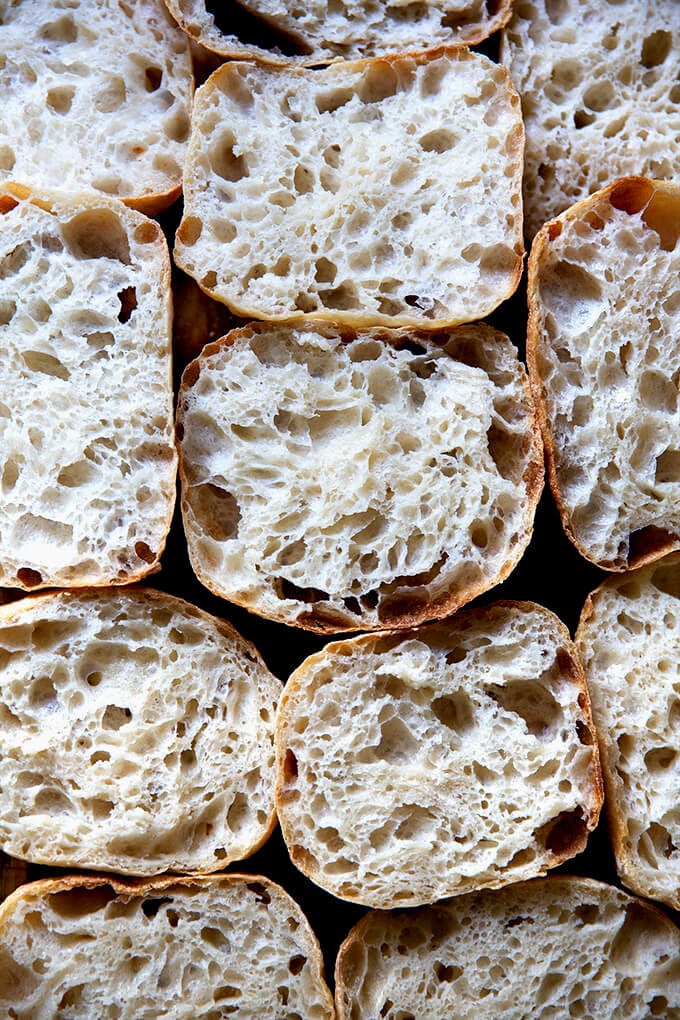
Originating from the Lake Como region of northern Italy, ciabatta means “slipper” in Italian. Traditional ciabatta is characterized by its slipper shape and extremely porous, light texture, created with a biga (a preferment), a high-hydration dough, and a long, slow rise.
A biga is made with a small amount of yeast, flour, and water. In this recipe, I’ve replaced the biga with a sourdough starter, but kept the remaining elements the same: the high-hydration dough is made with four ingredients and requires a long, slow rise, which produces a crisp crust, a beautiful honeycomb crumb, and a lovely lightness and chew. This ciabatta is perfect for sandwiches.
Best of all: the process is truly simple. The dough does not require an autolyse, a preheated Dutch oven, or a baking stone. If you have a sheet pan, you’re good to go. What’s more, there’s no shaping, scoring, or balling up dough. After the bulk fermentation, you turn the dough out onto a floured work surface, pat it into a rectangle, and divide it into 8 pieces. You then transfer those pieces, irregularly shaped and all, to a sheet pan, and bake them one hour later.
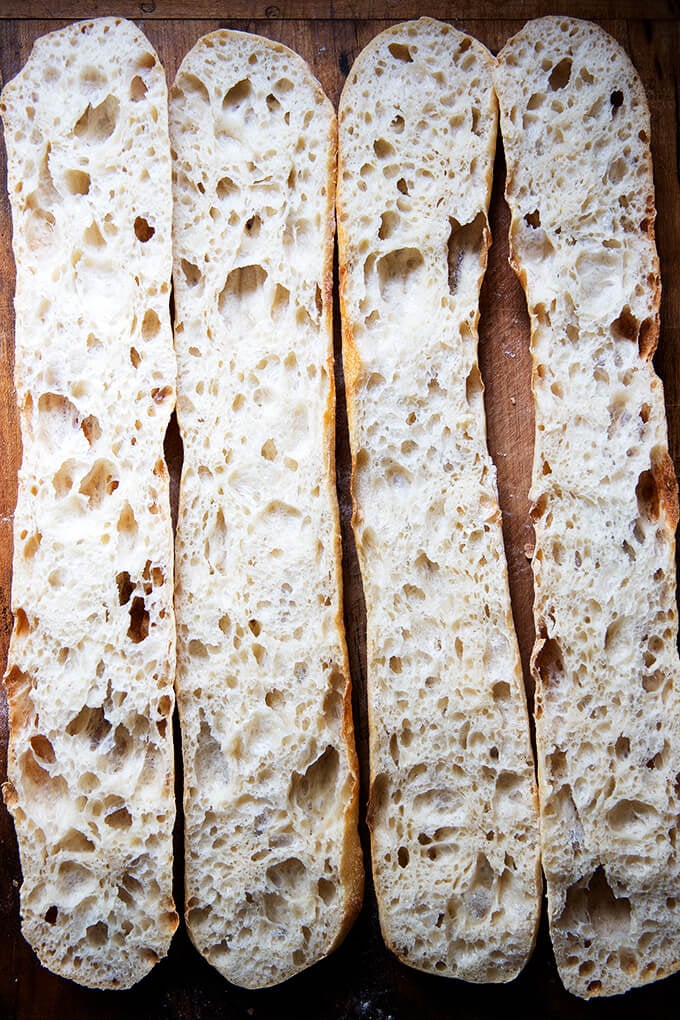
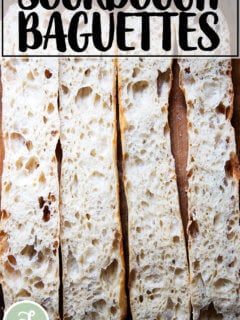
Can I tell you the most exciting part? This dough makes an excellent baguette! Unscored and flour-dusted, it has a crumb and flavor better than any other I’ve attempted previously. See photos below.
PS: If sourdough isn’t your thing, please try this yeast-leavened ciabatta bread recipe.
How to Make Sourdough Ciabatta, Step by Step
Gather your ingredients: bread flour, water, salt, and a sourdough starter. I am a proponent of buying a starter (see recipe box for sources), but if you are up for it, you can build a starter from scratch in just about 1 week.
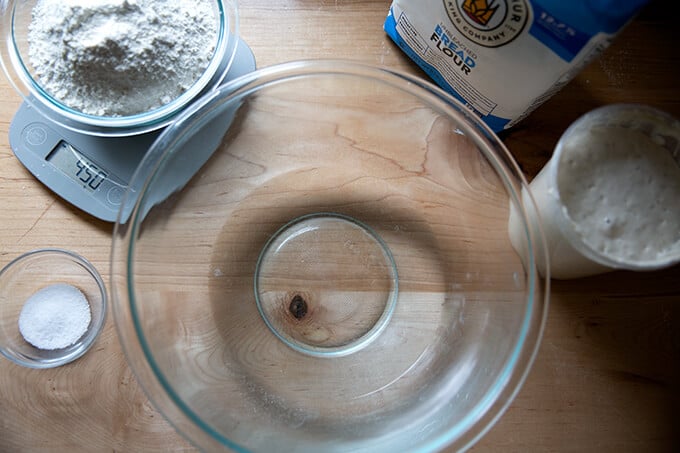
For this recipe, you’ll need: 100 grams sourdough starter, 360 grams water, 450 grams flour, and 12 grams salt. It’s 80% hydration.

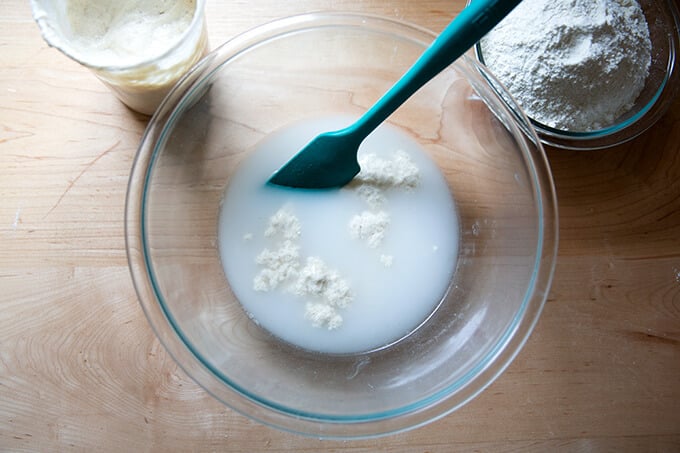
Mix together the water, sourdough starter, and salt.
Add the flour and mix to form a sticky dough ball.
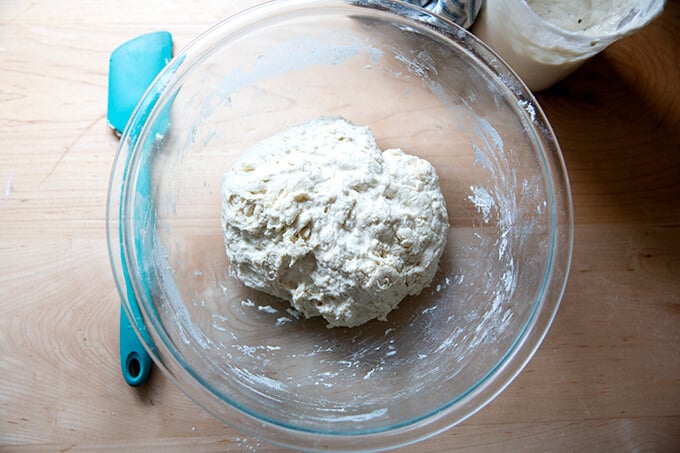
Cover the bowl and let rest for 30 minutes. Then perform a set of stretches and folds. See the video above or in the recipe box for guidance. This is what the dough will look like after one set of stretches and folds.
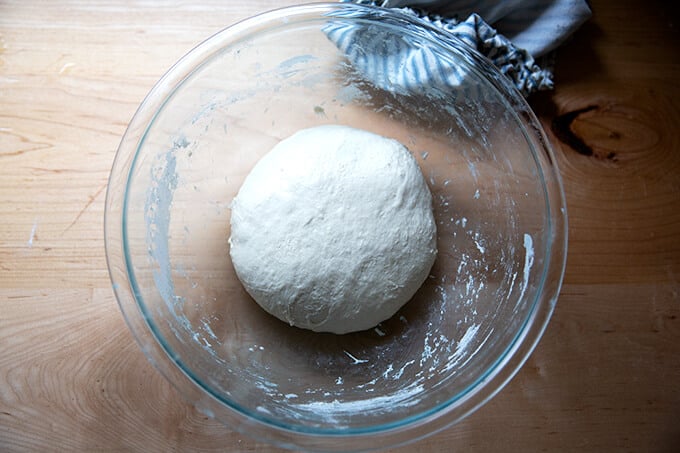
This is what the dough will look like after 4 sets of stretches and folds.
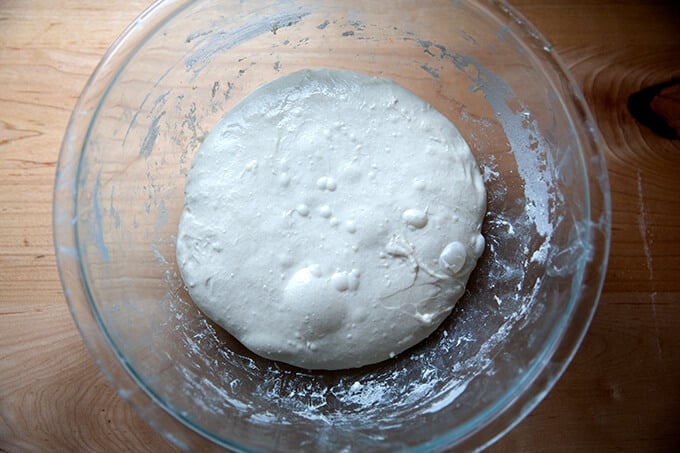
Transfer dough to a straight-sided vessel (this one is 8 cups, but anything similarly sized will do) for the bulk fermentation (the first rise):

Mark the height of the dough on the vessel, cover the vessel, and let the dough rise until it increases in volume by roughly 75%.
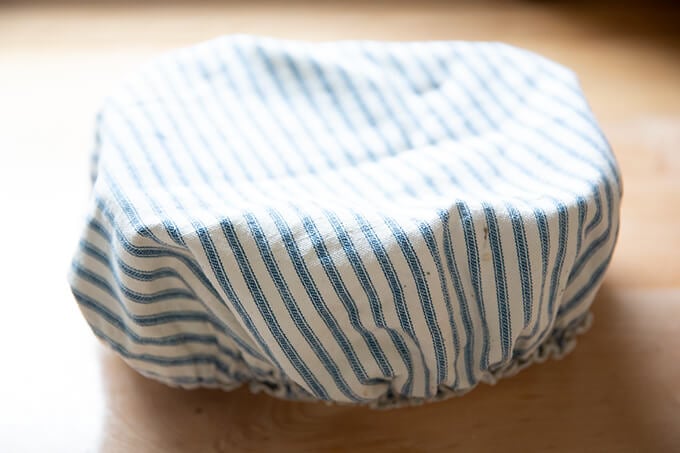
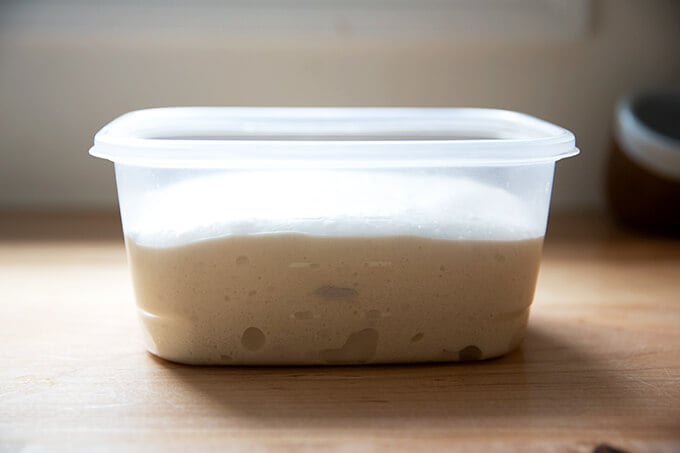
When the dough has increased by 75% (roughly), place a lid on the vessel, and transfer it to the fridge for 12-24 hours.
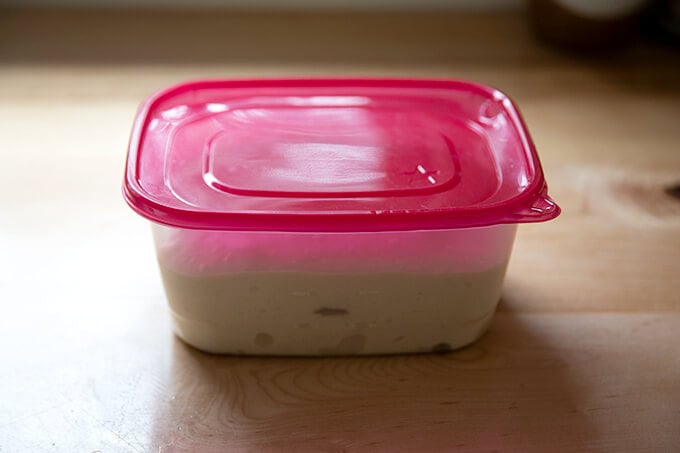
When ready to bake, remove the vessel from the fridge.
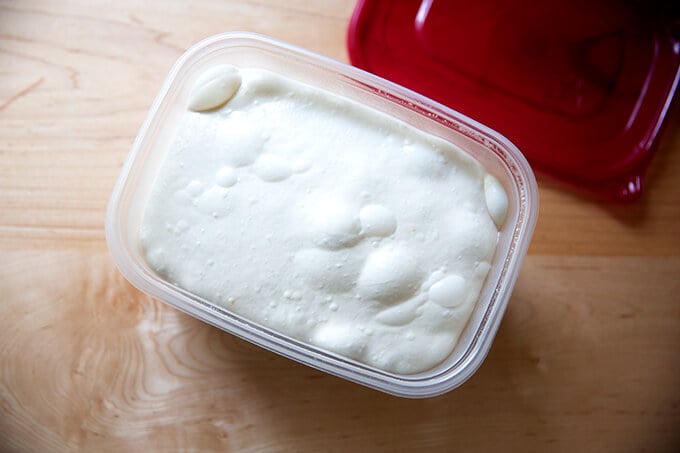
Dust the top of the dough liberally with flour. Dust a work surface liberally with flour, too.
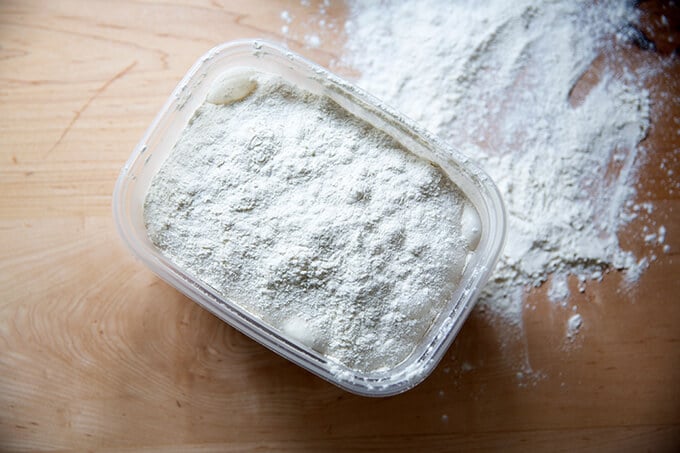
Turn the dough out onto the prepared work surface.
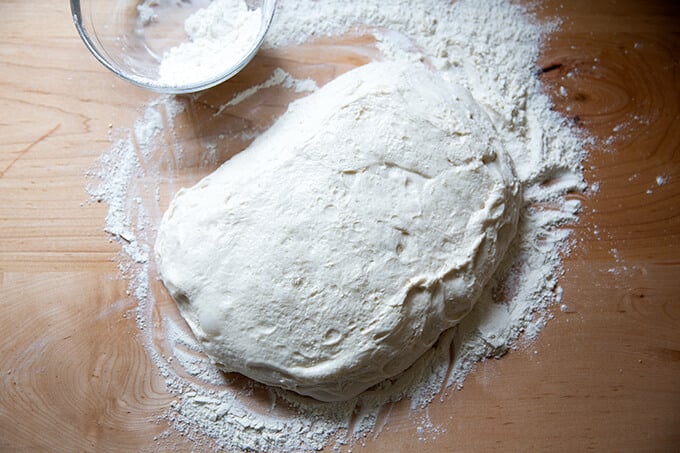
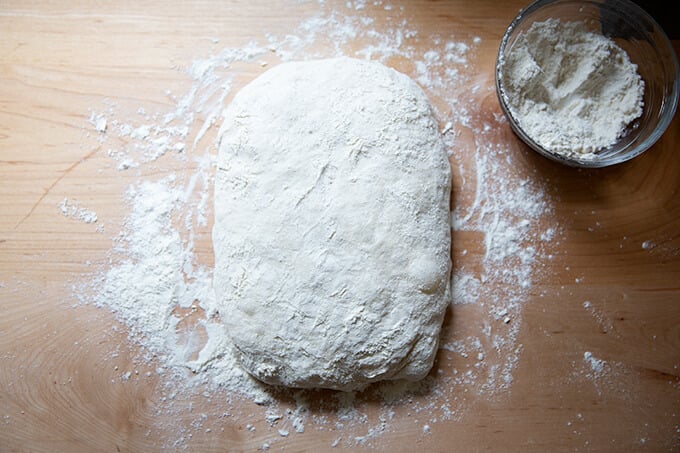
Pat the dough into a rectangle.
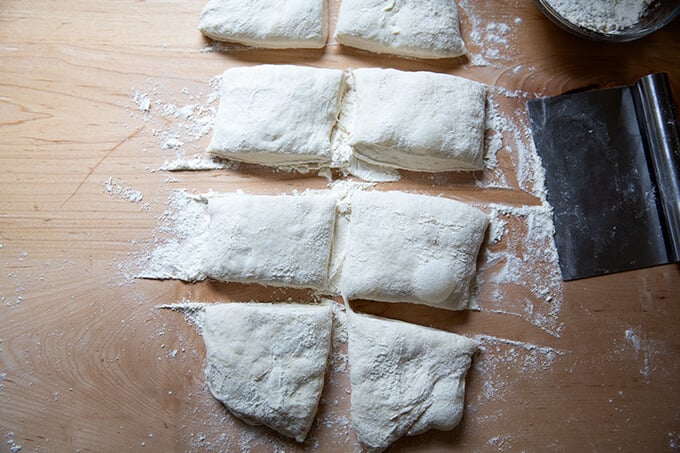
Cut the rectangle into 8 roughly equal portions.
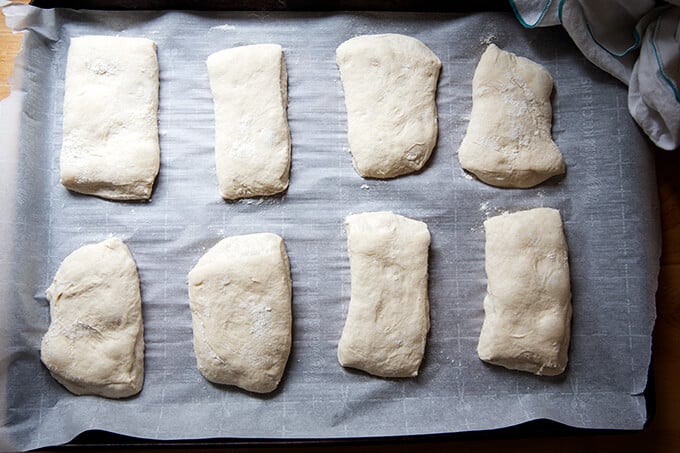
Transfer the portions to a parchment-lined sheet pan. Let rest for 1 hour. Then transfer to a 475ºF oven for 10 minutes. Lower the heat to 450ºF and bake for 10 minutes more.
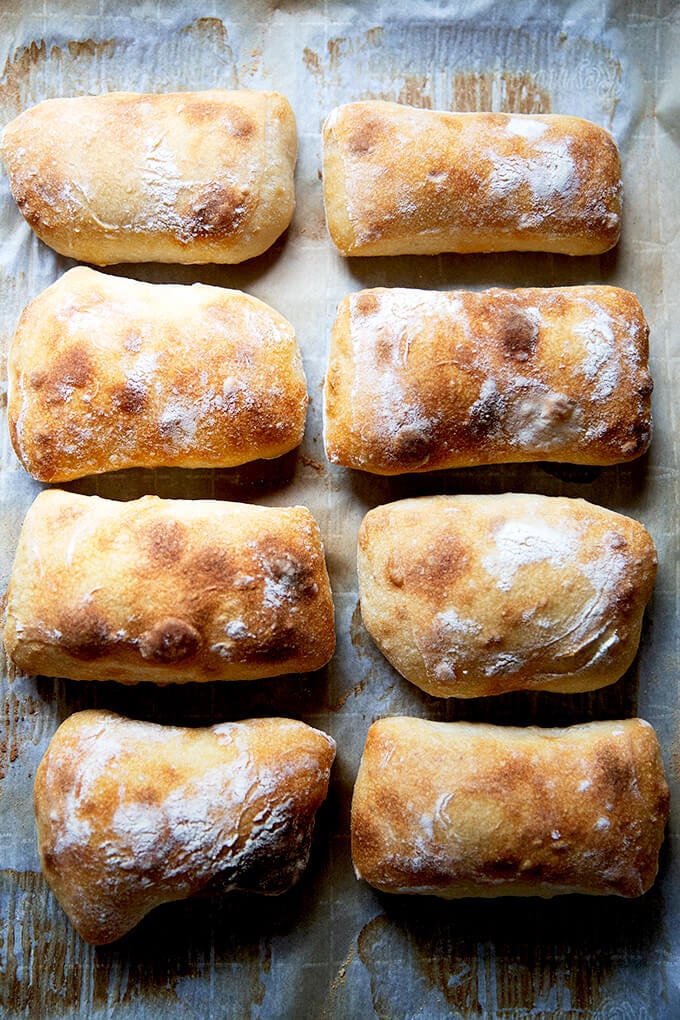
Transfer the rolls immediately to a cooling rack, and let cool for at least 20 minutes before cutting.

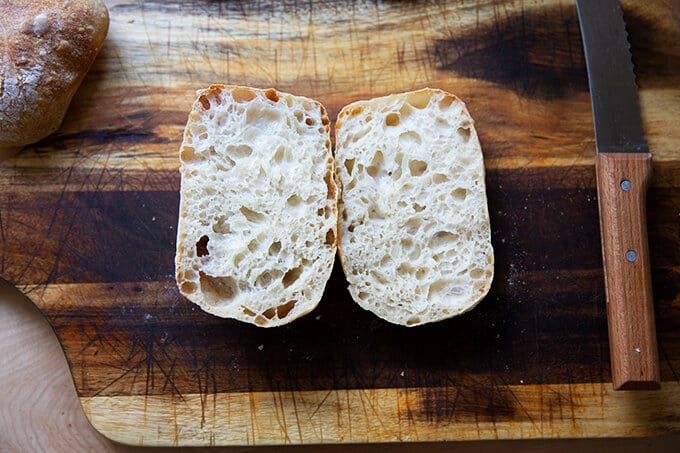
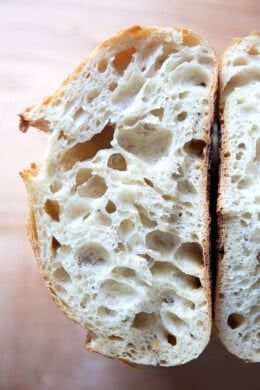
How pretty is that crumb?
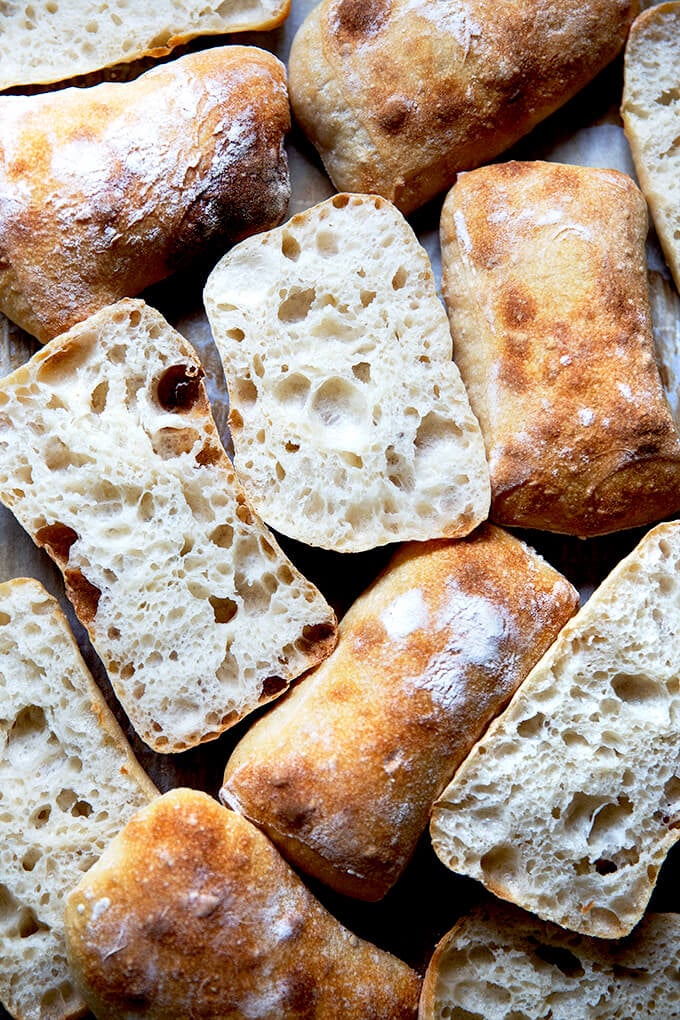
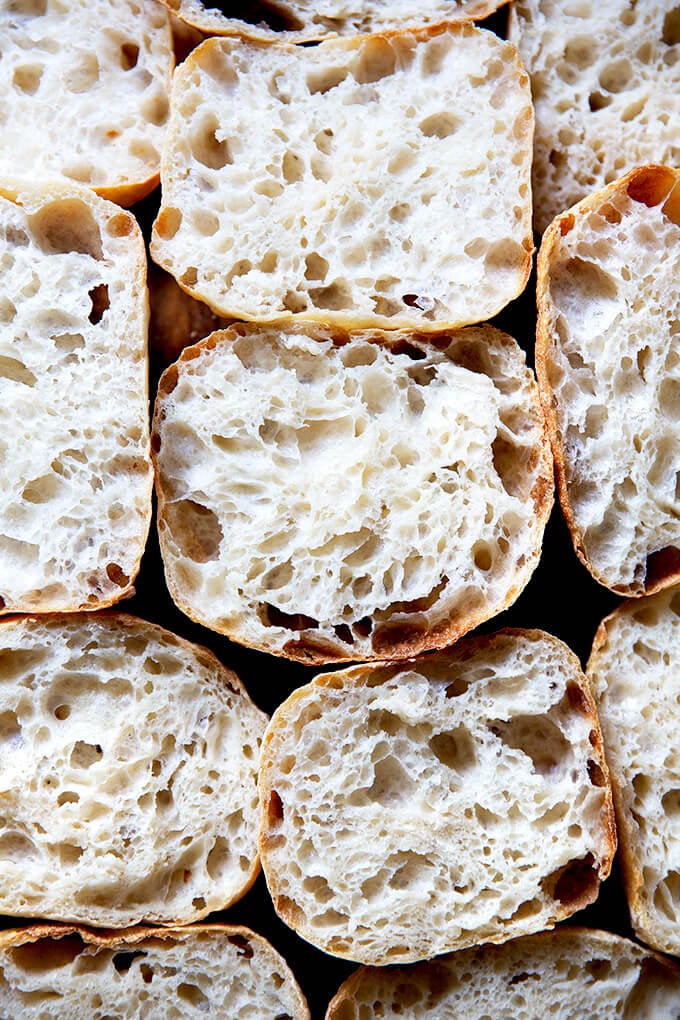
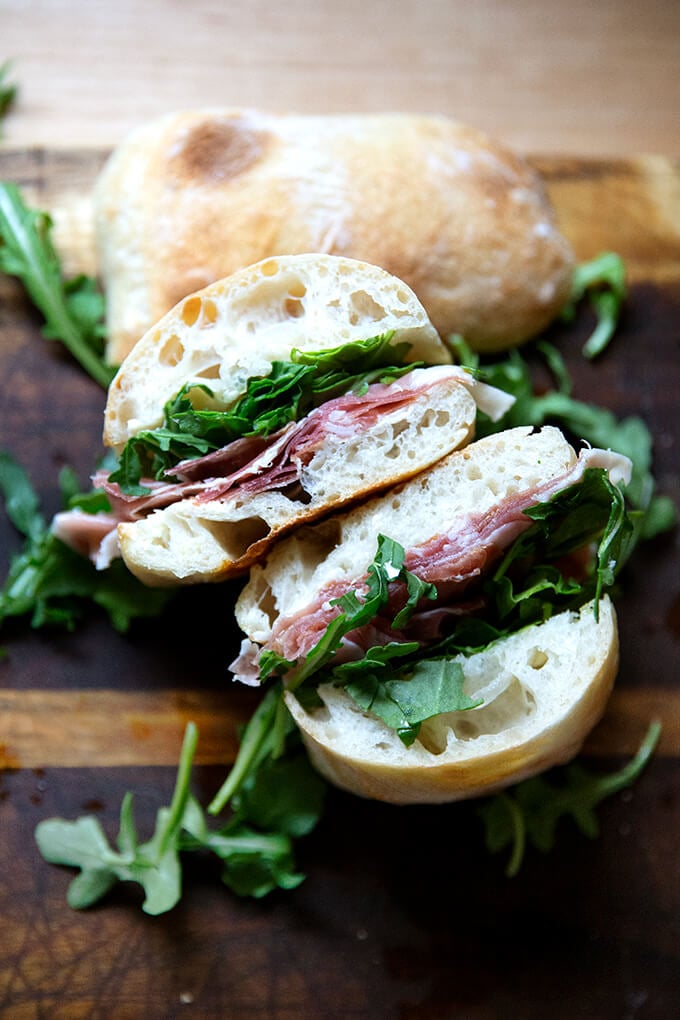
Ciabatta sandwich: This recipe is inspired by Gabrielle Hamilton’s Blood, Bones, and Butter. In short, the success of the sandwich relies on a delicate balance: “the perfection of three fats together — butter, olive oil, and the white fat from prosciutto or lardo.” To make it, spread good bread with “cool waxy butter,” top with prosciutto (more than you think), and arugula. Drizzle it all with good olive oil.
Sourdough Ciabatta “Baguettes” 🥖🥖🥖
To make baguettes, follow the same process, but instead of dividing the rectangle of dough into 8 portions, divide it into two. I find an extra-large sheet pan to be necessary to bake both baguettes at the same time. If you don’t have an extra-large sheet pan, I would bake one baguette at a time, and orient it at a diagonal angle from one corner to another.
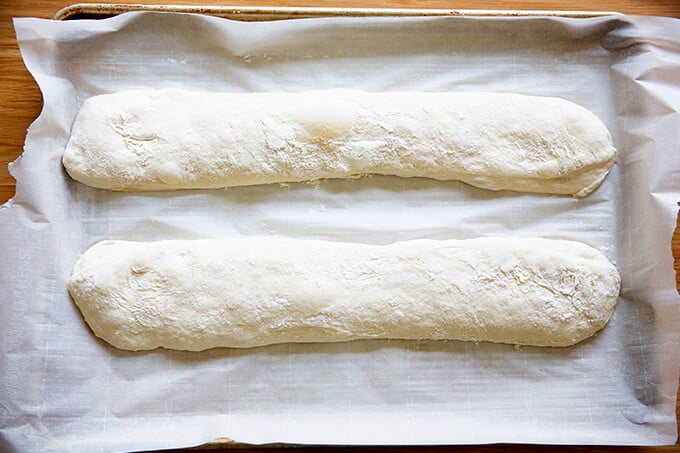
Bake the baguettes at the same temperature and for the same amount of time as the rolls.
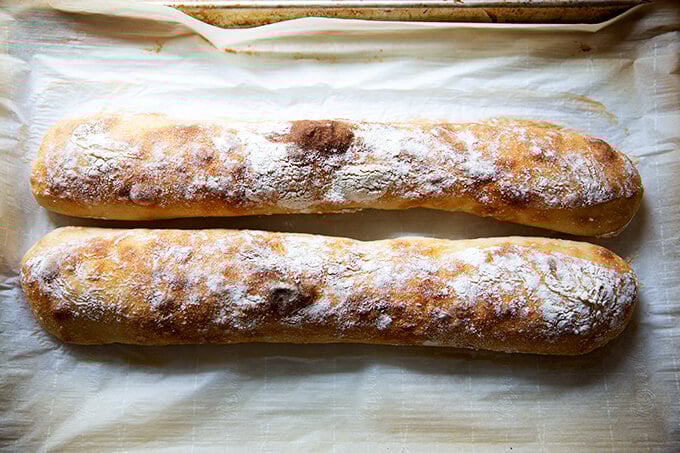
Not bad for the effort, right?
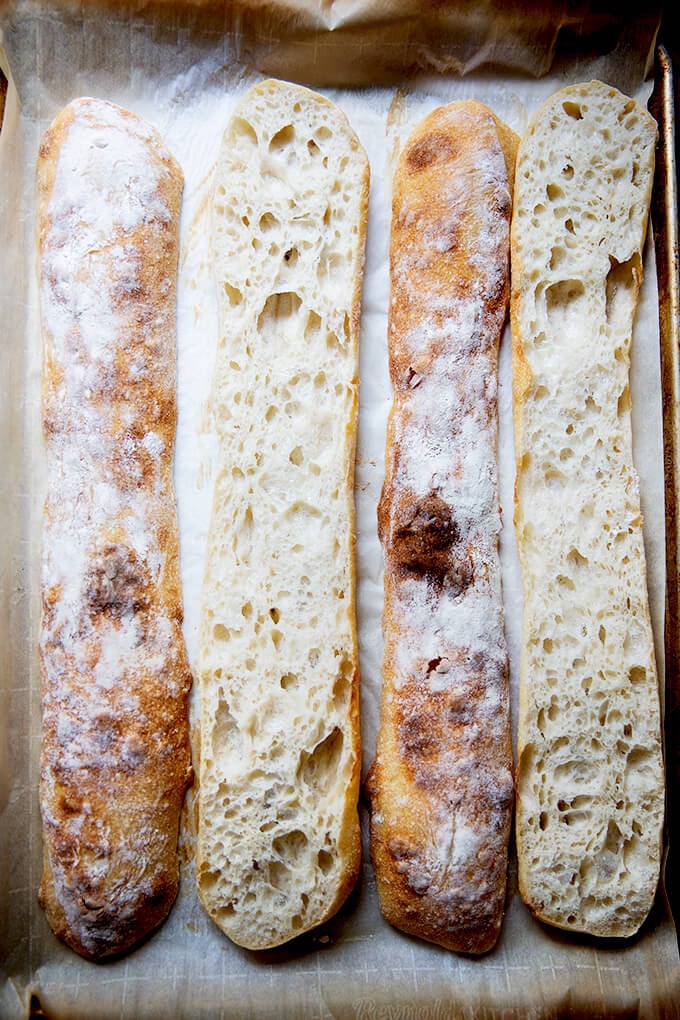
These ciabatta “baguettes” would be great vessels for giant sandwiches.

Simple Sourdough Ciabatta Bread
- Total Time: 24 hours 20 minutes
- Yield: 8 Rolls 1x
- Diet: Vegan
Description
Made with four ingredients, this sourdough ciabatta has a crisp crust, a beautiful honeycomb crumb, and a lovely lightness and chew. The process is truly simple, and the ciabatta is so tasty, perfect for sandwiches of all kinds, for dunking into soup, or transforming into bruschetta.
Notes:
- You need an active sourdough starter. You can build a starter from scratch in just about 1 week. But I am a huge proponent of buying a starter. Here are two sources:
- As always, I highly recommend investing in a digital scale before beginning any bread baking adventure.
Flour: I have had success using all-purpose flour, but if you can get your hands on bread flour, that is ideal, especially if you live in Canada or abroad. Moreover, if you live in Canada or abroad, you may need to reduce the water amount. Consider holding back some of the water during the mixing process to ensure you don’t end up with a soupy mess.
Straight-Sided Vessel:
- The vessel I use in this recipe, similar to this one, is 8 cups. Most grocery stores carry storage vessels similarly sized.
- Using a straight-sided vessel for the bulk fermentation will help prevent over-fermentation because it allows you to see when the dough has truly increased by 75% (or slightly more or less) in volume.
Ingredients
- 360 grams (about 1.5 cups) water
- 12 grams (about 2 teaspoons) salt
- 100 grams (about 1/2 cup) active sourdough starter, see notes above
- 450 grams (about 3.5 cups) bread flour, see notes above
Instructions
- Mix the dough: Place the water in a large bowl. Add the salt and stir briefly. Add the starter and stir briefly to incorporate. Add the flour, and stir until you have a wet, sticky dough ball. Knead briefly with your hands if necessary to incorporate the flour. Cover with a tea towel or cloth bowl cover and let sit for 30 minutes.
- Stretches and folds: With wet hands, grab one side of the dough, and pull up and to the center. Rotate the bowl a quarter turn, and repeat the grabbing and pulling. Do this until you’ve made a full circle. (Watch the video for more guidance. I do a few more pulls and turns in the video.) Cover the bowl. Repeat this process three more times at 30-minute intervals for a total of 4 sets of stretches and folds over the course of two hours. (In the video, I switch to coil folds for the last two sets of stretches and folds.)
- Bulk fermentation: Transfer the dough to a straight-sided vessel. Cover the vessel with a towel. Let rise at room temperature until the dough nearly doubles in volume (shoot for a 75% increase in volume). Times will vary depending on your environment and the strength of your starter. Recently, this has taken about 4 hours for me, but don’t worry if it takes longer for you. Cover vessel with a lid (ideally) or a towel (if you are using a towel, slick the top of the dough with oil to prevent it from drying out.) Transfer to fridge for 12-24 hours.
- Shape: Remove vessel from fridge. Remove lid. Sprinkle top of dough liberally with flour. Turn dough out onto a floured work surface. Pat dough into a rectangle. Sprinkle top with flour. Use a bench scraper to cut the dough in half vertically. Then make three cuts equally spaced in each half to create 8 small rectangles.
- Line a sheet pan with parchment paper. With floured hands, transfer each rectangle to the prepared pan, gently pulling outward. Cover the pan with a towel. Let stand for one hour.
- Bake: Heat oven to 475ºF. Transfer pan to oven and bake for 10 minutes. Lower heat to 450ºF, rotate pan, and bake for 10 minutes more. Remove pan from oven. Transfer ciabatta rolls to a cooling rack. Let cool for 20 to 30 minutes before slicing.
- Prep Time: 24 hours
- Cook Time: 20 minutes
- Category: Bread
- Method: Oven
- Cuisine: American, Italian
This post may contain affiliate links. Please read my disclosure policy.






804 Comments on “Simple Sourdough Ciabatta Bread”
What is the best way to store the rolls for use I. The next two days? Ziplock bag, brown paper bag?
Ziplock bag. Always reheat the day old bread before serving… it will revive beautifully.
Thank you so much for this recipe! The ciabatta bread turned out absolutely amazing!!! So delicious and so easy!
For some reason, the bread didn’t brown. I’ve never had this happen before. Do you have any ideas about what I could do the next time? (Which will be soon! ☺️)
Hi! What kind of flour are you using? It’s not bleached is it? You could try turning the oven up by 25ºF.
It’s unbleached. I’ll try turning the temperature up! Thank you!
Hello, I was wondering, if I didn’t want to put the dough in the fridge after the 4 hour bulk ferment would I go straight to the shape phase? Or would I let it proof longer before doing the shape phase? I suppose I could also make the proof longer?
Just curious how you would go about this if you didn’t want to put it in the fridge?
Yes, go straight into the shaping phase 🙂
Comes out perfectly every time.
Great to hear!
Amazing recipe, have been making this on repeat. I let the dough sit in the fridge 2-3 days now, and they turn out even better. I think my oven isn’t the greatest, so I usually bake mine @500F and then turn down temp to 475F. Thanks so much for the recipe, it’s literally foolproof.
Great to hear, Lia! Thanks so much for writing and sharing these notes. I find a longer fridge proof generally improves most breads. So glad that timing works for you 🙂
I tried to make this recipe like five times and they never turned out right. I gave up until the other day. I pulled my starter out of the fridge. Let it sit on the counter for a few hours fed it and the next morning tried this recipe again. The starter was not super bubbly and I did add a little bit of olive oil to the recipe. But oh my goodness it turned out perfect and amazing this time!. I will now be making this at least once a week for my breakfast sandwiches. No more Panera for me.
Great to hear you were able to finally make the recipe work. Thanks for writing and sharing your note. Love ciabatta for a breakfast sandwich 🙂
I have a couple of questions (I am making baguettes):
1. Can I mix the dough in my stand mixer, cover the bowl with plastic wrap, and mix the dough with my dough hook every 30 minutes for just a few minutes as my stretch and folds? 2. If I shouldn’t use my stand mixer, can I just mix the dough and do the stretch and folds in the straight edged vessel and then let it ferment in that same vessel (covered with plastic wrap)? 3. Can I bake these in a baguette pan (I have never made baguettes before and just bought the pan) and if so, do I need to grease it first? Thanks so much!
Hi Julie! Questions are answered below 🙂
1. Can I mix the dough in my stand mixer, cover the bowl with plastic wrap, and mix the dough with my dough hook every 30 minutes for just a few minutes as my stretch and folds?
I have not done this, so I can’t speak to how it will turn out, but I don’t see why it wouldn’t work except that the mixer might be too strong and might overwork the dough.
2. If I shouldn’t use my stand mixer, can I just mix the dough and do the stretch and folds in the straight edged vessel and then let it ferment in that same vessel (covered with plastic wrap)?
Yes, you can. I find it easier to mix dough in a bowl (as opposed to a straight-sided vessel) and I find it easier to do the stretches and folds in a bowl as well… this is just personal preference so if you don’t mind mixing and stretching and folding in the straight-sided vessel, go for it.
3. Can I bake these in a baguette pan (I have never made baguettes before and just bought the pan) and if so, do I need to grease it first?
Worth a shot! The shape will obviously be different. Yes, I would grease it first.
Fantastic recipe! Highly recommend this recipe, it`s easy and delicious.
Great to hear! Thanks for writing 🙂
Super easy to make. Perfect ciabatta rolls. My go-to recipe
Great to hear, Jenna! Thanks for writing 🙂
A great tasteful and easy recipe, thank you! I used my 7 years old starter and everything came out great, flavor, crumb, etc, EXEPT the crust which came out as thin as it should, but very hard. Any ideas/solutions? Thank you!🙏
Great to hear! My only suggestion would be to remove the bread from the oven and immediately wrap it in a towel, which will help steam and soften the crust a bit.
Alexandra thank you very much for your reply. Unfortunately I’ve tried everything (same thing happens with my sourdough loaves as well), playing around with oven temperatures, flours, pouring a small amount of water in my baking pan, using towels, dry and damp, but still get the hard crust. So disappointing…!!
Thanks for this receipe, I’ve made this a lot.
One thing I’ve not figured out is this: After the 75% bulk fermentation I put it in the fridge for around 12 hours, but the dough continues to rise a lot even in the fridge – too much, I think.
Do you have any thoughts about this?
Hi Karl! It sounds as though you have a very active starter, which is great, and it also sounds as though your fridge might not be as cold as mine? Do you know the temp roughly? When you put it in the fridge, have you deflated the dough and shaped it into a loaf? Or are you sticking the dough still in its risen state directly into the fridge?
We have our fridge set to 5C, which is 41F.
I haven’t been deflating the dough, or shaping it, I just put it directly in the fridge without touching it.
Thanks!
Ok, great: I think you should try deflating the dough after the bulk fermentation, shaping it, placing it in a towel-lined vessel (bowl, banneton, loaf pan… whatever you have that will accommodate the shape of the loaf you are making); then transferring it to the fridge (I tuck the whole vessel it in a produce bag from the store) for 24-48 hours.
Thanks – I did what you said above, and it did make a difference: the dough wasn’t so over-inflated when I turned it out on the worktop, and it had more ‘body'(?). That meant the rolls/loaves had a better, taller shape.
(I didn’t take in what you wrote about the towel lining for the vessel, so I didn’t do that, but I also wonder if the dough, being very sticky, would stick a lot to the towel?)
One problem: the rolls also ended up producting some big bubbles on the top surface – not sure how to best prevent that.
Separately: For many previous batches I had been working the dough more than your recipe, thinking that more gluten development might be better. But when I reduced the working it produced a crispier and less chewy texture, which was great. However, in the latest batch, in order to deflate the dought, effectively I was working it, maybe leading to the chewy texture coming back?
Karl, I have to confess, when I was responding to your initial comment, I thought you were writing about this sourdough boule recipe, which I get questions about all the time. Because I was thinking about that recipe, I suggested deflating/shaping the dough.
Apologies. OK, a few thoughts:
I think you should go back to the original process, but either transfer the dough to the fridge when it has increased in volume by only 50% or lower your fridge temp to 37ºF. Don’t deflate/shape the dough before putting it in the fridge.
Do not use a towel in the fridge! Again, this was suggested because I was thinking about the other recipe. My bad. Side note: Flour sack towels are very nonstick and work great for that other recipe, but it is much lower in hydration.
Big bubbles are leading me to think that the rolls need to proof longer at room temperature. Once your remove your dough from the fridge, turn it out, cut it, and transfer the portions to a baking sheet, let them proof for 2 or 2.5 hours. You’ll want to cover them so that they don’t dry out. I use a flour sack towel or tea towel for this and if the rolls are lightly floured, it should not stick.
Let me know if you give it another go!
Ok, I’ve made these 3 times in the last 10 days. Super simple and easy to accomplish a great roll! I will say, even having made many sourdough loaves, I wasn’t prepared for how flexible and ‘wet’ this dough would be – so don’t panic when that’s how it is. Trust the process, they turn out incredible!
Also – my kids enjoy making ‘pizzas’ on the rolls after I split them in half, so might be a good kid meal!
Thanks again!
Oh I love the pizza roll idea! Thanks for writing and sharing, and thanks for sharing your notes about the wet dough… coming from an experienced sourdough baker, that’s so encouraging for others 🙂
I make this all the time and it turns out perfect!
Great to hear, Ramie!
Can I use 100% hydration start ipo 80%
Hi Sandy! Can you clarify your question? I’m not sure what “100% hydration start ipo 80%” means.
My sourdough starter is 100% hydration of 1-1-1 isn’t a 80% one a different ratio of starter to flour to water. Just wanted to know if it would make a difference in the recipe.
Yes, an 80% hydration starter is stiffer than a 100% hydration starter. I always use a 100% hydration starter in all of my sourdough recipes, but I think an 80% hydration starter will be fine here. It’s such a high hydration dough, that it’s forgiving in this regard.
This recipe looks awesome! Thank you so much for sharing it. Have you ever tried shaping them into burger buns? Any idea how I can make them round without over deflating the dough and keep them round after they sit for an hour?
Hi! I have not, but you definitely could, you’ll just have to budget some more time. After you divide into 8 portions, ball up each portion; then let them proof again for 2 to 4 hours or until light to the touch. You’ll want to cover the balls while they proof or place them in a lidded vessel while they proof so that a skin doesn’t form on the dough.
Phenomenal recipe!! So easy and delicious. I made these to have with soup tonight and everyone was raving about the buns. I can’t wait to make them again!
Great to hear, Enya! Thanks so much for writing and sharing 🙂
This was AMAZING. How easy is this recipe!!! Wow. This should be everyone’s go to. I am shocked. Probably had the best sandwhich of my life!
Great to hear, Madi! Thanks so much for writing 🙂
Love this recipe! If I wanted to bake same day can I just shape after BF and then let proof a bit more on counter? I know taste may not develop as much but have company coming and need more rolls!
Yes, you can! As long as you manage your expectations about the texture/flavor (which it sounds as though you have :)), you can skip the fridge proof.
I’m trying to be as kind as I can. I have tried this recipe 3 separate times thinking I did something wrong each time and each time they NEVER turn out. The first time I did them, the bottom side was BURNT. I thought mmm maybe I need to flip them half way when I turn it down to 450. That time they ended up being FLAT like a pancake. Then I went back to what the recipe suggested and they were burnt and stuck the parchment paper. I never have problems with my breads or recipes. This is my first review I’ve ever left on a recipe because I literally have no idea what’s going on. I see the reviews and they are all great but I’ve tried it 3 times. Rotate pan, flip the rolls, lower the temp… I don’t get it, it NEVER turns out. Im sure im doing something wrong because all the reviews are good and there are a lot of good reviews so SOMEONE PLEASE HELP ME!!!!! I do live at elevation in Colorado but normally it doesn’t effect anything this bad. I JUST WANT CIABATTA!!!!!!!!
What is the material of the baking pan you are using? Is it dark or light colored?
What brand of parchment paper? Some brands unfortunately are not as nonstick as they advertise.
Is your oven reliable? Do you have an oven thermometer?
Are you using a scale to measure? What type/brand of flour are you using? And finally are you new to sourdough or experienced?
Generally, high-hydration doughs (like this one) with long slow rises (like this one) do well at elevation, so I don’t think that’s the issue.
Is there a reason you don’t need steam in the oven? For open baking or sourdough baguettes for example I usually bake on pizza stone and add steam and then remove steam half way
Hi Amanda! I never find that adding steam to the oven really works well to create that nice crust. When I make baguettes, I cover the loaves with a pan to create steam and when I make sourdough, I use a Dutch oven to create steam. But for open baking, I just don’t find that adding ice cubes or spraying with water really makes a difference.
Alexandra, I just want to thank you for such a glorious recipe. I have been making this for several years now, and it is by far the easiest and most tasty recipe I have come across. It is the only bread/rolls I routinely make and give away; and everyone raves about it! I also use use it for pizza dough with some added EVOO which is equally fantastic.
Thank you for taking the time to share your knowledge and experience with us!
So nice to read this, Kit! Thanks so much for writing and sharing all of this. Love that you use the dough for pizza, too. So fun!!
This is my first time making this ciabatta recipe – but I’ve made your boule recipe many times – and they turned out so well! I did panic a bit when the dough was super wet (using Canadian bread flour) and sprinkled in some extra in the first two folds, but it came out so great! TY!
Great to hear, Andrea! Thanks so much for writing and sharing this… glad you were able to fix the dough 🙂
I have made this at least 6 times. I absolutely love it. Not a lot of effort for such a good roll. I’ve made both baguettes and rolls. Thank you for the good recipe.
MaryJane
Great to hear, MaryJane! Thanks so much for writing 🙂
I absolutely love your recipes. Thank you for making my sourdough journey simple and easy. I love your video tutorials. I’ve made this recipe after making your step by step sourdough bread recipe and these came out perfect! I made one a baguette and the other loaf was used for 4 rolls. Absolutely beautiful and delicious! Thank you!!
Great to hear, Sam! Thanks so much for writing and sharing all of this 🙂
My go to recipe for focaccia bread. They are so good
Great to hear, Amber! Thanks so much for writing 🙂
Thank you so much for providing such great detailed instructions AND for answering every question someone asks! I can’t begin to say how helpful that is! I looked through a lot of the comments but didn’t see this so apologize in advance if you already answered! How long would you cook this if you just make 1 large loaf instead of the 8 smaller rolls? Thank you so much!
Sorry, after I sent my last question, I realized I had one more! How important is it to use a tall side container like that for the rise? I looked and don’t have anything like that. Will a bowl work or is there anything else you recommend? THANK YOU!
Do you have any food storage containers that are roughly 2-quart in size? If not, and if you are open to it, your grocery store might have one. I do find the straight-sided vessel to be game changing with sourdough because it really allows you to see how much your dough has truly grown in volume. It’s hard to gauge the dough’s % change in a bowl.
Thank you so much for all the detail and explanation you put into your recipes! It is SO helpful, especially that you actually answer everyone’s questions – that is such a rare treat in itself!
I apologize if you’ve already answered this, but couldn’t find it in any of the other comments! How long and at what temperature should you cook this if you would like to bake it as one single loaf? Is there a specific way you suggest shaping it for a single loaf? (sorry that’s a few questions in one 🙂 THANK YOU!
Hi! And I don’t think this has been asked. I have a yeasted ciabatta recipe and in the instructions in that post, I divide the dough in half and bake two large loaves: https://vector-hatch.live/2021/06/26/how-to-make-ciabatta-bread/%3C/a%3E
l’ll paste the instructions below from after the bulk fermentation. If you just want to make one large loaf, don’t divide the dough in half but follow the same process. Let me know if this helps!
Portion and shape: (Note: This is where I deviate from traditional ciabatta bread recipes. See notes in the post above for the more traditional shaping method.) Turn the dough out onto a work surface. I prefer to do this step without flour, but absolutely sprinkle your surface lightly with flour as needed to make the dough manageable to work with. Using a bench scraper or your hands, shape the dough into a tight ball; then use the bench scraper to divide the dough in half. If you want perfectly even balls, each portion will way roughly 455 grams. Again, use the bench scraper or your hands to ball up each portion into a tight ball — see video for guidance.
Proof: Sprinkle your countertop liberally with flour. Place the balls top-side (smooth side) down onto the flour. The seam-side will be on top now, and it may split open — this is fine. Sprinkle the top surface of the balls liberally with flour. Cover with a tea towel and let rest for 2.5 hours. After 2 hours of proofing, heat the oven to 425ºF.
Line a sheet pan with parchment paper. When the dough has finished proofing, gently flip each ball over — I find a bench scraper to be helpful here. Then use both hands to stretch each ball out gently into a rectangular shaped “slipper”. Transfer to the prepared pan.
Bake for 20 – 25 minutes or until the loaves are golden all around. Remove pan from oven. Transfer ciabatta rolls to a cooling rack. Let cool for 20 to 30 minutes before slicing.
What ratios you use to feed your starter? I see you have 100 g of active starter listed in ingredientt
equal parts by weight flour and water — it’s a 100% hydration starter
This was my first recipe with using sourdough starter. They turned out delicious! But it took about 12 hours for the dough to increase to 75%. I left it on a top shelf in the kitchen. Would sticking it in a pre-warmed oven make it go faster?
Great to hear! And yes, possibly, but you also run the risk of the dough over-fermenting. As long as you keep a close watch, you can use a slightly warm environment for the bulk fermentation, and definitely use a straight-sided vessel again so you can truly see when it’s time to end the bulk fermentation.