 →
→ 

Simple Sourdough Pizza Crust: A Step-by-Step Guide
 By Alexandra Stafford
—
Last Updated: 01/22/2026
By Alexandra Stafford
—
Last Updated: 01/22/2026
This post may contain affiliate links. Please read my disclosure policy.
As far as sourdough pizza recipes go, this one is as simple as it gets: it’s made with all-purpose or bread flour, and there is no autolyse or preferment — everything gets mixed together at once. Ready? Wake up your starter! Read on to learn 5 secrets to sourdough pizza success.🍕🍕🍕

This sourdough pizza recipe produces a pizza with a ballooned, blistered edge and a crisp but pliable crust. The secret to achieving this texture in a home oven is to use a high-hydration dough (75%), proper fermentation (long and slow) at each phase, gentle handling of the dough, and a screaming hot oven (ideally outfitted with a Baking steel or pizza stone).
Let’s explore each in more detail:
5 Keys to Sourdough Pizza Success
- Use a high-hydration dough: Because home ovens rarely reach above 550ºF, it takes longer for pizzas to cook. In contrast, a 900ºF oven will cook a pizza in 60 seconds. To prevent pizza dough from drying out in a home oven, it is important that the dough has a lot of water in it — i.e., it is high-hydration. In contrast, outdoor oven pizza doughs can be much lower hydration.
- Ferment sufficiently: After the first long, slow rise, transfer the dough to the fridge for at least 12 hours and up to 3 days. Time further develops flavor, helps with browning, and improves the texture of the pizza dough.
- Proof sufficiently: If time permits, allow the dough to come to room temperature for at least an hour before baking (and up to 2), which makes it easier to shape — room-temperature dough stretches into a round more easily than cold dough.
- Handle the dough minimally: Using a delicate hand when shaping the dough preserves the air pockets created during fermentation.
- Invest in a Baking Steel: Steel is a better conductor of heat than stone — i.e., it transfers heat to the dough faster — which promotes great oven spring, which translates to glorious bubbles throughout the dough.
How to Make Sourdough Pizza, Step by Step
As always, a scale is essential for the best results. You need water, flour, salt, and a sourdough starter:
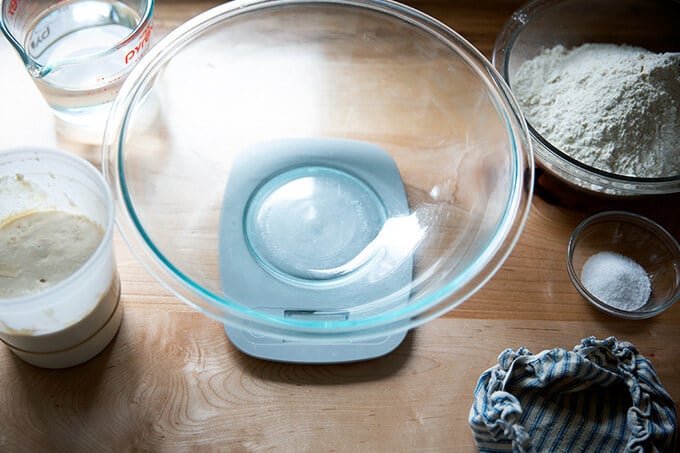
Combine 375 g water, 100 g sourdough starter, and 10 g salt in a bowl. (See notes in recipe box about using less water if you live in a humid environment.)
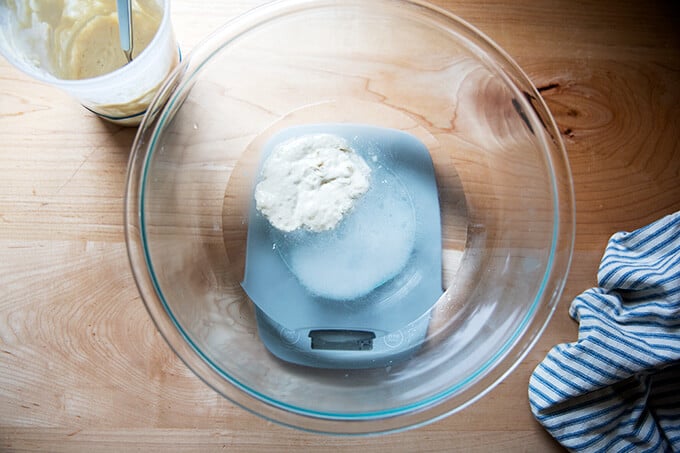
Stir to combine; then add …
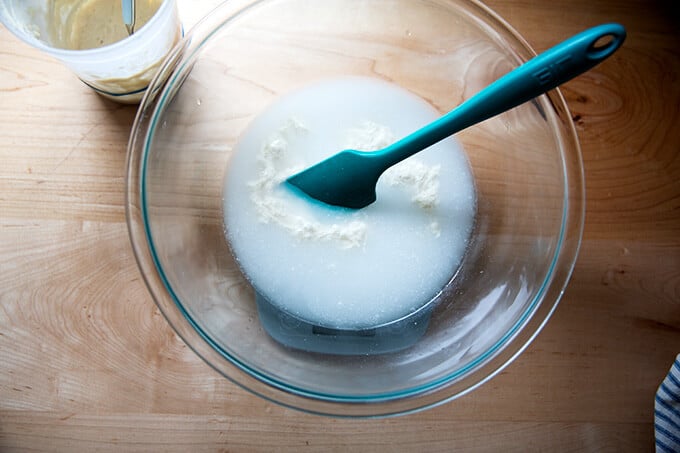
… 500 g all-purpose flour.
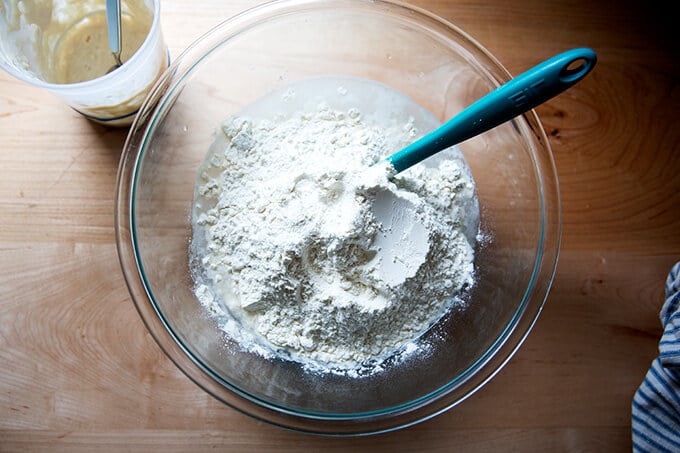
Stir until you have a sticky dough ball.
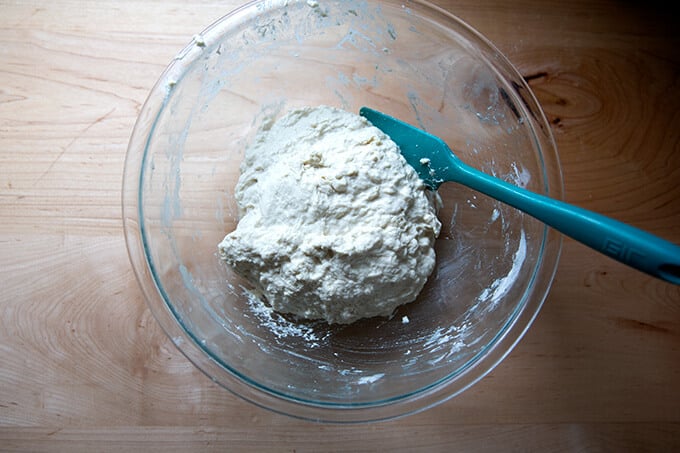
Transfer to a straight-sided vessel (if possible) and let rest for 30 minutes. Then, “stretch and fold” the dough (see video for guidance) 4 times at 30-minute intervals. Cover the vessel. Let it rest for 6 to 12 hours (see recipe notes for timing) or until the dough…
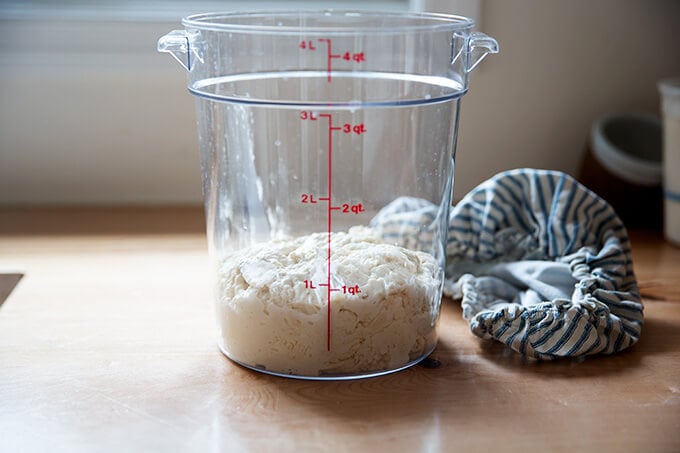
… has about doubled in volume. (Note: This is a little bit more than double. Ideally, you don’t want your dough to rise much beyond double. More recently, in fact, I stop the bulk fermentation when the dough has increased in volume by 50%.)
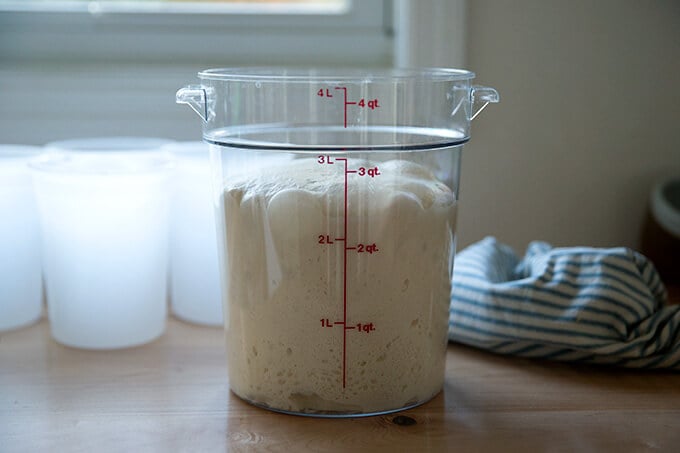
Turn the dough out onto a work surface. Use flour here as needed.
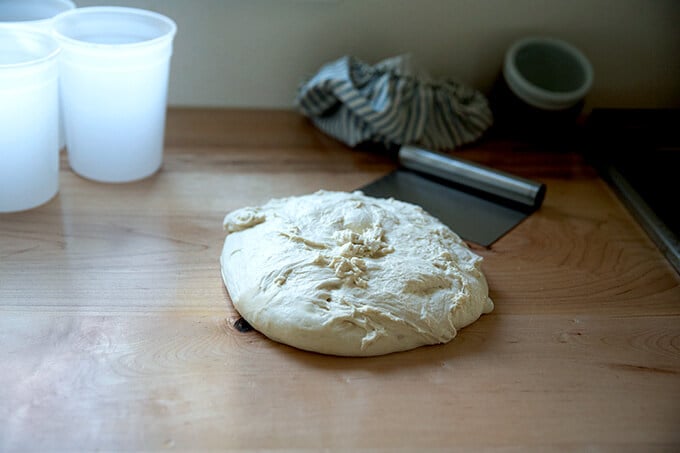
Portion into 4 equal pieces, again using flour as needed.
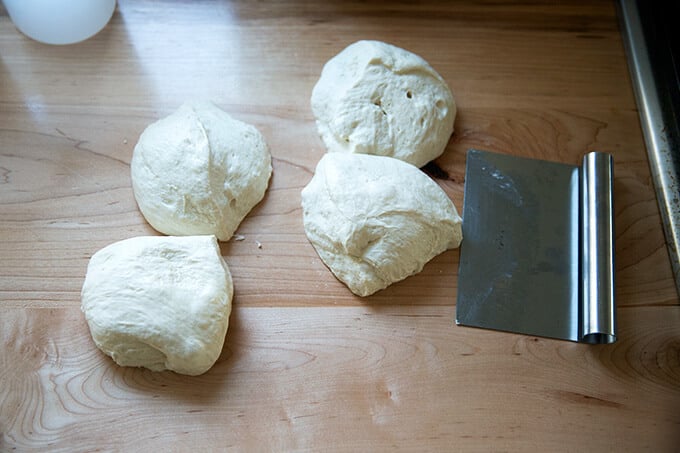
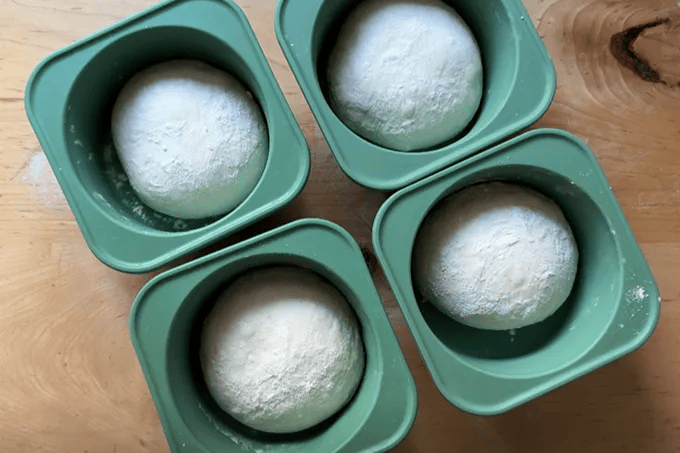
Ball up the dough, transfer the balls to storage containers, and stick them in the fridge. These Kevjes Dough Storage Vessels have become my favorite storage vessels for pizza dough balls:
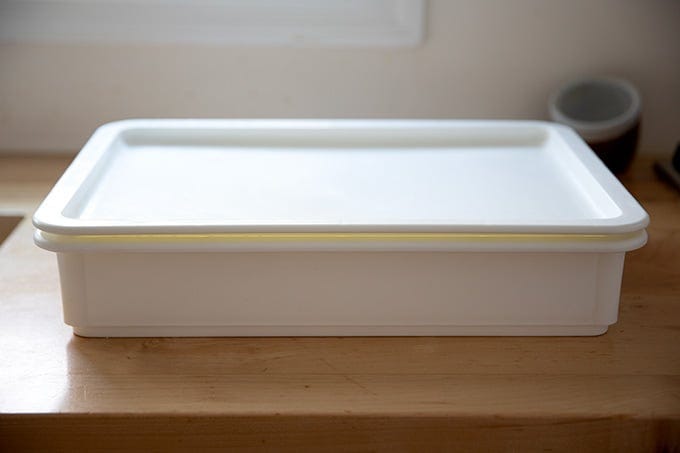
An hour prior to baking, remove a round (or more) of pizza dough from the fridge, and transfer it to a lidded vessel such as a DoughMate or a 9×13-inch baking dish covered with plastic wrap (to prevent the dough from drying out). If you have a Baking Steel, place it in the upper third of your oven, and heat the oven to 550ºF convection roast. (See recipe for other options.)
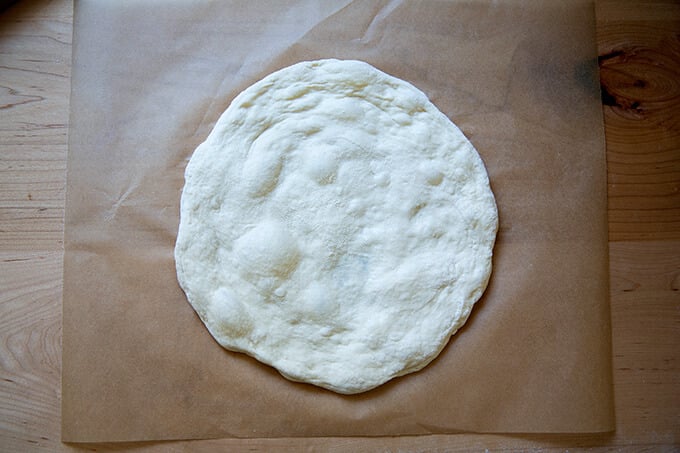
When the dough has proofed, delicately stretch it into a round, trying as best you can to preserve those air pockets.
Top as you wish. This one is spread with tomato sauce and topped with fresh mozzarella, parmesan, olive oil, and sea salt.
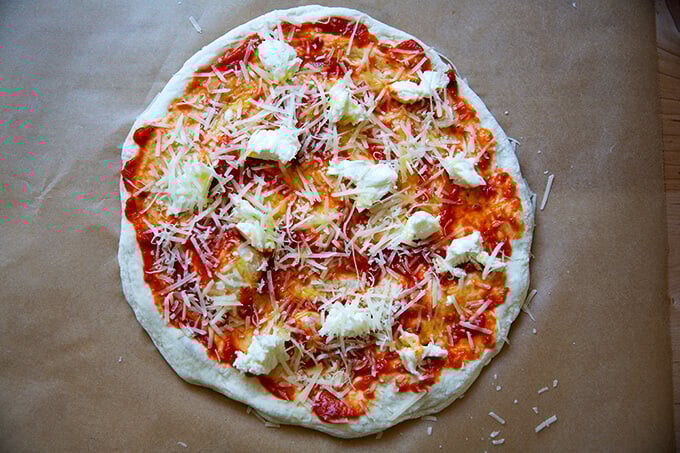
Transfer pizza, parchment paper and all, to a preheated Baking Steel or stone, using a peel — my favorite peel is the Epicurean Pizza Peel. Bake 5 to 6 minutes or until cooked to your liking.
Slice and serve.

A little fresh basil is always nice.

This is the beauty of the Baking Steel: oven spring!
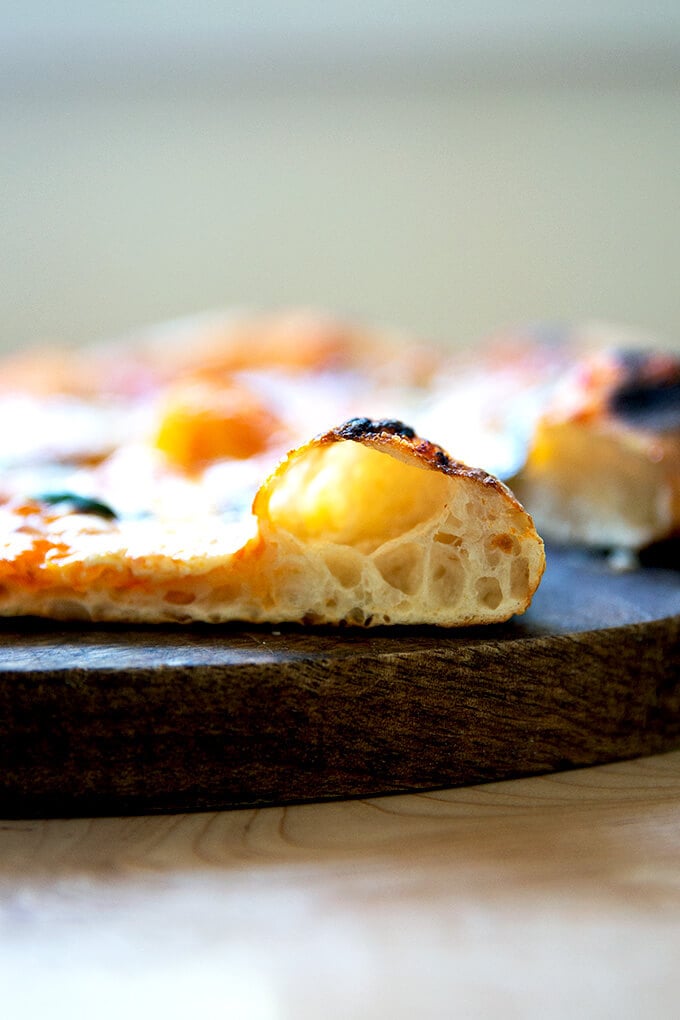
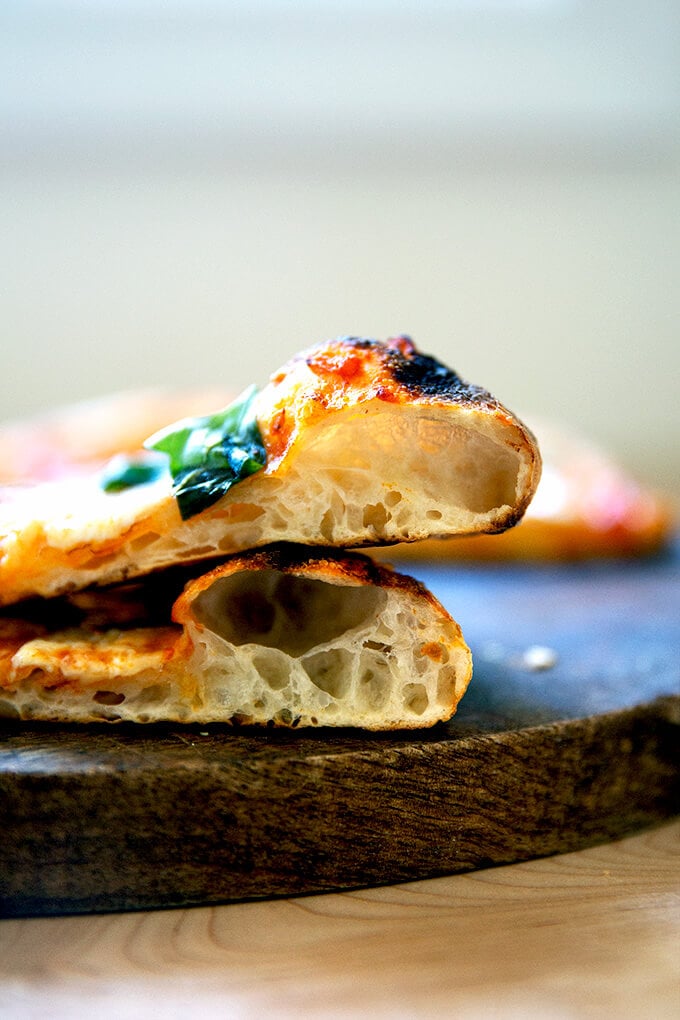
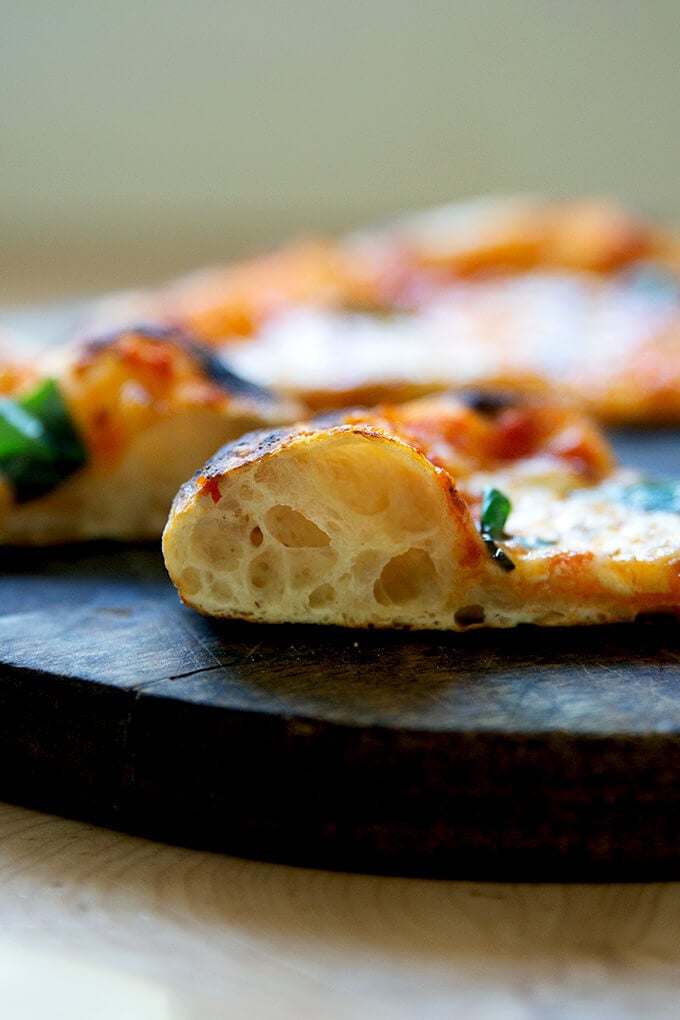
Another favorite: kale + crème fraîche:
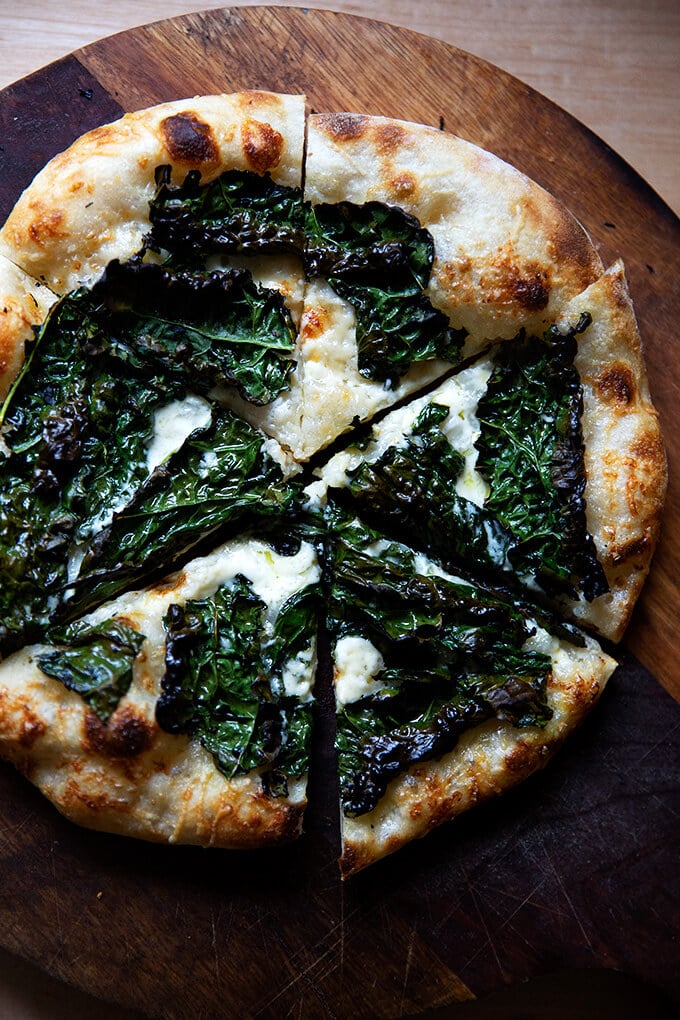
Another favorite: “naked” + spicy scallion (or ramp) oil:

Looking for more pizza inspo? My cookbook, Pizza Night includes 52 pizza and 52 salad recipes, one pair for every week of the year, as well as five simple desserts 🍕🍕🍕


Simple Sourdough Pizza Crust
- Total Time: 1 day + 1 hour
- Yield: 4 pizzas 1x
Description
Here is my guide for making sourdough pizza crust at home. Made with all-purpose or bread flour and no autolyse or preferment, the dough comes together simply: everything gets mixed together at once, and you are on your way! 🍕🍕🍕
**Attention Pizza Fans**: My pizza cookbook, Pizza Night, is now available everywhere books are sold. Get your copy here: Pizza Night
What you need to make this recipe…:
- …a sourdough starter. Ideally, you want to use your starter 4 to 6 hours after you feed it, when it has doubled in volume and is very bubbly and active. You can build a starter from scratch in just about 1 week. Or you can buy one. Here are two sources:
- …time. Once your starter is ready to go, this recipe requires an initial 6 – 18 hour rise, followed by at least 6 hours in the fridge or up to 3 days.
Timing/Schedule:
The timing will depend heavily on the time of year and the temperature of your kitchen. In the summer, because it is warm and humid, the first rise (bulk fermentation) of all my sourdoughs takes between 6 – 8 hours; in the winter it will take longer, 10 to 12 hours.
It is best to rely on visual cues. For the bulk fermentation, you want the dough to double or less than double: I now end my bulk fermentation when the dough has risen by 50% to 75% in volume. This is why I cannot recommend using a straight-sided vessel (as opposed to a bowl) enough. It makes gauging the first rise easier.
If at any point you are worried the dough will over-ferment — say, for example, the bulk fermentation is nearly complete but you are tired and want to go to bed — stick the vessel in the fridge and pick up the process in the morning. (Note: If your dough rises above double, don’t despair … my dough has tripled in volume during an overnight rise, and the resulting dough still had plenty of strength and spring.)
Schedule: I like mixing this dough in the evening, performing 4 stretch and folds before I go to bed (if time permits), then letting the dough complete its bulk fermentation at room temperature (68ºF) overnight or in the refrigerator (especially in the summer, when my kitchen is much warmer). In the morning, it’s typically ready to be portioned (if it rose at room temperature), transferred to storage vessels, and stashed in the fridge. If I had let my dough spend time in the fridge for the bulk fermentation, I remove it in the morning, and let it complete its bulk fermentation at room temperature. Once complete, I portion the dough and stash it in the fridge. Sometimes I’ll use the dough that same evening; sometimes I’ll use it the following day or the next. I encourage using the dough within 3 days.
In short: If you want pizza for the weekend, mix your dough on either Wednesday or Thursday.
Troubleshooting: If you have issues with your dough being too sticky, please read this post: Why is my sourdough so sticky? The 4 common mistakes.
Water: If you live in a humid environment or if you are making this on a particularly humid day, consider starting with less water, such as 335 grams of water, which will bring the hydration down to 70%. This amount of water will still produce a light airy crust but the dough will be more manageable.
Flour choice:
- You can make this dough with all-purpose flour or bread flour, and it works beautifully. You can use Tipo 00 flour if you want, but you’ll likely need to reduce the amount of water. Start with 350 grams and adjust moving forward based on your results.
Can You Freeze Sourdough Pizza Dough?
Yes. But, in my experience, the pizzas made from frozen dough do not spring as high upon being baked. They will still taste delicious as long as the time spent in the freezer is relatively short: the more time sourdough spends in the freezer, the more air bubbles it loses. After 1 week in the freezer, my dough will bake up fairly well. After 3 weeks in the freezer, my dough will be less bubbly and will bake into a thinner and crisper crust.
To freeze sourdough pizza dough: make it through step 4 in the recipe below or until after you transfer the portioned rounds to quart containers. At this point, transfer the quart containers to the freezer. To thaw, remove a container (or more) and let thaw in the refrigerator for 1 day or thaw at room temperature for 8 hours. Then, proceed with the recipe.
Favorite Pizza-Making Tools:
- Baking Steel
- Pizza Peel
- Parchment Paper: I bake my pizzas on parchment paper on my Baking Steel. Parchment allows for easy transfer from peel to steel.
- Cast Iron Skillet: If you do not have a Steel or stone, you can use a cast iron skillet. Rub a half teaspoon of oil over its surface, transfer a stretched dough round to the skillet. Top as desired. Bake at 450ºF for about 15 minutes.
- I love these Kevjes containers.
Ingredients
For the dough:
- 375 g water (or less, see notes above)
- 100 g sourdough starter, active and bubbly, see notes above
- 10 g salt
- 500 g all-purpose or bread flour
For each Margherita pizza:
- 2 tablespoons tomato sauce
- 1 to 2 oz mozzarella
- handful of grated Parmigiano Reggiano (less than an ounce)
- drizzle olive oil
- pinch sea salt
For each kale and crème fraiche pizza:
- extra-virgin olive oil
- a couple handfuls of baby or Tuscan kale
- 1 to 2 cloves garlic
- Sea salt, such as Maldon
- 2 tablespoons crème fraîche
- grated Parmigiano Reggiano, about 1/4 to 1/3 cup
For each naked pizza with ramp or scallion oil:
- 1/4 cup olive oil
- 1/4 cup minced scallions or ramps
- 1 teaspoon crushed red pepper flakes
- 1 to 2 tablespoons crème fraîche
- handful grated Parmigiano Reggiano
- sea salt
Instructions
- Mix the dough. Place the starter, salt, and water in a large bowl. Stir with a spatula to combine — it doesn’t have to be uniformly mixed. Add the flour. Mix again until the flour is completely incorporated. Transfer to a straight-sided vessel (if you have one.) Cover vessel with tea towel or cloth bowl cover and let stand 30 minutes.
- Stretch and fold: after 30 minutes have passed, reach into the vessel and pull the dough up and into the center. Turn the vessel quarter turns and continue this pulling 8 to 10 times. See video for guidance. Let the dough rest for another 30 minutes; then repeat the stretching and folding. If possible, repeat this cycle twice more for a total of 4 stretch and folds. By the 4th cycle, you will notice a huge difference in the texture of the dough: it will be smoother, stronger, and more elastic.
- Bulk fermentation: Cover vessel with a tea towel or bowl cover and set aside to rise at room temperature (70ºF/21ºC) for 4 to 18 hours (the time will vary depending on the time of year, the strength of your starter, and the temperature of your kitchen; see notes above) or until the dough has roughly doubled in volume. (UPDATE: In the past I have recommended letting the dough rise until it doubles in volume. If you’ve had success with this, continue to let the dough double. Recently, I have been stopping the bulk fermentation when the dough increases by 50% in volume, and I feel my dough is even stronger in the end.) Note: Do not use your oven with the light on for the bulk fermentation — it is too warm for the dough. When determining when the bulk fermentation is done, it is best to rely on visual cues (doubling in volume) as opposed to time. A straight-sided vessel makes monitoring the bulk fermentation especially easy because it allows you to see when your dough has truly doubled.
- Portion and shape: Turn the dough out onto a work surface and shape into a rough ball, using as much flour as needed — the dough will be sticky. Using a bench scraper, divide the dough into 4 equal portions. Sprinkle portions with flour. With floured hands, roll each portion into a ball, using the pinkie-edges of your hands to pinch the dough underneath each ball. Transfer each round of dough to a plastic quart container, cover, and store in fridge for at least 6 hours or up to 3 days or transfer to the freezer for up to 1 week. (To thaw, remove a container (or more) and let thaw in the refrigerator for 1 day or thaw at room temperature for 8 hours. Then, proceed with the recipe.)
- Make the pizzas: Pull out a round (or more) of dough from the fridge one hour before you plan on baking. Dust dough with flour and place on a floured work surface. Let sit untouched for about an hour (a little longer or shorter is fine). Place a Baking Steel or pizza stone in the top third of your oven. Set oven to 550ºF. Heat oven for at least 45 minutes but ideally 1 hour prior to baking.
- Shape the dough: Gently shape dough into a 10-inch (roughly) round handling it as minimally as possible. (See video for guidance.) Lay a sheet of parchment paper on top of a pizza peel. Transfer the dough round to the parchment-lined peel.
Top and Bake
- To make a classic Margherita-style pizza: Spread 2 tablespoons of tomato sauce over the surface of the dough. Top with mozzarella to taste. Sprinkle with parmesan to taste. Drizzle with olive oil. Sprinkle lightly with sea salt. Shimmy the pizza, parchment paper and all into the oven. Bake pizza until top is blistered, about 5-6 minutes. Transfer to cutting board. Sprinkle with basil, if you have it. Cut and serve. Discard parchment paper.
- To make a kale and crème fraîche pizza: Place the kale in a small bowl, drizzle with olive oil, season with sea salt, and toss. Spoon crème fraîche over the dough leaving a 1/2-inch border or so—I use about a tablespoon per pizza. Sprinkle with minced garlic and a handful of grated Parmigiano Reggiano. Top with the kale. Shimmy the pizza, parchment paper and all into the oven. Bake pizza until top is blistered, about 5 – 6 minutes. Transfer to cutting board. Cut and serve. Discard parchment paper.
- To make a naked pizza with scallion oil: Heat 1/4 cup olive oil in a skillet with 1/4 cup of minced scallions (or ramps!) and 1 teaspoon crushed red pepper flakes. Keep it over low heat while you make the pizza. Spoon crème fraîche over the dough leaving a 1/2-inch border or so—I use about a tablespoon per pizza. Sprinkle with a handful of grated parmesan. Shimmy the pizza, parchment paper and all into the oven. Bake pizza until top is blistered, about 5 – 6 minutes. Transfer to cutting board. At this point, the scallions should be starting to “frizzle”. If they aren’t, crank up the heat until the oil is sizzling. Spoon a few tablespoons of the hot oil over the pizza (you’ll have extra oil). Sprinkle with a pinch of sea salt. Cut and serve.
- Prep Time: 24 hours
- Cook Time: 5 to 6 minutes
- Category: Pizza
- Method: Oven
- Cuisine: American, Italian
This post may contain affiliate links. Please read my disclosure policy.







1,553 Comments on “Simple Sourdough Pizza Crust: A Step-by-Step Guide”
Hiii
Thanks for sharing this recipe, and thank you for all the replies to the comments!
QUESTION: what adjustments should be made for making this in a drier climate at altitude (Lake Tahoe ~4800 ft.)
Definitely found some useful tips here – for example, using fed vs. unfed sourdough starter.
I didn’t search the comments before using your recipe, so I ended up using unfed sourdough starter. Figured the extra flour and bulk fermentation would give the unfed starter lots of food to eat through.
Thank you!
– Nik
Hi Nik! I haven’t baked sourdough at altitude, so I don’t have too many tips, but from what I understand from others, sourdough does well at altitude because of the slower rise. If the dough felt at all dry, next time you could add more water, but if it didn’t, I wouldn’t make any changes. Let me know how it turns out and we can troubleshoot further.
I found Tipo 00 flour, rye, bread and other types at a local restaurant supply store that is open to the public. You do have to buy it in 50 lb sacks, but there’s no shipping and the bags cost around $30. I’ve been sharing the flours, and the tip, with friends.
Great pizza! I had feta cheese on hand for the caramelized onion, fig recipe and my family loved it and we make it every weekend for Pizza Night. Enjoy finding another use for sourdough starter.
Wonderful to hear this, Martha! I buy 50-lb bags of flour as well and have no trouble making my way through them 🙂 🙂 🙂 I gift flour too! In these crazy times, people are so grateful. Thanks for writing.
If you’d like to get some amazing type-00 that’s sold in 2lb, 5lb and larger, check this out 🙂 I use this and it works amazingly well.
https://centralmilling.com/product/tony-gemignani-pizza-flour-california-artisan-type-00/
Amazing! Thanks for the info, Nik!
This is where I buy all my flour, its local to me. For my sourdough bread (and almost everything else) I use type 85 malted. Its so amazing! 50# bags, no problem to get through. This is one blessing of the pandemic, it helped me find this source! I haven’t baked the pizza yet, but I’m heading the two day timing, so I will wait 🙂
So I have been baking sourdough bread for about 4 years due to my arthritis. I have cheated and eaten bought pizza and my hands hurt. I was desperate for a solution. Tried making pizza once before, and failed!! Saw your recipe, and was about to make dough, instead made a double batch of dough, then cut and quartered it like you said. Let it come to room temp ect… Anyway, the result was Fantastic!! So, So good. My family loved it. Home made is so much better, and good for my hands!! Thanks it was an amazing recipe. So happy to have pizza back in my wheelhouse.
So wonderful to hear this, Monica! Thanks so much for writing!
I did this recipe today. I only made 2 of the balls after 24hours retarding. I’ll do the other 2 in a couple of days. Excellent results. I’ve made quite a few different sourdough pizza recipes and this one is probably the best. I used 00 flour and it was a real success. Very strong gluten development so pizza was really easy to stretch with no tearing. Crust was super light and airy and the base came out beautifully. Very. Delicious.
Wonderful to hear this, Shawn! Tipo 00 flour truly makes such a lovely dough. Thanks for writing!
Hi. This may have been in earlier comments, but isn’t 550° way too hot for parchment? Do you not recommend going from a floured peel to the steel? I have only used my steel one other time, so I’m still a newbie. Can’t wait til tomorrow when the dough is ready to use!
Hi Katie! I have never had an issue with parchment in my oven, and I often preheat my steel for well over an hour at 550ºF and I have used all sorts of brands.
What is an issue with parchment paper is the broiler … it will catch fire.
Can’t wait to hear how the pizza turns out!
Hi Alexandra, thank you for the recipe! Can I cut the dough into four parts after putting in the fridge for 3 days (right before baking the pizza)? Or does the dough to need to be divided into four parts before it goes in the fridge? Thanks.
Hi Cathy,
My concern with dividing the dough later is that you’ll depress many of the air bubbles created in the dough. When the balls are portioned and in their individual containers, they rise a bit in the fridge and more air bubbles are created in the dough, and when I remove the balls to their floured work surfaces, I try to handle them as minimally as possible to prevent the loss of air bubbles. I think if you were to divide and shape the big batch of dough three days later, you’d lose a lot of these air bubbles.
But, I’m all for experimenting, too. Keep me posted on what you do!
I don’t normally leave reviews but I feel obligated for this recipe. I am a sourdough newbie, having just created my starter during quarantine, and was looking for fun recipes to make with it. This pizza dough was a HOME RUN. The instructions were super easy to follow, and the pizza come out so good. I used a pizza stone and a big bowl since we don’t have a straight-sided vessel. Apart from those adjustments, I followed the recipe exactly and it still came out amazing. Thanks so much for this recipe!! I’ll definitely be using it again.
Wonderful to hear this! Thanks so much for writing 🍕🍕🍕🍕🍕
I am loving all of the sourdough recipes!! I have so far made focaccia bread and this pizza dough. I am wanting to bake the pizza dough for (easy entertaining) use tomorrow and wonder if I can add a tomato sauce to the base now or tomorrow? The toppings will go on tomorrow night and (all 6) will be finished off in my tall oven. I have to use a pizza machine because my oven can’t get to the high temperature required and I do like a crispy bottom but really want to impress my guests with this yummy delight!
Thank you in advance
Hi Joanne! Sorry for the delay here … Hope I’m getting to you in time. I worry about putting the tomato sauce on now bc it might make the dough soggy. I think pre-baking the crust is brilliant and a great way to get ahead, but I would add all toppings just before baking.
OR: you could test one out so that you know for future use. Sauce one of the rounds and par bake it; leave the others naked.
Keep me posted on your trials!
Jen,
Sorry to hear the dough is giving you trouble. A few thoughts:
1. Your dough may have over fermented during the bulk fermentation. How long was it? Was there any strength or elasticity while you shaped it? Or was it totally slack? When you were doing the stretches and folds, was the dough workable? Or very wet?
2. Have you had success baking other sourdough breads? Is your starter strong and reliable?
It sounds as though you either need to reduce the water amount given your climate/flour or you need to more closely monitor your bulk fermentation.
Keep me posted on how it bakes.
Fabulously easy and tasty pizza dough recipe. The kids reaction was complete amazement as to how good it tasted “Wow dad! This tastes amazing – it’s sooooo good!”.
Only thing I did differently was to cook the pizza with tomato sauce for 4 minutes then add the cheese and other toppings after that.
Thank you very much for the recipe!
Wonderful to hear this, Stefano! So glad the kids appoved, too 🙂 I like your method, too, re sauce first, then cheese … I’ll try that!
Hi, thanks for the recipe! I went a little wrong and after the four stretch and folds, i immediately portioned the dough with flour and pinched and folded it to make balls. Its now doing its bulk fermentation overnight, in the morning what should i do? Should i pinch and fold it into another ball and do step 4 properly?
Hi Ramosann! Are the portions in their individual containers? Are you doing the bulk fermentation at room temperature? Part of me thinks you should stick the containers in the fridge if so, and then reassess in the morning.
Great recipe. Easy to follow and delicious on the first try! Thanks!
Wonderful to hear this, Denise!
I make this recipe once a week! LOVE it!!
Wonderful to hear this, Samira!!
The pizza turned out great! I was scarred by a previous attempt at pizza but your recipe was very doable and the video was helpful. My pizza had charred top and the bottom was slightly underdone. Should I bake longer at a lower temperature or lower the rack?
Thanks for the recipe, it’s a keeper!
Wonderful to hear this, Ann!
Questions: are you using a baking stone or Baking Steel? If not, I would definitely lower the temperature and bake it for a little bit longer.
Alexandra, I was using parchment on a pizza stone. I plan to try again this week!
OK, keep me posted. You could also play around with putting your stone in a different location … maybe the bottom rack.
Following up on my last comment…. the dough turned out absolutely stellar.
here’s how the final pizza turned out – https://imgur.com/Qekr5wQ
Oh… and this was with unfed sourdough starter.
Next batch, I’m using fed starter to see the difference 🙂
_____
Hiii
Thanks for sharing this recipe, and thank you for all the replies to the comments!
QUESTION: what adjustments should be made for making this in a drier climate at altitude (Lake Tahoe ~4800 ft.)
Definitely found some useful tips here – for example, using fed vs. unfed sourdough starter.
I didn’t search the comments before using your recipe, so I ended up using unfed sourdough starter. Figured the extra flour and bulk fermentation would give the unfed starter lots of food to eat through.
Thank you!
– Nik
★★★★★
ALEXANDRA — JULY 18, 2020 @ 1:29 PM REPLY
Hi Nik! I haven’t baked sourdough at altitude, so I don’t have too many tips, but from what I understand from others, sourdough does well at altitude because of the slower rise. If the dough felt at all dry, next time you could add more water, but if it didn’t, I wouldn’t make any changes. Let me know how it turns out and we can troubleshoot further.
Wonderful to hear this, Nik! And great to hear that it worked with unfed starter. Your pizza looks absolutely fabulous!
Alrighty – after a 4th round of pizza…
Here’s what I’ve uncovered:
Altitude 4800 feet
Temp: 68 degrees
Bulk Ferment: 10PM – 8AM
Cold Ferment: 48 Hours
Sourdough Starter: Unfed
Moisture: same ratio as recommended in above recipe (maybe a bit extra water)
3 major observations:
– Using unfed starter yielded a much better crust, puffier and chewy vs. flatter and chewy when using the fed starter.
– Parbake at 550 for 90 seconds + coated with olive oil during parbake – this leads to a significantly more consistent crust (especially when using tomato sauce vs. white pizza).
– 72 hours cold ferment led to better sourdough flavor, but not as much crust browning (maybe the yeast ate up too much of the starches / sugars and didn’t leave enough for maillard? 48-60 hours seems to be just right. Maybe coating with a bit of butter and sugar – but that would be blasphemy.
Nik, thank you so much for all of this. People ask all the time if they can use unfed starter, which I have yet to try, but which I can now give good guidance on …. going to try this ASAP.
I agree: 48-60 hours cold proof seems to be the sweet spot.
Re butter and sugar: sounds amazing. Maybe a drizzle of hot honey, too?
Hi there, thanks for this recipe. After following the instructions, my dough before making the pizza was still really sticky and came up very thin. It also stuck to the parchment paper. I didn’t have a baking steel or stone, but I did use the back of baking sheets pre-heated in a 550 degree oven.
Any tips?
Hi Katie, it sounds as though the dough over fermented during the bulk fermentation. When you were trying to shape the dough, was there any strength? Or was it totally slack? Unfortunately you can’t salvage over-fermented dough. Next time, I would try reducing the water a bit — in these hotter/more humid days, that will help. Also: shorten the bulk fermentation. How long roughly was the bulk fermentation?
Thanks for the quick reply! When I was trying to shape the dough before baking the pizza, it was very slack and sticky. :-\ I did the bulk fermentation (that’s the first time you let it sit, right?) Thursday night and let it sit for about 10 hours. On Friday morning it doubled in size nicely and looked bubbly and puffy. I divided it into three containers and put it in the fridge Friday morning until I took the containers out Saturday evening.
Sounds like I should have shortened that bulk fermentation?
Hi Katie! Yes, when dough is very slack/sticky, it’s often a sign of over fermentation. Next time, I would shorten the bulk fermentation (the first rise). If you want to do it over night, I would let it rise at room temp until you are ready for bed; then stick it in the fridge. Then pick up where you left off in the morning. In these hotter, more humid months, it’s important to make sure the dough doesn’t more than double in volume. Let me know if you have any other questions!
I started this recipe on Thursday evening, pulled 2 portions from the fridge on Friday for dinner that night, and pulled the other 2 Sunday night. On Friday night, everything turned out great!!! I have been trying to make a pizza recipe using starter (no-yeast) work for a few tries and it just was never turning out, until I found THIS recipe! Really glad I sought out another one because it turned out delicious. I’m still trying to nail the airiness and rise; I just didn’t have the same results as pictured. But I used the starter when it was “hungry”, and next time I’ll try the recipe when the starter has been fed and is at peak activity (double volume). The fermentation time ended up just right for me for Friday night dinner. Sunday was a different result. It was just too long a fermentation in the fridge, so in the future I won’t wait til that third day to enjoy the rest. The dough seemed fine when I pulled from the container to rest on the counter for an hour, but over that hour of rest it lost a bunch of elasticity which was visible before even trying to handle it. Handling it became a sticky mess of a nightmare and I barely was able to get it to lay in a decent shape for cooking. But it still tasted great, didn’t get over-sour with the extra time in the fridge. I’ll definitely be experimenting with this recipe again after a solid first go!
So nice to hear this, Sarah!
A few notes:
1. Yes, using fed, active, just-doubled-in-volume starter will make a difference.
2. Sometimes an hour rest at room temperature before baking can be too long … 45 minutes or less tends to be the sweet spot for me in these warmer months.
3. Sometimes 3 days in the fridge is just too long … it all depends on how the bulk fermentation goes (especially if you catch the dough (meaning shape the dough) before it doubles in volume).
Keep me posted on your trials!
Enjoyed your easy recipe-everything went like clockwork- new to. Sourdough baking at 74 years of age!
So nice to hear this, Anu! Thanks for writing 💕💕💕💕💕
I’ve used this recipe about a dozen times and it is a winner! One modification I make is that I found the amount of water in the recipe creates a much looser though than I prefer, so I reduced the amount of water by 50g and I get a perfect crust every time now. For anyone just starting out with this recipe I recommend following it exactly the first time and then modifying based upon your own preferences after that.
Matt, thank you so much for this! I really appreciate the encouragement to others both to give the recipe a go as is but also to cut the water back, which mostly likely will solve many issues for those who may have trouble with higher hydration doughs. Thanks so much for writing. So glad this has been a success for you!
I’m really excited to make this crust… I’ve been taking this time out of work to learn a lot about baking bread. I have a question about parchment paper used in temp greater than 425? I’ve actually caught it on fire before at 500… the directions say don’t use in over 425?
Marci
Hi Marci! When it caught on fire, was it under the broiler or just the oven? I have only had an issue with parchment under the broiler, but if you have had an issue at 500ºF, then don’t use the parchment. You’ll have to use cornmeal or something else to transfer the dough from peel to Baking Steel or baking stone.
I make the dough and my husband grills the pizza outside. This is our new favorite pizza dough recipe.
Wonderful to hear this, Heather!
I came here looking for grill instructions! Can you share how your husband did it? Did you still preheat a stone in the oven for an hour? Wanting to try this tomorrow night!
The pizza crust is delicious, but as it cooled a little it got very chewy and tough. (I’m a new sourdough baker and I’m having this problem with my sourdough bread recipes too.) For the pizza, I did bake it on a stone on the lower rack at 475 for around 10 or 12 minutes because I added some toppings that needed to cook a little longer. Otherwise I followed the recipe exactly and the dough looked beautiful. Is there some adjustment I need to make to get a less chewy crust? Thank you!
Hi Gay! I’m not sure there’s much you can do about the cooled pizza dough and the chewy texture. My only suggestion would be to pop it back in the oven (375F or so) for five minutes or so before eating it. I always toast or reheat day old sourdough.
Can you use 16 oz containers vice the 32 oz when you divide dough?
Hi Cassie! Sorry for the delay here … you might be able to, though it may be a tight squeeze. One woman who commented a long time ago used smaller containers, and the dough popped off the lids overnight in the fridge. Sourdough doesn’t expand the way yeast-leavened breads do in the fridge, but it does grow, so you just have to be careful. I would hate for you to lose dough due to the vessel.
I failed this recipe with my french flour, typo 000, 11,5% protein. I used 350g water. It was way, waaaaay too much. A puddle from the begining until the end. Had to use oil to sort of shape it. No rise. Crust hard as a cracker. It’s not the first time that I fail an english recipe, I think your good flours are really different from ours. I must stop trying to follow recipes and decide myself how much water my flour can take. I am sure your recipe is great for people who use the same kind of flour as you do but…
And it’s definitely not an overproofing issue, I made bread in the exact same timing, with much less hydration, and it turned out nicely.
Hi Synae! Bummer to hear this didn’t work out with your flour. If you are having success with a bread recipe, I would say use that ratio of flour to water as a guide, but then cut the water back a little bit. You want the dough to be a little more hydrated for pizza, but it definitely shouldn’t be a puddle.
Have been wanting to try a sourdough pizza base recipe as regular pizza has always given me tummy pains and bloating, and this recipe hit a home run! So clear and easy to follow and what a great result with just plain flour! I made it in the morning and skipped the refrigeration step (what does that do for the process?). The result was perfect and the family absolutely loved it! And this is my first time having pizza and experiencing zero pains afterwards! Can’t wait to make it again!
Wonderful to hear this, Lyn! The cold proof potentially makes for an even puffier/bubblier crust as well as a bit more depth of flavor, but if you are satisfied with your results, skip it!
I made this at 5400 feet altitude on the outdoor grill & it is the best!!! Used sourdough discard, 1 cup rye flour, and the rest type 00 flour from Central Milling. Thank you for this great recipe!
Amazing to hear this, Deanna! Thanks so much for writing!
Currently in the midst of making this pizza. I’m generally a good baker and know my stuff but really struggled with the dough and separating it in four pieces. I know this is supposed to be a sticky dough like most good breads and sourdough. But mine was way too wet and stuck pretty badly to the board. I did try to use some flour but it would absorb straight through and stick to the board anyway, my hands, the dough scraper. In the end I had to just try and separate and literally scoop it into the four containers (bowls for me I do t have the containers. I know how to handle sticky dough usually as I’ve made loss of him lahey no knead bread and pizza. I did everything same as you and the four stretch and folds and the dough looked beautiful. I let it sit on the kitchen bench overnight and it tripled. I did the last stretch and fold at 10ish and worked the dough at 10 this am where it had tripled in size. Did it over proof? This once happened to a no knead bread too and bc of the amount of flour I had to add it didn’t really turn out the way it’s supposed to. Just curious on your thoughts. Hoping the fridge time will help the dough although it did lose its air pockets during that terrible shaping.
Hi Mary! Sorry for the trouble you’re having with this one!
A few thoughts: This: “I let it sit on the kitchen bench overnight and it tripled.” It’s possible the dough over-fermented during the bulk fermentation. Super wet, sticky dough is a sign of over-fermentation. Unfortunately, it may be unsalvageable, but it’s worth giving a shot tomorrow. You’ll know if it over fermented if the dough doesn’t spring at all in the oven. Ideally, you want the dough to just about double (or less). I’ve had doughs triple, so you may be fine, but I am worried a little bit bc you said the dough is so sticky.
Next time, I would reduce the bulk fermentation. Is it warm and humid where you are? If so, I would consider reducing the water a bit, too. Try 350 g water.
Will this recipe work with discard? I just fed my starter but would like to get some pizza dough underway now and am wondering if using discard will affect the outcome greatly? Thanks!
A number of commenters have had great success using discard. I always use fresh starter, doubled in volume, but I am all for experimenting, and I do think discard could work.
Hi there my base was not so good not sure why. Once out the fence it had expanded slot and very sticky. Cooked at 250c in normal convection oven but raw un middle
It sounds as though it over fermented. How long was your bulk fermentation and at what temperature?
I am in the middle of making and my four doughs are resting in the fridge now. During shaping, the dough was too wet and sticky to handle, so I couldn’t shape it into a ball at all and just scraped it as best I could and plopped it into the four containers. I am wondering if my dough had overfermented at room temperature overnight. I foresee that it will be even harder for me to shape it into a pizza disc later. Would you have any recommendations for fixes? Thank you!
Hi Janice! Bummer to hear this. If the dough was impossibly wet and sticky — as in without any strength or elasticity — it likely over fermented, in which case, unfortunately, it is unsalvageable.
How many hours was the bulk fermentation? Did the dough more than double in volume?
Hi Alexandra, thanks for your reply.
Temp: 30 degrees
Bulk Fermentation: 10PM – 9AM (11 hours)
Cold Ferment: first batch 8 hours/ second batch 32 hours
Baking temp: 230C, pizza tray preheated in oven for 1 hour prior to baking
Baking time: around 15 mins
I am guessing I went a bit overboard with the bulk fermentation, as the portioned dough appeared to be a puddle even after sitting in the fridge, and I could only add lots of flour to coat it for shaping. Also it may be due to the “wet fingers” method that I used during stretch and fold, so more water was added than required. I baked the pizzas at 230C (because that’s as high up a temperature as my oven would go) so I extended the baking time as required. The pizzas turned out to be undercooked and had a gum line in the middle – perhaps that is due to the inadequate stretching so the pizza base was too thick. But I will definitely give your recipe a try again!
Hi Janice! Thanks for all of the details. It definitely sounds as though your dough over fermented. Next time, I would try to mix the dough in the morning so that you can monitor the bulk fermentation more closely. OR: after you do the stretches and folds, transfer the pan to the fridge and pick up the bulk fermentation where you left off in the morning. I don’t know if you are able to be home to monitor the bulk, but if you are, you really want to make sure the dough doesn’t more than double in volume. This is why I can’t recommend a straight-sided vessel for the bulk fermentation enough.