 →
→ 

Simple Sourdough Pizza Crust: A Step-by-Step Guide
 By Alexandra Stafford
—
Last Updated: 01/22/2026
By Alexandra Stafford
—
Last Updated: 01/22/2026
This post may contain affiliate links. Please read my disclosure policy.
As far as sourdough pizza recipes go, this one is as simple as it gets: it’s made with all-purpose or bread flour, and there is no autolyse or preferment — everything gets mixed together at once. Ready? Wake up your starter! Read on to learn 5 secrets to sourdough pizza success.🍕🍕🍕
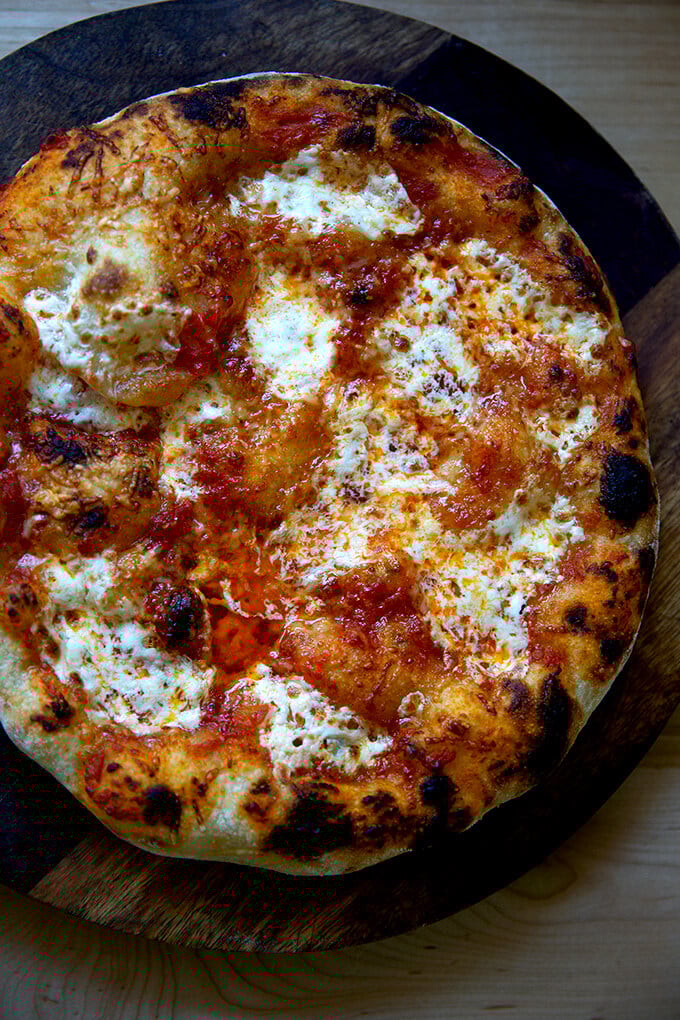
This sourdough pizza recipe produces a pizza with a ballooned, blistered edge and a crisp but pliable crust. The secret to achieving this texture in a home oven is to use a high-hydration dough (75%), proper fermentation (long and slow) at each phase, gentle handling of the dough, and a screaming hot oven (ideally outfitted with a Baking steel or pizza stone).
Let’s explore each in more detail:
5 Keys to Sourdough Pizza Success
- Use a high-hydration dough: Because home ovens rarely reach above 550ºF, it takes longer for pizzas to cook. In contrast, a 900ºF oven will cook a pizza in 60 seconds. To prevent pizza dough from drying out in a home oven, it is important that the dough has a lot of water in it — i.e., it is high-hydration. In contrast, outdoor oven pizza doughs can be much lower hydration.
- Ferment sufficiently: After the first long, slow rise, transfer the dough to the fridge for at least 12 hours and up to 3 days. Time further develops flavor, helps with browning, and improves the texture of the pizza dough.
- Proof sufficiently: If time permits, allow the dough to come to room temperature for at least an hour before baking (and up to 2), which makes it easier to shape — room-temperature dough stretches into a round more easily than cold dough.
- Handle the dough minimally: Using a delicate hand when shaping the dough preserves the air pockets created during fermentation.
- Invest in a Baking Steel: Steel is a better conductor of heat than stone — i.e., it transfers heat to the dough faster — which promotes great oven spring, which translates to glorious bubbles throughout the dough.
How to Make Sourdough Pizza, Step by Step
As always, a scale is essential for the best results. You need water, flour, salt, and a sourdough starter:
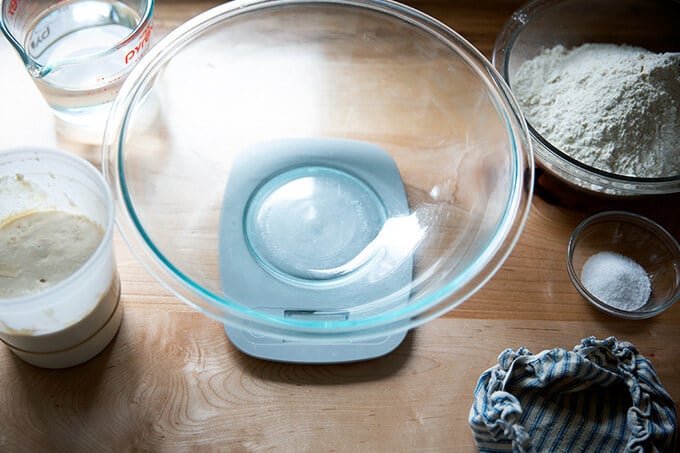
Combine 375 g water, 100 g sourdough starter, and 10 g salt in a bowl. (See notes in recipe box about using less water if you live in a humid environment.)
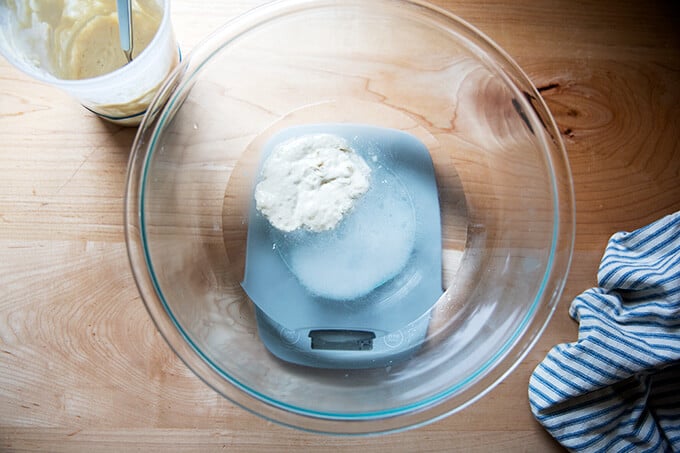
Stir to combine; then add …
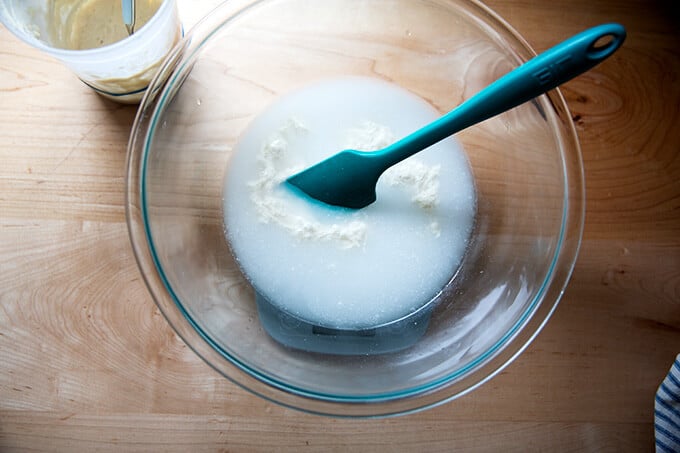
… 500 g all-purpose flour.
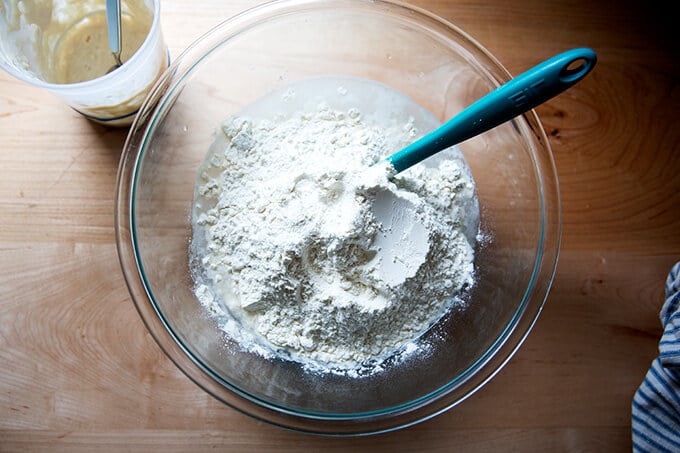
Stir until you have a sticky dough ball.
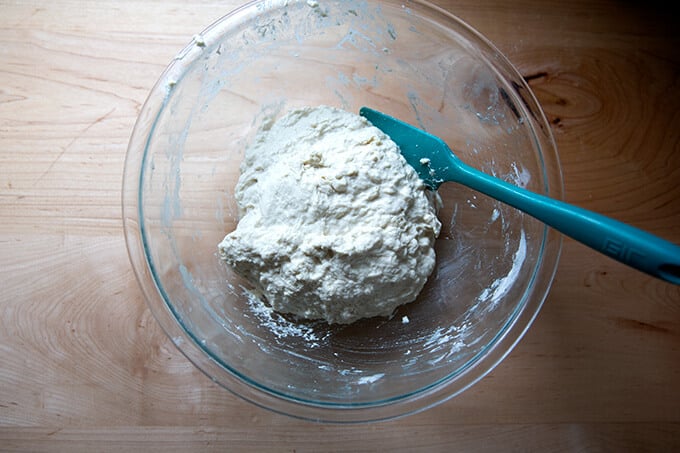
Transfer to a straight-sided vessel (if possible) and let rest for 30 minutes. Then, “stretch and fold” the dough (see video for guidance) 4 times at 30-minute intervals. Cover the vessel. Let it rest for 6 to 12 hours (see recipe notes for timing) or until the dough…
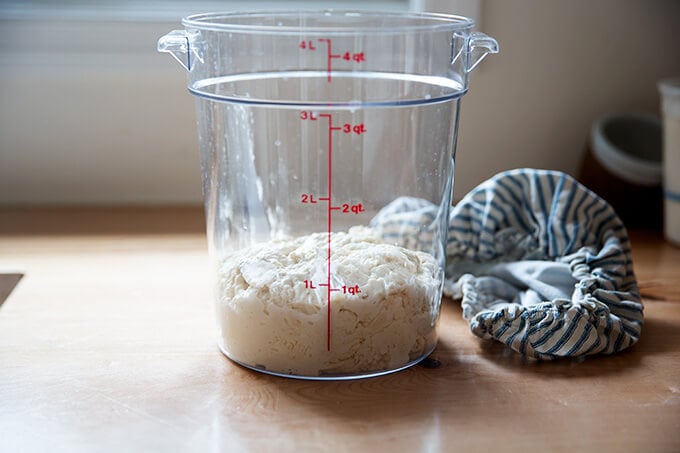
… has about doubled in volume. (Note: This is a little bit more than double. Ideally, you don’t want your dough to rise much beyond double. More recently, in fact, I stop the bulk fermentation when the dough has increased in volume by 50%.)
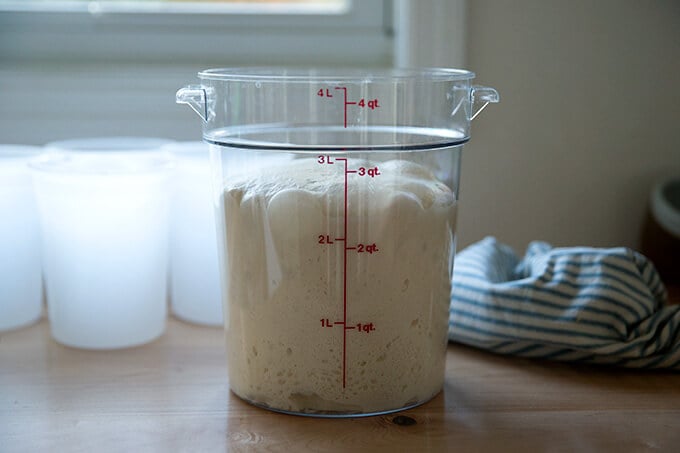
Turn the dough out onto a work surface. Use flour here as needed.
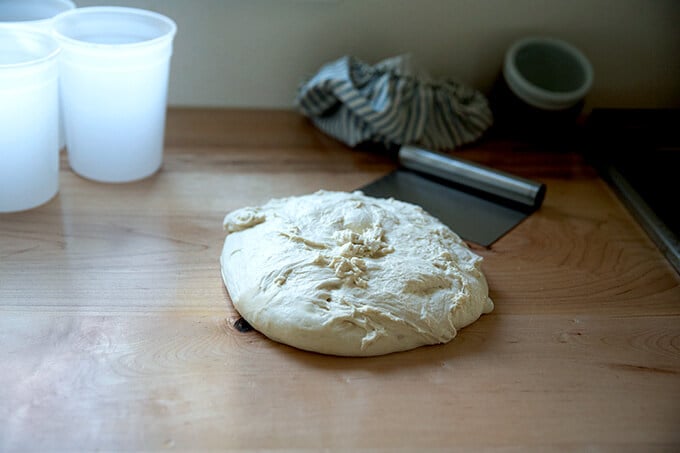
Portion into 4 equal pieces, again using flour as needed.
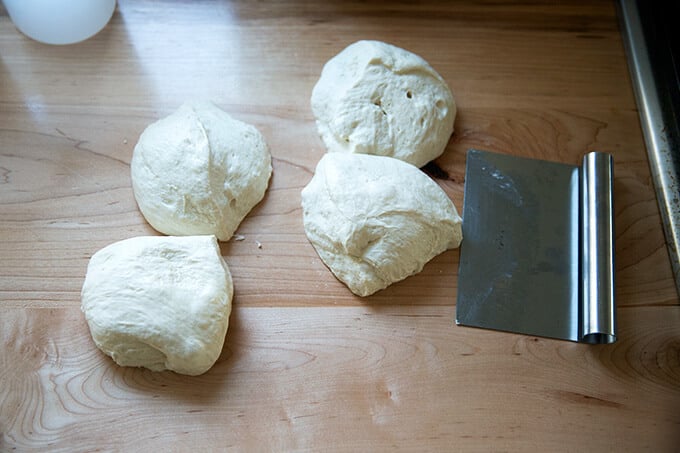
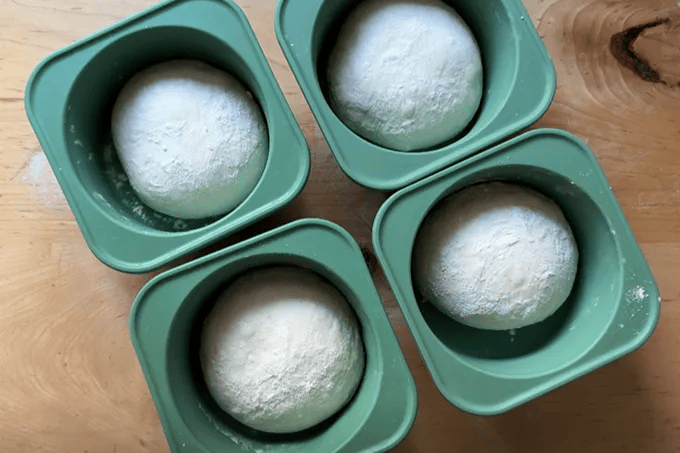
Ball up the dough, transfer the balls to storage containers, and stick them in the fridge. These Kevjes Dough Storage Vessels have become my favorite storage vessels for pizza dough balls:
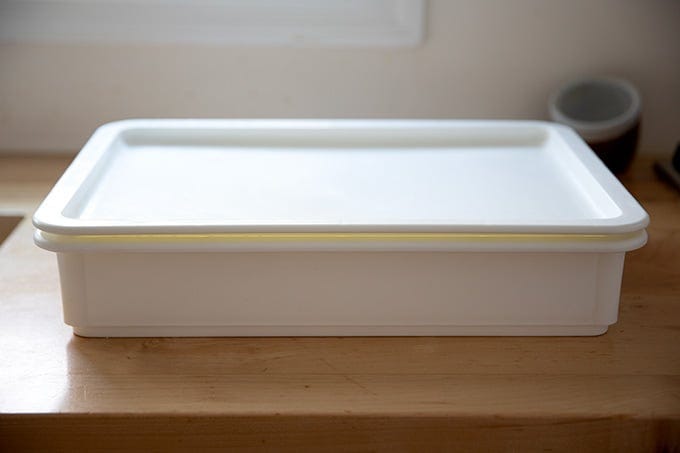
An hour prior to baking, remove a round (or more) of pizza dough from the fridge, and transfer it to a lidded vessel such as a DoughMate or a 9×13-inch baking dish covered with plastic wrap (to prevent the dough from drying out). If you have a Baking Steel, place it in the upper third of your oven, and heat the oven to 550ºF convection roast. (See recipe for other options.)
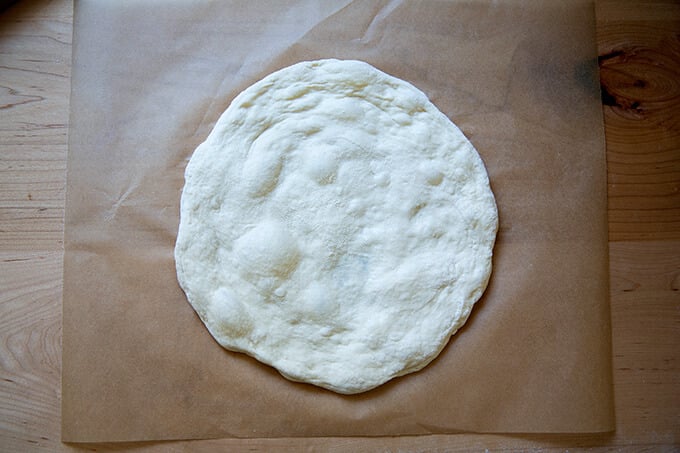
When the dough has proofed, delicately stretch it into a round, trying as best you can to preserve those air pockets.
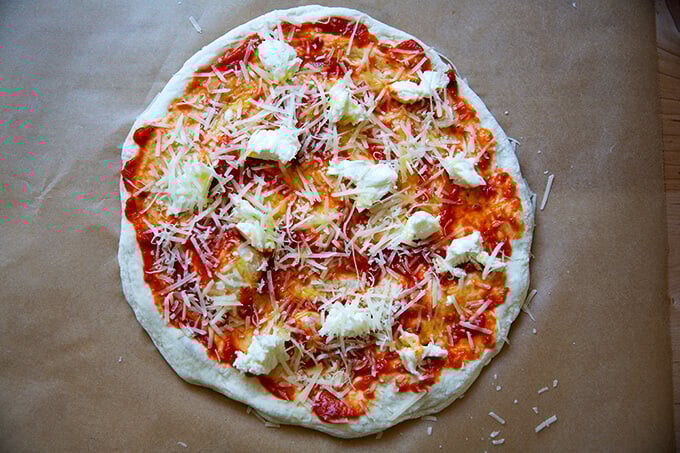
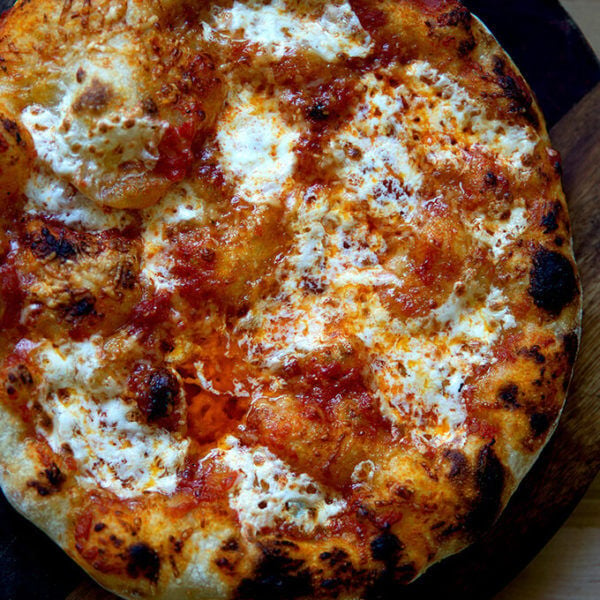
Top as you wish. This one is spread with tomato sauce and topped with fresh mozzarella, parmesan, olive oil, and sea salt.
Transfer pizza, parchment paper and all, to a preheated Baking Steel or stone, using a peel — my favorite peel is the Epicurean Pizza Peel. Bake 5 to 6 minutes or until cooked to your liking.
Slice and serve.
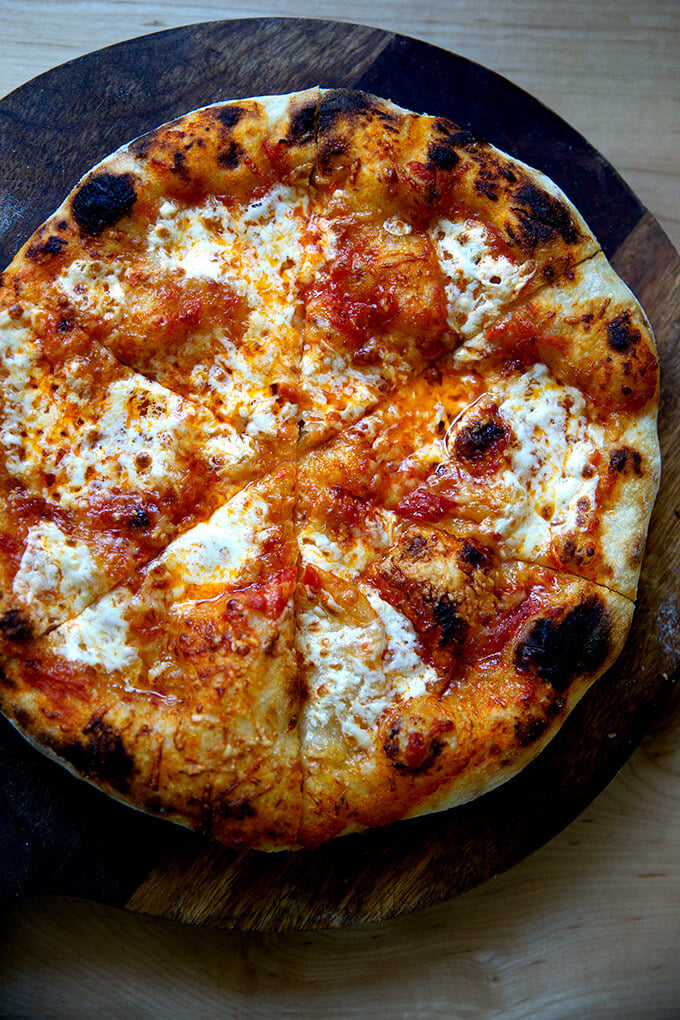
A little fresh basil is always nice.
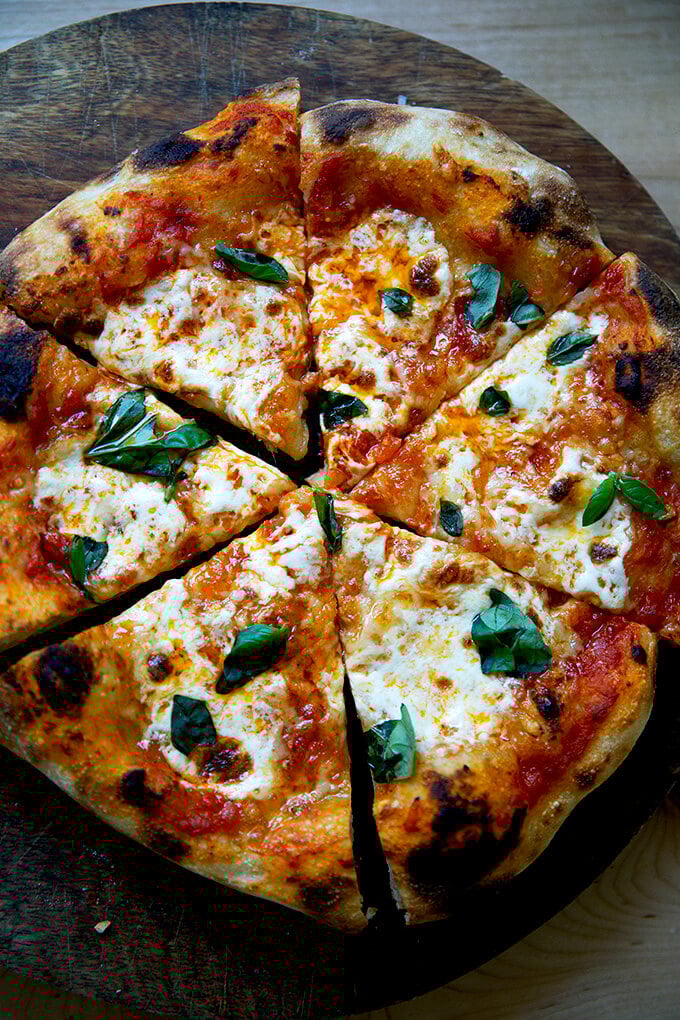
This is the beauty of the Baking Steel: oven spring!
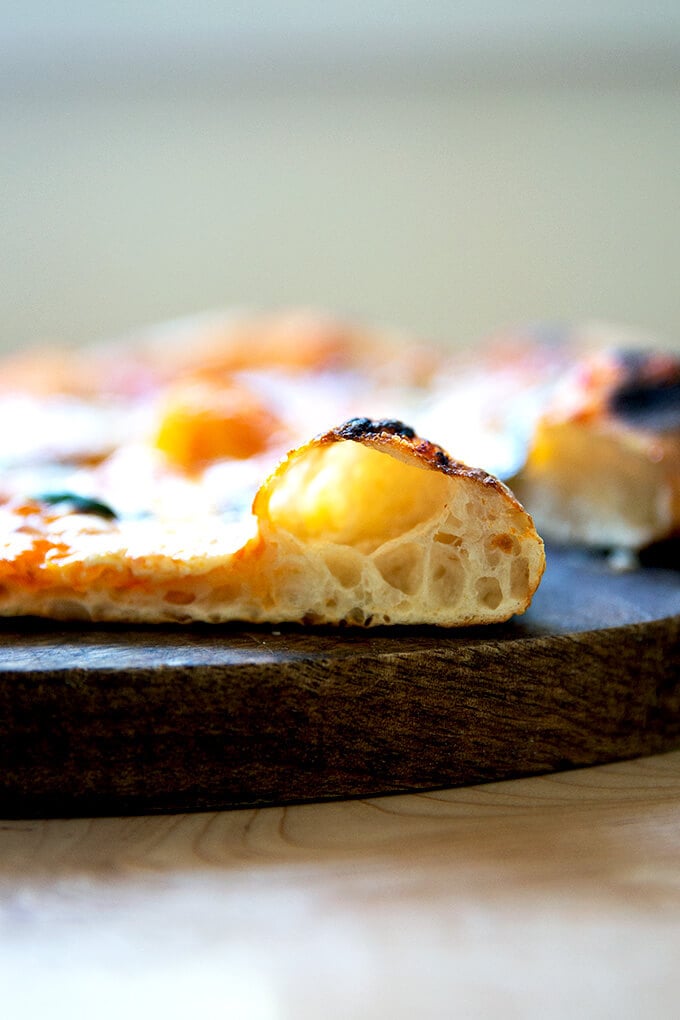
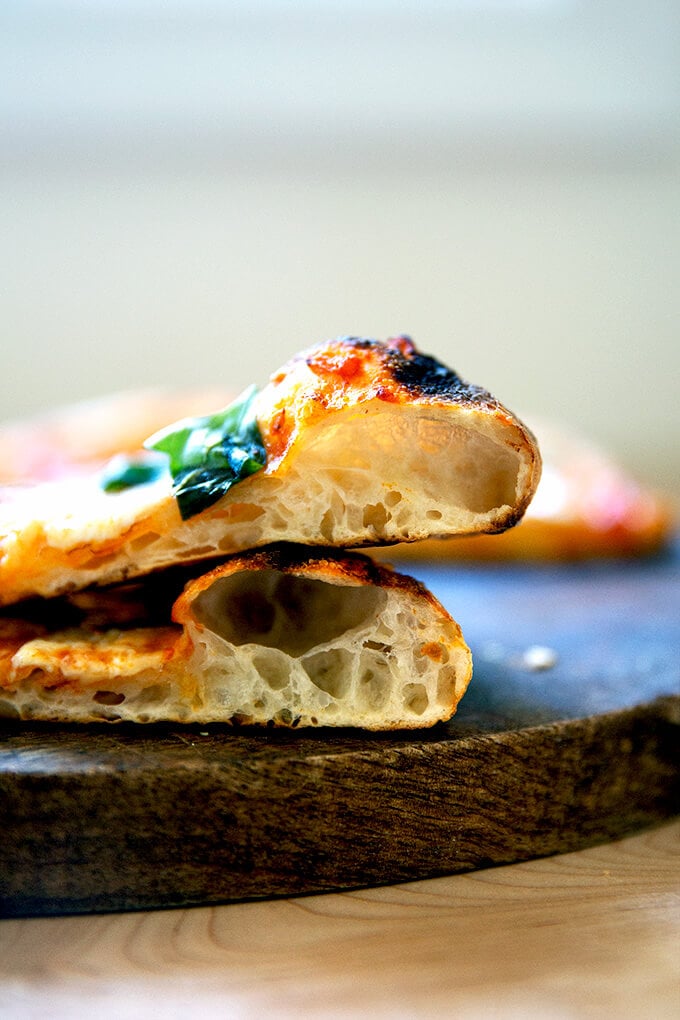
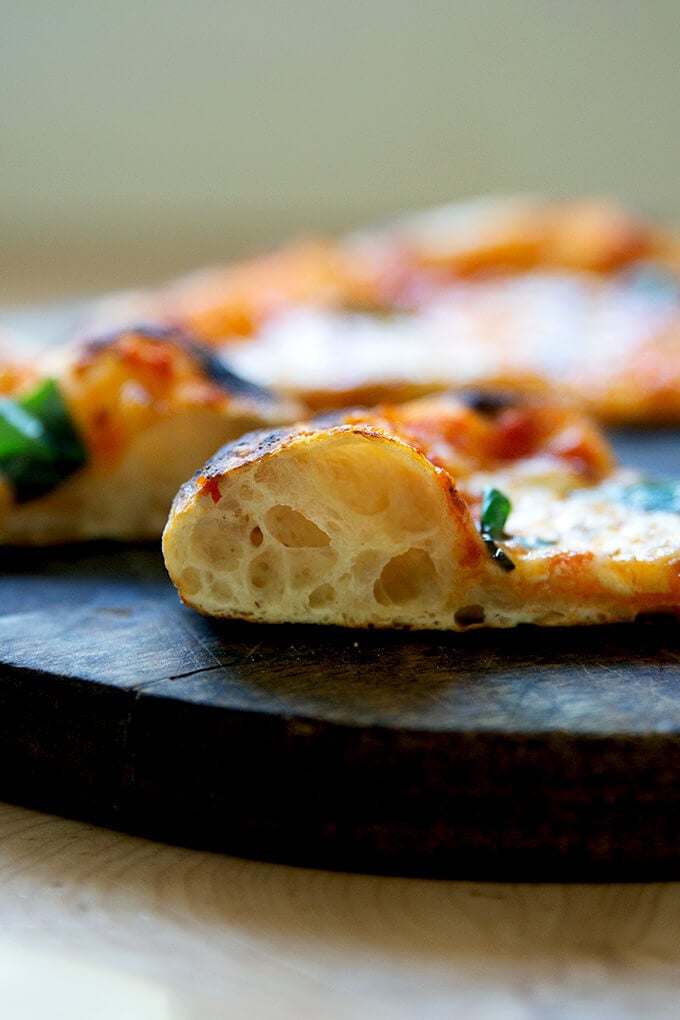
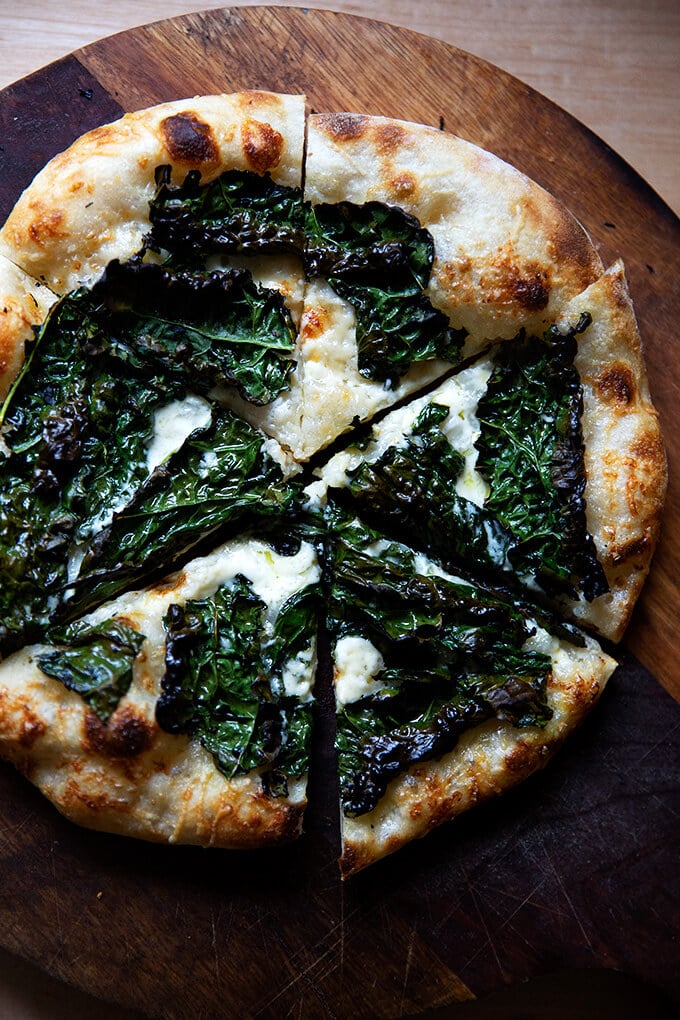
Another favorite: kale + crème fraîche:
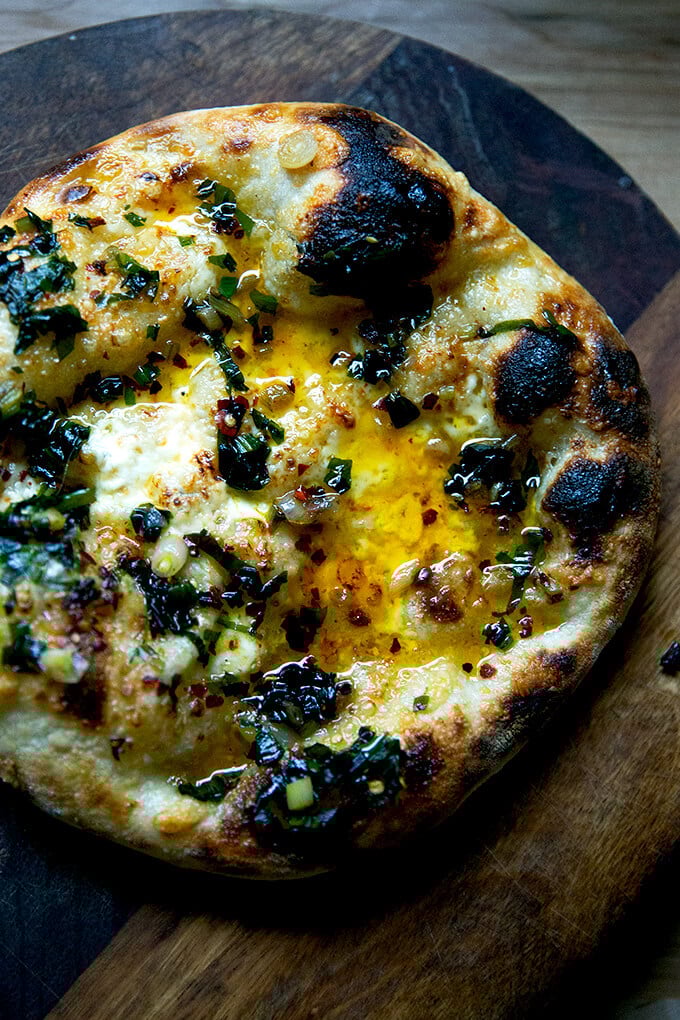
Another favorite: “naked” + spicy scallion (or ramp) oil:
Looking for more pizza inspo? My cookbook, Pizza Night includes 52 pizza and 52 salad recipes, one pair for every week of the year, as well as five simple desserts 🍕🍕🍕

Simple Sourdough Pizza Crust
- Total Time: 1 day + 1 hour
- Yield: 4 pizzas 1x
Description
Here is my guide for making sourdough pizza crust at home. Made with all-purpose or bread flour and no autolyse or preferment, the dough comes together simply: everything gets mixed together at once, and you are on your way! 🍕🍕🍕
**Attention Pizza Fans**: My pizza cookbook, Pizza Night, is now available everywhere books are sold. Get your copy here: Pizza Night
What you need to make this recipe…:
- …a sourdough starter. Ideally, you want to use your starter 4 to 6 hours after you feed it, when it has doubled in volume and is very bubbly and active. You can build a starter from scratch in just about 1 week. Or you can buy one. Here are two sources:
- …time. Once your starter is ready to go, this recipe requires an initial 6 – 18 hour rise, followed by at least 6 hours in the fridge or up to 3 days.
Timing/Schedule:
The timing will depend heavily on the time of year and the temperature of your kitchen. In the summer, because it is warm and humid, the first rise (bulk fermentation) of all my sourdoughs takes between 6 – 8 hours; in the winter it will take longer, 10 to 12 hours.
It is best to rely on visual cues. For the bulk fermentation, you want the dough to double or less than double: I now end my bulk fermentation when the dough has risen by 50% to 75% in volume. This is why I cannot recommend using a straight-sided vessel (as opposed to a bowl) enough. It makes gauging the first rise easier.
If at any point you are worried the dough will over-ferment — say, for example, the bulk fermentation is nearly complete but you are tired and want to go to bed — stick the vessel in the fridge and pick up the process in the morning. (Note: If your dough rises above double, don’t despair … my dough has tripled in volume during an overnight rise, and the resulting dough still had plenty of strength and spring.)
Schedule: I like mixing this dough in the evening, performing 4 stretch and folds before I go to bed (if time permits), then letting the dough complete its bulk fermentation at room temperature (68ºF) overnight or in the refrigerator (especially in the summer, when my kitchen is much warmer). In the morning, it’s typically ready to be portioned (if it rose at room temperature), transferred to storage vessels, and stashed in the fridge. If I had let my dough spend time in the fridge for the bulk fermentation, I remove it in the morning, and let it complete its bulk fermentation at room temperature. Once complete, I portion the dough and stash it in the fridge. Sometimes I’ll use the dough that same evening; sometimes I’ll use it the following day or the next. I encourage using the dough within 3 days.
In short: If you want pizza for the weekend, mix your dough on either Wednesday or Thursday.
Troubleshooting: If you have issues with your dough being too sticky, please read this post: Why is my sourdough so sticky? The 4 common mistakes.
Water: If you live in a humid environment or if you are making this on a particularly humid day, consider starting with less water, such as 335 grams of water, which will bring the hydration down to 70%. This amount of water will still produce a light airy crust but the dough will be more manageable.
Flour choice:
- You can make this dough with all-purpose flour or bread flour, and it works beautifully. You can use Tipo 00 flour if you want, but you’ll likely need to reduce the amount of water. Start with 350 grams and adjust moving forward based on your results.
Can You Freeze Sourdough Pizza Dough?
Yes. But, in my experience, the pizzas made from frozen dough do not spring as high upon being baked. They will still taste delicious as long as the time spent in the freezer is relatively short: the more time sourdough spends in the freezer, the more air bubbles it loses. After 1 week in the freezer, my dough will bake up fairly well. After 3 weeks in the freezer, my dough will be less bubbly and will bake into a thinner and crisper crust.
To freeze sourdough pizza dough: make it through step 4 in the recipe below or until after you transfer the portioned rounds to quart containers. At this point, transfer the quart containers to the freezer. To thaw, remove a container (or more) and let thaw in the refrigerator for 1 day or thaw at room temperature for 8 hours. Then, proceed with the recipe.
Favorite Pizza-Making Tools:
- Baking Steel
- Pizza Peel
- Parchment Paper: I bake my pizzas on parchment paper on my Baking Steel. Parchment allows for easy transfer from peel to steel.
- Cast Iron Skillet: If you do not have a Steel or stone, you can use a cast iron skillet. Rub a half teaspoon of oil over its surface, transfer a stretched dough round to the skillet. Top as desired. Bake at 450ºF for about 15 minutes.
- I love these Kevjes containers.
Ingredients
For the dough:
- 375 g water (or less, see notes above)
- 100 g sourdough starter, active and bubbly, see notes above
- 10 g salt
- 500 g all-purpose or bread flour
For each Margherita pizza:
- 2 tablespoons tomato sauce
- 1 to 2 oz mozzarella
- handful of grated Parmigiano Reggiano (less than an ounce)
- drizzle olive oil
- pinch sea salt
For each kale and crème fraiche pizza:
- extra-virgin olive oil
- a couple handfuls of baby or Tuscan kale
- 1 to 2 cloves garlic
- Sea salt, such as Maldon
- 2 tablespoons crème fraîche
- grated Parmigiano Reggiano, about 1/4 to 1/3 cup
For each naked pizza with ramp or scallion oil:
- 1/4 cup olive oil
- 1/4 cup minced scallions or ramps
- 1 teaspoon crushed red pepper flakes
- 1 to 2 tablespoons crème fraîche
- handful grated Parmigiano Reggiano
- sea salt
Instructions
- Mix the dough. Place the starter, salt, and water in a large bowl. Stir with a spatula to combine — it doesn’t have to be uniformly mixed. Add the flour. Mix again until the flour is completely incorporated. Transfer to a straight-sided vessel (if you have one.) Cover vessel with tea towel or cloth bowl cover and let stand 30 minutes.
- Stretch and fold: after 30 minutes have passed, reach into the vessel and pull the dough up and into the center. Turn the vessel quarter turns and continue this pulling 8 to 10 times. See video for guidance. Let the dough rest for another 30 minutes; then repeat the stretching and folding. If possible, repeat this cycle twice more for a total of 4 stretch and folds. By the 4th cycle, you will notice a huge difference in the texture of the dough: it will be smoother, stronger, and more elastic.
- Bulk fermentation: Cover vessel with a tea towel or bowl cover and set aside to rise at room temperature (70ºF/21ºC) for 4 to 18 hours (the time will vary depending on the time of year, the strength of your starter, and the temperature of your kitchen; see notes above) or until the dough has roughly doubled in volume. (UPDATE: In the past I have recommended letting the dough rise until it doubles in volume. If you’ve had success with this, continue to let the dough double. Recently, I have been stopping the bulk fermentation when the dough increases by 50% in volume, and I feel my dough is even stronger in the end.) Note: Do not use your oven with the light on for the bulk fermentation — it is too warm for the dough. When determining when the bulk fermentation is done, it is best to rely on visual cues (doubling in volume) as opposed to time. A straight-sided vessel makes monitoring the bulk fermentation especially easy because it allows you to see when your dough has truly doubled.
- Portion and shape: Turn the dough out onto a work surface and shape into a rough ball, using as much flour as needed — the dough will be sticky. Using a bench scraper, divide the dough into 4 equal portions. Sprinkle portions with flour. With floured hands, roll each portion into a ball, using the pinkie-edges of your hands to pinch the dough underneath each ball. Transfer each round of dough to a plastic quart container, cover, and store in fridge for at least 6 hours or up to 3 days or transfer to the freezer for up to 1 week. (To thaw, remove a container (or more) and let thaw in the refrigerator for 1 day or thaw at room temperature for 8 hours. Then, proceed with the recipe.)
- Make the pizzas: Pull out a round (or more) of dough from the fridge one hour before you plan on baking. Dust dough with flour and place on a floured work surface. Let sit untouched for about an hour (a little longer or shorter is fine). Place a Baking Steel or pizza stone in the top third of your oven. Set oven to 550ºF. Heat oven for at least 45 minutes but ideally 1 hour prior to baking.
- Shape the dough: Gently shape dough into a 10-inch (roughly) round handling it as minimally as possible. (See video for guidance.) Lay a sheet of parchment paper on top of a pizza peel. Transfer the dough round to the parchment-lined peel.
Top and Bake
- To make a classic Margherita-style pizza: Spread 2 tablespoons of tomato sauce over the surface of the dough. Top with mozzarella to taste. Sprinkle with parmesan to taste. Drizzle with olive oil. Sprinkle lightly with sea salt. Shimmy the pizza, parchment paper and all into the oven. Bake pizza until top is blistered, about 5-6 minutes. Transfer to cutting board. Sprinkle with basil, if you have it. Cut and serve. Discard parchment paper.
- To make a kale and crème fraîche pizza: Place the kale in a small bowl, drizzle with olive oil, season with sea salt, and toss. Spoon crème fraîche over the dough leaving a 1/2-inch border or so—I use about a tablespoon per pizza. Sprinkle with minced garlic and a handful of grated Parmigiano Reggiano. Top with the kale. Shimmy the pizza, parchment paper and all into the oven. Bake pizza until top is blistered, about 5 – 6 minutes. Transfer to cutting board. Cut and serve. Discard parchment paper.
- To make a naked pizza with scallion oil: Heat 1/4 cup olive oil in a skillet with 1/4 cup of minced scallions (or ramps!) and 1 teaspoon crushed red pepper flakes. Keep it over low heat while you make the pizza. Spoon crème fraîche over the dough leaving a 1/2-inch border or so—I use about a tablespoon per pizza. Sprinkle with a handful of grated parmesan. Shimmy the pizza, parchment paper and all into the oven. Bake pizza until top is blistered, about 5 – 6 minutes. Transfer to cutting board. At this point, the scallions should be starting to “frizzle”. If they aren’t, crank up the heat until the oil is sizzling. Spoon a few tablespoons of the hot oil over the pizza (you’ll have extra oil). Sprinkle with a pinch of sea salt. Cut and serve.
- Prep Time: 24 hours
- Cook Time: 5 to 6 minutes
- Category: Pizza
- Method: Oven
- Cuisine: American, Italian
This post may contain affiliate links. Please read my disclosure policy.






1,553 Comments on “Simple Sourdough Pizza Crust: A Step-by-Step Guide”
I ended up doubling the recipe because I was so excited after reading all the positive comments. Then I came across the comment about freezing and your response. Now I have eight balls of dough in my fridge. I’ll probably make three or four of them the other four sounds like it would be best to par. Bake them, then freeze them. After I pull it out of the freezer how long should I keep it at room temperature before I put it in the hot oven. I know just having the regular balls you need to have a one hour at room temperature so I’m sure the frozen one needs to be thawed first then toppings added then baked right
Hi Jenn,
Can you clarify: are you going to freeze the parbaked rounds? Or are you going to freeze some of the dough balls?
The parbaked rounds thaw pretty quickly: I’d say 1 hour at room temperature. Dough balls take longer, but as noted in the post, I don’t find sourdough dough balls do very well in the freezer.
Sorry, I plan to parbake rounds for 60-90 seconds then freeze.
Or would you recommend( texture and quality of end product ) I make all 8 pizzas then freeze those not eaten to make premade frozen pizza . If the latter, should I thaw for 1 he then bake?
Hi, I do think parbaking for 60-90 seconds, then freezing the completely cooled parbaked rounds is the best option.
You may want to see what one commenter, Charissa, did to make “homemade frozen pizza”: https://vector-hatch.live/2020/05/01/simple-sourdough-pizza-a-step-by-step-guide/comment-page-19/#comments%3C/a%3E (This isn’t a direct link to the comment… search for her name and the comment will come up).
Thanks for that I found it quickly dated April 2nd. I cooked up 1 full pizze and parbaked the others last night. My son found the crust chewy. I had the dough in the fridge for 3 days. I the rounds were so light and fluffy and had many air pockets when I was very gently handling it to shape. Is that expected? I was hoping for light and airy napolitain style of crust. It was much thinner than previous pizza sourdough recipes, so that was great!
Hi! What kind of flour did you use? And did you use a scale to measure? And are you baking them on a Baking Steel?
I used AP flour. Used scale and pizza stone and partake rounds on stainless steel.
Hi! You may find you’ll get better spring in the oven with bread flour. I also do think a Baking Steel will give you superior results to a pizza stone. Did you preheat your stone for about an hour before using? When you say “partake rounds on stainless steel” I’m assuming your meant “parbake” but can you clarify what you mean: did you parbake the rounds on a stainless steel pan as opposed to your stone?
This is a great recipe. I love the ease and the taste. I used some corn meal on the parchment to add some texture to the bottom. I found the dough easier to work with after two days of refrigeration and just made the perfect pizza. Thanks for the recipe.
Great to hear, Nancy! Thanks so much for writing and sharing this 🙂
There is no Reply option to your last response June 11th to my comment so writing it here. I forgot to mention that I added 1 tsp of vital gluten to each cup of APF to boost gluten content to wards Bread flour’s. Yes, parbake not partake. I cooked up the rounds on stainless steel baking sheets and cooked the full pizza on the stone. The stone was heated 1 hr before to max temp 450. I noticed my rounds were not uniform when they cooked – eg some areas rose, some didn’t.
OK, got it. I would parbake on your pizza stone next time. I think you’ll get a better-textured crust if you do.
I also recently discovered that my fully baked/topped pizzas freeze very well. I let them cool completely; then tuck them into 2-gallon ziptop bags. I was able to get two pizzas in one bag, each separated by a round of parchment paper. To reheat, I placed the frozen pizza directly on the rack for 8 minutes @ 400ºF.
Do I HAVE to put the dough in the fridge after shaping the 4 balls of dough?
Nope! But good things happen to the dough with cold fermentation. I find 24-48 hours to be the sweet spot.
thank you for this recipe. We have enjoyed it. What is your cooking recommendations for turning the pizza into stromboli?
Hi! I have a stromboli guide here: https://pizzaeveryfriday.substack.com/p/stromboli-every-saturday
The dough I use is slightly lower hydration, so my suggestion would be, if you want to use this dough, is to lower it to 70% hydration (roughly), which will allow you to roll it out.
I made this dough and the pizza was fantastic. I also tried freezing the dough as instructed, I was so disappointed with it as I thawed it out and used it, the dough never got crisp, I left it in fridge to thaw and then on counter as instructed. What went wrong?
How long was it frozen for? I need to add some notes to the recipe in regard to freezing. In the actual post, I say this in regar to freezing: “Yes you can freeze the dough, but in my experience, the pizzas made from frozen dough do not spring as high upon being baked, but they still taste delicious as long as the time spent in the freezer is relatively short: the more time sourdough spends in the freezer, the more air bubbles it loses. After 1 week in the freezer, my dough will bake up fairly well. After 3 weeks in the freezer, my dough will be less bubbly and will bake into a thinner and crisper crust.”
Solid! I don’t have a pizza stone so I par bake at level 2 from bottom for about 4 min, put toppings on and bake on same level for about 5 and then move to level 2 from top to finish.
Great to hear, Lollie! Thanks so much for writing and sharing your notes 🙂
I am a huge fan and learned to bake sourdough bread from your tutorials. During bulk fermentation, I use the fabric bowl covers that you recommend. I recently bought your new cookbook, and I am excited to learn more about pizza. My question is, here in this recipe you direct us to use the bowl cover or tea towel during BF, but I see in your cookbook Sourdough Neopolitanish recipe, you direct us to cover tightly during BF. Can you please clarify? Thanks very much.
Thank you, Deirdre! When I was first learning to bake, my mother always covered her rising breads with tea towels, so that is what I did, too. When I discovered cloth bowl covers, I was in heaven, because I loved how easily they stayed in place. As I baked more, I started getting more into longer, slower rises, both with yeast breads and sourdough breads. With these longer rises, I noticed that my dough would sometimes form a crust/dry out. I realized that if my bowl had more of a sealed cover, the crust wouldn’t form. So, for any long, slow rise, I now recommend using a sealed lid. Hope that helps!
If I parbake and leave out to use for a later day do you know how long it would be good for?
I’d say 2-3 days in an airtight bag.
Hi!! Super excited to try this. Would this recipe work in a pizza oven?
Hi and yes, but you’ll want to lower the hydration. My preferred method for my Gozney Dome is to cook my pizzas at 650ºF-750ºF for 2.5-3 minutes (as opposed to 800-900ºF for 60 seconds). At that temperature range, I find 68-70% hydration to be great depending on the flour you are using (if using a tipo 00 type flour, 68%; if using a bread or ap flour, 70%).
For this recipe, I’d suggest using between 325 and 335 grams of water. Let me know if you have any more questions 🙂
This is my go-to recipe for SD pizzas. It is very close to the basic SD bread recipe which is great. Even bringing the hydration down to 68-64% still leaves an overly extensible dough which is carefully managed by flopping it on parchment paper to launch. Maybe all long ferment SD pizzas get this way after the gluten’s are nearly consumed. I have freshly fed starter and a first rise at 75%. I have also made this at least 15 times. Any thoughts on how to strengthen the dough for handling? Thanks!
Great to read all of this, Gus! What kind of flour are you typically using?
KA Bread always!
Thanks
OK, great. And are you doing four sets of stretches and folds? And how long are you cold fermenting the dough before baking?
I do find the sweet spot to be 1-2 days in the fridge…after that, the gluten structure really begins weakening.
My only final thought would be to do a sort of autolyse… not a true autolyse, but you could mix the dough without the salt; let it rest 30 minutes; then knead in the salt. I ate this process because I find it hard to knead in salt after the fact, but doing so potentially could make for a stronger gluten structure.
Ali, Thanks for your comments. I do autolyse for 30 minutes and then 3SF’s with a Coil fold at the end. I’ve come to believe that that is the nature of the beast with higher hydration doughs and sourdough. I may try 07% IDY as Dan Richer has mentioned. Thanks and best of luck!
That’s a great idea! I have Dan’s book but must have missed that tip. Thanks for sharing.
I have been making sourdough for a while now, and started experimenting with yeast pizza doughs. I was getting frustrated and decided to go back to what I know best. This recipe was perfect and made our most successful pizzas yet!
Great to hear, Cindy! Thanks so much for writing and sharing this 🙂
Why no oil and sugar in this pizza dough?
It’s not necessary! This is a Neapolitan-style pizza dough, and this style of dough does not contain oil (or it may contain very small amounts) or sugar. During the long slow rise, enzymes in the flour and wild yeasts will convert the starches in the flour into sugars, which will lend its own subtle sweetness and which will help with browning, too.
Oops! After the rest overnight, the recipe says, “use as much flour as needed.” I used as much needed, as I kneaded it to form a traditional ball of pizza dough (2 cups of flour, and probably 8 minutes of kneading). Uh, oh! Then I watched Alexandra’s VIDEO, and realized I messed up. Watch the VIDEO! “Add as much flour as needed” means a small sprinkle. No kneading, just folding. I am very new to this, but a yeast breadmaker and baker in general, so that brain took over! Oh well! I guess I’ll see how my dough comes out! 🙂
Hi Courtney! Sorry the instructions confused you. I do worry that that amount of additional flour will alter the texture of the dough. Do you have a digital scale?
I do have a scale. You’re reciepe is almost 1000 grams and I added the 2 cups of flour (240g).
The Pizza was nice and thin and tasted good, but not sourdough. I will do it the right way next time. I think I am also scared of trying to get a high hydration dough on and off the peel into our pizza oven (Ooni). Practice! Ordered your book, and looking forward to the journey! Thank you!
Great to hear about the scale, Courtney, and thank you so much for ordering my book… it means a lot 🙂 If you are going to be baking this in your Ooni, which is obviously a much higher temperature than a home oven, you’re going to want to reduce the hydration. I like to use a 70% hydration dough in my outdoor pizza oven. The instructions are in the book though, so you can see how to adapt this recipe for cooking in an outdoor oven. You’ll see my instructions for cooking in an outdoor oven as well in the book.
Thanks again!
I’ve tried a few sourdough pizza dough recipes and this is my favourite to date hands down!! Easy to follow and the dough was light, airy, nice and soft in the middle with a great chew outside. I just wish I could get those pretty blisters 🙂
Great to hear, Tracey! Thanks so much for writing 🙂
Regarding those pretty blisters, are you using a baking steel in your oven? And if so, what rack do you have the baking steel on?
I have a baking steel and I baked on the BBQ and then transferred to the oven to broil on the top rack but still couldn’t get those blisters. Maybe I’ll try the oven next time from start to finish. My oven isn’t convection unfortunately.
Yeah, try the Baking Steel on the top rack of your oven. Preheat it for 1 hour at its hottest setting. You can switch to the broiler at the end (remove parchment paper if you use it) to get a bit more char.
Good Morning – Thanks for all the great recipes and detailed instructions. The videos are the most helpful. I made the pizza dough and it was great. Just wondering if I could try using 00 Pizza Flour? I still have a lot of King Arthur’s 00 Pizza Flour after trying several other 00 dough recipes with no luck. If OK, what adjustments should I make? Thanks again !
You’ll need to cut back the water significantly because 00 flour doesn’t absorb water the way commercial bread flour does. You might also find that the crust doesn’t brown as well as bread flour.
I’d start with 325-335 grams water. You can always add a little bit of water in if the dough seems too dry.
My first time making any type of pizza dough and it turned out perfectly! So airy and tender with a nice chew.
Great to hear, JG! Thanks so much for writing 🙂
The recipe says to cut into 4 pieces. Do you know what the weight of each ball is in ounces?
First time trying this recipe.
Thx
Roughly 240 grams each!
Another wonderful recipe from you with clear instructions/video. I’m curious to know what oven you have; I’ve only baked with fire bricks on my grill as my oven only goes to 450F at best. I’m looking for a 550F temp (or greater) oven. Thanks!
Hi! I have a Wolf oven… not sure what model, but it gets up to 550, which is great for pizza 🙂
Thank you! Wolf is my first choice but wasn’t able to find the spec on the high temp. Gorgeous oven/range.
It’s a great oven! I figured out what I have: it’s the M Series.
gorgeous oven and better yet great for high temperature baking. thank you.
What difference do you notice with bf to more than double vs only 50% volume increase?
For some doughs, doubling in volume means overfermenting, which means the dough loses all strength and elasticity. At 50% rise, there is less chance of overfermenting, and the dough retains all of its strength before the cold proof, where it continues to ferment and develop flavor.
How big of a pizza should each ball make?
The dough balls should be roughly 240-245 grams each. Each pizza will be roughly 11-12 inches.
About what size (how many inches) are these pizza crusts?
Also, you say to bake at 550 on the pizza steel but at 450 if using a cast iron skillet, is that correct? Why such a vast difference in temp?
Thanks Ali!
Hi Shawna! The crusts are roughly 11 inches in diameter.
When you bake in a skillet you need to bake it for longer (like 15 minutes) and it’s not preheated. A preheated baking steel will cook the pizzas in 5-6 minutes. A longer bake time with the skillet means the oven temp needs to be reduced, otherwise the top will burn before the pizza is cooked through.
I love that this is the same basic recipe as your sourdough bread. I doubled this and made 8 individual pizzas for family night today. I could probably have gotten away with just this recipe, but feeding 9 people including teens I wanted to overcook vs. under. Now, if only I could find a good sauce recipe!
Great to hear, Jasmine! Thanks so much for writing. And yes, I’m finding I need to double everything with a few teenagers in the house now 🙂
This is the no-cook tomato sauce recipe from my cookbook Pizza Night. It’s the one I make most often now:
No-Cook Tomato Sauce
Makes 1 quart
1 garlic clove2
8-oz can peeled San Marzano tomatoes, such as La Valle, Di Napoli, or Afeltra
1 to 1.5 teaspoons fine sea salt
3 tablespoons olive oil
Place the garlic in a food processor and purée until smooth. Add the tomatoes, 1 teaspoon of the salt, and the olive oil, and purée until smooth. Taste. Add the remaining 0.5 teaspoons salt if desired. Purée again. Transfer to a storage jar and keep in the fridge for at least one week.
Do I preheat the oven for 45 min WHILE the cast iron skillet is in the oven?? Can’t wait to try this. And do you have to put them in plastic containers?
Hi Brandi! Apologies for the delay here. No, for the cast iron skillet method, you do not preheat the skillet… you’ll bake the pizza longer at a lower temperature. Regarding containers, are you looking for a non-plastic option?? There are alternatives for sure to the plastic. These are my favorite.
Can you half the recipe and make one large pizza? Just my husband and I . Thanks
Yes!
New-ish to sourdough and SUCH a fan of your “simple sourdough” recipe. Thought I’d try my hand at this pizza crust but have a question – when I divide into the dough balls to refrigerate overnight, can I just place the dough balls onto a large baking sheet (or 2) and cover? The plan was to double the recipe and make 8 dough balls to use all at the same time (can I effectively double this recipe? Or should I make 2 separate recipes? I do have 2 straight sided 4qt vessels for bulk fermentation). Thanks so much!!
You can definitely double the recipe! And one 4-quart vessel should be fine for the bulk fermentation for a double batch. Yes, you can use 2 sheet pans but be sure that the dough is very well protected by the plastic wrap — if even a small portion of it is exposed, it will dry out/form a crust and will not handle properly as a result. So yes, use whatever vessel you have, just be sure it is sealed 🙂
Hi! I made this recipe for the first time and my dough turned out more like a pinsa Romana instead of Neapolitan. Any ideas why is that? I used 00 flour and the dough looked great!
I think it’s likely because using 00 flour here will create a wetter dough — it just isn’t as absorbent as bread or all-purpose flour. My suggestion would be to use bread flour next time around.
I don’t really like the balloon pockets so I work mine down. My husband says its the best homemade pizza he has ever had. I am so thrilled for a simple, sour dough, go to recipe! I want to experiment with par baking so I can freeze some. Some said 30-90 seconds? That sounded too short?
Great to hear! Love this 🙂 And yes, I’d say 60-90 seconds is right… you want the dough to barely take on any color.
Hi! For the first rise, can you leave it in the fridge overnight to double in size?
Hi! You likely won’t see much rise in the fridge — sourdough doesn’t change much in the fridge. You can use the fridge if you are worried about your dough over fermenting at room temperature, definitely use your fridge, but know that you will need to give the dough time at room temperature to grown to that 50-75% increase in volume.
Perfect every time! I cut the dough into three instead of four and it’s the perfect size for my staub cast iron pan. I bake at 550 and turns out perfect!
Great to hear, Jess! Thanks so much for writing and sharing your notes… great method and helpful for others who don’t have a Steel.
I ended up with a sticky mess, couldn’t really release from the BF bowl, then definitely too sticky to make into balls. What did I do wrong? Overferment?
Yes, possibly.
Did you use a scale to measure?
What type of flour?
Did you use a straight-sided vessel for the bulk fermentation?
How long was the BF?
Are you new to sourdough and confident in the strength of your starter?