 →
→ 

Simple Sourdough Pizza Crust: A Step-by-Step Guide
 By Alexandra Stafford
—
Last Updated: 01/22/2026
By Alexandra Stafford
—
Last Updated: 01/22/2026
This post may contain affiliate links. Please read my disclosure policy.
As far as sourdough pizza recipes go, this one is as simple as it gets: it’s made with all-purpose or bread flour, and there is no autolyse or preferment — everything gets mixed together at once. Ready? Wake up your starter! Read on to learn 5 secrets to sourdough pizza success.🍕🍕🍕
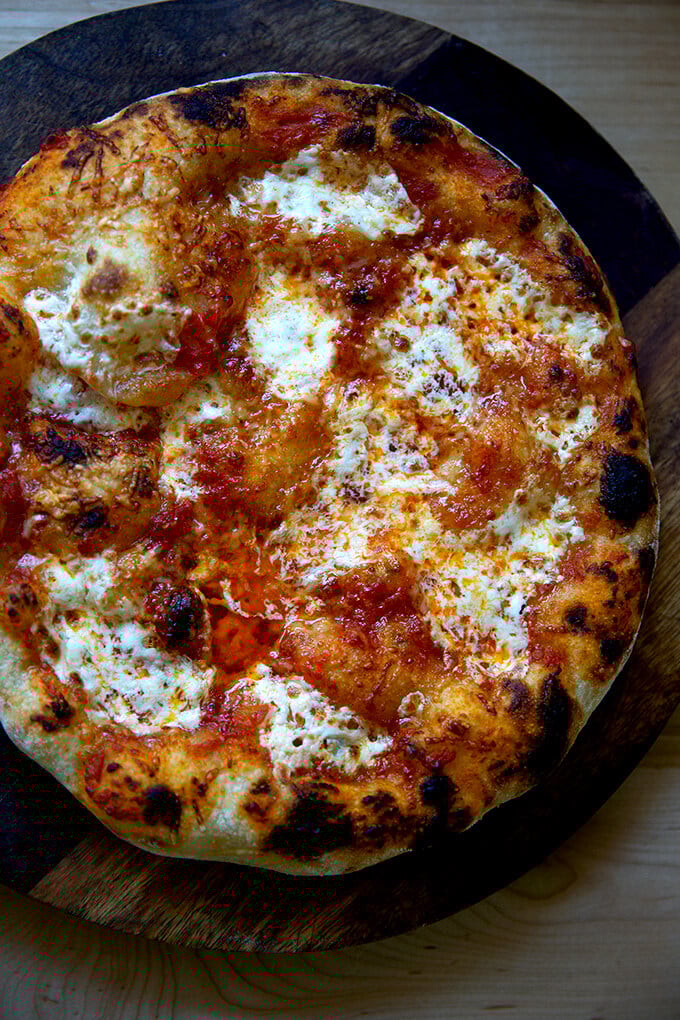
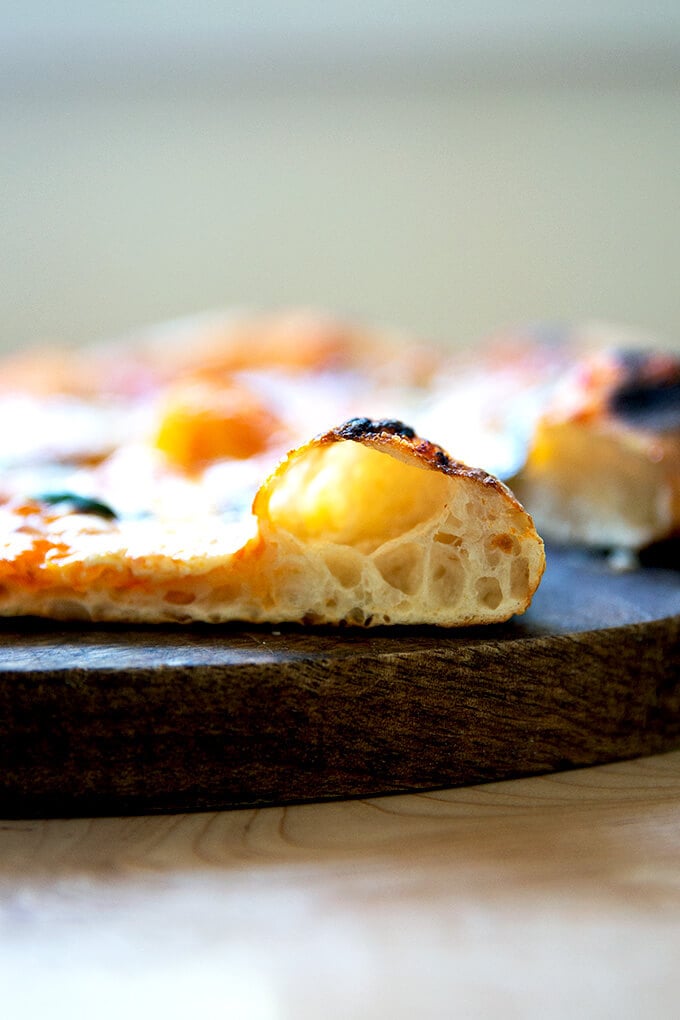
This sourdough pizza recipe produces a pizza with a ballooned, blistered edge and a crisp but pliable crust. The secret to achieving this texture in a home oven is to use a high-hydration dough (75%), proper fermentation (long and slow) at each phase, gentle handling of the dough, and a screaming hot oven (ideally outfitted with a Baking steel or pizza stone).
Let’s explore each in more detail:
5 Keys to Sourdough Pizza Success
- Use a high-hydration dough: Because home ovens rarely reach above 550ºF, it takes longer for pizzas to cook. In contrast, a 900ºF oven will cook a pizza in 60 seconds. To prevent pizza dough from drying out in a home oven, it is important that the dough has a lot of water in it — i.e., it is high-hydration. In contrast, outdoor oven pizza doughs can be much lower hydration.
- Ferment sufficiently: After the first long, slow rise, transfer the dough to the fridge for at least 12 hours and up to 3 days. Time further develops flavor, helps with browning, and improves the texture of the pizza dough.
- Proof sufficiently: If time permits, allow the dough to come to room temperature for at least an hour before baking (and up to 2), which makes it easier to shape — room-temperature dough stretches into a round more easily than cold dough.
- Handle the dough minimally: Using a delicate hand when shaping the dough preserves the air pockets created during fermentation.
- Invest in a Baking Steel: Steel is a better conductor of heat than stone — i.e., it transfers heat to the dough faster — which promotes great oven spring, which translates to glorious bubbles throughout the dough.
How to Make Sourdough Pizza, Step by Step
As always, a scale is essential for the best results. You need water, flour, salt, and a sourdough starter:
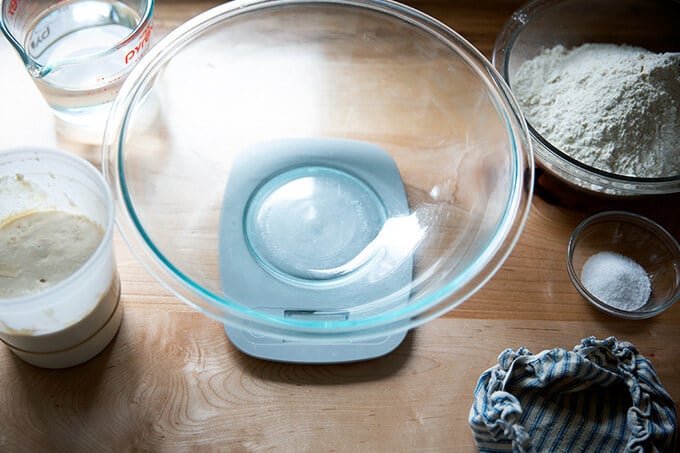
Combine 375 g water, 100 g sourdough starter, and 10 g salt in a bowl. (See notes in recipe box about using less water if you live in a humid environment.)
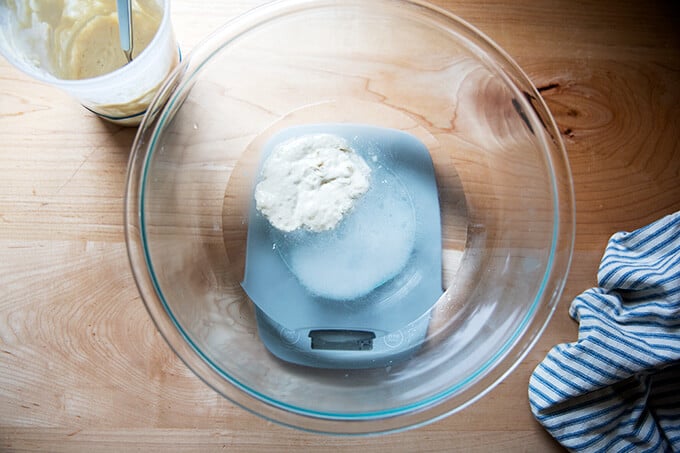
Stir to combine; then add …
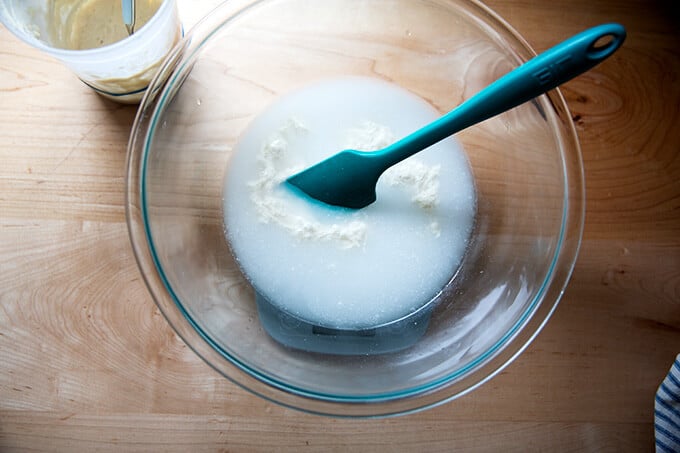
… 500 g all-purpose flour.
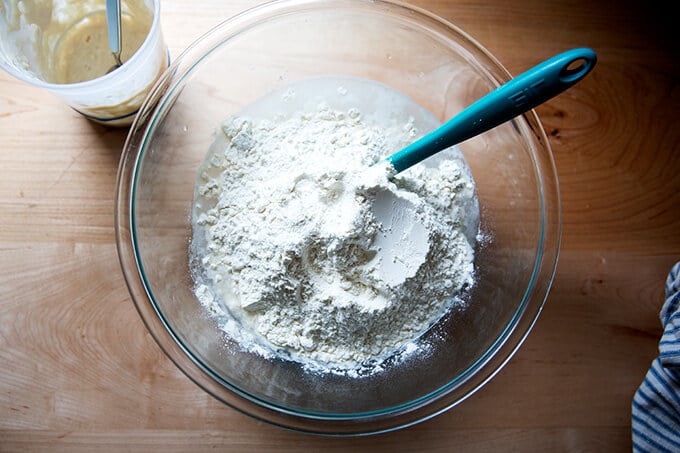
Stir until you have a sticky dough ball.
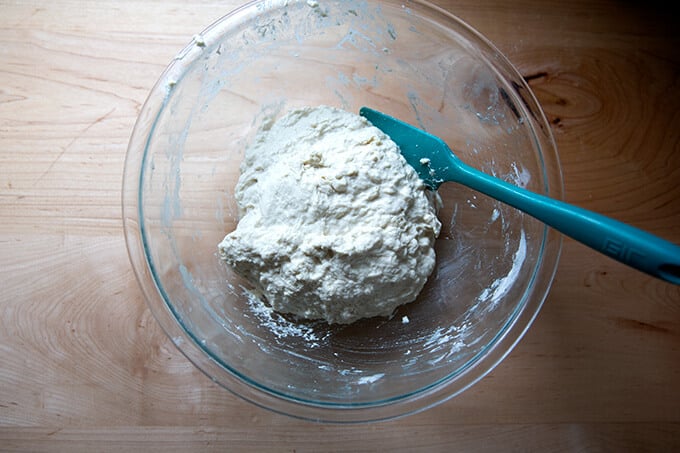
Transfer to a straight-sided vessel (if possible) and let rest for 30 minutes. Then, “stretch and fold” the dough (see video for guidance) 4 times at 30-minute intervals. Cover the vessel. Let it rest for 6 to 12 hours (see recipe notes for timing) or until the dough…
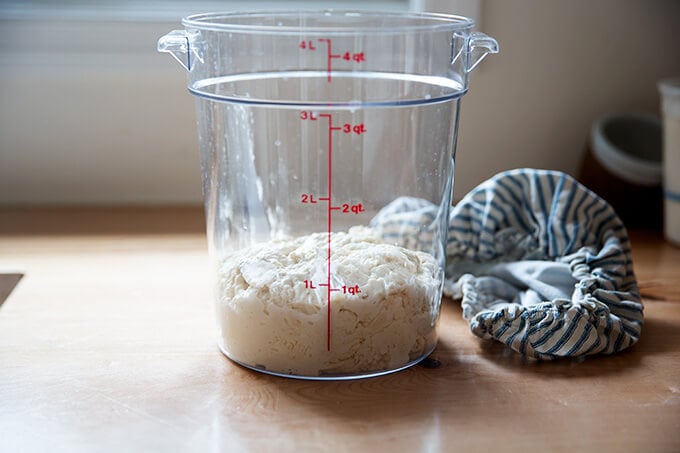
… has about doubled in volume. (Note: This is a little bit more than double. Ideally, you don’t want your dough to rise much beyond double. More recently, in fact, I stop the bulk fermentation when the dough has increased in volume by 50%.)
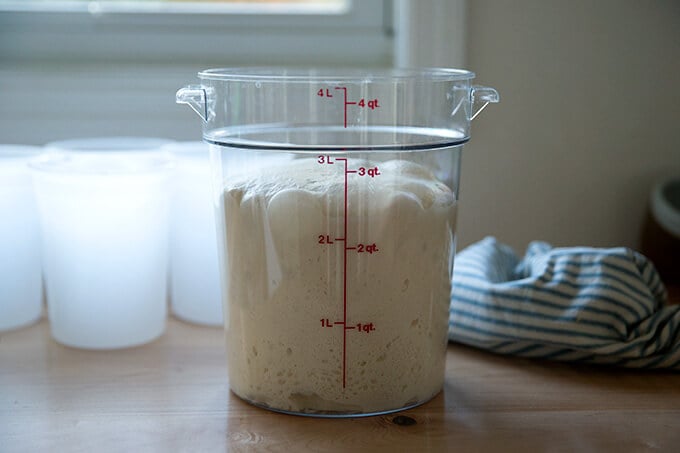
Turn the dough out onto a work surface. Use flour here as needed.
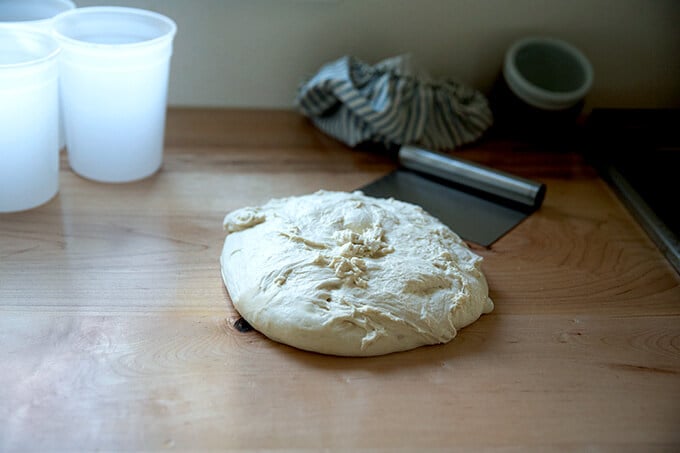
Portion into 4 equal pieces, again using flour as needed.
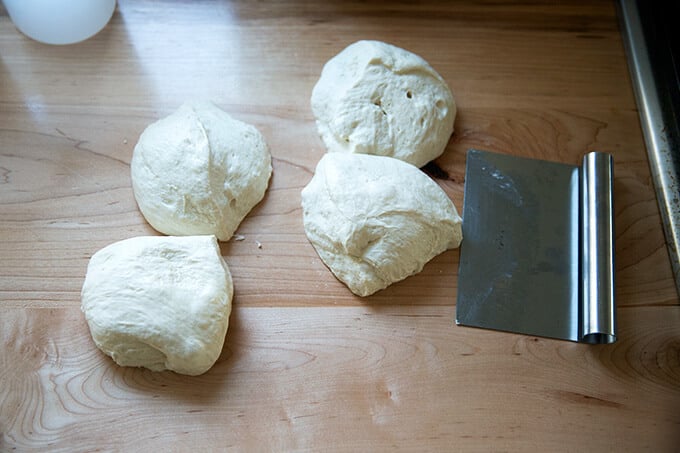
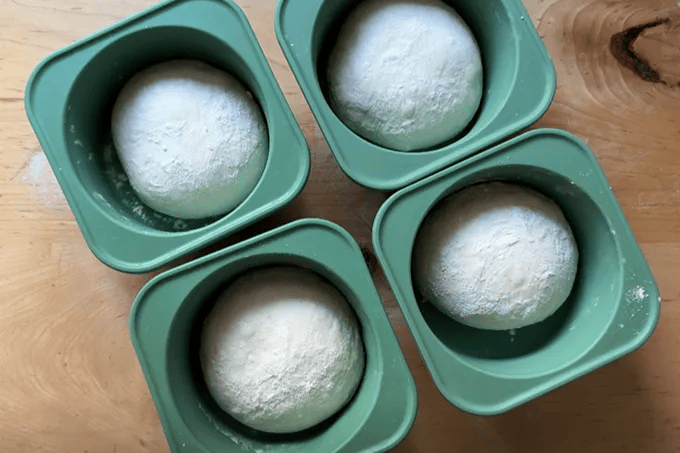
Ball up the dough, transfer the balls to storage containers, and stick them in the fridge. These Kevjes Dough Storage Vessels have become my favorite storage vessels for pizza dough balls:
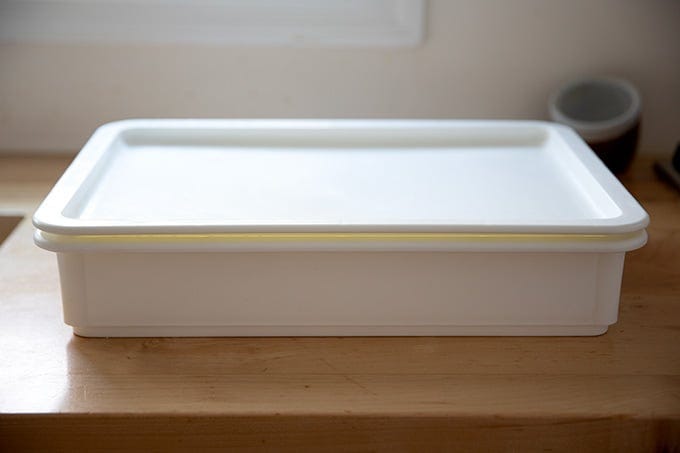
An hour prior to baking, remove a round (or more) of pizza dough from the fridge, and transfer it to a lidded vessel such as a DoughMate or a 9×13-inch baking dish covered with plastic wrap (to prevent the dough from drying out). If you have a Baking Steel, place it in the upper third of your oven, and heat the oven to 550ºF convection roast. (See recipe for other options.)
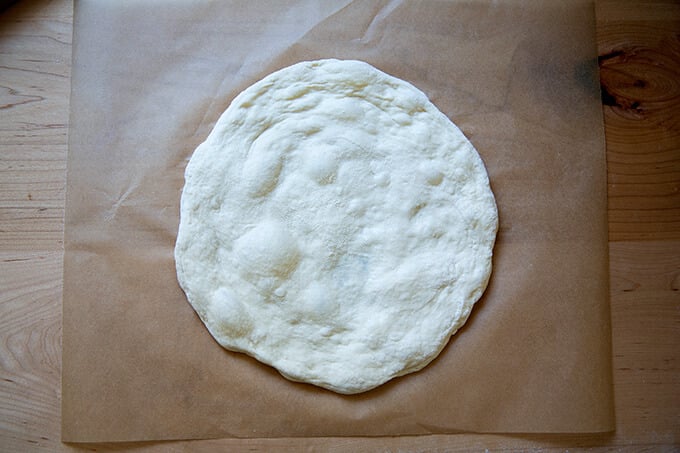
When the dough has proofed, delicately stretch it into a round, trying as best you can to preserve those air pockets.
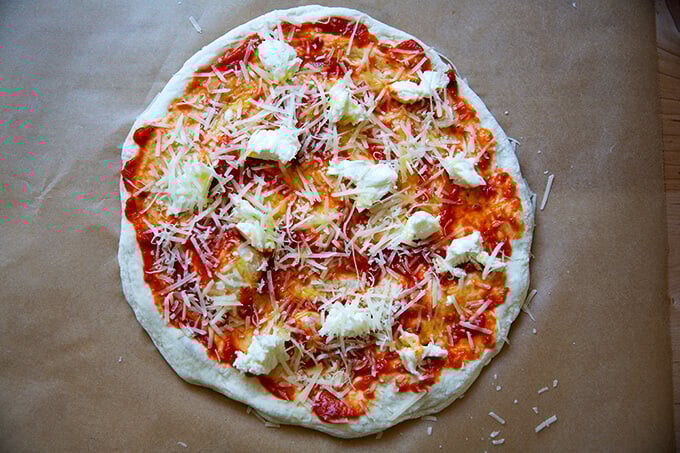
Top as you wish. This one is spread with tomato sauce and topped with fresh mozzarella, parmesan, olive oil, and sea salt.
Transfer pizza, parchment paper and all, to a preheated Baking Steel or stone, using a peel — my favorite peel is the Epicurean Pizza Peel. Bake 5 to 6 minutes or until cooked to your liking.
Slice and serve.

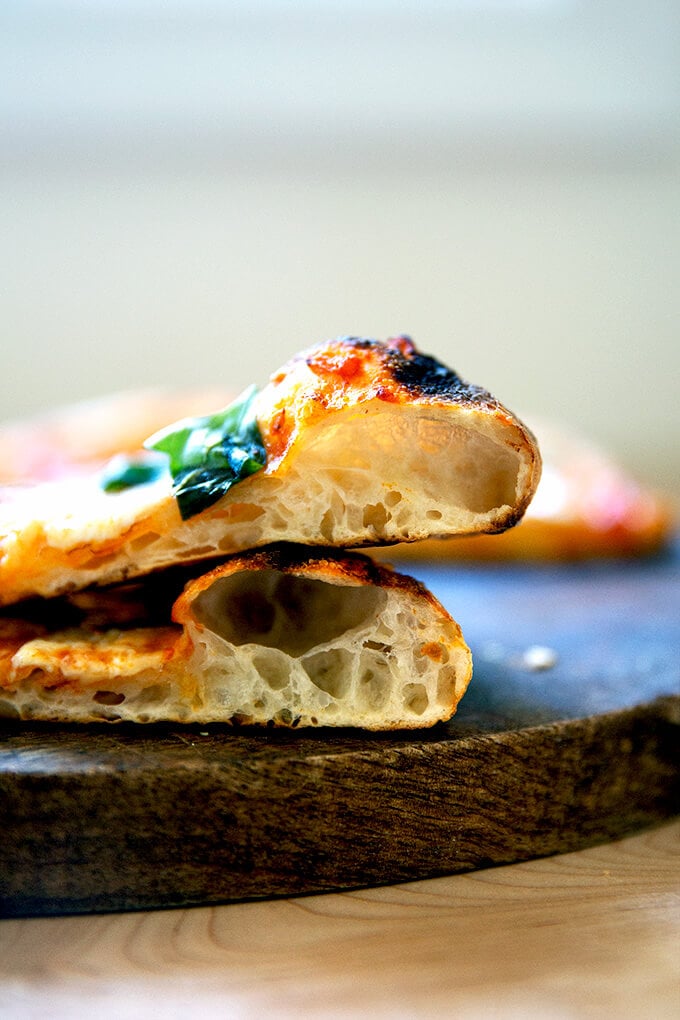
A little fresh basil is always nice.

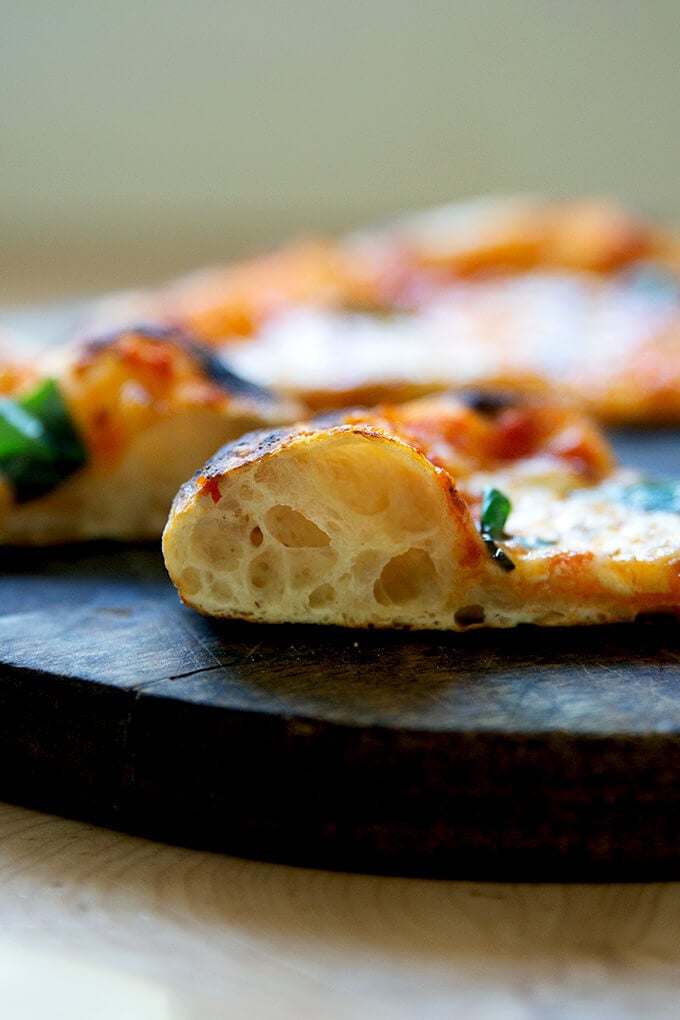
This is the beauty of the Baking Steel: oven spring!
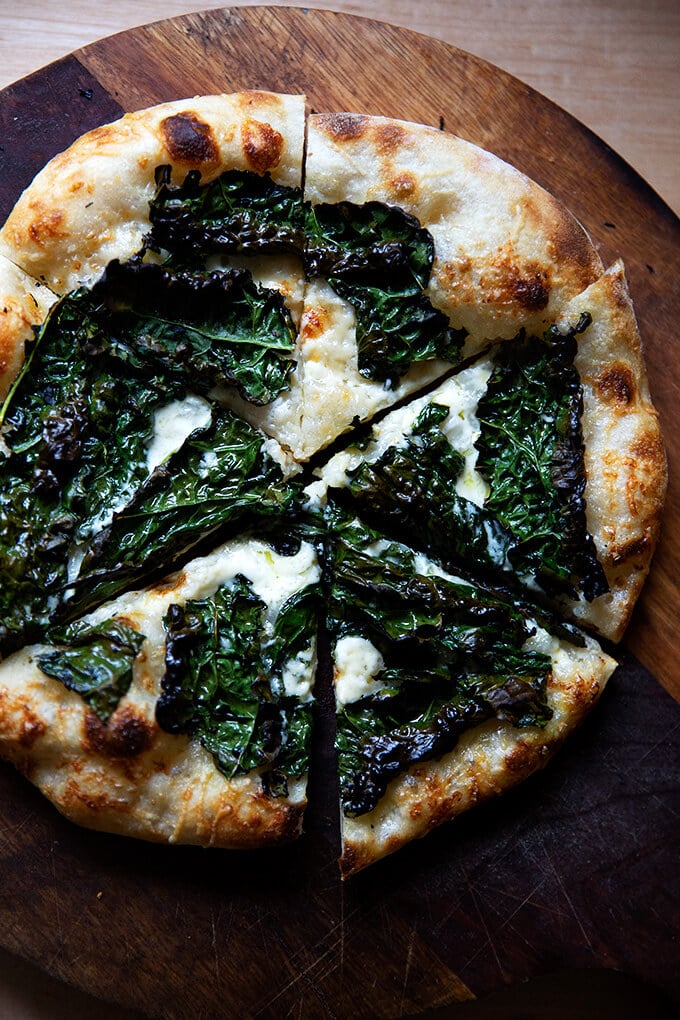
Another favorite: kale + crème fraîche:
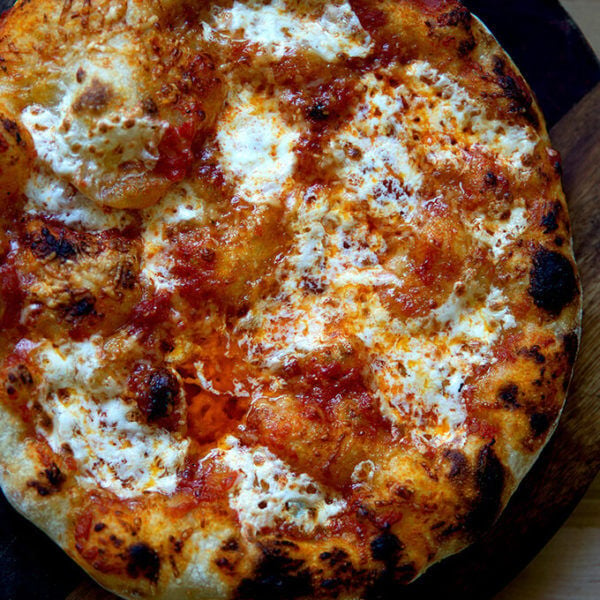
Another favorite: “naked” + spicy scallion (or ramp) oil:

Looking for more pizza inspo? My cookbook, Pizza Night includes 52 pizza and 52 salad recipes, one pair for every week of the year, as well as five simple desserts 🍕🍕🍕

Simple Sourdough Pizza Crust
- Total Time: 1 day + 1 hour
- Yield: 4 pizzas 1x
Description
Here is my guide for making sourdough pizza crust at home. Made with all-purpose or bread flour and no autolyse or preferment, the dough comes together simply: everything gets mixed together at once, and you are on your way! 🍕🍕🍕
**Attention Pizza Fans**: My pizza cookbook, Pizza Night, is now available everywhere books are sold. Get your copy here: Pizza Night
What you need to make this recipe…:
- …a sourdough starter. Ideally, you want to use your starter 4 to 6 hours after you feed it, when it has doubled in volume and is very bubbly and active. You can build a starter from scratch in just about 1 week. Or you can buy one. Here are two sources:
- …time. Once your starter is ready to go, this recipe requires an initial 6 – 18 hour rise, followed by at least 6 hours in the fridge or up to 3 days.
Timing/Schedule:
The timing will depend heavily on the time of year and the temperature of your kitchen. In the summer, because it is warm and humid, the first rise (bulk fermentation) of all my sourdoughs takes between 6 – 8 hours; in the winter it will take longer, 10 to 12 hours.
It is best to rely on visual cues. For the bulk fermentation, you want the dough to double or less than double: I now end my bulk fermentation when the dough has risen by 50% to 75% in volume. This is why I cannot recommend using a straight-sided vessel (as opposed to a bowl) enough. It makes gauging the first rise easier.
If at any point you are worried the dough will over-ferment — say, for example, the bulk fermentation is nearly complete but you are tired and want to go to bed — stick the vessel in the fridge and pick up the process in the morning. (Note: If your dough rises above double, don’t despair … my dough has tripled in volume during an overnight rise, and the resulting dough still had plenty of strength and spring.)
Schedule: I like mixing this dough in the evening, performing 4 stretch and folds before I go to bed (if time permits), then letting the dough complete its bulk fermentation at room temperature (68ºF) overnight or in the refrigerator (especially in the summer, when my kitchen is much warmer). In the morning, it’s typically ready to be portioned (if it rose at room temperature), transferred to storage vessels, and stashed in the fridge. If I had let my dough spend time in the fridge for the bulk fermentation, I remove it in the morning, and let it complete its bulk fermentation at room temperature. Once complete, I portion the dough and stash it in the fridge. Sometimes I’ll use the dough that same evening; sometimes I’ll use it the following day or the next. I encourage using the dough within 3 days.
In short: If you want pizza for the weekend, mix your dough on either Wednesday or Thursday.
Troubleshooting: If you have issues with your dough being too sticky, please read this post: Why is my sourdough so sticky? The 4 common mistakes.
Water: If you live in a humid environment or if you are making this on a particularly humid day, consider starting with less water, such as 335 grams of water, which will bring the hydration down to 70%. This amount of water will still produce a light airy crust but the dough will be more manageable.
Flour choice:
- You can make this dough with all-purpose flour or bread flour, and it works beautifully. You can use Tipo 00 flour if you want, but you’ll likely need to reduce the amount of water. Start with 350 grams and adjust moving forward based on your results.
Can You Freeze Sourdough Pizza Dough?
Yes. But, in my experience, the pizzas made from frozen dough do not spring as high upon being baked. They will still taste delicious as long as the time spent in the freezer is relatively short: the more time sourdough spends in the freezer, the more air bubbles it loses. After 1 week in the freezer, my dough will bake up fairly well. After 3 weeks in the freezer, my dough will be less bubbly and will bake into a thinner and crisper crust.
To freeze sourdough pizza dough: make it through step 4 in the recipe below or until after you transfer the portioned rounds to quart containers. At this point, transfer the quart containers to the freezer. To thaw, remove a container (or more) and let thaw in the refrigerator for 1 day or thaw at room temperature for 8 hours. Then, proceed with the recipe.
Favorite Pizza-Making Tools:
- Baking Steel
- Pizza Peel
- Parchment Paper: I bake my pizzas on parchment paper on my Baking Steel. Parchment allows for easy transfer from peel to steel.
- Cast Iron Skillet: If you do not have a Steel or stone, you can use a cast iron skillet. Rub a half teaspoon of oil over its surface, transfer a stretched dough round to the skillet. Top as desired. Bake at 450ºF for about 15 minutes.
- I love these Kevjes containers.
Ingredients
For the dough:
- 375 g water (or less, see notes above)
- 100 g sourdough starter, active and bubbly, see notes above
- 10 g salt
- 500 g all-purpose or bread flour
For each Margherita pizza:
- 2 tablespoons tomato sauce
- 1 to 2 oz mozzarella
- handful of grated Parmigiano Reggiano (less than an ounce)
- drizzle olive oil
- pinch sea salt
For each kale and crème fraiche pizza:
- extra-virgin olive oil
- a couple handfuls of baby or Tuscan kale
- 1 to 2 cloves garlic
- Sea salt, such as Maldon
- 2 tablespoons crème fraîche
- grated Parmigiano Reggiano, about 1/4 to 1/3 cup
For each naked pizza with ramp or scallion oil:
- 1/4 cup olive oil
- 1/4 cup minced scallions or ramps
- 1 teaspoon crushed red pepper flakes
- 1 to 2 tablespoons crème fraîche
- handful grated Parmigiano Reggiano
- sea salt
Instructions
- Mix the dough. Place the starter, salt, and water in a large bowl. Stir with a spatula to combine — it doesn’t have to be uniformly mixed. Add the flour. Mix again until the flour is completely incorporated. Transfer to a straight-sided vessel (if you have one.) Cover vessel with tea towel or cloth bowl cover and let stand 30 minutes.
- Stretch and fold: after 30 minutes have passed, reach into the vessel and pull the dough up and into the center. Turn the vessel quarter turns and continue this pulling 8 to 10 times. See video for guidance. Let the dough rest for another 30 minutes; then repeat the stretching and folding. If possible, repeat this cycle twice more for a total of 4 stretch and folds. By the 4th cycle, you will notice a huge difference in the texture of the dough: it will be smoother, stronger, and more elastic.
- Bulk fermentation: Cover vessel with a tea towel or bowl cover and set aside to rise at room temperature (70ºF/21ºC) for 4 to 18 hours (the time will vary depending on the time of year, the strength of your starter, and the temperature of your kitchen; see notes above) or until the dough has roughly doubled in volume. (UPDATE: In the past I have recommended letting the dough rise until it doubles in volume. If you’ve had success with this, continue to let the dough double. Recently, I have been stopping the bulk fermentation when the dough increases by 50% in volume, and I feel my dough is even stronger in the end.) Note: Do not use your oven with the light on for the bulk fermentation — it is too warm for the dough. When determining when the bulk fermentation is done, it is best to rely on visual cues (doubling in volume) as opposed to time. A straight-sided vessel makes monitoring the bulk fermentation especially easy because it allows you to see when your dough has truly doubled.
- Portion and shape: Turn the dough out onto a work surface and shape into a rough ball, using as much flour as needed — the dough will be sticky. Using a bench scraper, divide the dough into 4 equal portions. Sprinkle portions with flour. With floured hands, roll each portion into a ball, using the pinkie-edges of your hands to pinch the dough underneath each ball. Transfer each round of dough to a plastic quart container, cover, and store in fridge for at least 6 hours or up to 3 days or transfer to the freezer for up to 1 week. (To thaw, remove a container (or more) and let thaw in the refrigerator for 1 day or thaw at room temperature for 8 hours. Then, proceed with the recipe.)
- Make the pizzas: Pull out a round (or more) of dough from the fridge one hour before you plan on baking. Dust dough with flour and place on a floured work surface. Let sit untouched for about an hour (a little longer or shorter is fine). Place a Baking Steel or pizza stone in the top third of your oven. Set oven to 550ºF. Heat oven for at least 45 minutes but ideally 1 hour prior to baking.
- Shape the dough: Gently shape dough into a 10-inch (roughly) round handling it as minimally as possible. (See video for guidance.) Lay a sheet of parchment paper on top of a pizza peel. Transfer the dough round to the parchment-lined peel.
Top and Bake
- To make a classic Margherita-style pizza: Spread 2 tablespoons of tomato sauce over the surface of the dough. Top with mozzarella to taste. Sprinkle with parmesan to taste. Drizzle with olive oil. Sprinkle lightly with sea salt. Shimmy the pizza, parchment paper and all into the oven. Bake pizza until top is blistered, about 5-6 minutes. Transfer to cutting board. Sprinkle with basil, if you have it. Cut and serve. Discard parchment paper.
- To make a kale and crème fraîche pizza: Place the kale in a small bowl, drizzle with olive oil, season with sea salt, and toss. Spoon crème fraîche over the dough leaving a 1/2-inch border or so—I use about a tablespoon per pizza. Sprinkle with minced garlic and a handful of grated Parmigiano Reggiano. Top with the kale. Shimmy the pizza, parchment paper and all into the oven. Bake pizza until top is blistered, about 5 – 6 minutes. Transfer to cutting board. Cut and serve. Discard parchment paper.
- To make a naked pizza with scallion oil: Heat 1/4 cup olive oil in a skillet with 1/4 cup of minced scallions (or ramps!) and 1 teaspoon crushed red pepper flakes. Keep it over low heat while you make the pizza. Spoon crème fraîche over the dough leaving a 1/2-inch border or so—I use about a tablespoon per pizza. Sprinkle with a handful of grated parmesan. Shimmy the pizza, parchment paper and all into the oven. Bake pizza until top is blistered, about 5 – 6 minutes. Transfer to cutting board. At this point, the scallions should be starting to “frizzle”. If they aren’t, crank up the heat until the oil is sizzling. Spoon a few tablespoons of the hot oil over the pizza (you’ll have extra oil). Sprinkle with a pinch of sea salt. Cut and serve.
- Prep Time: 24 hours
- Cook Time: 5 to 6 minutes
- Category: Pizza
- Method: Oven
- Cuisine: American, Italian
This post may contain affiliate links. Please read my disclosure policy.







1,553 Comments on “Simple Sourdough Pizza Crust: A Step-by-Step Guide”
This was excellent. Pizza night just got way tastier!
My favorite pizza was topped with tomato sauce, mozzarella, goat cheese, thinly sliced tomato’s. Drizzled with balsamic and basil once out of the oven.
We also made a dessert pizza. Brushed with melted butter and dusted with a generous amount of cinnamon sugar and served with a simple vanilla glaze (1/2c. powdered sugar, 2 TBSP heavy cream, 1/2tsp vanilla bean paste). SOO GOOD!
My family was thrilled with this crust. Thanks for the recipe!
YUM!!! That all sounds fantastic. Thanks for sharing your dessert pizza notes — my family would love this!!
My dough didn’t rise at all overnight. Why would this be?
Are you confident in the strength of your starter? Are you using a scale to measure? What type of flour are you using?
First attempt at sourdough pizza and what a delicious end result! First, this recipe was super easy to follow and it made a lot of pizza. Second, the texture of the crust was perfect–crisp, chewy and filled with air pockets. Finally, the flavor was exceptional. This will be my go-to sourdough pizza recipe going forward.
Great to hear, Linda! Thanks so much for writing and sharing all of this 🙂
This is amazing and we’ve made it several times! I have also gifted a batch to some family friends for a pizza night. Is there any reason this can’t be frozen for longer so I can keep some on hand?
Great to hear, Amy! Unfortunately, I find that sourdough dough does not freeze well even for short periods of time (like a week) — it just loses its oomph. I advise parbaking the rounds (60-90 seconds); then freezing those.
Hi Ali, I have made this pizza recipe a couple of times and it has turned out pretty good. |’m wondering, after the bulk fermentation time, can I use it the same day to make my pizza? The total time of the bulk fermentation was 18 hours at room temperature.
I have divided it in four balls, and now having it sitting on my counter covered and in a plastic bag under I make the pizzas for dinner.
This time I decreased my water to 350 grams and it seems a bit better and not so wet.
What is the process if you don’t want to cold ferment it?
Thank you
Lina
Hi Linda! Yes, you can use it the same day. You may not get quite the bubbly texture or browning or as quite complex flavor, but it will still be delicious. The process is the same: let the dough ball proof at room temperature in a lidded vessel for at least an hour; then proceed. What did you end up doing? I’m realizing I’m a few days late here.
Hi. We’re so excited to try your pizza crust recipe!!! If I’m going to try and bake it on cast iron at 450ºF for about 15 minutes… Do I need to preheat the cast iron like you do the steel or stone?
Hi! It’s up to you. If you have a large cast iron skillet that you think you easily shimmy a pizza on to, then go for it. Otherwise, you can follow the process here: How to Make Excellent Skillet Pizza
Made this pizza tonight and baked at 500 for 10 minutes using parchment on baking steal. The bottom of my dough was not crispy and it was almost a little chewy and under cooked? Any help?
Hmmm… how long did you preheat your Steel for? And did you make any changes to the dough recipe? How about the toppings… what did you use? Do you have an oven thermometer?
Seriously good. Never going back to regular pizza dough again. Chewy and tender, nice pockets. I cooked on 450F for a little longer. Pizza stone. Easy, too!
Great to hear, Kat! Thanks for writing 🙂
Wow, thank you for the detailed recipe and instructions. The crust and taste was great. Unfortunately I didn’t get any blackened blisters on top which I was hoping for. My oven only goes to 525F. I did use a baking steel preheated for 1 hour. Do you have any tips for achieving the blisters on the top crust? Thanks Ali!
Great to hear! Do you have a convection roast setting? And on what rack are you placing the Steel? What type of flour are you using?
How many does this make ? It is for 1 ? Sorry if I missed that part , I re-read a few times lol
The dough yields 4 rounds.
I preheated my oven at 550 with my steel for over an hour. My pizza didn’t get the crisp I wanted. I may try to partake it first then add toppings and finish it off. The taste was on point.
Hi Hannah! Bummer to hear this. Parbaking will definitely help with the crispness. What did you top the dough with? And were your toppings at room temperature? And did you use a scale when making the dough?
I used a scale. Yes I let my toppings come to room temp. I think parbake or changing the rack position in the oven. The taste was perfect.
Great to hear re taste. I find I get the best browning on the very top rack. Hope the parbake yields better results for you.
I am making my dough tomorrow night but we don’t have Baking Steel. We will use a regular baking sheet. Should we still preheat the pan and for how long? And should we par bake the crust? Thanks!!
Hi! I’m likely too late here. What did you end up doing?
For people who don’t have a Baking Steel, I recommend preheating an old sheet pan, one you don’t care about because it will warp. I would preheat it for 45 minutes toan hour. I would make one pizza without the parbake and see how it turns out. If it isn’t crisp enough, you can parbake the remaining rounds.
Omg.. this crust is OUT OF THIS WORLD. The dough is like authentic Italian dough. I will admit I was like man this is some lengthy process dough but was super worth every bit of work (really it just requires planning ahead) usually pizza night is last minute thrown together but I’ll be putting this on the menu and having it in the fridge ready! 10/10!!
Great to hear, Ledly! Thanks so much for writing and sharing all of this 🙂 I love having my dough made, portioned and in the fridge a few days ahead of time… it’s a win-win: prep work done + better flavor.
Hello, I’ve enjoyed all your recipes, but in this pizza recipe, you asked us to mix the starter, water and salt together first and that makes the starter go leathery and not easily mixed. Respectfully, Jan Leeson from Nakusp, BC.
Hi! Sorry to hear you found the mixing process tricky… I have not experienced what you are describing, but any textural issues with the dough should resolve themselves during the stretches and folds phase.
I didn’t have a very good turn out on the texture. But I was wondering if you have some advice on adding flavor to the crust? I like a crust with slices and probably heavier on the oil.
Hi Stacey,
I have heard about pizzerias brushing the baked crust with olive oil out of the oven, and sprinkling on salt, parmesan, and/or other seasonings — you could do this or make a garlic-herb-parmesan oil for brushing on the crust out of the oven. If you have extra, you can serve alongside the pizza for dipping.
Thank you! That sounds good!
My favorite pizza dough recipe. Have made it dozens of times!
Great to hear, Hannah! Thanks so much for writing 🙂
This recipe is amazing! Such great instructions, thorough and easy to follow. The pizzas turned out amazing! This will be on full rotation for us! Thank you!
Great to hear, Shana! Thanks so much for writing 🙂
I’m on my second round of stretch and folds and my dough is quite firm and not squishy at all should I avoid another set of stretch and folds
Hi Betsy! I’m likely too late here. I would have suggested continuing on with the s&fs. Are you using a scale to measure? What type of flour are you using?
Absolutely love this recipe! I accidentally let mine go too long and it was a little over double with big bubbles during the bulk fermentation and it was the best pizza I’ve ever made. It was light and airy with a crisp crust and nice bubbles during baking. We’ve done it both in the oven on a stone and in an Gozney pizza oven and every time it’s perfect! Instead of parchment paper I use cornmeal and pizza seasoning before it goes onto the stone.
Great to read this, Lynn! Thanks so much for writing and sharing these notes. I fired up my Gozney for the first time last weekend… it’s so much fun 🙂
Hi, is 3 days the absolute limit in the fridge or could ai do 4? I was planning to make it tonight(day 3), but we went to a birthday party last night and at lunch time today that both served pizza lol.
Should I just freeze and thaw?
Hi! It’s hard to say… a lot depends on your starter and the flour you are using. For instance, I’ve been using Petra flour in my pizzas, and while I absolutely love it, I’ve realized the dough balls don’t hold up as well over long periods of time. With KAF bread flour, the dough balls can sometimes last a week. I would not freeze and thaw — see how it goes and then you’ll know for future reference how long you can store your dough balls given your environment/ingredients.
Thank you for your reply! I’m pretty new to sourdough so everything is an experiment at this point lol. I’m making it tonight, day four. We’ll see how it goes!
I plan to make this recipe. I saw you mention to someone else about parbaking for 60-90 seconds if I wanted to freeze it.
Do you think I could parbake the rounds and then top with sauce, cheese, and toppings to create a frozen pizza that I would bake when ready to eat? I’m hoping to make frozen pizzas to pull out for dinners on a busy night when I don’t have as much time to make dinner..
Please let me know your thoughts!
Thank you
I think you could! I would try with maybe one round first before you go all in on 4 rounds. I think a 90-second parbake or maybe slightly longer might be best if you are going to top and freeze. Would love to know how it turns out if you give this a go 🙂
I tried it! And it worked nicely! 🙂
So I doubled the recipe and then portioned it into 5 balls of dough as I wanted my pizzas to be a bit bigger in size.
I followed the recipe as followed otherwise. Except I did 50/50 WW flour and AP flour. And I’m really enjoying that.
When prepping, I parbaked the rounds for 3 mins with nothing on them. I also handled them a bit extra to make them a bit thinner as they puff up too much without any toppings.
Once cooled, I topped with the sauce, the cheese, and the toppings. The only thing I would do differently next time is trying to “dry out” the “wet” toppings a bit more (pineapple, tomato slices, hot peppers, etc) as they created a lot of excess moisture.
And then I froze those on baking sheets until frozen, then transferred to XL ziploc bags. They’re the perfect size!
When ready to eat one, I had preheated the oven to 375 F and then put the frozen pizza in on my pizza stone, thinking that might be enough. However it took about 20 mins or more of cooking and I struggled with a pool of liquid in the middle and trying not to overcook it, but also for it not to be frozen. It did work but I’m going to try another method tonight.
I’m pulling out the pizza and thawing for 30 mins. And then I’m going to put that in a cold oven and turn the oven to 375 F and see if thats better.
I did also broil on LOW for a bit to try and ensure the top of the pizza was heating nicely.
And overall, it was very very similar to when I freshly baked the pizzas. Except for needing more than twice the time in the oven!
(When making a fresh pizza, I found the top third of the oven was not near enough to the element, so I bake on the middle rack, and I bake them for 7-8 mins.)
Thank you for a wonderful pizza dough recipe! So happy to have found this!
Great to read all of this, Charissa! Thanks so much for writing and sharing these notes. So helpful for others wanting to attempt homemade frozen pizza — many people have asked over the years. I think drying out your toppings is a great idea. Good luck with your next attempt and thanks again for sharing!
When divided into 4, how large is each pizza?
The pizzas are roughly 11 to 12 inches in diameter.
Or do you need the weight of the dough balls? They’ll be roughly 245 grams each.
Hi
Trying both your sourdough recipe and pizza. On pizza recipe. If I want only 2 rounds, can I just cut ingredients by half for all including starter? Does times for bulk and refrigerator change.
Thanks for your great instructions.
Laura
Hi! Yes, halve all of the ingredients ideally using a scale. Bulk and fridge time remain the same 🙂
I have made this dough a couple times and really like the flavor and texture. Both times my dough was very stretchy (not sticky) and a bit difficult to handle, like when I picked it up my fingers almost poked through the dough. Wondering if I should take it out of the fridge closer to cooking time rather than an hour before.
Hi Pam! Are you using a scale to measure? What type of flour are you using? Do you live in a humid environment? It’s possible you need to reduce the amount of water you are using from the start.
Hi Ali, I am using a scan to measure and using King Arthur all purpose flour. Live in VT so not exceptionally humid at this time of year. I’ll try reducing the amount of water next time. Just want to thank you, all your recipes are easy to follow and everything comes out delicious. I’ve made the roasted eggplant lasagna 2x recently and the brioche buns I make regularly, so good!
Awww, thanks 🙂 Nice to read all of this.
Great re scale.
You may find bread flour helps, but you could also try reducing the water slightly from the start.
And it is possible that you need a shorter room temperature proof before baking. What’s nice about a long room temperature proof before baking is that the dough balls “open up” (meaning stretch out) so easily. But if you are finding that they open up too easily, it’s possible that a shorter room temp proof will help.
I love this recipe but I have one question – after bulk fermentation do I have to split the dough before putting in the fridge or can I just put the big dough ball in the fridge and then split it up when I take it out 1 hour before baking? It’s just easier to store 1 big ball in the fridge vs many smaller ones (I usually double the recipe) but idk if not splitting it until after will mess anything up. Thank you for such wonderful recipes!!
You don’t have to, but there is one advantage to having the dough in balled up form, namely that it will be easier to stretch out — as soon as you portion your batch of dough and ball it up, those dough balls are going to be so tight and will need at least an hour (maybe 2 depending on the time of year and temperature of your kitchen) to relax and get to a point of being ready to be opened up… if you have that time, then go for it 🙂
If I only need to make 2 pizzas, and I cut the dough into quarters (so I have 4), what should I do w/ the other 2 dough balls? Is there a recipe that I could use? they have been sitting in the firdge for 2 days. Next time, should I do something with them right away?
As noted in the post, I don’t love freezing sourdough dough balls — I just find it loses some of its oomph.
I would suggest, letting all four dough balls proof at room temperature. While you have your Baking Steel or pizza stone hot, bake your two pizzas, then with the other two, parbake them for 90 seconds or so. You can freeze the parbaked rounds; then use those for a future pizza night.
Hey!!
I’m doing your sourdough pizza for the first time in my gozney. I have only used your Neapolitan recipe which is fantastic. I have some 00 pizza flour but you recommend not using in home oven. Would it work in a pizza oven given higher temp option? Any thoughts or tips are greatly appreciated!!
Thanks!
Yes, it will! Remember to lower the hydration of the pizza dough if you are baking it in your outdoor oven: 68-70% hydration is what I like to do, and I bake @ 650-750ºF for 2.5 to 3 minutes (as opposed to 900ºF for less than 60 seconds). Good luck with it!
Hi there! Do you know how many calories per pizza (the dough only)?! Thanks!
I don’t! Sorry. Try Very Well Fit dot Com to calculate the nutrition info.
I have made this dough a few times but tonight my dough was so sticky, I could hardly work with it. I had reduced the water this time to 335g-wondering if that’s why? Will the dough get less sticky after being in the fridge?
Wow, crazy! Where are you located? A humid environment? And what type of flour are you using?
I used half KA bread flour and half Janie Mills pizza flour. I’m in Southern California so it is slightly humid. It was still pretty sticky after being in the fridge- we used lots of flour to roll it out. It worked out but the taste just wasn’t as good as it usually is 🙁 any suggestions for next time?
I think it probably has to do with the Janie Mills pizza flour, which sounds lovely. It probably just doesn’t absorb water the way bread flour does, which is leading to the wetter dough, and it probably doesn’t have as strong as a gluten structure, which could lead to a less light/airy/poofy crust. My suggestion would be to use a smaller amount of the Janie Mills pizza flour next time around. Small amounts of these freshly milld flours go a long way by imparting flavor, color and aroma. I would suggest 75 grams of Janie Mills flour next time. It sounds like a small amount but I think it will give you a good baseline. Depending on your results, you can increase the amount next time around.
Hi Alexandra, I made your recipe again decreasing my water to 350 g. I bought a pizza steel and put the pizzas on parchment paper and then slid them off a few minutes after being in the oven directly on the pizza steel.
I got some good bubbles in the crust, but would like to get more. What can you suggest?
I cold fermented the dough for three days and it was quite wet in my individual containers, so I needed to really put done quite a bit of flour.
I watched your video, and I notice that you stretch it again making the balls and put quite a bit of flour around the ball before putting into the plastic container. Is it better to add the flour then, maybe that’s what will give me more bubbles?
Hi Lina! What type of flour are you using?
How many pizza doughs does this make? And approximately how many inches for each pizza?
Four pizzas, each about 11-12 inches in diameter.
Hi there, planning to try this recipe out. I have 2 questions
1. Can I add vital gluten to AP flour to increase protein content to bread flour?
2. Would this dough hold up thin ham and pineapple to make Hawaiian pizza?
Thx!
I have never used vital gluten, so I can’t speak to how it will work, but if you’ve used it in the past and have liked it, then go for it 🙂
Yes to ham and pineapple! I do like to use a lighter hand when topping these pizzas, so keep that in mind, but otherwise that combo will work great, here.