 →
→ 

Simple Sourdough Pizza Crust: A Step-by-Step Guide
 By Alexandra Stafford
—
Last Updated: 01/22/2026
By Alexandra Stafford
—
Last Updated: 01/22/2026
This post may contain affiliate links. Please read my disclosure policy.
As far as sourdough pizza recipes go, this one is as simple as it gets: it’s made with all-purpose or bread flour, and there is no autolyse or preferment — everything gets mixed together at once. Ready? Wake up your starter! Read on to learn 5 secrets to sourdough pizza success.🍕🍕🍕

This sourdough pizza recipe produces a pizza with a ballooned, blistered edge and a crisp but pliable crust. The secret to achieving this texture in a home oven is to use a high-hydration dough (75%), proper fermentation (long and slow) at each phase, gentle handling of the dough, and a screaming hot oven (ideally outfitted with a Baking steel or pizza stone).
Let’s explore each in more detail:
5 Keys to Sourdough Pizza Success
- Use a high-hydration dough: Because home ovens rarely reach above 550ºF, it takes longer for pizzas to cook. In contrast, a 900ºF oven will cook a pizza in 60 seconds. To prevent pizza dough from drying out in a home oven, it is important that the dough has a lot of water in it — i.e., it is high-hydration. In contrast, outdoor oven pizza doughs can be much lower hydration.
- Ferment sufficiently: After the first long, slow rise, transfer the dough to the fridge for at least 12 hours and up to 3 days. Time further develops flavor, helps with browning, and improves the texture of the pizza dough.
- Proof sufficiently: If time permits, allow the dough to come to room temperature for at least an hour before baking (and up to 2), which makes it easier to shape — room-temperature dough stretches into a round more easily than cold dough.
- Handle the dough minimally: Using a delicate hand when shaping the dough preserves the air pockets created during fermentation.
- Invest in a Baking Steel: Steel is a better conductor of heat than stone — i.e., it transfers heat to the dough faster — which promotes great oven spring, which translates to glorious bubbles throughout the dough.
How to Make Sourdough Pizza, Step by Step
As always, a scale is essential for the best results. You need water, flour, salt, and a sourdough starter:
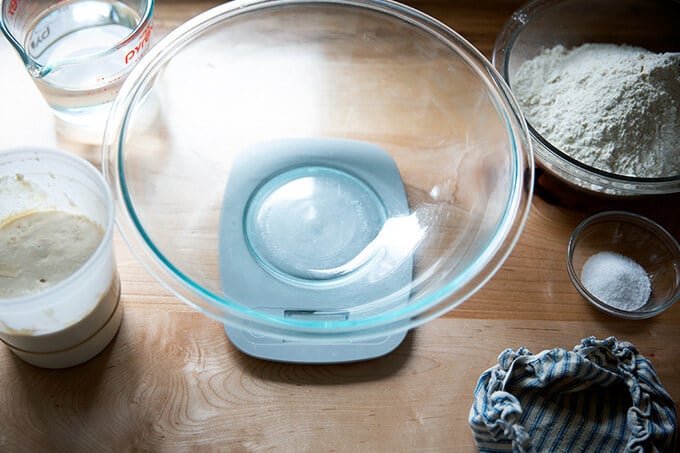
Combine 375 g water, 100 g sourdough starter, and 10 g salt in a bowl. (See notes in recipe box about using less water if you live in a humid environment.)
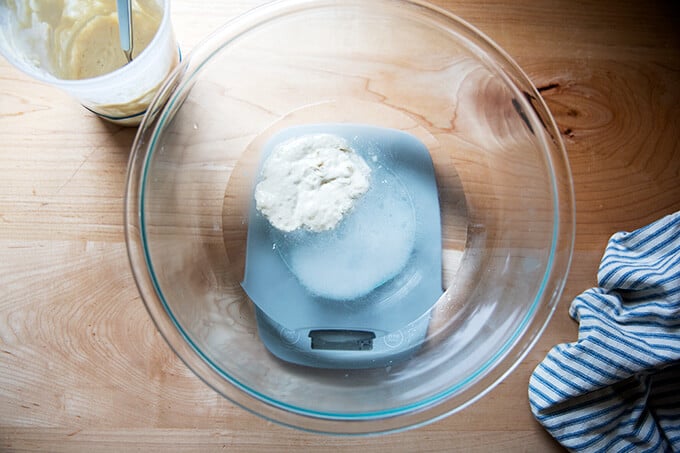
Stir to combine; then add …
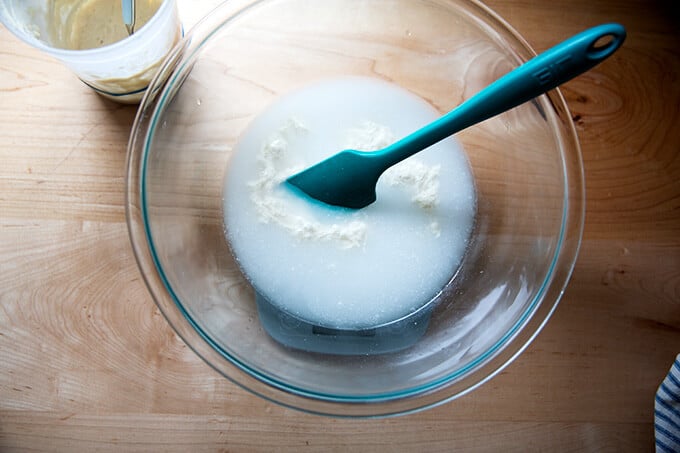
… 500 g all-purpose flour.
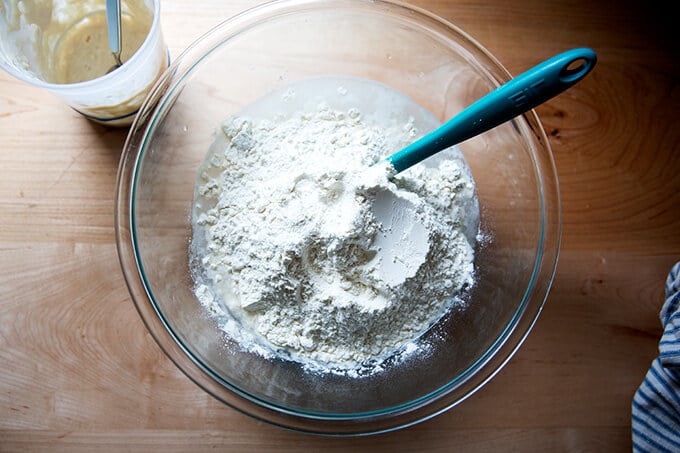
Stir until you have a sticky dough ball.
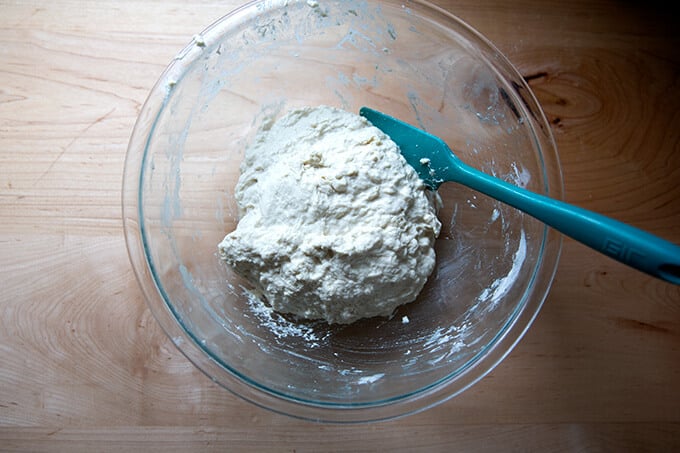
Transfer to a straight-sided vessel (if possible) and let rest for 30 minutes. Then, “stretch and fold” the dough (see video for guidance) 4 times at 30-minute intervals. Cover the vessel. Let it rest for 6 to 12 hours (see recipe notes for timing) or until the dough…
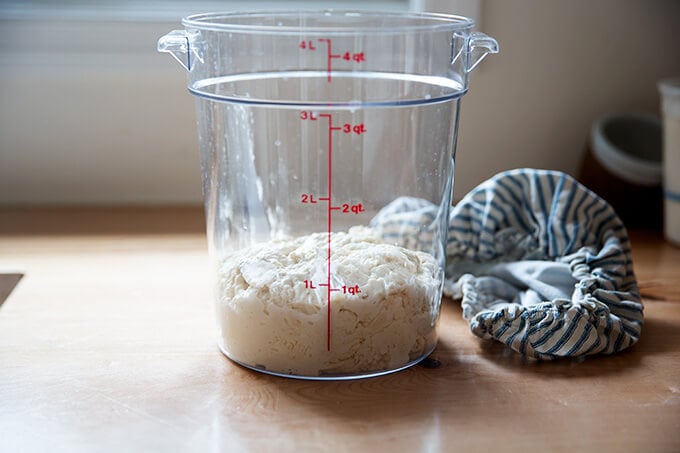
… has about doubled in volume. (Note: This is a little bit more than double. Ideally, you don’t want your dough to rise much beyond double. More recently, in fact, I stop the bulk fermentation when the dough has increased in volume by 50%.)
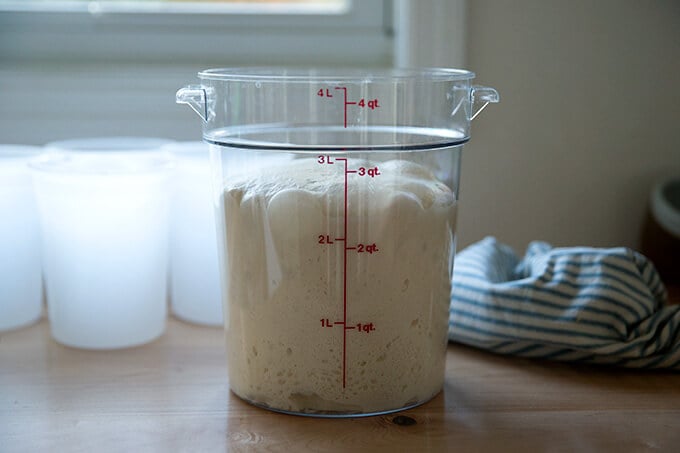
Turn the dough out onto a work surface. Use flour here as needed.
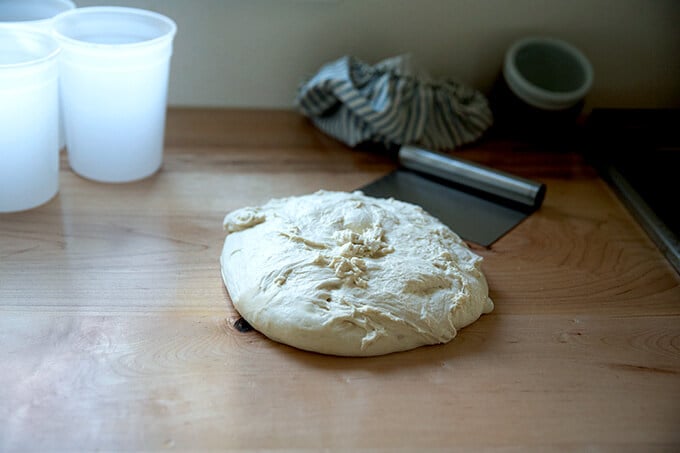
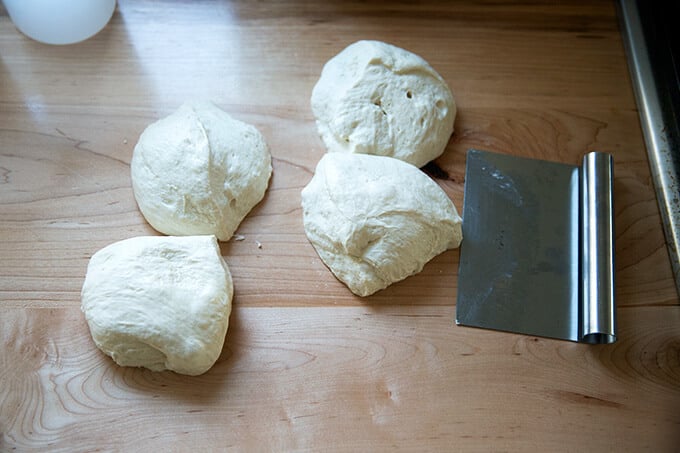
Portion into 4 equal pieces, again using flour as needed.
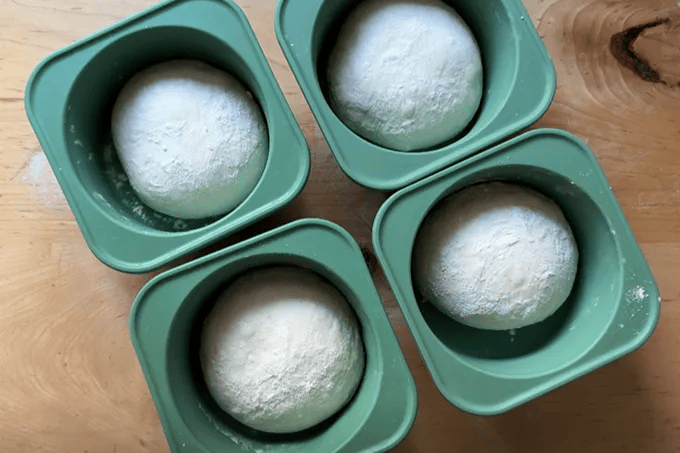
Ball up the dough, transfer the balls to storage containers, and stick them in the fridge. These Kevjes Dough Storage Vessels have become my favorite storage vessels for pizza dough balls:
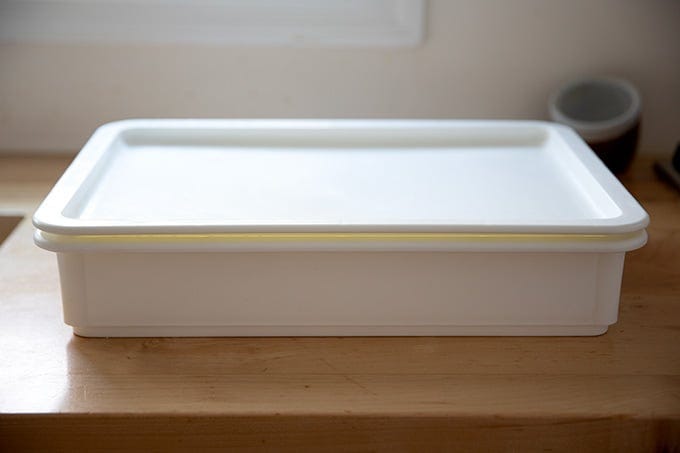
An hour prior to baking, remove a round (or more) of pizza dough from the fridge, and transfer it to a lidded vessel such as a DoughMate or a 9×13-inch baking dish covered with plastic wrap (to prevent the dough from drying out). If you have a Baking Steel, place it in the upper third of your oven, and heat the oven to 550ºF convection roast. (See recipe for other options.)
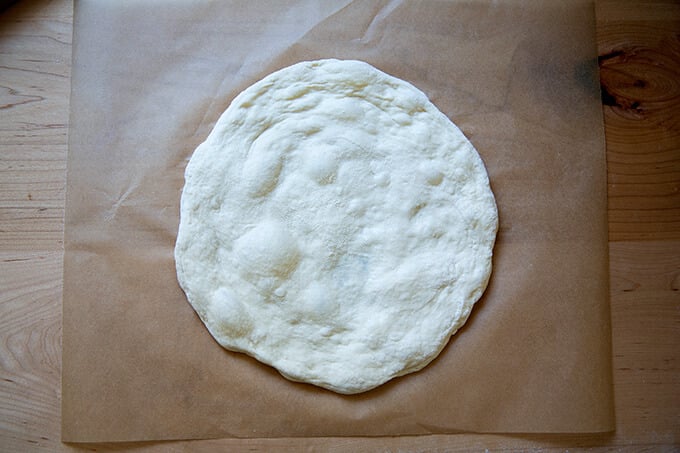
When the dough has proofed, delicately stretch it into a round, trying as best you can to preserve those air pockets.
Top as you wish. This one is spread with tomato sauce and topped with fresh mozzarella, parmesan, olive oil, and sea salt.
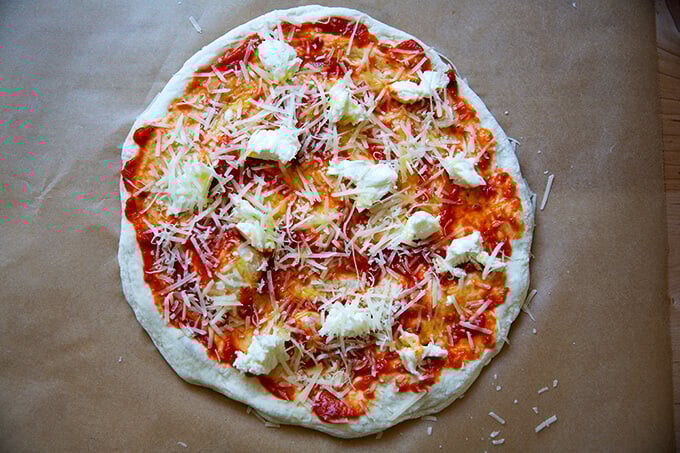
Transfer pizza, parchment paper and all, to a preheated Baking Steel or stone, using a peel — my favorite peel is the Epicurean Pizza Peel. Bake 5 to 6 minutes or until cooked to your liking.
Slice and serve.

A little fresh basil is always nice.

This is the beauty of the Baking Steel: oven spring!
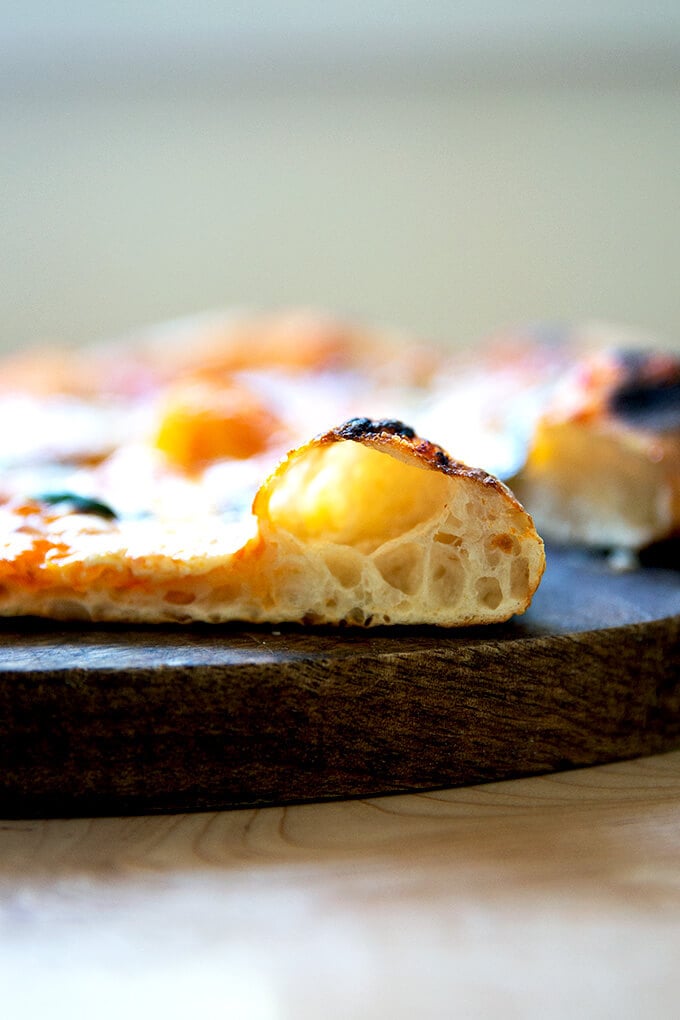
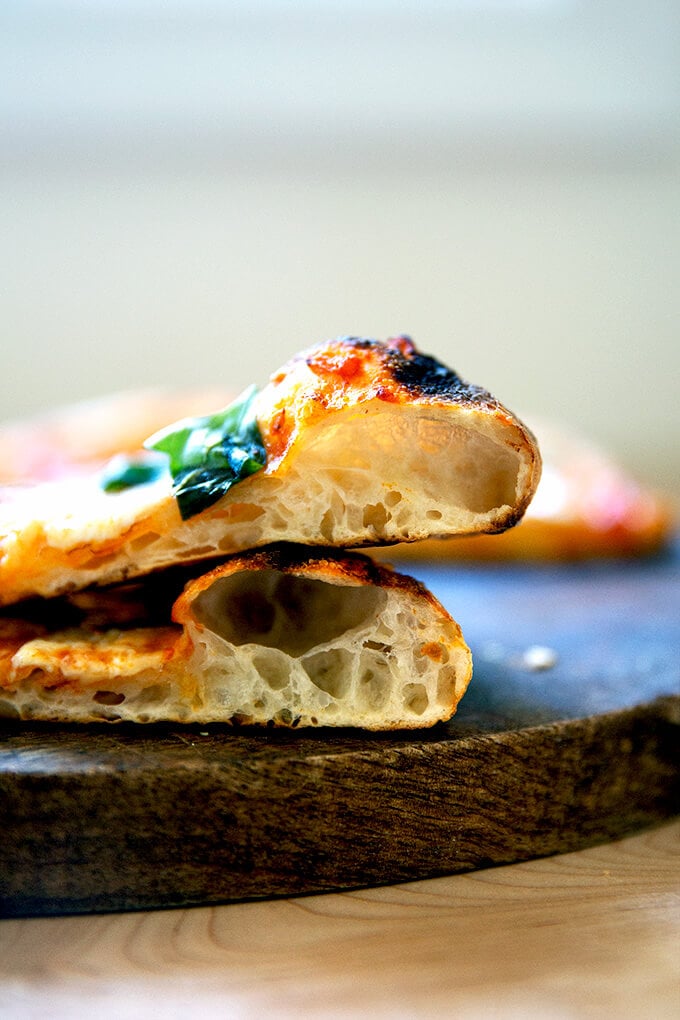
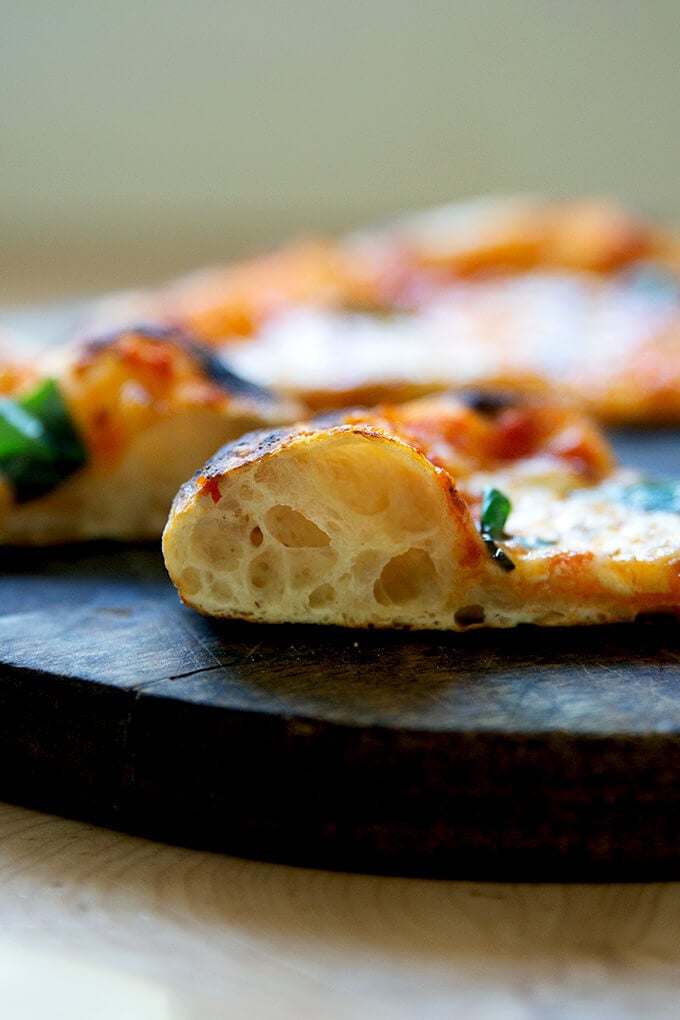
Another favorite: kale + crème fraîche:
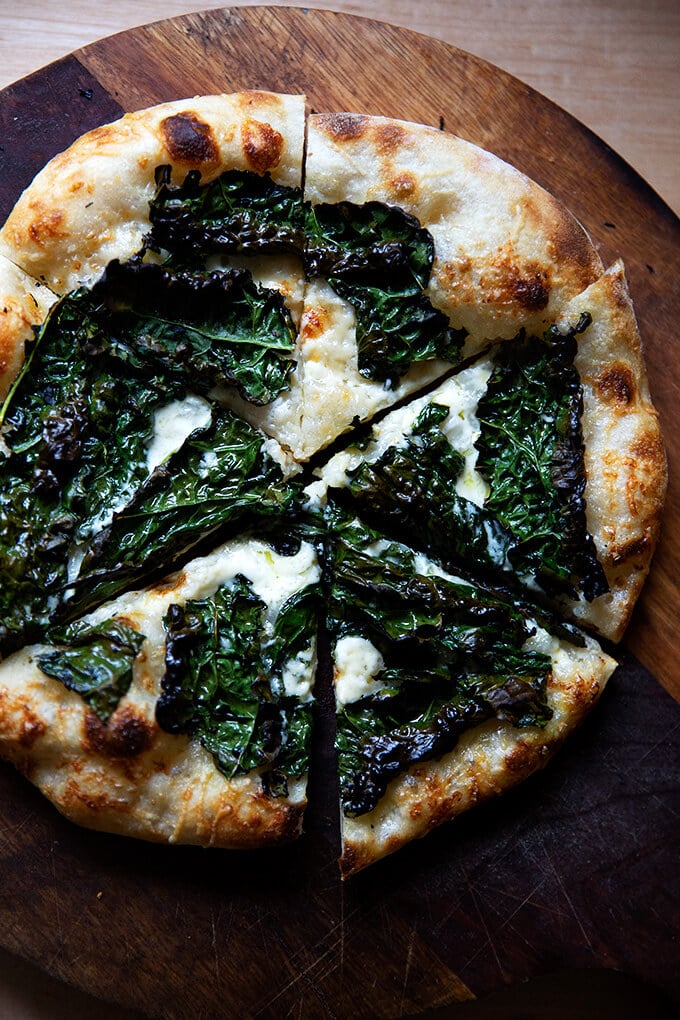
Another favorite: “naked” + spicy scallion (or ramp) oil:

Looking for more pizza inspo? My cookbook, Pizza Night includes 52 pizza and 52 salad recipes, one pair for every week of the year, as well as five simple desserts 🍕🍕🍕


Simple Sourdough Pizza Crust
- Total Time: 1 day + 1 hour
- Yield: 4 pizzas 1x
Description
Here is my guide for making sourdough pizza crust at home. Made with all-purpose or bread flour and no autolyse or preferment, the dough comes together simply: everything gets mixed together at once, and you are on your way! 🍕🍕🍕
**Attention Pizza Fans**: My pizza cookbook, Pizza Night, is now available everywhere books are sold. Get your copy here: Pizza Night
What you need to make this recipe…:
- …a sourdough starter. Ideally, you want to use your starter 4 to 6 hours after you feed it, when it has doubled in volume and is very bubbly and active. You can build a starter from scratch in just about 1 week. Or you can buy one. Here are two sources:
- …time. Once your starter is ready to go, this recipe requires an initial 6 – 18 hour rise, followed by at least 6 hours in the fridge or up to 3 days.
Timing/Schedule:
The timing will depend heavily on the time of year and the temperature of your kitchen. In the summer, because it is warm and humid, the first rise (bulk fermentation) of all my sourdoughs takes between 6 – 8 hours; in the winter it will take longer, 10 to 12 hours.
It is best to rely on visual cues. For the bulk fermentation, you want the dough to double or less than double: I now end my bulk fermentation when the dough has risen by 50% to 75% in volume. This is why I cannot recommend using a straight-sided vessel (as opposed to a bowl) enough. It makes gauging the first rise easier.
If at any point you are worried the dough will over-ferment — say, for example, the bulk fermentation is nearly complete but you are tired and want to go to bed — stick the vessel in the fridge and pick up the process in the morning. (Note: If your dough rises above double, don’t despair … my dough has tripled in volume during an overnight rise, and the resulting dough still had plenty of strength and spring.)
Schedule: I like mixing this dough in the evening, performing 4 stretch and folds before I go to bed (if time permits), then letting the dough complete its bulk fermentation at room temperature (68ºF) overnight or in the refrigerator (especially in the summer, when my kitchen is much warmer). In the morning, it’s typically ready to be portioned (if it rose at room temperature), transferred to storage vessels, and stashed in the fridge. If I had let my dough spend time in the fridge for the bulk fermentation, I remove it in the morning, and let it complete its bulk fermentation at room temperature. Once complete, I portion the dough and stash it in the fridge. Sometimes I’ll use the dough that same evening; sometimes I’ll use it the following day or the next. I encourage using the dough within 3 days.
In short: If you want pizza for the weekend, mix your dough on either Wednesday or Thursday.
Troubleshooting: If you have issues with your dough being too sticky, please read this post: Why is my sourdough so sticky? The 4 common mistakes.
Water: If you live in a humid environment or if you are making this on a particularly humid day, consider starting with less water, such as 335 grams of water, which will bring the hydration down to 70%. This amount of water will still produce a light airy crust but the dough will be more manageable.
Flour choice:
- You can make this dough with all-purpose flour or bread flour, and it works beautifully. You can use Tipo 00 flour if you want, but you’ll likely need to reduce the amount of water. Start with 350 grams and adjust moving forward based on your results.
Can You Freeze Sourdough Pizza Dough?
Yes. But, in my experience, the pizzas made from frozen dough do not spring as high upon being baked. They will still taste delicious as long as the time spent in the freezer is relatively short: the more time sourdough spends in the freezer, the more air bubbles it loses. After 1 week in the freezer, my dough will bake up fairly well. After 3 weeks in the freezer, my dough will be less bubbly and will bake into a thinner and crisper crust.
To freeze sourdough pizza dough: make it through step 4 in the recipe below or until after you transfer the portioned rounds to quart containers. At this point, transfer the quart containers to the freezer. To thaw, remove a container (or more) and let thaw in the refrigerator for 1 day or thaw at room temperature for 8 hours. Then, proceed with the recipe.
Favorite Pizza-Making Tools:
- Baking Steel
- Pizza Peel
- Parchment Paper: I bake my pizzas on parchment paper on my Baking Steel. Parchment allows for easy transfer from peel to steel.
- Cast Iron Skillet: If you do not have a Steel or stone, you can use a cast iron skillet. Rub a half teaspoon of oil over its surface, transfer a stretched dough round to the skillet. Top as desired. Bake at 450ºF for about 15 minutes.
- I love these Kevjes containers.
Ingredients
For the dough:
- 375 g water (or less, see notes above)
- 100 g sourdough starter, active and bubbly, see notes above
- 10 g salt
- 500 g all-purpose or bread flour
For each Margherita pizza:
- 2 tablespoons tomato sauce
- 1 to 2 oz mozzarella
- handful of grated Parmigiano Reggiano (less than an ounce)
- drizzle olive oil
- pinch sea salt
For each kale and crème fraiche pizza:
- extra-virgin olive oil
- a couple handfuls of baby or Tuscan kale
- 1 to 2 cloves garlic
- Sea salt, such as Maldon
- 2 tablespoons crème fraîche
- grated Parmigiano Reggiano, about 1/4 to 1/3 cup
For each naked pizza with ramp or scallion oil:
- 1/4 cup olive oil
- 1/4 cup minced scallions or ramps
- 1 teaspoon crushed red pepper flakes
- 1 to 2 tablespoons crème fraîche
- handful grated Parmigiano Reggiano
- sea salt
Instructions
- Mix the dough. Place the starter, salt, and water in a large bowl. Stir with a spatula to combine — it doesn’t have to be uniformly mixed. Add the flour. Mix again until the flour is completely incorporated. Transfer to a straight-sided vessel (if you have one.) Cover vessel with tea towel or cloth bowl cover and let stand 30 minutes.
- Stretch and fold: after 30 minutes have passed, reach into the vessel and pull the dough up and into the center. Turn the vessel quarter turns and continue this pulling 8 to 10 times. See video for guidance. Let the dough rest for another 30 minutes; then repeat the stretching and folding. If possible, repeat this cycle twice more for a total of 4 stretch and folds. By the 4th cycle, you will notice a huge difference in the texture of the dough: it will be smoother, stronger, and more elastic.
- Bulk fermentation: Cover vessel with a tea towel or bowl cover and set aside to rise at room temperature (70ºF/21ºC) for 4 to 18 hours (the time will vary depending on the time of year, the strength of your starter, and the temperature of your kitchen; see notes above) or until the dough has roughly doubled in volume. (UPDATE: In the past I have recommended letting the dough rise until it doubles in volume. If you’ve had success with this, continue to let the dough double. Recently, I have been stopping the bulk fermentation when the dough increases by 50% in volume, and I feel my dough is even stronger in the end.) Note: Do not use your oven with the light on for the bulk fermentation — it is too warm for the dough. When determining when the bulk fermentation is done, it is best to rely on visual cues (doubling in volume) as opposed to time. A straight-sided vessel makes monitoring the bulk fermentation especially easy because it allows you to see when your dough has truly doubled.
- Portion and shape: Turn the dough out onto a work surface and shape into a rough ball, using as much flour as needed — the dough will be sticky. Using a bench scraper, divide the dough into 4 equal portions. Sprinkle portions with flour. With floured hands, roll each portion into a ball, using the pinkie-edges of your hands to pinch the dough underneath each ball. Transfer each round of dough to a plastic quart container, cover, and store in fridge for at least 6 hours or up to 3 days or transfer to the freezer for up to 1 week. (To thaw, remove a container (or more) and let thaw in the refrigerator for 1 day or thaw at room temperature for 8 hours. Then, proceed with the recipe.)
- Make the pizzas: Pull out a round (or more) of dough from the fridge one hour before you plan on baking. Dust dough with flour and place on a floured work surface. Let sit untouched for about an hour (a little longer or shorter is fine). Place a Baking Steel or pizza stone in the top third of your oven. Set oven to 550ºF. Heat oven for at least 45 minutes but ideally 1 hour prior to baking.
- Shape the dough: Gently shape dough into a 10-inch (roughly) round handling it as minimally as possible. (See video for guidance.) Lay a sheet of parchment paper on top of a pizza peel. Transfer the dough round to the parchment-lined peel.
Top and Bake
- To make a classic Margherita-style pizza: Spread 2 tablespoons of tomato sauce over the surface of the dough. Top with mozzarella to taste. Sprinkle with parmesan to taste. Drizzle with olive oil. Sprinkle lightly with sea salt. Shimmy the pizza, parchment paper and all into the oven. Bake pizza until top is blistered, about 5-6 minutes. Transfer to cutting board. Sprinkle with basil, if you have it. Cut and serve. Discard parchment paper.
- To make a kale and crème fraîche pizza: Place the kale in a small bowl, drizzle with olive oil, season with sea salt, and toss. Spoon crème fraîche over the dough leaving a 1/2-inch border or so—I use about a tablespoon per pizza. Sprinkle with minced garlic and a handful of grated Parmigiano Reggiano. Top with the kale. Shimmy the pizza, parchment paper and all into the oven. Bake pizza until top is blistered, about 5 – 6 minutes. Transfer to cutting board. Cut and serve. Discard parchment paper.
- To make a naked pizza with scallion oil: Heat 1/4 cup olive oil in a skillet with 1/4 cup of minced scallions (or ramps!) and 1 teaspoon crushed red pepper flakes. Keep it over low heat while you make the pizza. Spoon crème fraîche over the dough leaving a 1/2-inch border or so—I use about a tablespoon per pizza. Sprinkle with a handful of grated parmesan. Shimmy the pizza, parchment paper and all into the oven. Bake pizza until top is blistered, about 5 – 6 minutes. Transfer to cutting board. At this point, the scallions should be starting to “frizzle”. If they aren’t, crank up the heat until the oil is sizzling. Spoon a few tablespoons of the hot oil over the pizza (you’ll have extra oil). Sprinkle with a pinch of sea salt. Cut and serve.
- Prep Time: 24 hours
- Cook Time: 5 to 6 minutes
- Category: Pizza
- Method: Oven
- Cuisine: American, Italian
This post may contain affiliate links. Please read my disclosure policy.








1,553 Comments on “Simple Sourdough Pizza Crust: A Step-by-Step Guide”
Good morning Ali, I am ready to divide my dough after the overnight fermenting. Can I make two larger pizzas instead of the four small ones or will it interfere with the rise?
Thank you!
Absolutely! Go for it 🙂 🙂 🙂
Hi there! Trying out sourdough pizza for the first time, and hoping to adapt it into a pan pizza (our favorite!)
I was wondering how you would suggest moving forward after step 4 to make this into a pan pizza?
I normally make it with a yeasted dough, it has a bulk rise then a second rise after shaping/putting the dough into the pan. Would you recommend doing something similar with the sourdough dough?
Thanks so much and I can’t wait to taste it!
Hi! And apologies for the delay here. Yes, something very similar. What size are your pans? Are you planning on dividing the dough into 4 portions? I would likely put a few teaspoons (or more) of olive oil into the pan, transfer the portioned dough ball to the pan and turn them to coat; then let them hang out for a few hours … could be anywhere from 1 to 4 hours. Then stretch, top, and bake.
Make sense? Let me know if you give it a go!
This has become a weekly event in our home. I love this recipe and clarity. Thank you!
Great to hear this, Cynthia! Thanks so much for writing 🍕🍕🍕🍕🍕
I am a “Southern transplant” having grown up in New England and then moving to Tennessee after getting married. I’ve been in search of good pizza down here for 20 years and have given up and started experimenting with different dough recipes, never finding the exact right one. I recently starting teaching my self about sourdough and came across this recipe. I will never use another dough recipe – this one is perfect! I used my baking steel and got a perfectly crispy bottom with a wonderful airy chewy crust. Thank you!
So wonderful to hear this, Kelly! Thanks so much for writing and sharing all of this. Great to hear about the Baking Steel, too. I find it makes all the difference.
I really want to try this but I hadn’t even heard for sourdough starters before a few days ago. I want to perfect my pizzas.
This sounds scary, I’m not gonna lie. LOL
Can I use a dry sourdough starter? If so, do I have to do something different?
Thanks!
Hi Tina, yes you can use a dry starter, but you’ll have to activate it by feeding it flour and water. Once you get it to point where it is doubling in volume within 6 hours or so of a feeding, it’s good to go!
Have you ever added diastatic malt powder? If so, how much? Thanks!!
I have not used diastatic malt powder unfortunately so I cannot comment on quantities.
This is *IT*! I’ve been searching for a good sourdough crust recipe and am thrilled to have finally found it! Wonderfully chewy, bubbly crust – a treat to eat! So many of the other recipes I’ve tried focus on shorter proving times with help from activated yeast. They short cuts don’t work and lead to poorly developed crusts. Thank you for sharing the secret to a heavenly homemade crust!
So great to hear this, Kerry 🙂 🙂 🙂 Thanks so much for writing.
Soooo good! This is the best sourdough pizza I’ve made. Can’t believe you basically just make sourdough bread and stretch it into pizza. I made the naked pizza (like at a restaurant!) and pepperoni and roasted pepper. Yum! Thanks so much for posting this.
Great to hear, Carolyn! Thanks so much for writing and sharing your notes … all sound delicious!! 🙂 🙂 🙂
What is an “autolyse or preferment or levain”. I’ve never heard those terms before.
Hi Ken! Autolyse is a technique that calls for mixing flour and water together and allowing them to sit for several hours before adding the salt and sourdough starter. This process allows gluten to develop in dough prior to mixing. It also makes the dough more extensible. A preferment is a small portion of dough — flour, water, yeast — that is prepared in advance and allowed to ferment. A levain is the same thing but with sourdough starter: a small portion of dough ± flour, water, sourdough starter — that is prepared in advance and allowed to ferment.
This was my first attempt at pizza dough and hit a home run! This recipe has Easy-to-follow directions & minimal ingredients, but most importantly produced a delicious pizza! I modified my baking temp/time/method to accommodate preheated cast iron skillet @450 for 15min & liked the results. Will definitely use this recipe again! Thank you!!
So great to hear all of this, Tina 🙂 🙂 🙂 Thanks so much for writing and sharing your notes. Nice work adjusting time and temperature to accommodate the skillet.
Hi Ali,
We are enjoying making your sourdough bread and make a loaf every week. We are having trouble cutting the loaves and are looking for a cutting board that will catch the crumbs and allow you to cut the slices evenly. I’ve seen many on the internet but none that will accommodate the round size loaf your recipe makes. Do you have any suggestions? Thanks! Still loving your recipes!
Maria
Great to hear, Maria! The board you are describing is not coming to mind. Can you elaborate? By catching the crumbs, do you want a ridge around perimeter, kind of like a meat-cutting board? I will keep my eyes peeled. I have to say, I do find it very hard to find good cutting boards anymore. Nearly all of mine are hand-me-downs,
Hi Ali,
I’m trying to send you a photo from google search that will explain it. If you google search under “bread slicer with cutting guide & crumb catcher” it will bring up what I’m looking for except they are all too small to handle a round 8″ bread. They are all made for a loaf size.
Just wondering if you have seen anything like it?
BTW….I’m making your chicken legs in wine today!
Thanks!
Maria
Ok, got it, I know exactly what you’re talking about now. And I am seeing that they’re all really meant for sandwich-style loaves (as you noted) as opposed to round boules. I found this one on Breadtopia, but it’s out of stock at the moment, and while it catches crumbs, it doesn’t help with slicing: https://breadtopia.com/store/bread-cutting-board-natural/
I’ll keep my eyes peeled! Hope the chicken turned out well 🙂 🙂 🙂
Hello,
Everything was going as expected until the end. I put my 4 balls of dough in the fridge for about 20 hours, I brought them out an hour ahead before rolling. The dough seemed reasonably springy when I rolled it out, but it didn’t rise or react in the oven. It just turned out hard and flat as if the natural yeast was dead. Any ideas what happened? I still have 2 balls left, but not sure what to do. Thanks for your help!
Hi Cherie!
Bummer to hear this. It does sound as though the dough overfermented.
Questions: have you made other sourdough bread recipes with success? Are you confident in the strength of your starter? Did the bulk fermentation go OK? As in, did the dough nearly double in volume before you portioned it?
You are saying ROLLING, as in with a rolling pin? I use my hands to very lightly pull the dough into shape while manipulating it as little as possible. This could be a reason why your dough was hard and flat. Could be, I am no expert. Don’t give up, keep experimenting. Sourdough is an ongoing learning process.
I made this recipe last week and since there are only two of us we got to eat it twice! It is excellent! I want to make it for a larger group. Can I double the recipe just by doubling the ingredients and carrying on with the same instructions?
Great to hear Cathy! And yes, go for it: double it and follow the same instructions.
Goodness! Okay, I’ve been using this for pizza night for a couple of months now, and we love it. BUT THEN, I ended up with some extra dough that I wasn’t going to make pizza with and didn’t want to freeze. Instead I divided it up into 100g portions, rolled it out and cooked it up like naan with a brush of olive oil and some salt before putting it on a hot griddle. The result is the dreamiest flat bread ever! Just throwing that out there. Thanks for a super (and versatile) recipe!
That sounds so amazing!! I love this idea so much. Going to try it very soon as I have this dough rising as I type. Thanks so much for writing!
Probably the best and easiest sourdough pizza recipes I’ve tried, and we’ve made it several times now using both her kale and crème fraîche and the basic Margherita pizza recipe. They are both delicious! Thank you so much for sharing!
Wonderful to hear this, Hannes 🙂 🙂 🙂 Thanks so much for writing.
Do you think I could partially bake and then a bit later add sauce, etc and finish baking after that?
Definitely! May I ask why you are interested in a parbake?
Hi Alexandra, a troubleshooting question… I’ve followed all your steps to the letter and also watched your video up until proofing. I’ve stretched and folded, then proofed until doubling in size. The dough is really wet and I was hoping after proofing it would better the structure. When it came turning out onto the table, it collapsed and spread. Even adding spoonfuls of flour, I can’t for the life of me shape it into a ball. The texture is springy but wet. I’ve now put it into 4 containers but I’m worried I won’t be able to make pizza out of it. I have friends coming tomorrow night for a pizza party (now realising this is a bit ambitious..) Please help!
Hi Emma! It sounds as though the dough overfermented, and unfortunately, it will bot be usable for your pizza night. Where are you located? I have a feeling you need to reduce the amount of water you are using to start, and I also think you’ll need to shorten your bulk fermentation.
Are you using a scale to measure? Is your starter reliable? As in have you made other sourdough breads successfully with it?
So sorry about your pizza night!! I would make a yeast dough in the meantime. It will still be delicious. Depending on where you are, however, you may need to reduce the water for that recipe as well.
Thank you for replying so quickly! My starter does work well, but I’ve only ever used it for sourdough bread before. This is the first time I’ve tried to branch out 🙂 I’m based in Asia, so the climate is quite humid. It does make sense to use less water then and try and get it to a closer consistency to your photos. I was also using a bowl to proof, I don’t have a vessel like you do. I’ll definitely try again since your photos look wonderful and will let you know how it goes!
Ok, sounds great! I think finding the right ratio of water given your environment will be the first step. Then making sure the bulk fermentation is not too long is the next critical step. Good luck!
How do I freeze, store, and thawhalf if the dough for next weekend?
Hi! After you ball up the 4 portions of dough, transfer each to a quart container (or something similar). Transfer to the freezer immediately. Thaw overnight in the fridge and then at room temperature for 4 to 5 hours. Or thaw at room temperature for 8 hours.
Hello, I just wanted to drop a note of appreciation for this recipe. Am very new to sourdough making and had only dreamed of being able to make sourdough pizza. I have tried this recipe now a few times and it is just perfect. I have been using a rye sourdough started and following the recipe but using a mix of both spelt white & wholemeal ( a touch more white than the wholemeal). It turns out beautifully everytime and I love that you can rest some dough in the fridge to have another pizza another day. I do bake the pizza dough a little in the oven before adding the sauce and toppings and found this works better for us than putting them on the raw dough base. Very grateful for you publishing this simple can do recipe 🙂 Happy pizza making!
So great to hear this Heather 🙂 🙂 🙂 Thanks so much for writing and sharing your notes. So helpful for others to hear that a brief parbake works well for you.
This is my go to recipe! I usually bake after 6-8h in the fridge, but this past time I did it around 32h in the fridge and the dough was over proofed. Still got some great tasting pizzas, but dough was definitely not as pillowy. Any recommendations to prevent that? Should I just punch down and let it rise again?
Interesting! So, when you say 32 hours, at this point the dough is portioned into balls and each ball is in a container, right? Or was the dough still in a large mass after the 32 hours?
Yes, portioned but didn’t use on the day portioned if that makes sense
OK, my only thought is that perhaps with this latest batch you pushed the bulk fermentation farther? Did the dough more than double in volume during the bulk fermentation? Was it a warmer day do you remember? I’m just thinking that maybe the dough lost its oomph and couldn’t recover. What type of flour are you using?
It did more than double but just by a little. And it is starting to warm up where we are. I usually do overnight bulk ferment so maybe I’ll give it a go again. I’m using KAF FLOUR.
OK, yeah, I think if you keep the bulk fermentation to a 50-75% rise, you’ll be able to keep it for a few days in the fridge.
Greetings Ali!
I’m currently on the road and came across your recipe. I will be home in a few days and CANNOT wait to try your recipe. It will be one of the first things I make after I get my starter (Brewtus) active again.
My question for you is, can the dough be made up to a certain point and then frozen? It would be super convenient for days when I randomly get a hankering for pizza and don’t want to wait a few days for it.
My second question is, will this dough hold up to a lot of toppings or is it best for just cheese and one or two? My partner and I tend to throw on at least 5 toppings.
Thanks in advance!
Hi Nikki!
This dough unfortunately doesn’t do great in the freezer for long periods of time — a week or so. I have better results freezing this yeast-leavened dough. And this dough also is best with 2 to 3 toppings, but if you prefer more, just experiment! It might be fine.
I have been struggling with sourdough pizza crust for a little while now. I’ve tried a couple other recipes to no avail. I came across this one and gave it at shot and the crust came out perfectly! I was so excited to finally get those bubbles. This will be my go to recipe from now on! So chewy, flavorful and just delicious!
Great to hear, Megan! Thanks so much for writing 🙂 🙂 🙂
Hi Alexandra, thank you for sharing this recipe! I loved your sourdough focaccia and beginners recipe!
I tried this recipe and I missed the part where it says to fold it 8-10 times and did only folded it 4 times every 30 mins for 3 rounds and then I did 10 folds for the 4th round. Will this be okay for my pizza dough? And just wondering why so many folds in this recipe per round?
Thanks in advance!!
Oh yes, totally fine! I need to re-read my recipe because that’s confusing — what’s important is doing the stretches and folds every 30 minutes for the first 2 hours (if time permits) — it’s not as important how many times you stretch and fold during each of those rounds. Hope that makes sense. And I hope your pizza turns out well!
After shaking the dough into your 10 round pizza crust can you freeze for later use?
You can but sourdough pizza dough doesn’t freeze that well for long periods of time. I would suggest baking your crust without any toppings for 2 to 3 minutes, letting it cool, wrapping it and then freezeing. Then thaw, top, and finish baking when you are ready.
Hi , the place I live has a hot climate.
So for bulk fermentation can I keep the dough in the fridge? It’s 35-40 degree Celsius here.
You can, and I would recommend storing it in a straight-sided vessel so that you can monitor how it is rising. You might want to leave it at room temperature for an hour or so; then transfer it to the fridge. You need the dough to increase in volume by about 75% (or a little more or a little less) before portioning the dough and proceeding.
I just made your recipe tonight and need to freeze it until next week. What is the procedure for using it once it’s been frozen? The recipe mentioned checking the notes but I couldn’t find anything. Maybe I’m just overlooking it. Thanks for any help you can give me.
Hi Gena, you can thaw it overnight in the fridge. I would remove it 3 to 4 hours before baking to ensure it thaws completely and gets up to room temperature before using.
Hi! Made this last week and it was perfection! I only used 2/4 dough balls. The other two have been in the fridge for one week. Can I use them tonight?
Great to hear! You can try, and I definitely would … you don’t want to wait much longer. You may find that you don’t get as much oven spring and the dough might feel a little more slack than previously. But definitely go for it!
Is this dough freezer friendly?
You can freeze it, but it doesn’t do well in the freezer for long periods of time … I wouldn’t freeze it for much more than 1-2 weeks.
Smells so good so far, can’t wait to put in oven.
Question: do I have to refrigerate the dough before cooking?
Great to hear! You don’t have to. You can simply shape and let the dough proof at room temperature, but I do think you get better results with some cold fermentation, ideally 24-48 hours. Hope it turns out well for you!
Is there a way to freeze this?
Yes, but I don’t recommend freezing it for more than 1 to 2 weeks — sourdough pizza dough just doesn’t do that well in the freezer for long periods of time.
I was really hoping for nicely blackened bubbly crust, but it fell a bit flat on my first try. I purchased a pizza steel, but only 1/8 inch, so that could be one reason for not getting the rise and bubbles. I activated my starter yesterday, and it took about 6 hours to double so I think it is good. I mixed my dough using grams to cups conversions, so that could be an issue. Put in a plastic water pitcher and covered with a tea towel and elastic band and went to bed. 11 hours later in the morning my dough bulk fermented about 2.5 times. Portioned and put in the fridge for 7 hours. Preheated my oven for an hour with steel and cooked for 6 minutes, didn’t look done so I did another 2 minutes, it wasn’t bad pizza. It had a few small bubbles but they didn’t puff up and get nice colour. Any tips??? Looking forward to trying again.
Hi Brandon! A few thoughts and questions:
1. Have you had success with other sourdough bread recipes? I always start with the starter: had it spent a lot of time in the fridge? I like to feed my starter at least twice before using it if it’s spent a good amount of time in the fridge.
2. When you say grams to cups conversion, do you mean you used cup measurements as opposed to weight?
3. When you say it bulk fermented 2.5 times, do you mean it increased 2.5x in volume?
I’m concerned your dough over fermented during the bulk fermentation. Did it have strength and elasticity when you shaped it into 4 portions?
I love this recipe. The dough is so workable
Great to hear, Molly! Thanks for writing 🙂