 →
→ 

Simple Sourdough Focaccia: A Beginner’s Guide
 By Alexandra Stafford
—
Last Updated: 01/22/2026
By Alexandra Stafford
—
Last Updated: 01/22/2026
This post may contain affiliate links. Please read my disclosure policy.
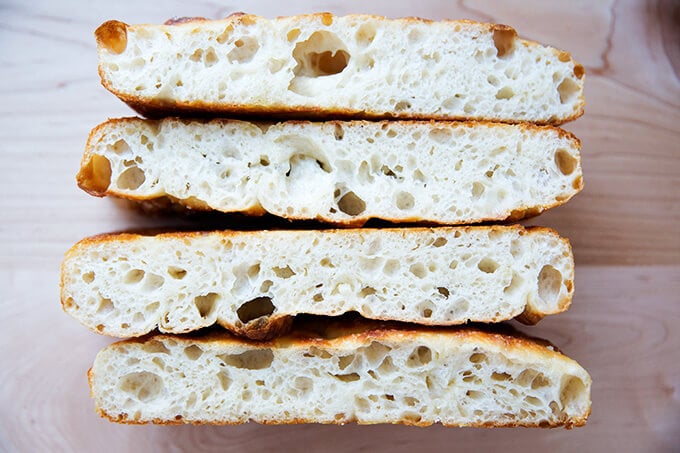
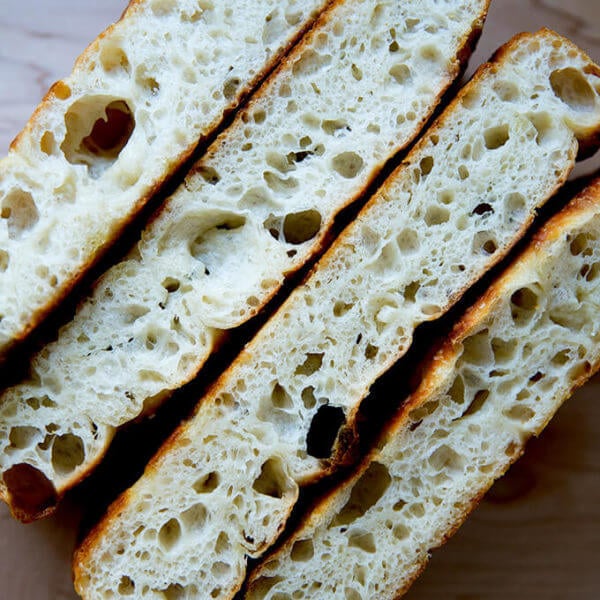
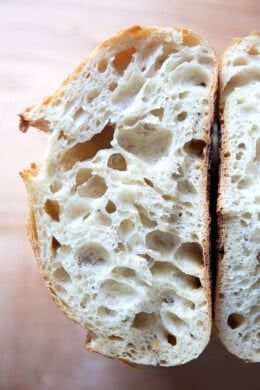
With its oil-crisped crust and light, bubbly crumb, sourdough focaccia is a delicious and versatile bread, perfect for sandwiches but also great as an appetizer and dinner bread. It’s also one of the easiest breads to make. Find step-by-step instructions on how to make this wildly popular bread below!
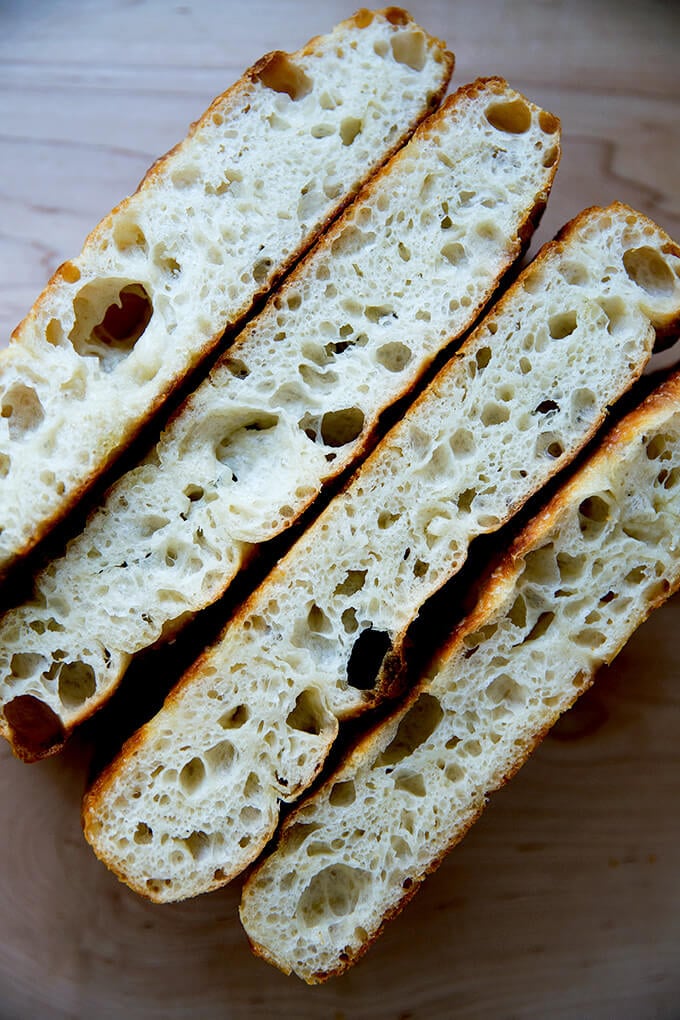
Adapted from my favorite yeasted, slow-rise focaccia recipe — overnight refrigerator focaccia — this sourdough focaccia recipe replaces the yeast with a sourdough starter. If you are interested in getting started with sourdough, focaccia is the ideal place to start.
Why? First, it requires no special equipment — not a Dutch oven or a Baking Steel. All you need is a 9×13-inch pan, which you likely own. Second, unlike sourdough boules, which require practiced shaping, sourdough focaccia requires nothing more than whisking, stirring, and sliding the dough into a pan. Third, it requires no scoring. With focaccia, you don’t need a razor-sharp lame — you use your fingers to dimple the dough.
Focaccia, sourdough or otherwise, is my favorite bread for so many reasons, namely its versatility — sandwiches, appetizers, dinner — but also its flavor and texture: the oil-crisped crust, the generous amount of salt, the chewy crumb. Learn to make it at home by following the simple guide below.
How to Make Sourdough Focaccia, Step by Step
First, wake up your starter by feeding it. If you don’t have a starter and don’t have a friend who can lend you one, I recommend buying one. When you are ready to feed your starter, discard most of it, down to a tablespoon or two, then add about 45 g flour…
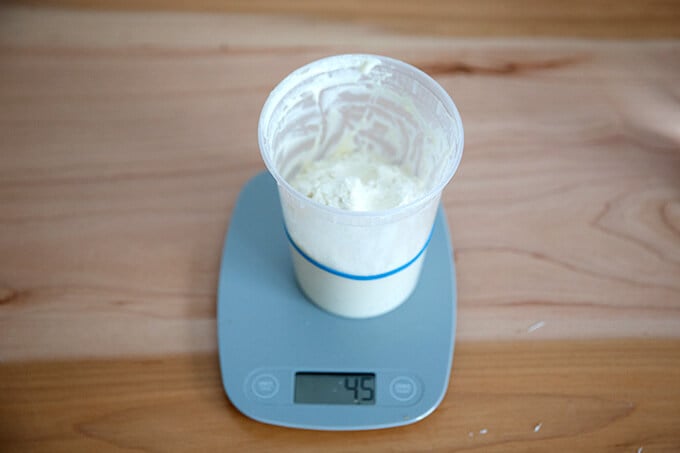
… and 45 g water. You don’t have to be exact, but when you’re getting started, I think it’s helpful to weigh both the water and flour. Depending on how long the starter has been in the fridge, it may need one or two feedings before use.
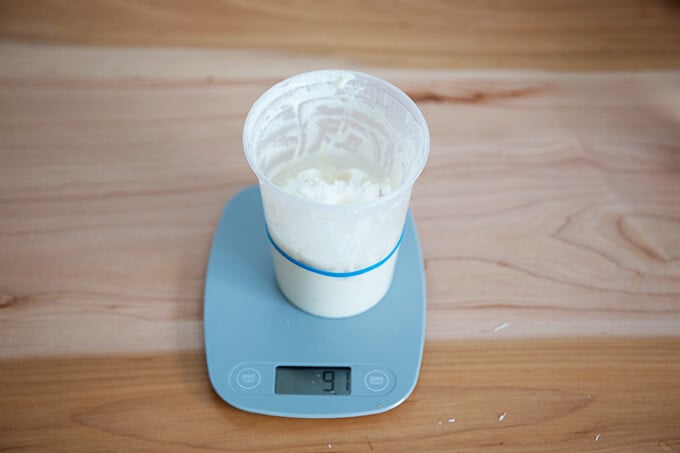
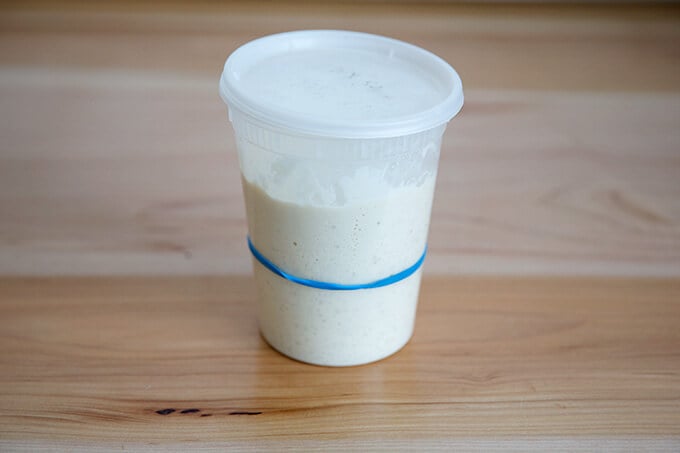
If you stick a rubber band around your starter vessel, you’ll know when …
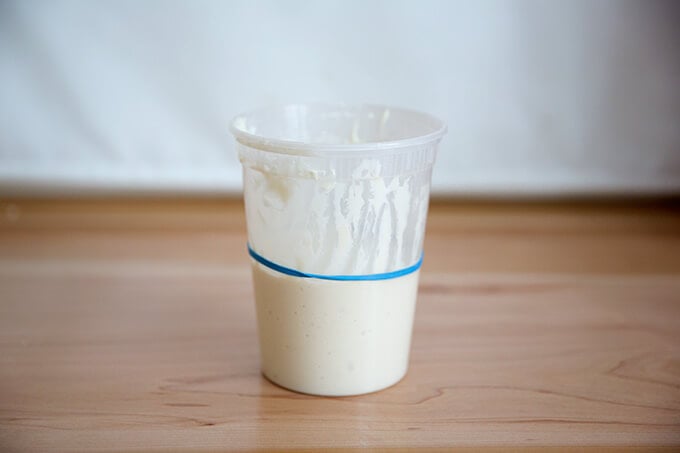
… it has doubled and is ready for use.
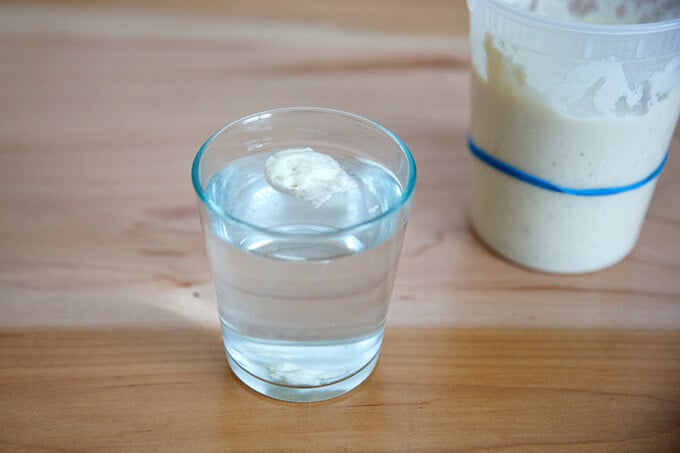
If you need reassurance as to if it’s ready, you can do the float test: drop a spoonful of starter into a glass of water. If it floats, it’s ready.
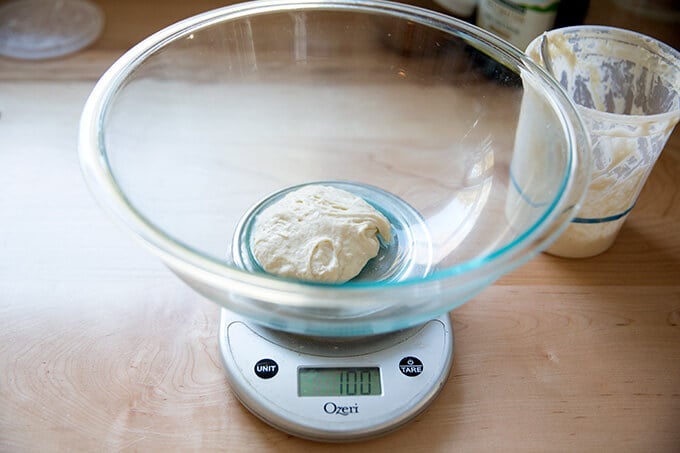
As with all bread, when mixing sourdough doughs, it’s best to weigh everything with a digital scale. Start with 100 g starter.
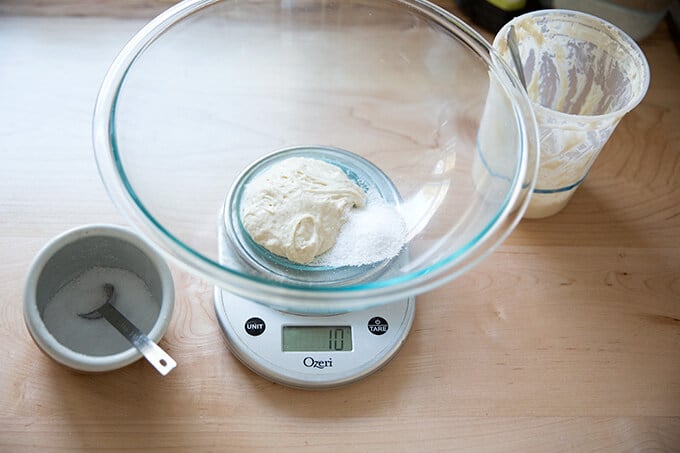
Add 10 g kosher (or other) salt.
Add 440 g water. (See recipe notes: If you live in a humid environment, you may want to use less.)
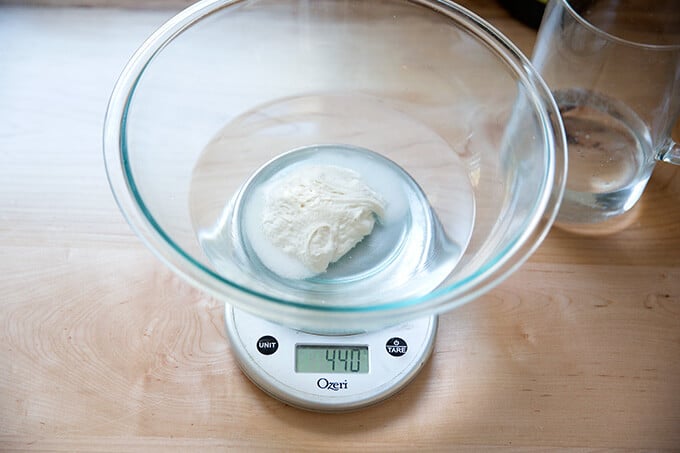
Stir to combine.
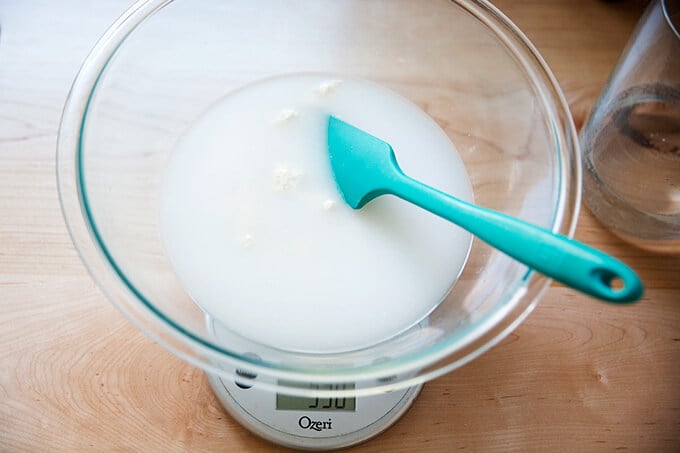
Add 512 g bread flour.
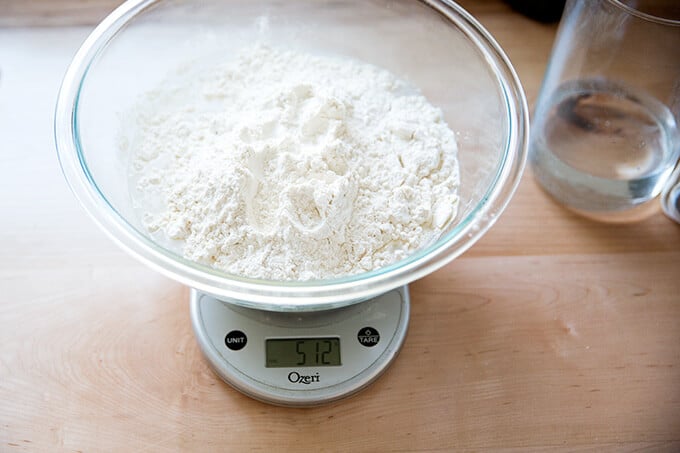
Stir to form a sticky dough ball.
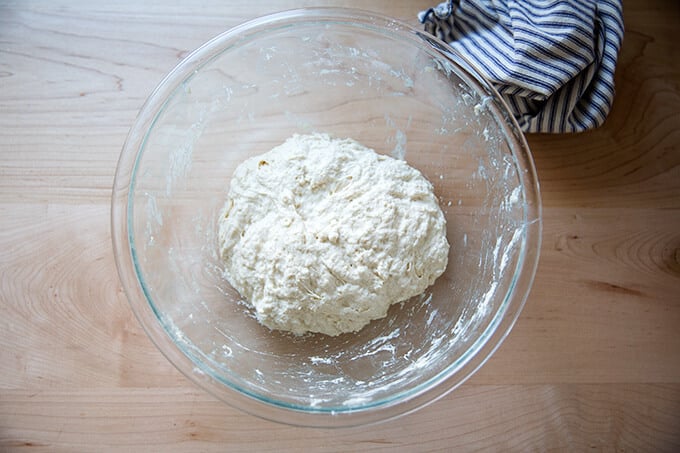
Cover with a towel or bowl cover, and let rise for 8 – 18 hours at room temperature (times will vary depending on the time of year and how warm your kitchen is … in the summer, this may take only 4 hours):
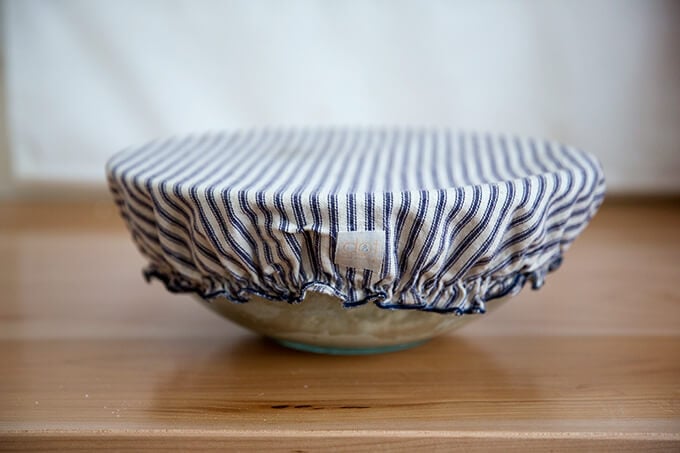
When it doubles …
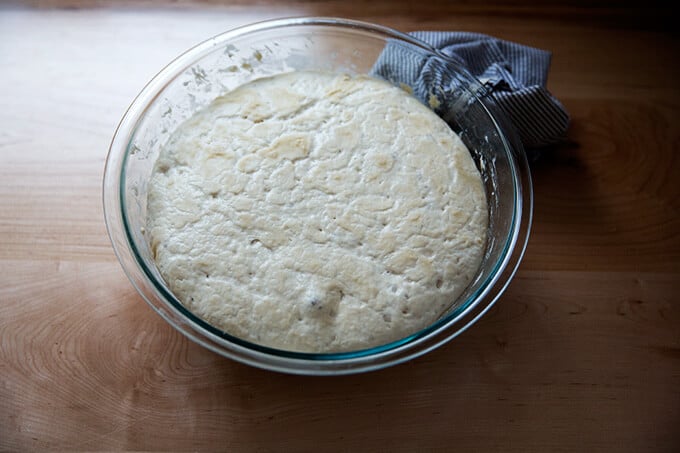
… drizzle it with some olive oil.
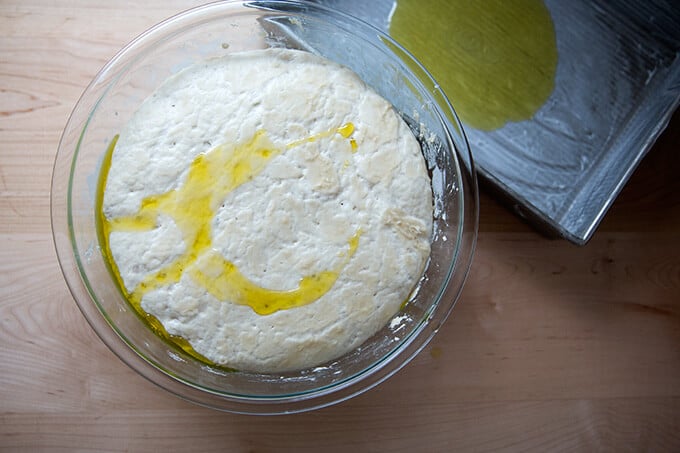
Deflate the dough by pulling the sides into the center.
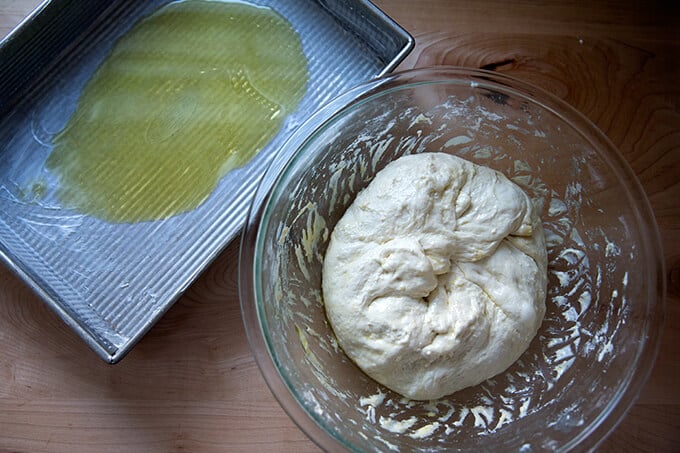
Dough, ready to make it’s second rise, which will take 5-6 hours. Love this USA Pan.
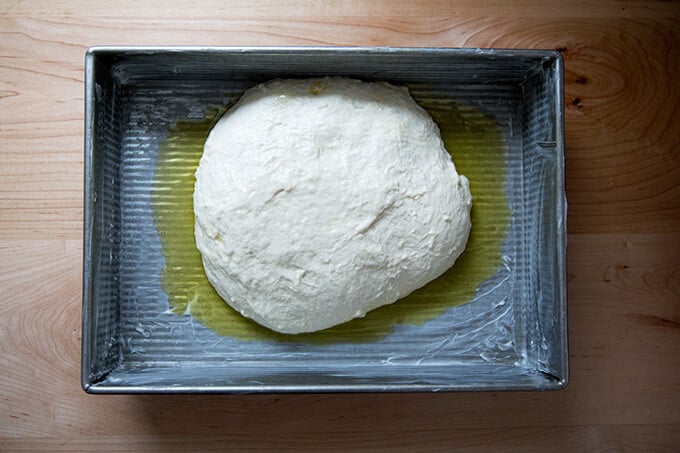
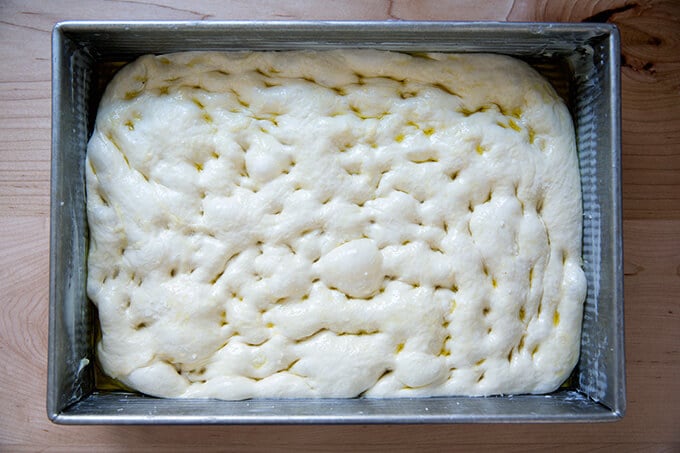
After 5-6 hours, the dough is ready to be dimpled and stretched and salted. Bake at 425ºF for 25 minutes.
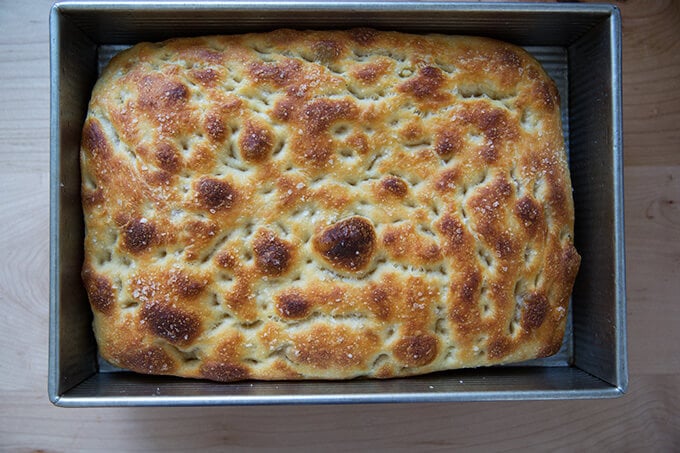
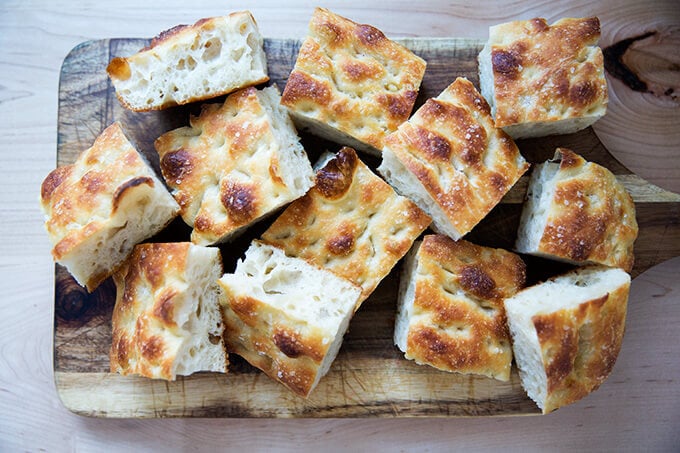
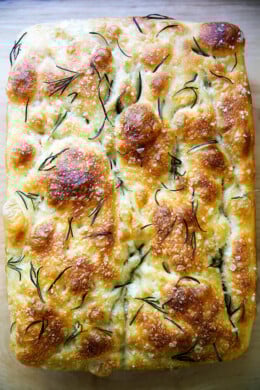
Just-baked sourdough focaccia:
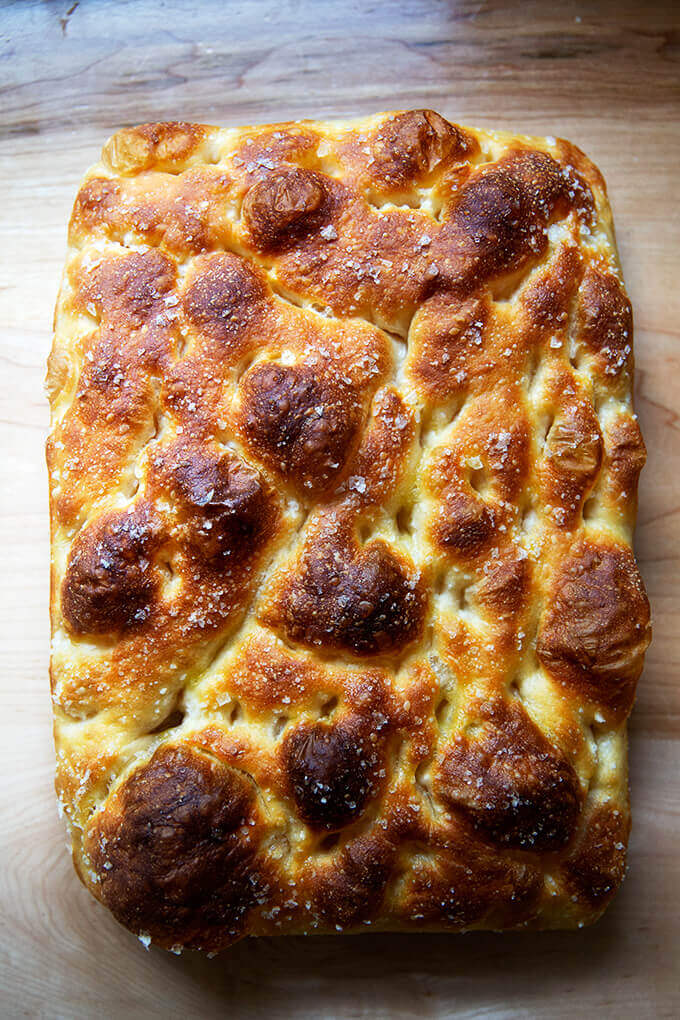
Simple Sourdough Focaccia
- Total Time: 24 hours 25 minutes
- Yield: 1 loaf 1x
Description
With its oil-crisped crust and light, bubbly crumb, sourdough focaccia is a delicious and versatile bread, perfect for sandwiches but also great as an appetizer and dinner bread. It’s also one of the easiest breads to make. Find step-by-step instructions on how to make this wildly popular bread below!
Notes:
Adapted from my favorite yeasted, slow-rise focaccia recipe — overnight refrigerator focaccia — this recipe replaces the yeast with a sourdough starter. Find video guidance and step-by-step instruction below.
What you need to make this recipe…:
- …a sourdough starter. You can buy one (from places like Breadtopia or King Arthur Flour) or you can make it yourself from scratch (a one- to two-week process).
- …time. Once your starter is ready to go, this recipe requires an initial 4- to 18-hour rise, followed by a second 4- to 6-hour second rise. After the initial rise (depending on the time of year and temperature of your kitchen), you can deflate the dough, and stick it in the fridge for 8 to 10 hours (maybe longer), which might help you regarding your schedule. Keep in mind, when you remove the dough from the fridge and transfer it to a pan, it will still need to rise for another 5- to 6- hours.
- …water. Chlorine in water can adversely affect sourdough. Leaving water at room temperature for 24 hours will allow most of the chlorine to escape. When I am in the habit of making sourdough bread, I fill a large pitcher with water and leave it out at room temperature. I use this for my sourdough breads and starter. Truth be told, I’ve used water straight from the tap and have not noticed a difference.
- …mixing/rising vessels. I love this 4-quart bowl + lid set for mixing and rising all sorts of dough. With sourdough, I love using a straight-sided vessel for the bulk fermentation, which allows me to see precisely how much my dough has increased in volume.
Water quantity: Depending on where you live and the time of year, you may need to cut the water back. If you live in a humid environment, for instance, I would suggest starting with 430 g water. If you are not using bread flour, you also may need to cut the water back a bit.
Timing:
The more I make sourdough, the more I realize so much depends on the time of year and the temperature of my kitchen. In the summer, because it is so warm, the first rise (bulk fermentation) takes between 4 – 6 hours; in the winter the first rise takes 12 – 18 hours.
This recipe’s key is to ensure the first rise doesn’t go too long — you want the dough to nearly double. A straight sided vessel (as opposed to a bowl) makes gauging the first rise easier. (Note: If your dough rises above double, don’t despair … recently my dough tripled in volume during an overnight rise, and the resulting focaccia was still delicious, light, airy, etc.)
A few thoughts: If you are making this focaccia in the summer (northern hemisphere), use 50 g of starter and check the dough every couple of hours. If you are making this in the winter, use 100 g of starter, and plan for a long first rise.
Troubleshooting: If you have issues with your dough being too sticky, please read this post: Why is my sourdough so sticky? The 4 common mistakes.
Flour choice:
- I’ve been using King Arthur Flour’s special patent flour — bought a 50-lb. bag of it at Restaurant Depot. Its protein content, 12.7%, is the same as the protein content of its bread flour. I also have used all-purpose flour (11.7%) with success, but I recommend bread flour, which seems to be more reliable for people especially those living in humid climates. If you only have ap flour on hand, you may consider reducing the water a bit — bread flour absorbs slightly more liquid than all-purpose flour.
Ingredients
- 50 g – 100 g (1/4 to 1/2 cup) active starter, see notes above
- 10 g (about 2.5 teaspoons) kosher salt
- 430 – 440 g water (1.75 cups – 1.75 cups + 2 tablespoons), room temperature, see notes above*
- 512 g (about 4 cups) bread flour, see notes above
- 3 tablespoons extra-virgin olive oil, divided, plus more for drizzling
- Nice, flaky sea salt, such as Maldon
Instructions
- Place the starter, salt, and water in a large bowl. Stir with a spatula to combine — it doesn’t have to be uniformly mixed. Add the flour. Mix again until the flour is completely incorporated.
- If time permits, perform one “fold”: 30 minutes after you mix the dough, reach into the bowl and pull the dough up and into the center. Turn the bowl quarter turns and continue this pulling 8 to 10 times. See video for guidance.
- Drizzle with a splash of olive oil and rub to coat. Cover bowl with a tea towel or bowl cover and set aside to rise at room temperature (70ºF/21ºC) for 4 to 18 hours (the time will vary depending on the time of year, the strength of your starter, and the temperature of your kitchen — in summer, for instance, my sourdoughs double in 6 hours; in winter, they double in 18 hours. Do not use an oven with the light on for the bulk fermentation — it will be too warm. It is best to rely on visual cues (doubling in volume) as opposed to time to determine when the bulk fermentation is done. A straight-sided vessel makes monitoring the bulk fermentation especially easy because it allows you to see when your dough has truly doubled.).
- When dough has doubled, place 2 tablespoons of olive oil into a 9×13-inch pan. (I have been using this USA Pan, which I love. I have had no sticking issues. If you are using a glass pan, you may, as a precaution, want to butter it it first — I have had disasters with bread sticking when I’ve used oil alone with other baking vessels.)
- Drizzle dough with a tablespoon of olive oil. Use your hand to gently deflate the dough and release it from the sides of the bowl. Gently scoop the dough into the center of the pool of oil in your prepared pan. Fold dough envelope style from top to bottom and side to side to create a rough rectangle. Turn dough over so seam-side is down. Video guidance here.
- Rub top of dough with oil. Leave alone for 4 to 6 hours, uncovered, or until puffy and nearly doubled.
- Heat oven to 425ºF. Rub hands lightly with oil, and using all ten fingers, press gently into the dough to dimple and stretch the dough to nearly fit the pan. Sprinkle generously with sea salt. Transfer pan to the oven and bake for about 25 minutes or until golden all around. Remove pan from oven and transfer bread to a cooling rack. Cool at least 20 minutes before slicing.
- Prep Time: 24 hours
- Cook Time: 25 minutes
- Category: Bread
- Method: Oven
- Cuisine: Italian
This post may contain affiliate links. Please read my disclosure policy.








1,671 Comments on “Simple Sourdough Focaccia: A Beginner’s Guide”
Just made this for the first time and I am hooked! I added rosemary and garlic to half and left the other half plain. I added 4 sets of folds like I saw on other focaccia recipes. Tuned out AMAZING!
Great to hear, Debbie! Thanks so much for writing and sharing your notes 🙂
This was ridiculously easy, and so incredibly delicious! I did overnight BF from 10pm -10am on the counter (it was a strangely cold 65 degree June weekend), until it doubled, into the same USA pans that you have, and let it sit for another 6 hours until it filled the pan and was bubbly and jiggly. Baked up 2″ tall with lots of big holes! Topped half w/ coarse salt, and half with Trader Joe’s Everything Bagel seasoning. I usually make sourdough boules, but I’ll probably be making this more going forward, since it’s so delicious, with close to zero effort. Thank you so much for your recipe!
Great to hear Kona! I love focaccia for the reason you state: so delicious, close to zero effort 🙂 Thanks so much for writing and sharing your notes.
Love this recipe! I was wondering what the cook time would be/ if it would be possible to bake the recipe in a sheet pan so that I could get a thinner focaccia for sandwiches.
It will be roughly the same. Just keep an eye on it, and start checking at around 20 minutes. Bake it until it is evenly golden or to your liking.
This was my first sourdough recipe I made after taking your ‘Sourdough Starter from Scratch’ challenge in May. First of all, I felt like a slow starter (LOL); it took nearly two weeks for my sourdough to start doubling. When it finally started to be very lively, I had to stash it in the fridge for two weeks while I was on a trip. When I got home from my trip, I was very happy to find that it took only one feeding for the starter to spring back to life, although I fed it three times for the discard before making this focaccia recipe.
The bread came out great – it looks just like yours! And it tastes like sourdough bread! I was a little worried because it seemed too wet, but it rose perfectly and was easy to handle; very jiggly and held its shape. Because it was late, I put it in the fridge after the first rise. I did not punch it down, l just loaded the dough, all risen in the bowl, into the fridge. In the morning it was still nicely risen. I put it in the pan with oil and folded it. It was ready to bake in about 5 hours, but I didn’t have time to bake it until about 7 hours later. The longer second rise did not seem to matter, as I said, it came out great. I am in Maine, and this occurred over two days of 90-degree weather with moderate humidity. I know this is long-winded, but I wanted to share my sourdough journey because I don’t think it was all “by-the-book”, but it worked out great.
Judi!! Thank you for all of this! I think it’s so important for others (especially beginners) to read comments like this, because they are so encouraging: there is no one/direct/right way to a loaf of sourdough bread. We have to be adaptable to life circumstances and to how our dough is behaving. I’m so happy this was a success, and I’m so happy you stuck with your starter … it can be a tedious 2 weeks, but it is so worth it in the end. Thanks again so much for writing!
I’m an expert at your overnight focaccia using commercial yeast, and also your sourdough boule. So now I’m ready to try SD focaccia. I’m in Southern California, and it’s now pretty warm and humid. At some point, I’m going to have to refrigerate the dough overnight because I can’t babysit it all day, and jump when it’s ready. So, at what point should I refrigerate it? Just trying to think of the timeline for this. Thank you 🙂
Hi! You can refrigerate it any time during the bulk fermentation if you need to. If you do, return it to room temperature to complete the bulk fermentation. You can also refrigerate it after the bulk fermentation: deflate it, ball it up, and place in the fridge in an airtight vessel for 24 – 48 hours; then proceed with the recipe.
can I divide this in two cake pans instead of a 9×13?
Yes!
Thank you for that suggestion, Beth. I just tried the two-cake-pan-method today and it worked perfectly! The bake time was the same (25 minutes) but I rotated the pans halfway through.
Great to hear Lynette! Thanks so much for writing and sharing these notes 🙂
Very tasty but extremely wet dough. I would cut down by at least 20-25%. It was so wet it wouldn’t even dimple. I bake quite often and the ratios I found a bit off (it’s summer and humid) as well.
I added italian style dry seasoning into the dough and used quality EVOO. Tastes fantastic but it was just a bit too wet of a dough. Will try again.
This makes sense Jordan! I think sourdough is all about dialing in the ratio of water to flour given your environment (humid or dry) and the flour you are using. If you live in a humid environment and are using all-purpose flour as opposed to bread flour, it’s possible that reducing the water will give you better results. Thanks for writing and sharing your notes.
I have made this a couple of times as well as the yeast version and to be honest I can’t tell much difference, but if I let it slow ferment in the fridge for 2-3 days I think it would taste very different . I also do more stretch and folds (massive fan of this) and top it with thinly sliced heirloom tomatoes, garlic oil, Nigella seeds and salt and freshly ground black pepper. An absolute winner with all my family and friends, so thank you again Alexandra for a wonderful recipe 😊😊
Great to hear, Annie! Thanks so much for writing and sharing your notes. Your toppings sound lovely 🙂
Such a great recipe! Simple, easy and delicious! Wonderfully bubbly and flavorful! I topped mine with green olives and cherry tomatoes 🙂
Great to hear, Christine! Thanks so much for writing. Green olives + tomatoes sounds so lovely 🙂
I’m trying to figure out a way to have the dough ready to bake mid-morning – if I put the dough in the frig at step 6 will it rise overnight?
I’ve made this focaccia once and it got rave reviews. I also made your peasant bread, but have recently converted to sourdough – good fun.
Hi! Sourdough doesn’t change much in the fridge, but yes, you can absolutely place the dough (in its prepped pan) in the fridge. I’d remove it early 5/6 am-ish if you want it by mid morning.
This is the first time I’ve planned ahead enough to make this. I started at 2 pm. By 9 pm it had doubled so I just stuck it in the fridge as is. I took it back out at 10 am and cooked it at 7 pm. It was incredible!! Thank you!!
Great to hear, Sarah! Thanks so much for writing and sharing your notes 🙂
I have a question.
On your recipe to print out, you said to drizzle olive oil before you start the first rise, but on your video, you don’t drizzle oil till after the first rise.
Which is correct?
Would drizzling oil before the first rise prevent the dough from rising?
Either is fine! Oil will not prevent the dough from rising! I did that out of habit… sometimes I coat dough balls in oil to prevent them from drying out during long, slow rises; now I just use a lid that creates a sealed environment.
Thank you.
This recipe was wonerful, delicious, crispy and fluffy all at the same time. Love it. My husband said it was the best he ever had. So easy too. I put sun dried tomatoes on it and some trader joes everything but the bagel spice…..perfection
YUM! ALL sounds delicious. Thanks for writing and sharing your notes.
I have been a little frustrated with sourdough and this recipe change my life. I have done it twice and the outcome is amazing, perfect for friends meeting or family dinner. I’m just wondering how to storage and if it’s ok to not burn it the top and if I give some to family can I tell them to place them in the oven for few minutes??
Great to hear!
Store the bread at room temperature in an airtight bag for as long as 3 days. Always reheat before serving: pop the focaccia in the oven at 350ºF for 15 minutes.
One of my favorite sourdough recipes. Been making it for a few years. I was wondering if it’s possible to let it do the second rise in the pan in the fridge overnight? I like to bake it in the morning and take it into work but it’s been too hot and over fermenting if I leave it out overnight.
Yes, you can! Just be sure the pan is covered tightly with plastic wrap so that the dough doesn’t form a crust. You’ll still need to let it proof at room temperature before baking.
Hi Ali, I am new to baking with sourdough and am always looking for recipes that are easy to follow and aren’t overly complicated to make, especially bread recipes. I’ve finally gotten Cruella “Doughville”(my sourdough starter) to a consistent healthy level. 😊🙌🏻
One of my husband’s favorite breads is focaccia. So I looked in Pinterest to find an easy to make recipe and yours came up in the first set of suggested sourdough focaccia bread recipes. I decided to make it to go with our dinner tonight. It was AMAZING!! Tasted so good and the texture was perfect. I was so excited and proud of myself that I’d finally made a successful sourdough bread !!
Thank you so much for sharing your recipes and other sourdough baking tips.
Cherilyn
It’s so nice to read this, Cherilyn! Thanks so much for writing and sharing your experience. I’m so glad Cruella “Doughville” (so good!!) is cooperating 🙂
Hi Ali! I am trying to improve my luck with sourdough recipes but I think our Midwest humidity is my foe. I am in the process of making your SD focaccia with the addition 1.5 bulbs of roasted garlic & fresh rosemary. I followed your suggestions on high humidity and using AP flour by only adding 50g of starter and only 400g of water but I probably should have used less with adding the roasted garlic because my dough is very sticky. I went to do the stretch & fold 30 min after mixing the dough and it really stuck to my hand. Is there a fix for this? Could I add some whole wheat flour to help improve this or what do you suggest?
Sincerely, Debby Willis
Hi Debby! This is definitely a wet and sticky dough, so the issues you are facing might not be issues at all, unless the dough is more of a puddle than a sticky ball. When you did the stretches and folds, were you using a wet hand? It’s counter intuitive, but using a wet hand will prevent sticking, and being pretty aggressive with the stretches and folds will build strength.
You can use some ww flour, which is thirstier than ap flour, and will soak up some of that liquid. That said, the more ww flour you use, the less lofty your loaf will be.
Roasted garlic sounds so lovely!! I think/hope it turns out well for you. Keep me posted on how it progresses!
Hi! I made this recipe and I thought it was super helpful and easy to follow. One question that I have, (and I consistently have this problem w bread making) is that in the final stage my dough doesn’t look as jiggly and bubbly as I think it should. Any tips? Thank you!!
Hi! Are you using a scale to measure? What type of flour are you using?
Have only been baking sourdough recipes for a few months now with my sister and this was one of our first recipes we tried. Very beginner friendly and helpful tips and steps. Have made this at least 10-15 times now and get rave reviews each time! Especially tasty making sandwiches with pesto, burrata cheese, roasted tomatoes, and deli meat. I add sliced shallots, fresh rosemary, and sprinkle a generous amount of flaked salt right before baking.
Great to hear, Diana! Thanks so much for writing and sharing all of these notes 🙂
Best focaccia recipe I’ve ever tried, and also the easiest!
Great to hear, Cinzia! Thanks so much for writing 🙂
Hi Ali,
I have made this focaccia several times and it is amazing!! Everyone raves about it when I take it somewhere! Have you ever substituted some of the flour for tipo 00? I mostly want to use up some I have.
I have Pizza night and love it! I love making meals for my family and bringing everyone together through food. Keep sharing your passion w us!
Hi Sharon! Thank you for writing and for your kind words. I’m so happy to hear about Pizza Night!
OK, you can use some tipo 00 flour, but keep in mind that it may make the dough much wetter — tipo 00 flour doesn’t absorb water the way bread flour does. It’s often used in lower hydration doughs (like 60-65%) that are baked in outdoor pizza ovens. It is known for its extensible gluten structure, which is great for pizza, but maybe not ideal for focaccia. It also might not brown as well as bread flour.
All of this said: I know what it’s like having flour on hand that you want to use up, so if you use 25% tipo 00 flour here, it should be fine 🙂
I have made this recipe SSSOOOOO many times over the last 5 years or so- literally in the hundreds because it is everyone’s absolute favorite. Whenever I bring it to a potluck, it gets the most rave reviews and of all the sourdough recipes I make, it’s the easiest!!!
I’m so happy to hear this, Cory! Thanks so much for writing and sharing this 🙂
I am excited to try this. Can I let it rise for the second time in the refrigerator?
Yes! Be sure the vessel is covered tightly with plastic wrap so that the dough doesn’t dry out.
Can I freeze the dough raw? If so, at what stage of the process?
No, I wouldn’t recommend doing this. Sourdough dough does not do well in the freezer.
Hi!!! I’ve been exclusively baking your basic sourdough since I recently started my SD journey 🙂 I know this focaccia will be so easy to nail! Will it stay fresh the same few days as regular sourdough loaf? Because I know in the past when I made regular yeast we focaccia it was really mostly only fresh for a day. Thank you!!!!
Yes, I’d say it stays fresh for at least 3 days at room temperature in an airtight bag or vessel. I do always recommend re-heating day old bread, whether it’s yeast or sourdough, before serving — either in the toaster or toaster oven or for 15 minutes @ 350ºF in the oven.
This was pretty easy and ridiculously amazing. Chewy and soft and absolutely the best I’ve had. I’m pretty new to sourdough and I found it very easy! I threw in some chopped sun-dried tomatoes and fresh rosemary while doing the folds in the 9×13 pan before letting it expand… didn’t disrupt the texture at all and added some great flavor. My husband loved it!
Great to hear, Abbey! Thanks so much for writing and sharing these notes. Sun dried tomatoes + rosemary sounds divine 🙂
A bit confused as the written version of the recipe says to add olive oil for the first rise but in the photo explanation you only add it to the second rise only? Hopefully it turns out okay still.
It will be fine! I do generally slick all of my doughs with some olive oil during the first rise. It protects the surface from drying out.
So simple to make and so delicious 🤤
I use it to make sandwiches 😋
Great to hear, Cynthia! Thanks for writing 🙂
Hi Ali! This recipe was amazing! So easy and fairly quick as far as sourdough goes. I added rosemary and flaky salt. I love making a sourdough boule for everyday bread, but this is a great recipe to have in your back pocket to change it up! Thank you!
So nice to read this, Sheri! I agree: focaccia is the best in terms of the effort to reward ratio 🙂 Thanks for writing and sharing your thoughts!
Hey, thank you so much for sharing your recipe! I was looking for advice, the bread turned out good but a bit too sour. Do you know what may have caused it? Thank you!
Hi! Are you new to sourdough? Can you tell me about your starter? Homemade or purchased? After you fed your stater, how long had it risen before you used it?
Thank you so much for taking the time to reply! I’m not exactly new to sourdough, but I took a break for a while because life got a bit busy. The starter is my own, homemade one—it’s been in the fridge for some time, though I did feed it a few times before using it for the focaccia. That might be where the issue came from. I really appreciate your help!
Hi! Feeding it a few times before using it is a very good idea… I don’t think that is the issue. Are you using bread flour for the bread? And what flour are you using to feed your starter? How long are you cold proofing the dough before baking it?