 →
→ 

Simple Sourdough Focaccia: A Beginner’s Guide
 By Alexandra Stafford
—
Last Updated: 01/22/2026
By Alexandra Stafford
—
Last Updated: 01/22/2026
This post may contain affiliate links. Please read my disclosure policy.
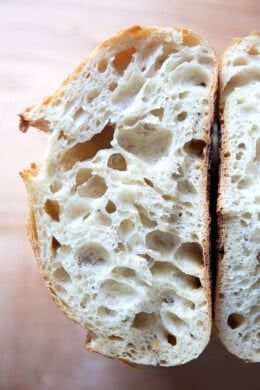
With its oil-crisped crust and light, bubbly crumb, sourdough focaccia is a delicious and versatile bread, perfect for sandwiches but also great as an appetizer and dinner bread. It’s also one of the easiest breads to make. Find step-by-step instructions on how to make this wildly popular bread below!
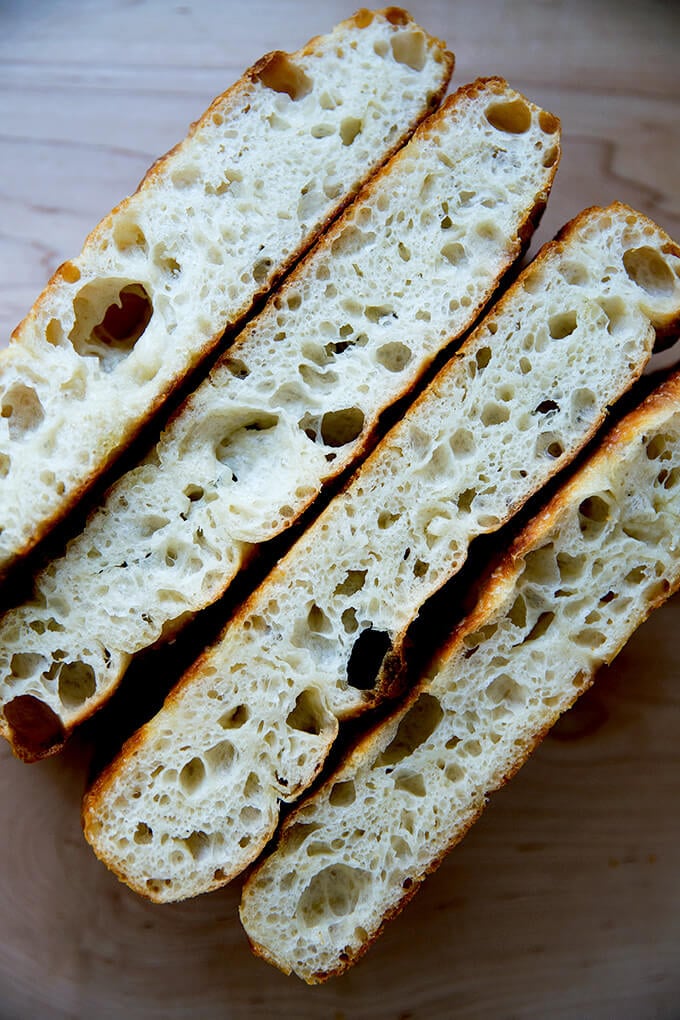
Adapted from my favorite yeasted, slow-rise focaccia recipe — overnight refrigerator focaccia — this sourdough focaccia recipe replaces the yeast with a sourdough starter. If you are interested in getting started with sourdough, focaccia is the ideal place to start.
Why? First, it requires no special equipment — not a Dutch oven or a Baking Steel. All you need is a 9×13-inch pan, which you likely own. Second, unlike sourdough boules, which require practiced shaping, sourdough focaccia requires nothing more than whisking, stirring, and sliding the dough into a pan. Third, it requires no scoring. With focaccia, you don’t need a razor-sharp lame — you use your fingers to dimple the dough.
Focaccia, sourdough or otherwise, is my favorite bread for so many reasons, namely its versatility — sandwiches, appetizers, dinner — but also its flavor and texture: the oil-crisped crust, the generous amount of salt, the chewy crumb. Learn to make it at home by following the simple guide below.
How to Make Sourdough Focaccia, Step by Step
First, wake up your starter by feeding it. If you don’t have a starter and don’t have a friend who can lend you one, I recommend buying one. When you are ready to feed your starter, discard most of it, down to a tablespoon or two, then add about 45 g flour…
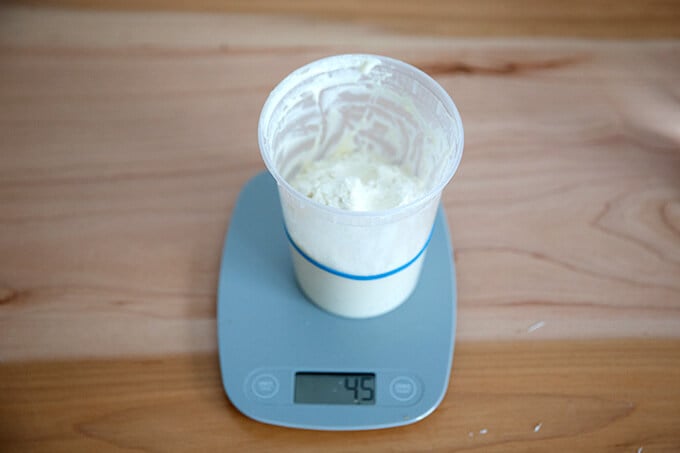
… and 45 g water. You don’t have to be exact, but when you’re getting started, I think it’s helpful to weigh both the water and flour. Depending on how long the starter has been in the fridge, it may need one or two feedings before use.
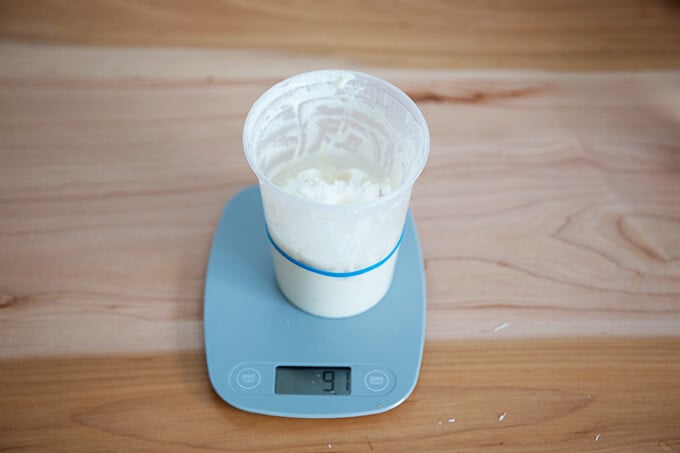
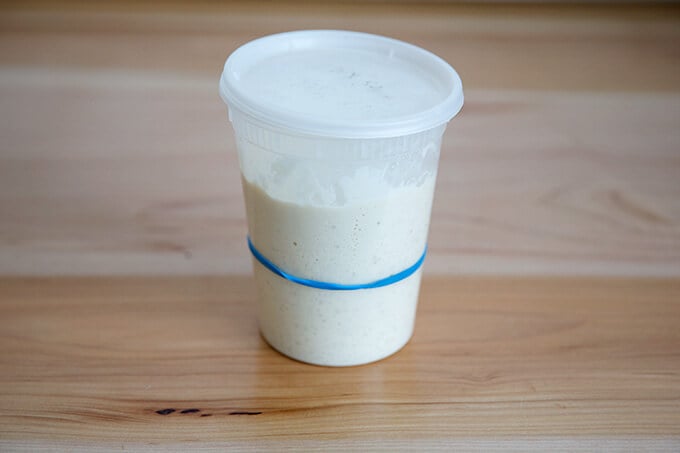
If you stick a rubber band around your starter vessel, you’ll know when …
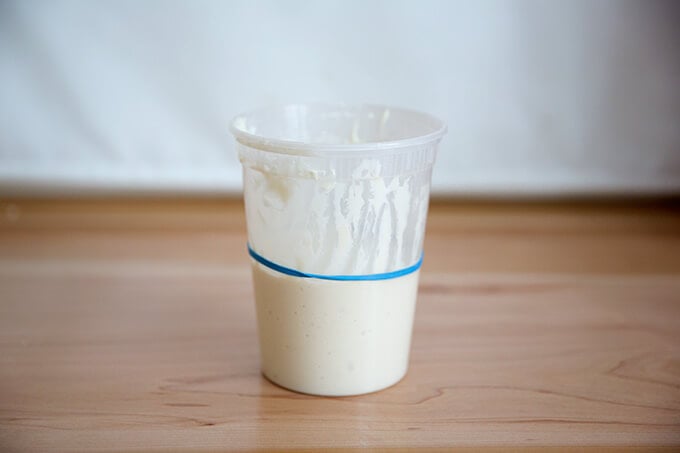
… it has doubled and is ready for use.
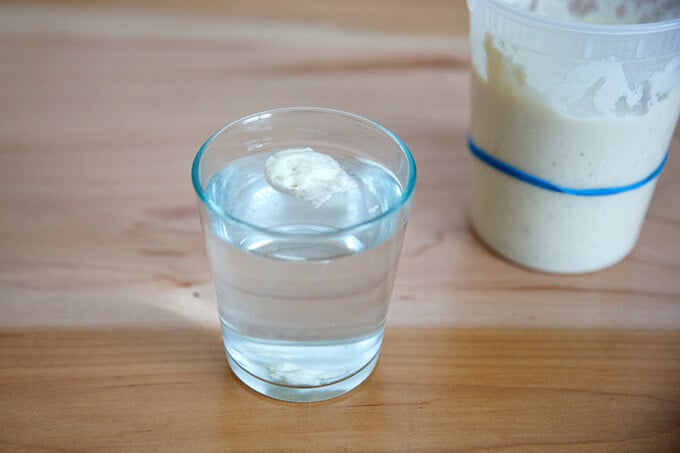
If you need reassurance as to if it’s ready, you can do the float test: drop a spoonful of starter into a glass of water. If it floats, it’s ready.
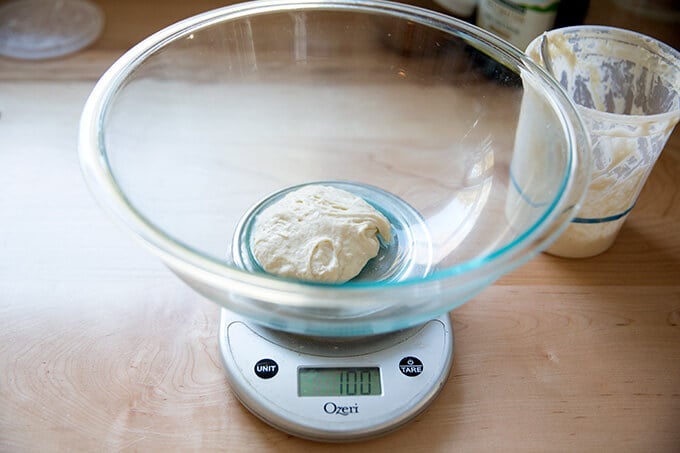
As with all bread, when mixing sourdough doughs, it’s best to weigh everything with a digital scale. Start with 100 g starter.
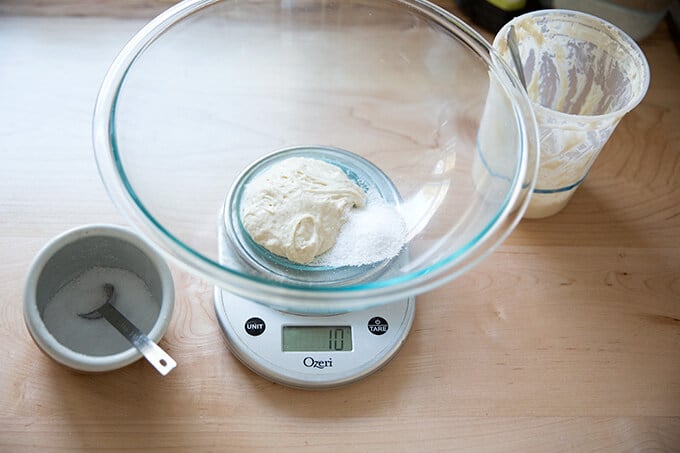
Add 10 g kosher (or other) salt.
Add 440 g water. (See recipe notes: If you live in a humid environment, you may want to use less.)
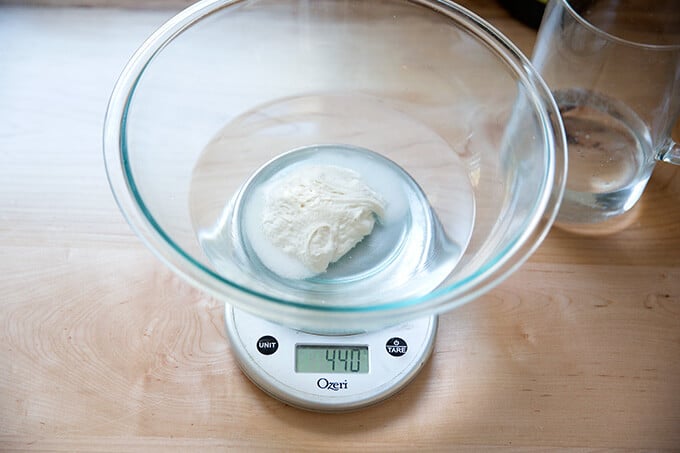
Stir to combine.
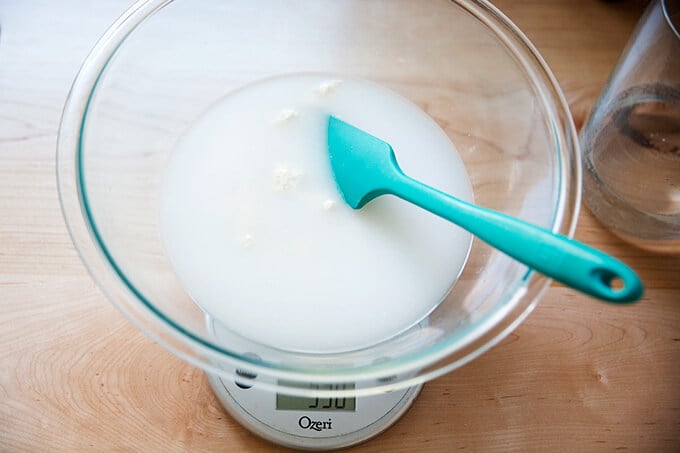
Add 512 g bread flour.
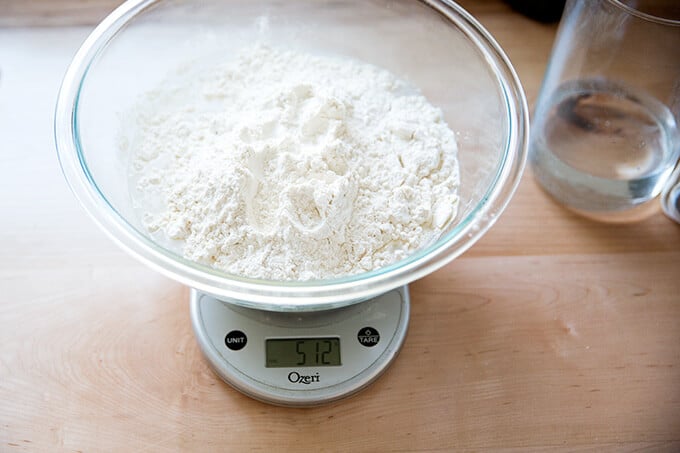
Stir to form a sticky dough ball.
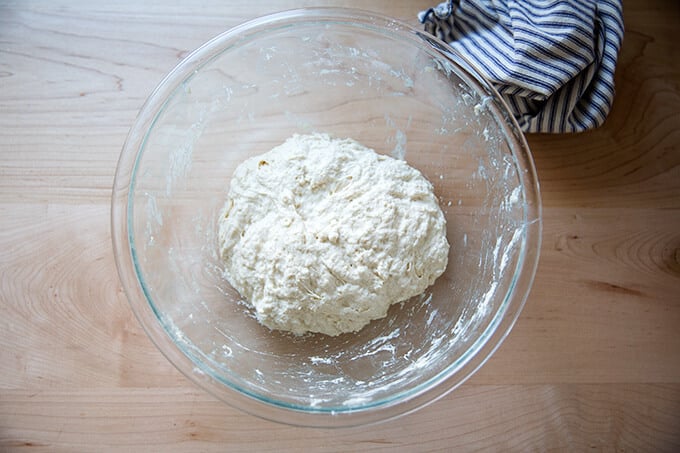
Cover with a towel or bowl cover, and let rise for 8 – 18 hours at room temperature (times will vary depending on the time of year and how warm your kitchen is … in the summer, this may take only 4 hours):
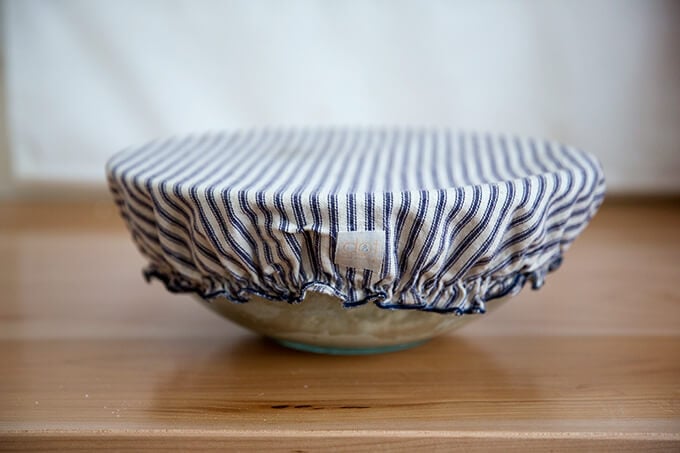
When it doubles …
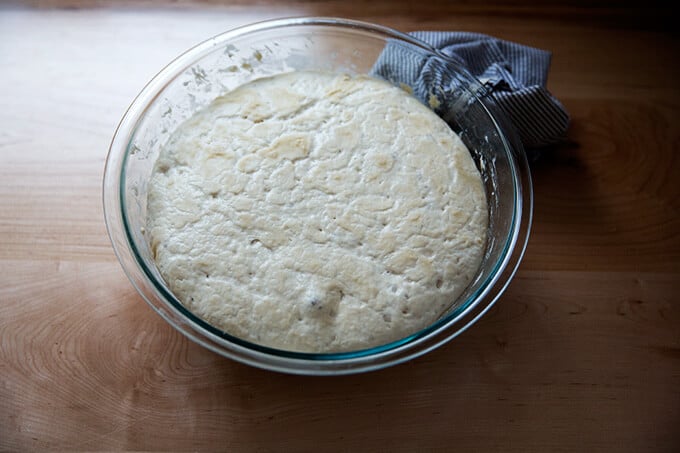
… drizzle it with some olive oil.
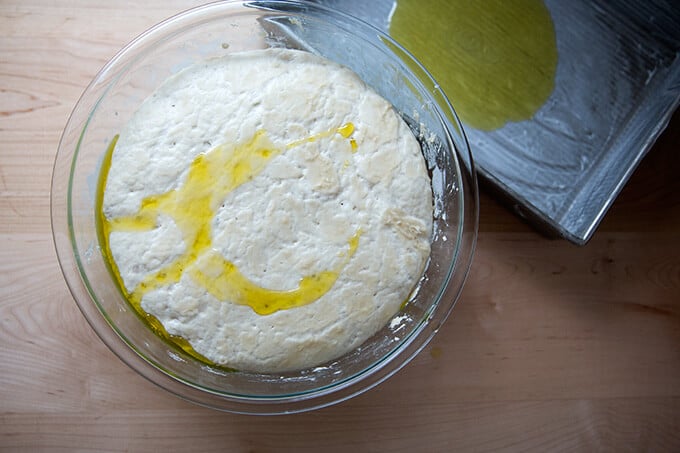
Deflate the dough by pulling the sides into the center.
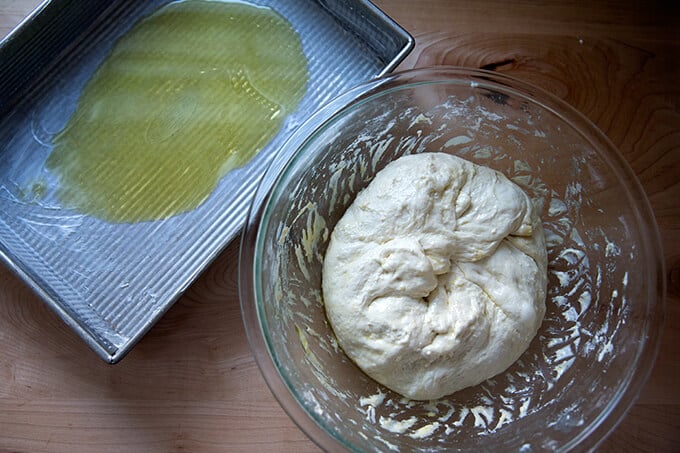
Dough, ready to make it’s second rise, which will take 5-6 hours. Love this USA Pan.
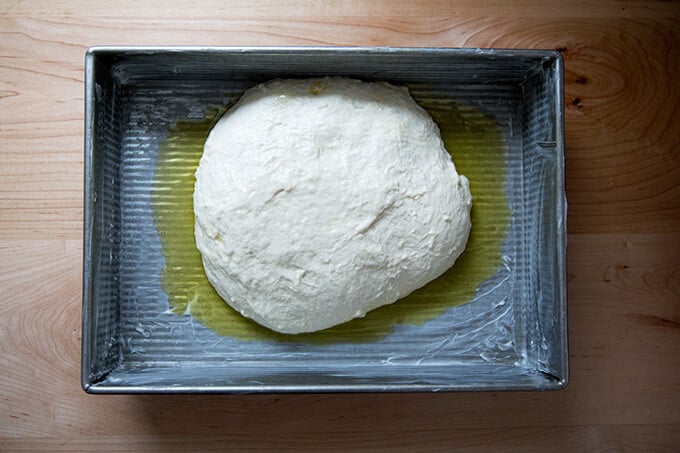
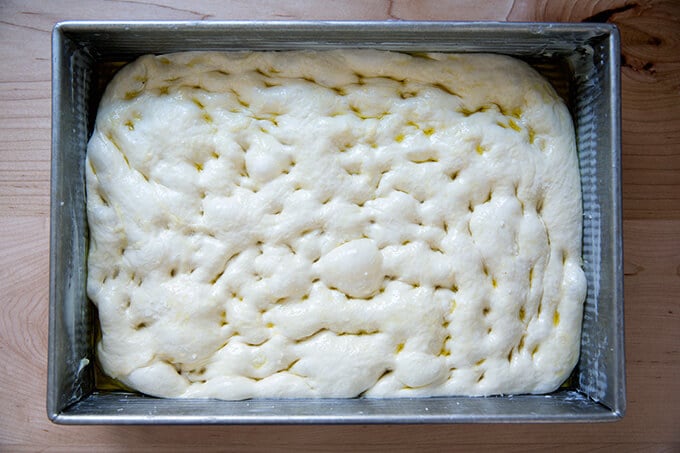
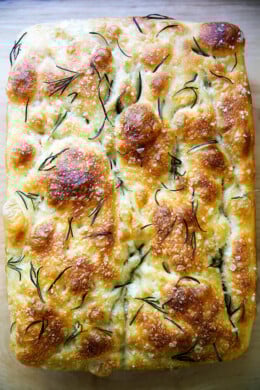
After 5-6 hours, the dough is ready to be dimpled and stretched and salted. Bake at 425ºF for 25 minutes.
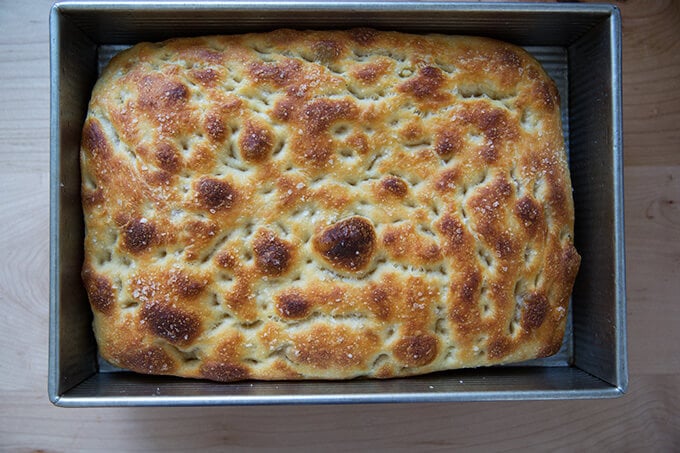
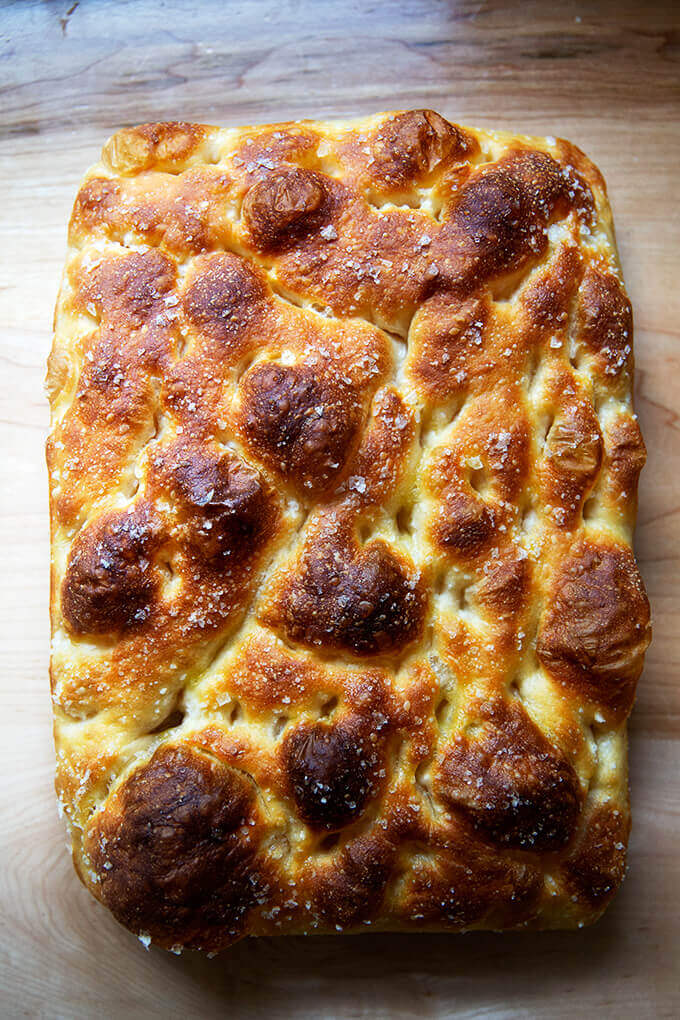
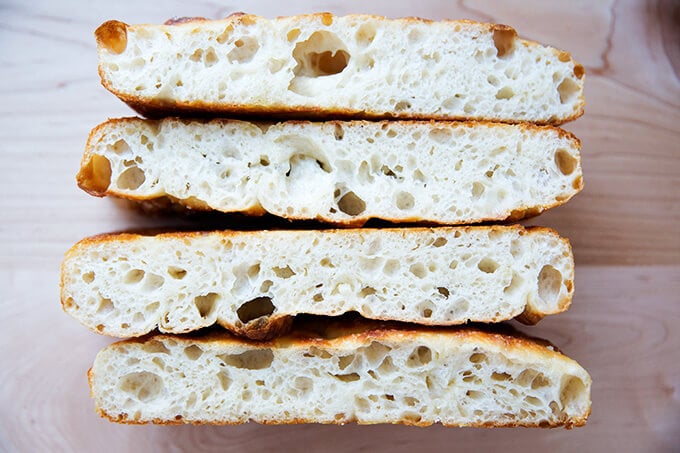
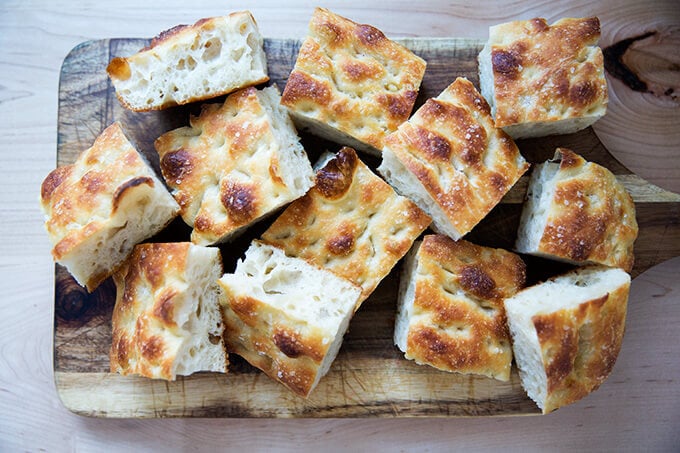
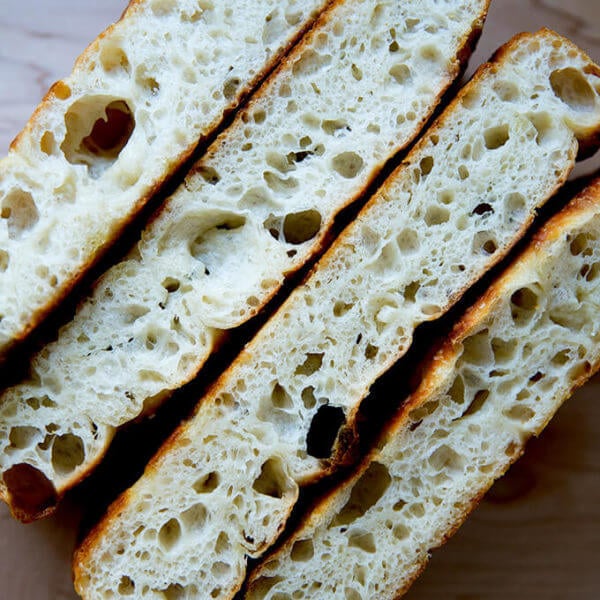
Just-baked sourdough focaccia:
Simple Sourdough Focaccia
- Total Time: 24 hours 25 minutes
- Yield: 1 loaf 1x
Description
With its oil-crisped crust and light, bubbly crumb, sourdough focaccia is a delicious and versatile bread, perfect for sandwiches but also great as an appetizer and dinner bread. It’s also one of the easiest breads to make. Find step-by-step instructions on how to make this wildly popular bread below!
Notes:
Adapted from my favorite yeasted, slow-rise focaccia recipe — overnight refrigerator focaccia — this recipe replaces the yeast with a sourdough starter. Find video guidance and step-by-step instruction below.
What you need to make this recipe…:
- …a sourdough starter. You can buy one (from places like Breadtopia or King Arthur Flour) or you can make it yourself from scratch (a one- to two-week process).
- …time. Once your starter is ready to go, this recipe requires an initial 4- to 18-hour rise, followed by a second 4- to 6-hour second rise. After the initial rise (depending on the time of year and temperature of your kitchen), you can deflate the dough, and stick it in the fridge for 8 to 10 hours (maybe longer), which might help you regarding your schedule. Keep in mind, when you remove the dough from the fridge and transfer it to a pan, it will still need to rise for another 5- to 6- hours.
- …water. Chlorine in water can adversely affect sourdough. Leaving water at room temperature for 24 hours will allow most of the chlorine to escape. When I am in the habit of making sourdough bread, I fill a large pitcher with water and leave it out at room temperature. I use this for my sourdough breads and starter. Truth be told, I’ve used water straight from the tap and have not noticed a difference.
- …mixing/rising vessels. I love this 4-quart bowl + lid set for mixing and rising all sorts of dough. With sourdough, I love using a straight-sided vessel for the bulk fermentation, which allows me to see precisely how much my dough has increased in volume.
Water quantity: Depending on where you live and the time of year, you may need to cut the water back. If you live in a humid environment, for instance, I would suggest starting with 430 g water. If you are not using bread flour, you also may need to cut the water back a bit.
Timing:
The more I make sourdough, the more I realize so much depends on the time of year and the temperature of my kitchen. In the summer, because it is so warm, the first rise (bulk fermentation) takes between 4 – 6 hours; in the winter the first rise takes 12 – 18 hours.
This recipe’s key is to ensure the first rise doesn’t go too long — you want the dough to nearly double. A straight sided vessel (as opposed to a bowl) makes gauging the first rise easier. (Note: If your dough rises above double, don’t despair … recently my dough tripled in volume during an overnight rise, and the resulting focaccia was still delicious, light, airy, etc.)
A few thoughts: If you are making this focaccia in the summer (northern hemisphere), use 50 g of starter and check the dough every couple of hours. If you are making this in the winter, use 100 g of starter, and plan for a long first rise.
Troubleshooting: If you have issues with your dough being too sticky, please read this post: Why is my sourdough so sticky? The 4 common mistakes.
Flour choice:
- I’ve been using King Arthur Flour’s special patent flour — bought a 50-lb. bag of it at Restaurant Depot. Its protein content, 12.7%, is the same as the protein content of its bread flour. I also have used all-purpose flour (11.7%) with success, but I recommend bread flour, which seems to be more reliable for people especially those living in humid climates. If you only have ap flour on hand, you may consider reducing the water a bit — bread flour absorbs slightly more liquid than all-purpose flour.
Ingredients
- 50 g – 100 g (1/4 to 1/2 cup) active starter, see notes above
- 10 g (about 2.5 teaspoons) kosher salt
- 430 – 440 g water (1.75 cups – 1.75 cups + 2 tablespoons), room temperature, see notes above*
- 512 g (about 4 cups) bread flour, see notes above
- 3 tablespoons extra-virgin olive oil, divided, plus more for drizzling
- Nice, flaky sea salt, such as Maldon
Instructions
- Place the starter, salt, and water in a large bowl. Stir with a spatula to combine — it doesn’t have to be uniformly mixed. Add the flour. Mix again until the flour is completely incorporated.
- If time permits, perform one “fold”: 30 minutes after you mix the dough, reach into the bowl and pull the dough up and into the center. Turn the bowl quarter turns and continue this pulling 8 to 10 times. See video for guidance.
- Drizzle with a splash of olive oil and rub to coat. Cover bowl with a tea towel or bowl cover and set aside to rise at room temperature (70ºF/21ºC) for 4 to 18 hours (the time will vary depending on the time of year, the strength of your starter, and the temperature of your kitchen — in summer, for instance, my sourdoughs double in 6 hours; in winter, they double in 18 hours. Do not use an oven with the light on for the bulk fermentation — it will be too warm. It is best to rely on visual cues (doubling in volume) as opposed to time to determine when the bulk fermentation is done. A straight-sided vessel makes monitoring the bulk fermentation especially easy because it allows you to see when your dough has truly doubled.).
- When dough has doubled, place 2 tablespoons of olive oil into a 9×13-inch pan. (I have been using this USA Pan, which I love. I have had no sticking issues. If you are using a glass pan, you may, as a precaution, want to butter it it first — I have had disasters with bread sticking when I’ve used oil alone with other baking vessels.)
- Drizzle dough with a tablespoon of olive oil. Use your hand to gently deflate the dough and release it from the sides of the bowl. Gently scoop the dough into the center of the pool of oil in your prepared pan. Fold dough envelope style from top to bottom and side to side to create a rough rectangle. Turn dough over so seam-side is down. Video guidance here.
- Rub top of dough with oil. Leave alone for 4 to 6 hours, uncovered, or until puffy and nearly doubled.
- Heat oven to 425ºF. Rub hands lightly with oil, and using all ten fingers, press gently into the dough to dimple and stretch the dough to nearly fit the pan. Sprinkle generously with sea salt. Transfer pan to the oven and bake for about 25 minutes or until golden all around. Remove pan from oven and transfer bread to a cooling rack. Cool at least 20 minutes before slicing.
- Prep Time: 24 hours
- Cook Time: 25 minutes
- Category: Bread
- Method: Oven
- Cuisine: Italian
This post may contain affiliate links. Please read my disclosure policy.










1,671 Comments on “Simple Sourdough Focaccia: A Beginner’s Guide”
New to sourdough and this was soooo easy and tastes incredible! Thanks Ali for a thorough and easy to follow recipe. I ended up leaving mine in the oven for 35 mins and it is crispy, fluffy, airy with a bit of decadence – just the way a perfect focaccia should be. I am HOOKED!
Great to hear, Gina! Thanks so much for writing and sharing your notes. Sourdough focaccia is heaven 🙂
I’ve made it twice in two weeks and I’m hooked! Simple, early to follow instructions. Thank you☺️
Great to hear, Michele! Thanks so much for writing 🙂
Just made this and it’s so fluffy + delicious! Your recipes were the first I followed when I started sourdough baking 3 years ago and I keep coming back to them for reference. Thank you!
Great to hear this, Loryne 🙂 Thanks so much for taking the time to write and share this 🙂
I just made this focaccia. And it turned out pretty well! But I am curious about leaving it uncovered during the second rise. It got a bit of a rind and then didn’t rise as well as I’d hoped. Yours doesn’t look like that happened. Would it work to cover the dough during the second rise?
Yes, you can definitely cover the pan for the second rise. If the dough ball is sufficiently covered in oil, it should be necessary, but when it’s dry and cold out, which could cause the second rise to be longer, there is that risk of a crust forming. So yes, cover it next time with a pan or plastic wrap.
Should it cool in the pan or taken out of the pan? It’s sticking a little to the pan and I don’t want to risk releasing moisture while it cools by manhandling it out of the pan. Looks great! Love your formulas/recipes and videos.
Hi Eva! I’m likely too late here, but I transfer it to a cooling rack immediately. You can’t hurt it by letting it sit in the pan, though the bottom might steam a little bit more and therefore lose its crispness. Did you butter the pan before adding oil to it? Thank you for your kind words!
I actually cooled it about ten minutes in the pan and was able to coax it out of the pan. I used plenty of olive oil. Outstanding!
Oh great to hear! Thanks for circling back 🙂
Incredible! Started with your sourdough loaf recipe which turned out perfect every time so moved on to trying foccacia and it works great! Ps doing 4-5 h of bulk fermentation, placing dough in fridge and then continuing is THE way to go
Great to hear, Maria! Thanks so much for writing and sharing these notes. So helpful for others 🙂
I was trying to make sour dough loaf but didn’t get my timing right on my bulk fermentation 😫 So I decided to switch gears and used this recipe starting at the step where you let rise from 18 hours (it’s winter here)
It came out excellent and i’m grateful for the pictures well explained instructions. Made it easier to adjust and make up ground.
I’ll try this recipe to a T next time. I’m going to give it 5 stars tho since the two recipes started almost the same…
I wanted to leave a comment incase anyone ever over ferments during the bulk stage getting the webbing type dough- that they can pivot and instead of a having potentially a heavy flat sourdough loaf get some amazing fociccia bread instead…
Cheers
Awwww, love reading all of this, Emmy! Thanks so much for writing and sharing your experience/notes — it’s so helpful and encouraging for others.
Absolutely loved the recipe
Have made 4 different types and made one for a pizza crust
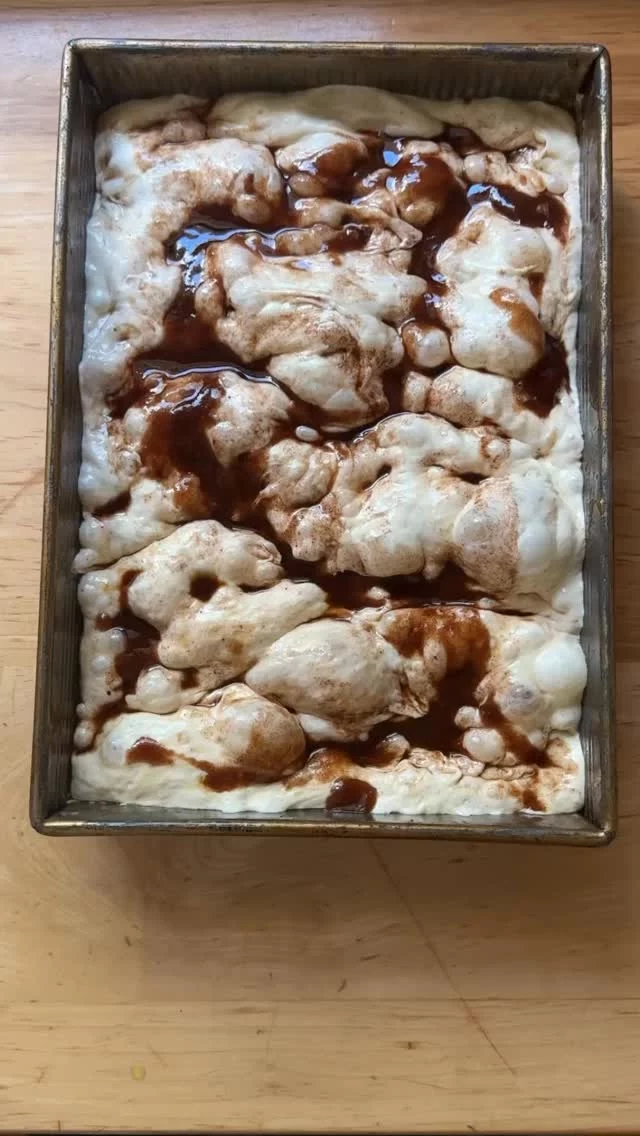
Also made a cinnamon roll type . So good didn’t last a day
Great to hear, Jeremy! Thanks so much for taking the time to write and share all of this 🙂
I’ve been making things with discard, but this was my first real sourdough item. It came out beautifully despite a plethora of obstacles (we heat with wood – who KNOWS what the temps in my kitchen might be… My knee gave out yesterday and so this morning I had to go to doctor and x-ray during the time that I should have been setting it up for the second rise…we bake in a wood oven and the thermometer went wacky a month ago so everything’s even more of an experiment than usual. But it was gorgeous and delicious! We ate about 2/3 of the loaf with oil and herbs to dip in, and now we are going to just skip dinner.
Awww, Cynthia, I love reading all of this! Thank you for writing and sharing your notes and experience. I hope that your x-ray didn’t reveal anything serious and that you are on the mend. But this comment is very encouraging, because I think sourdough is really much more forgiving than many people think.
this is the most amazing beautiful mouthwatering bread i have ever made or eaten. i think i need to open up a bakery now, thanks to the masterpiece that is this recipe. i was interested in customizing it a bit with some toppings including tomatoes and grated parmesan- just wondering if you had any tips for this (when to add the toppings, etc)? thank you so much!
Hi! I would suggest adding the parm to the dough itself — you can toss it with the flour. You can add tomatoes on top just before dimpling. Great to read all of this, Katrina 🙂
This recipe was great! I used to love making focaccia, but didn’t want to use yeast any more. I thought, surely there’s got to be a sourdough starter recipe for one! Yours was the 1st one I stumbled on! I made it the other day and it was YUMMY YUMMY!!! In addition to the maldon salt flakes, I also added some fresh rosemary and thyme leaves. So tasty! But with only 2 of us in the house, I’m wondering if I can just 1/2 this recipe? Has anyone ever tried 1/2 to make a smaller focaccia?
Great to hear, Jen! Thanks so much for writing and sharing this. Yes, you can definitely halve the recipe 🙂
Outstanding bread.. very well explained. Than you for sharing!
Great to hear, Matthew! Thanks so much for writing 🙂
I love this recipe and your yeast focaccia recipe!! Wondering how I can adapt this recipe to make it more versatile time wise. Is there any point where I can set this in the fridge? I love that the other recipe using yeast is more carefree, but prefer the taste with sourdough!
Great to hear, Mel 🙂 Yes, after the bulk fermentation, you can ball it up and transfer it to the fridge in an airtight container for as long as 2 days.
Can you please further explain after BF how to “ball it up and transfer to fridge” ?
There is no right way to do it: I like to use a flexible bench scraper, which I use to release the dough from the sides of the bowl and turn into the center. I do this a few times around the edges, and by the end I have a rough ball. In short: you’re simply deflating the dough. When you transfer to the fridge, the important thing is to make sure the bowl/vessel is sealed so that a crust doesn’t form on the dough.