 →
→ 

Simple, 4-Ingredient Homemade Pizza Dough
 By Alexandra Stafford
—
Last Updated: 11/04/2025
By Alexandra Stafford
—
Last Updated: 11/04/2025
This post may contain affiliate links. Please read my disclosure policy.
Made with 4 ingredients — flour, water, salt, and yeast — this simple, no-knead pizza dough recipe can be ready start to finish in 3 hours. It produces a pizza with a ballooned edge and crisp but pliable crust. You can use the dough the same day you mix it or store it in the fridge for up to 5 days (or freeze it!). 🍕🍕

Let’s get straight to it. This is a 4-ingredient, high-hydration, no-knead dough. It is the simplest of the simple homemade pizza recipes and, in my opinion, the tastiest, too. If you have time to prep your dough a few days in advance, you’ll be setting yourself up for serious pizza bliss (read on to learn why) but know that you can make excellent pizza, start to finish, in 3 hours.
The first step to making excellent pizza at home is to get comfortable working with high-hydration pizza doughs. Here’s why:
Why High-Hydration Pizza Dough is Best For a Home Oven
High-hydration doughs, such as this overnight focaccia, are doughs made with a high proportion of water relative to the flour. This high proportion of water creates a pizza crust that stays crisp but moist during the cooking process with beautiful air pockets throughout.
How? Understand this relationship, understand everything:
The lower the oven temperature, the higher the dough hydration. And conversely: The higher the oven temperature, the lower the dough hydration.
A great way to understand this concept is to look at the makeup of a classic Neapolitan-style pizza dough. Neapolitan-style pizza is characterized by a blistered and ballooned outer edge with a soft, thin (and sometimes wet) center. Contrary to what you might expect, Neapolitan-style pizza dough is on the lower end of the hydration spectrum: 60 to 65%.
The reason Neapolitan pizzas emerge light and airy with nearly wet centers is because they cook in 60 to 90 seconds in 900ºF ovens. In this short period of time, very little water evaporates from the dough, which allows it to retain its moisture.
When you bake pizza in a home oven, which can only get up to 550ºF, the baking time is longer, during which time a lot of water will evaporate. If you were to bake a 65% hydration Neapolitan pizza dough in your home oven, you will be left with a dry, tough crust due to all of the moisture loss during the long bake.
So, in sum: to prevent your crust from being dry and tough in a home oven, it needs more water from the start.
Working With High Hydration Dough
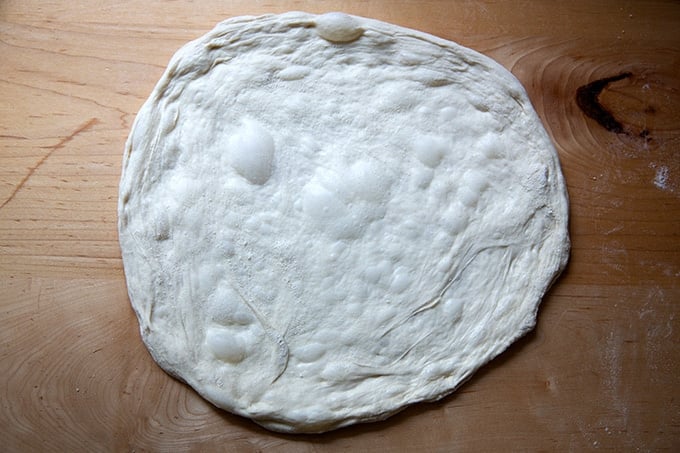
Working with high-hydration dough can be tricky, and the best way to deal with it is to handle it gently. During the shaping process — the point at which you are stretching your ball of dough into a 10- to 12-inch round — take care to use a light touch. When you handle the dough minimally, you preserve the bubbles created during the rising. See these bubbles? …
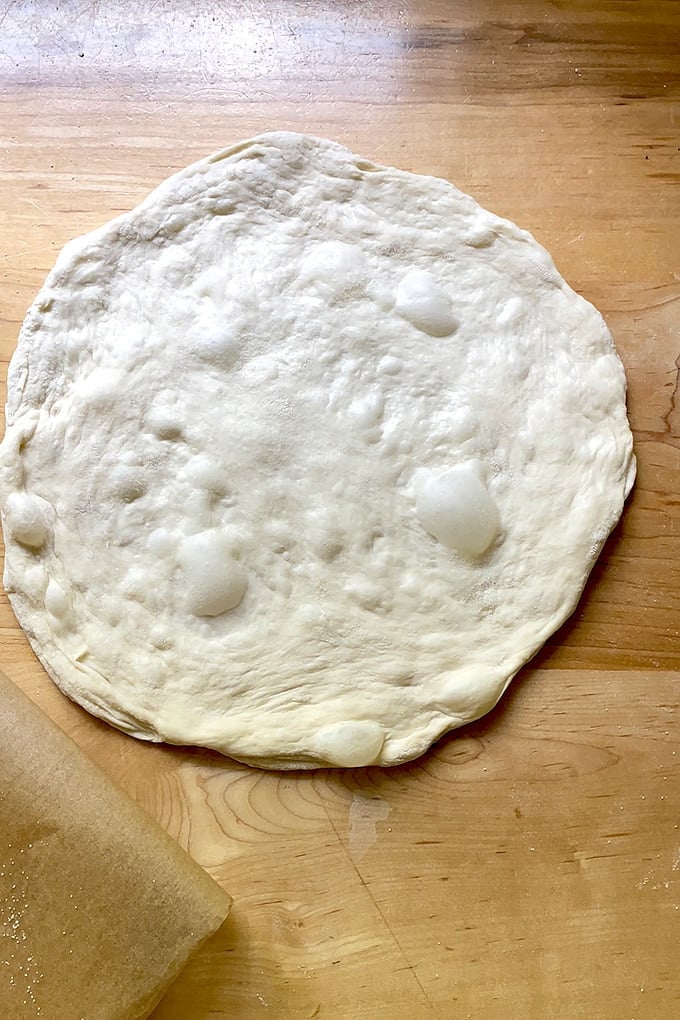
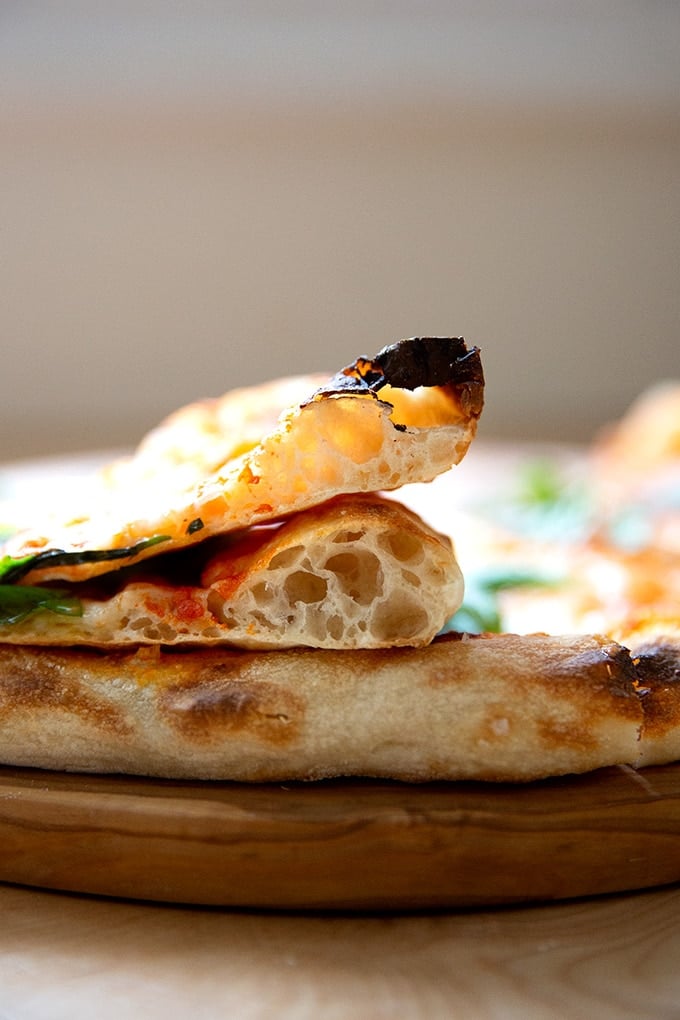
Those bubbles become these ballooned textures throughout the dough:
4 Tips for Making Excellent Pizza at Home
1. Use good, unbleached, and unbromated flour. King Arthur bread or all-purpose flour is my favorite.
What is the difference between bread and all-purpose flour? Mostly the protein content. KAF bread flour has a higher protein content (12.7% protein) than the all-purpose flour (11.7% protein). A dough made with bread flour as opposed to all-purpose flour will absorb slightly more liquid and will therefore be slightly stiffer. If you live in a humid environment and often find your dough to be too wet, using bread flour may help.
What about Tipo 00 Flour? Tipo 00 flour is the flour required in the production of D.O.C. Neapolitan pizza. Contrary to popular belief, the “00” is not an indicator of protein content. It refers, rather, to the fineness of the milling, “00” being the finest grade in the Italian classification system. It is known for the extensible gluten structure it creates in pizza dough. When you use Tipo 00 flour, you may find your dough to be much wetter than when you use bread flour, so you may need to adjust the recipe slightly: use less water or more flour.
While I love using tipo 00 flour (Petra 5063 being my favorite) in my outdoor oven, today I find I get better results — better oven spring and browning — in my home oven when I use bread flour or all-purpose flour, namely KAF, whose flour contains a small amount of malt, which helps with browning.
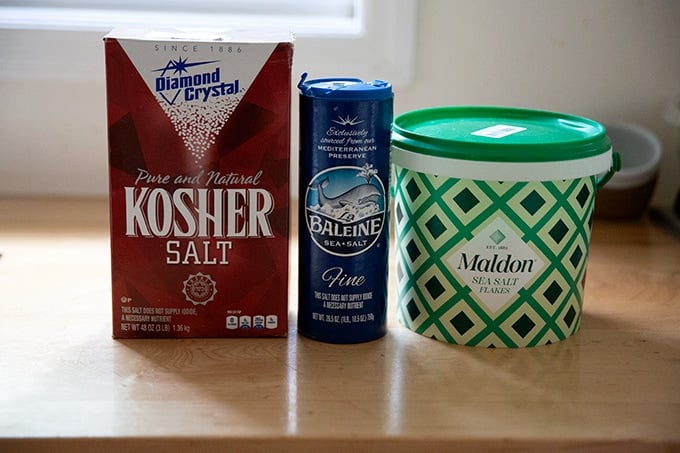
2. Don’t be afraid of salt.
Salt is important in pizza dough not only for flavor but also for strengthening gluten and controlling fermentation. My preference is Diamond Crystal kosher salt or Baleine fine sea salt, both of which dissolve quickly.
How Much Salt to Use: The rule of thumb with pizza dough is that the weight of the salt should be 2 to 3% the weight of the flour. For this recipe that is 10 to 15 grams. I use 15 grams of salt, and I do not find the dough to be too salty.
Flaky sea salt for finishing. I sprinkle every pizza I bake with Maldon Sea Salt just before it sliding it into the oven.
3. Invest in a Baking Steel.
The single best and easiest/most affordable step you can take to make better pizza at home is to invest in a Baking Steel. In short, steel is a more conductive cooking surface than stone. This means heat transfers more quickly from steel to food than it does from stone to food. Why is this important for pizza? Serious Eats’ Kenji J Lopez Alt offers this explanation:
“How does the baking surface affect hole structure? Well those crust holes develop when air and water vapor trapped inside the dough matrix suddenly expand upon heating in a phenomenon known as oven spring. The faster you can transfer energy to the dough, the bigger those glorious bubbles will be, and the airier and more delicate the crust.”
4. If time permits, make your dough several days in advance.
Why? Because: during a long, slow, cold fermentation, enzymes in both the flour and the yeast will break down the starches in the flour into simple sugars, which will contribute both to flavor and to browning. Moreover, during this time in the fridge, the dough will relax, making it easier to stretch into rounds on baking day.
PS: Simple Sourdough Pizza Crust Recipe
How to Make Pizza Dough, Step by Step
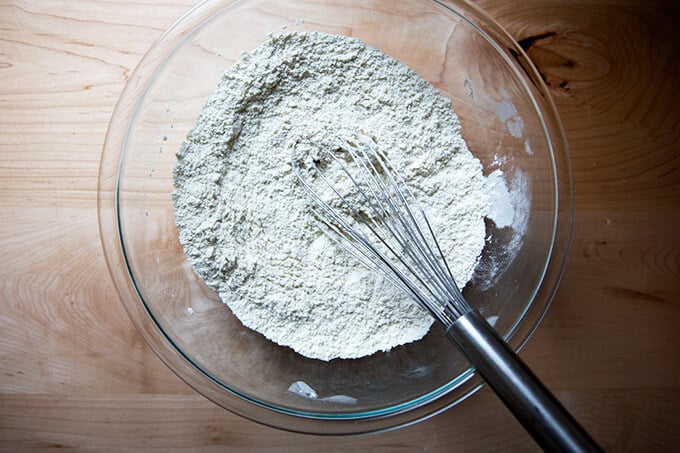
Whisk together flour, salt, and instant yeast (SAF is my preference):
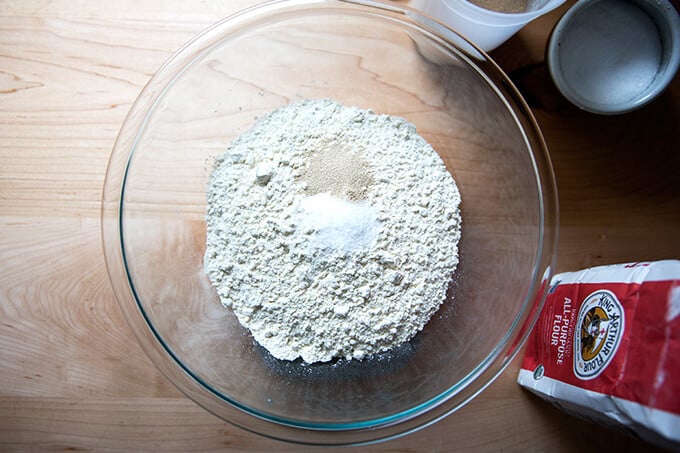
Add water, and …
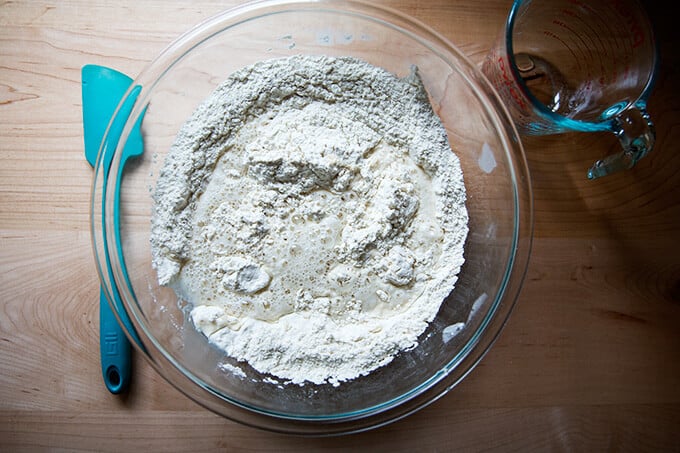
… mix to form a sticky dough ball:
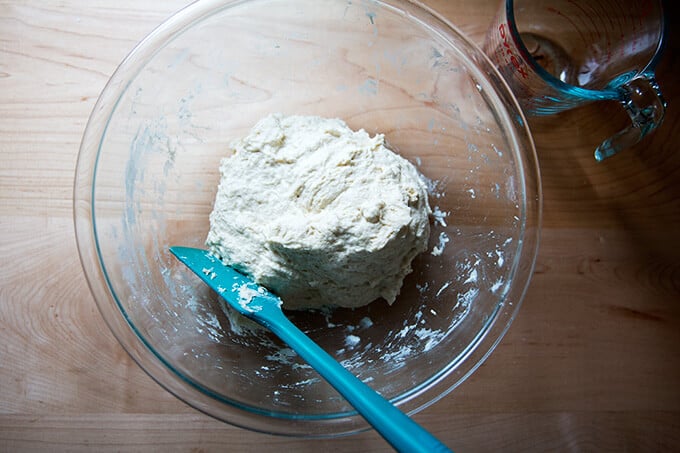
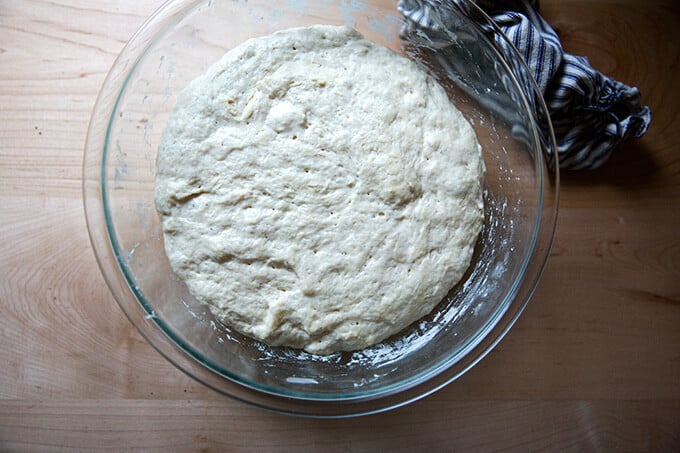
Let rise in a warm spot till nearly doubled, about 1.5 hours.
Turn out onto a floured work surface.
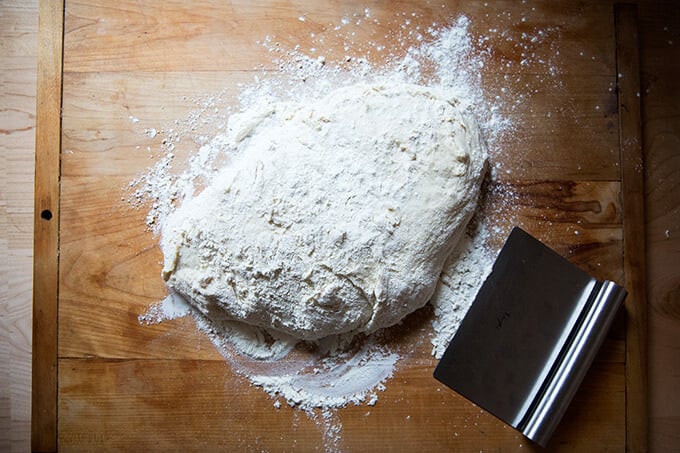
Divide into four portions and …
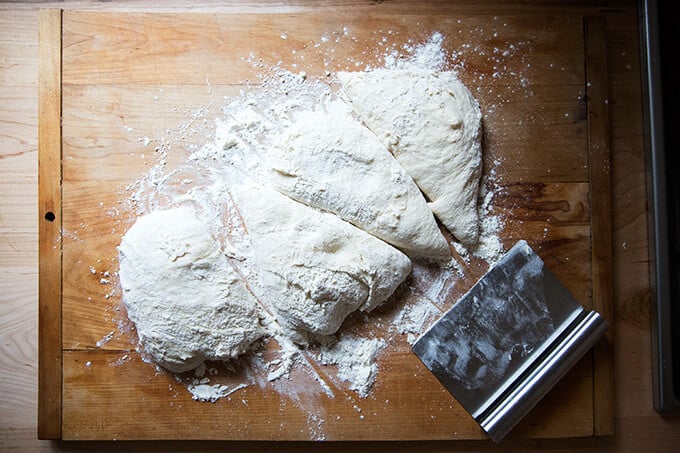
… ball up, using as much flour as needed.
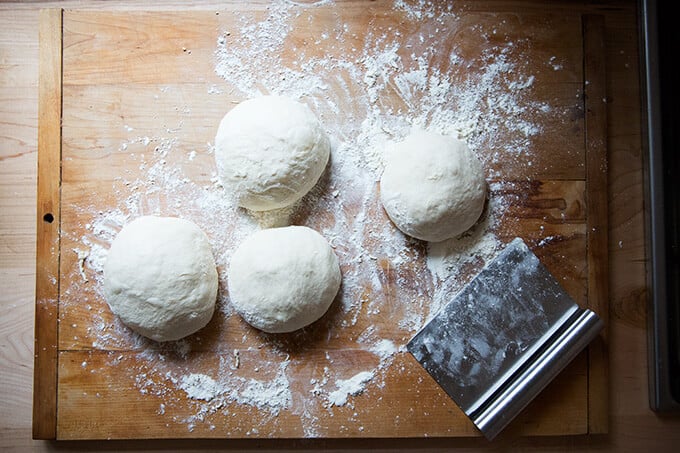
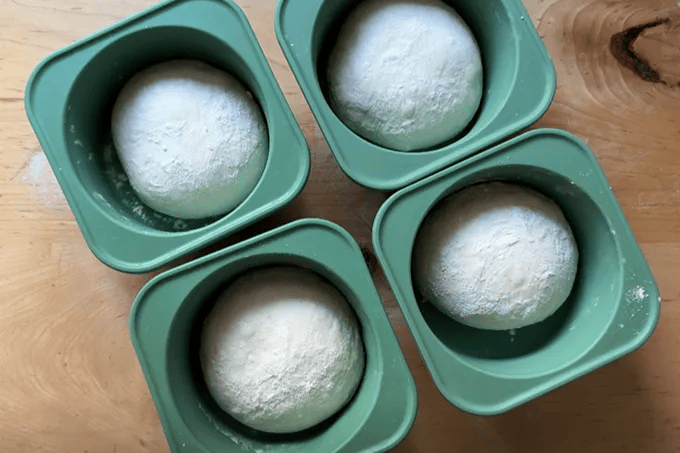
If you are baking pizza immediately, let the dough rest for another hour before shaping. Otherwise, transfer the balls to storage containers and stick them in the fridge. These Kevjes Dough Storage Vessels have become my favorite:
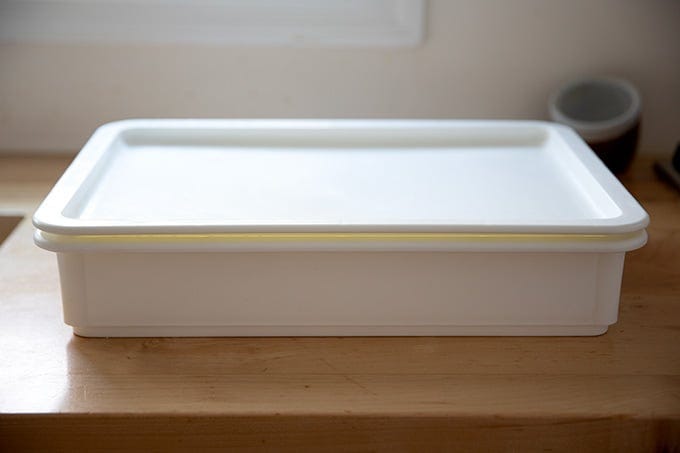
When it’s time to bake, transfer the dough rounds to a lidded vessel such as a DoughMate or a 9×13-inch baking dish covered with plastic wrap (to prevent the dough from drying out), and let the rounds sit for about an hour at room temperature.
When the dough has proofed, gently stretch it into an 11-inch round, using lightly floured hands:
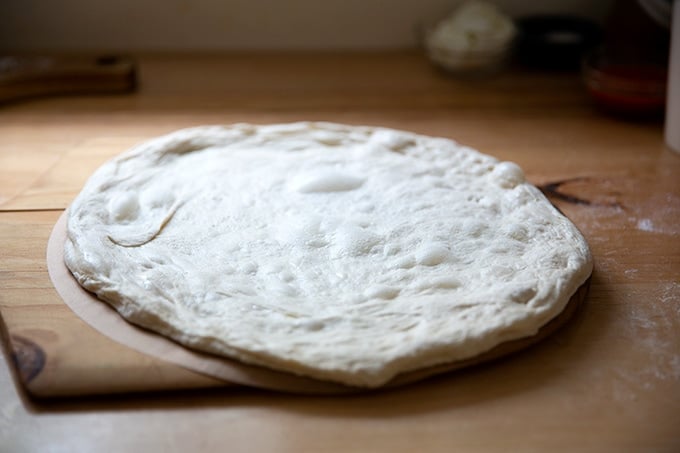
Transfer the round to a peel lined with parchment paper.
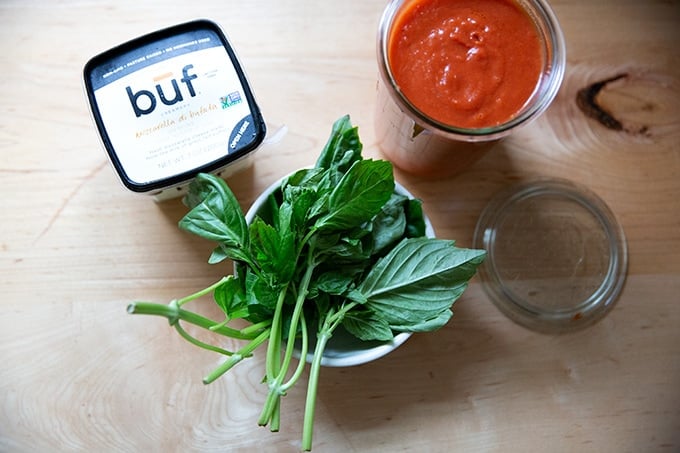
Get your toppings ready. For a classic Margherita pizza, you’ll need tomato sauce, mozzarella, and fresh basil.
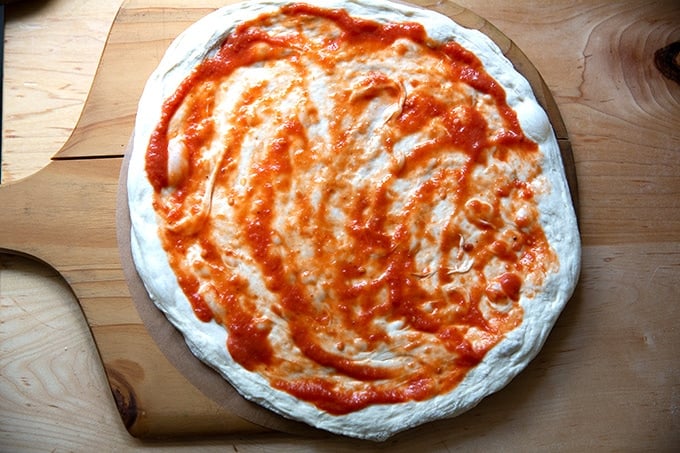
Spread about 2 ounces of tomato sauce over your dough.
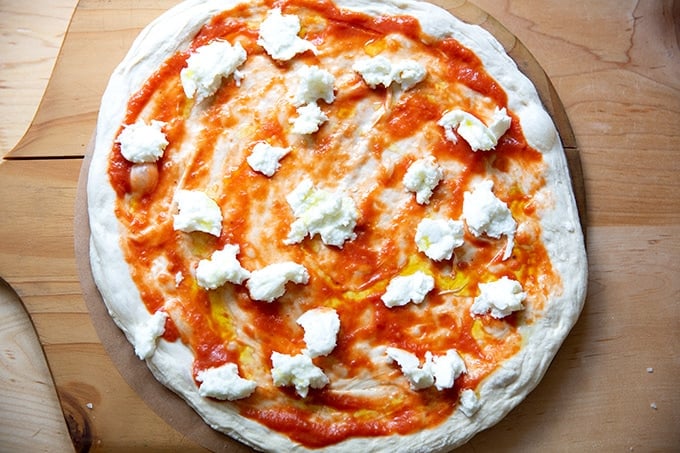
Top with about 3 ounces of mozzarella. Drizzle lightly with olive oil and sprinkle with sea salt.
Bake on a preheated Baking Steel at 550ºF for 5 to 6 minutes. Shower with fresh basil out of the oven.

The beauty of the Baking Steel + high hydration dough: oven spring.
Troubleshooting
Why is my pizza dough too wet?
It is possible that given your environment and the type of flour you are using, you are using too much water relative to the amount of flour. The fix is simple: reduce the amount of water. Ideally, you are measuring with a scale, so you can ensure you are measuring accurately and making meaningful adjustments. Try holding back 50 grams of water and seeing if that helps.
That said, please read above about the importance of using a high-hydration pizza dough in a home oven. If your dough, upon being mixed, is unable to form a sticky dough ball, you likely need to reduce the water. Reference the video for dough texture.
Why is my pizza dough soggy?
There are several culprits here:
- too much sauce, cheese, and/or toppings
- oven not hot enough
- too short of a baking time
Solutions:
- Invest in a Baking Steel. Read why above.
- Try laying the cheese on top of the dough; then the sauce. The cheese might provide some insulation from the sauce, thereby preventing the dough from getting soggy.
- Consider employing a parbake: bake your pizza “naked” for one minute; then continue baking for 4 to 5 minutes more once topped.
- Try using semolina on your peel.
- Before stretching your dough ball into a round, slick it lightly in a bit of olive oil.
- Use a lighter hand when topping.
PS: If you’re looking for more pizza-making guidance, check out my New York Times bestselling cookbook, Pizza Night, which includes 52 pizza and 52 salad recipes, one pair for every week of the year, as well as five simple desserts 🍕🍕🍕


Simple, 4-Ingredient Homemade Pizza Dough
- Total Time: 2 hours 35 minutes
- Yield: 4 pizzas 1x
Description
Made with 4 ingredients — flour, water, salt, and yeast — this simple, no-knead pizza dough recipe is a snap to throw together, and you can use the dough the same day you mix it or store it in the fridge for up to 5 days (or freeze it!). If you love pizza with a ballooned edge and crisp but pliable crust, this pizza dough recipe is for you.
**Attention Pizza Fans: My new cookbook, Pizza Night, is here.**
NOTES:
- This recipe yields 4 rounds of dough. The recipe can be halved but know that the dough can be refrigerated for up to five days. I refrigerate individual rounds of dough in Kevjes dough storage containers.
- The dough can be frozen, too. After the first rise and after you transfer the portioned rounds to quart containers, this is your opportunity to freeze. Transfer the quart containers to the freezer for as long as 3 months. To thaw, remove a container (or more) and let thaw in the refrigerator for 1 day or thaw at room temperature for 4 to 8 hours. Then, proceed with the recipe.
Ingredients & Tools
- Measure Accurately: As always, for best results use a scale to measure. I love this Ooni scale for its precision, especially when measuring smaller quantities of salt and yeast.
- Peel: This is my favorite.
- Parchment: These rounds are so handy for making the transition from the peel to the Baking steel or pizza stone.
- Yeast: SAF Instant Yeast is my favorite. If you need to use active dry yeast instead of instant, sprinkle it over the lukewarm water and let it stand for about 10 minutes or until it gets foamy before adding to the other ingredients.
- Warm place to rise: Here’s a trick for making the perfect warm spot for the dough to rise. Turn the oven on and let it preheat for 1 minute; then shut it off. The temperature will be between 80° F and 100° F. you should be able to place your hand on the oven grates without burning them.
- Flour: You can use bread flour and all-purpose flour here but if you live in a humid environment, I would consider using bread flour if you can get your hands on it. If you are in Canada or the UK, also consider using bread flour or consider holding back some of the water (see next paragraph). Reference the video for how the texture of the dough should look; then add water back as needed.
- Water: I find the sweet spot for me to be about 418 grams of water, which is roughly an 82% hydration dough. That said: If you live in a humid environment, if you live abroad, if you are using all-purpose flour or Tipo 00 flour, if you dislike handling wet doughs, consider starting with 400 grams of water, which will lower the hydration to 77%. If the dough feels dry, add water as needed to get it to the right consistency (reference the video).
- Salt: The rule of thumb with pizza dough is that the weight of the salt should be 2 to 3% the weight of the flour. For this recipe that is 10 to 15 grams. I tend to use 12 to 15 grams of salt, and I do not find the dough to be too salty, but I have a high salt tolerance. Use an amount appropriate to your tastes and preferences. Finally, I always use Diamond Crystal kosher salt, but you can use fine sea salt or whatever salt you like.
- Toppings: In the notes below the recipe, find the toppings for a classic Margherita pizza and for a kale, parmesan, and crème fraîche pizza. See above for 6 other favorite pizza recipes.
- Timeline: Make it Tonight: Plan on 3 hours start to finish from when you mix your dough to when you turn out a freshly baked pizza. Make it Tomorrow (and beyond): Method 1: Mix your dough today, let it rise for 1.5 hours (roughly). Portion it into 4 balls; then transfer to the fridge for up to 5 days. When using dough you’ve stored in the refrigerator, remove it one hour prior to baking.
Ingredients
Please Read All Notes Above Before Proceeding
- 4 cups (512 g) bread flour or all-purpose flour, plus more for assembly
- 3 to 4 teaspoons (10 to 15 g) kosher salt
- 1 teaspoon (4 g) instant yeast
- 1.75 to 2 cups (400 to 454 g) lukewarm water
Instructions
- Make the dough: In a large bowl, whisk together the flour, salt, and instant yeast. Add the water. Using a rubber spatula, mix until the water is absorbed and the ingredients form a sticky dough ball. Pour a drop or two of oil over the top and rub with your hands to coat. Cover the bowl with a damp tea towel or plastic wrap and set aside in a warm spot to rise for 1 to 1 1/2 hours, or until the dough has doubled in bulk. (Note: Optional Step: If time permits, 30 minutes after you cover the bowl, perform one set of stretches and folds: grab an edge of the dough using a wet hand and stretch it up and in. Repeat this 8 to 10 times, grabbing a different edge each time. By the end, the dough should transform from shaggy in texture to smooth and cohesive. I find performing a set of stretches and folds gives my dough more strength and ultimately more lightness.)
- Prepare the oven: If you are baking the pizzas right away (as opposed to refrigerating the dough for another day), place a Baking Steel or pizza stone in top third of oven and preheat oven to its hottest setting, 550°F. Be sure the Baking Steel heats for at least 45 minutes once the oven temperature reaches 550ºF.
- Ball up the dough: Cover a work surface or cutting board liberally with flour — the dough is very wet, so don’t hesitate to use flour as needed. Turn the dough out onto your floured surface and use a bench scraper to divide the dough into 4 equal portions. With floured hands, roll each portion into a ball, using the pinkie edges of your hands to pinch the dough underneath each ball. If you are not baking the pizza the same day, transfer each round of dough to a storage container (see notes above), cover, and store in the fridge. (At this point, if you plan on freezing the dough, transfer the vessels to the freezer for up to 3 months. See notes above for thawing.) If you are baking right away, let the balls sit on their tucked-in edges for 30 to 60 minutes without touching in a lidded, lightly floured vessel such as a DoughMate or a 9×13-inch pan covered with plastic wrap.
- Proof the dough: If using refrigerated dough, pull out a pizza round (or as many as you wish) from the fridge 60 to 90 minutes before you plan on baking. Transfer the rounds to a lidded, lightly floured vessel such as a DoughMate or a 9×13-inch pan covered with plastic wrap.
- Make the pizzas: Handling the dough as minimally as possible, shape the dough into a 10″–12″ round. If the dough has proofed sufficiently, you should be able to pick it up and stretch it very easily using the back of your hands. Lay a sheet of parchment paper on a pizza peel, and pour a few drops of oil into the center of it. (Note: the oil is optional. It’s especially helpful if you find shaping dough using the backs of your hands tricky.) Transfer the dough round to the parchment-lined baking peel.
- Top pizza as desired or to make the Margherita pizza: spread 2 ounces of tomato sauce over your pizza dough. Top with 3 ounces of mozzarella. Drizzle with olive oil. Season with a pinch of flaky sea salt. Shimmy the pizza, parchment paper and all into the oven. To make the kale and crème fraîche pizza: Place the kale in a small bowl, drizzle lightly with olive oil, season with sea salt, and toss with your hands till the kale is coated in oil and salt. Spoon crème fraîche over the dough leaving a 1/2-inch border or so—I use 1 to 2 tablespoons per pizza. Sprinkle with the garlic and a handful of the grated Parmigiano Reggiano. Top with the kale.
- Bake the pizza: Shimmy the pizza, parchment paper and all into the oven. Bake the pizza until the top is blistered, about 5 minutes. Transfer to a cutting board. Shower basil over the pizza Margherita. Cut and serve. Discard parchment paper.
Notes
Margherita Pizza:
- 2 ounces tomato sauce, such as this one
- 3 ounces fresh mozzarella (if using buffalo mozzarella, drain before using)
- olive oil
- flaky sea salt
- fresh basil
Kale & Creme Fraiche Pizza:
- extra-virgin olive oil
- a couple handfuls of baby kale
- 1 to 2 cloves garlic
- Sea salt, such as Maldon
- 2 tablespoons crème fraîche
- grated Parmigiano Reggiano, about 1/4 to 1/3 cup
- Prep Time: 2 hours 30 minutes
- Cook Time: 5 minutes
- Category: Pizza
- Method: Baked
- Cuisine: American, Italian
This post may contain affiliate links. Please read my disclosure policy.








824 Comments on “Simple, 4-Ingredient Homemade Pizza Dough”
Absolutely love this recipe!! I’ve been looking for a pizza dough that was a perfect size for three people and the fluffiness of the crust is amazing! This is a perfect recipe and instructions for someone like me who is slowly learning different recipes, and the step-by-step instructions and notes are super helpful!! I often find the information before the recipe to be useless but all the tips provided are super helpful and informative!
So nice to hear this, Rebecca! Thanks so much for writing. Sometimes I feel we live on this this recipe around here. Glad you like it, too 🙂
Delicious. The kids are raving about it! So light and airy.
So nice to hear this, Andrea! Always great to get the thumbs up from the kids, too 🙂
Can I use gluten free flour … thank you in in advance
Hi Sally! It’s a little tricky … I don’t think you’ll have success by simply making a swap one for one here with gluten-free flour … you may need to add some eggs for structure. This is my gluten-free flour peasant bread recipe … it may give you some ideas. Wish I could offer more guidance here!
My dough didn’t rise after taking it out of the fridge. I didn’t use 00 flour. That’s the only deviation from the recipe. Any suggestions?
Hi Toby! Sorry for the delay here and the trouble. Question: Did the first rise go OK? Did the dough double before you transferred it to the fridge?
Tried this today. So simple and so flavourful! The end result was perfect – crisp base and a nicely risen bread. Loved it
Wonderful to hear this, Priyanka! Thanks so much for writing 🙂 🙂 🙂
We love this dough! First time making it ahead and it’s a game changer. It will be how I make this from now on. Thanks for the detailed instructions.
Great to hear this, Robin! Thanks for writing 🙂
This pizza dough recipe is amazing! The directions are easy to follow and the dough comes out perfect every time. The dough has great flavor and texture up in such a short amount of time! I have made this recipe so many times and this is the only recipe that I use.
So nice to hear this, Kiley!! Thanks so much for writing 🍕🍕🍕🍕🍕
I can’t wait to try this recipe. My daughter uses it all the time. My oven only heats to 500 degrees. Will that change the outcome?
500F should be just fine, Nancy! The timing should be roughly the same. Hope you love the pizza!
Fine ground flour like 00 does create more gluten, the protein created when water mixes with flour. So while you’re technically correct that 00 flour has the same protein content as other flours, 00 flour will create more gluten than all purpose flour, making it more stretchy and chewy.
The finer 00 flour particles expose more of the prolamin and glutelin proteins naturally occurring in the wheat grain, which when combined with water, create more gluten.
Bread flour tries to get a similar result by adding more vital wheat gluten, which you can also buy on your own (Bob’s Red Mill) and add to AP flour, about a tablespoon per cup. However, both bread flour and AP flour with added gluten will still have a slightly different texture than 00, since it is a finer grind.
So interesting, Chris! Thanks so much for writing and sharing all of this. I have read over the years why 00 flour makes for a more extensible dough, but I can never commit it to memory. This makes sense. Thanks so much for taking the time to write.
Question? If using 00 flour, how many grams? I would think it would weigh less than AP flour.
Thank you.
Hi PattiAnn! I would actually still do 512 g flour, but I might hold back some of the water. I might start with 425g of water; then add the remainging a little at a time, if necessary. I would reference the video for how the dough should look. I love 00 flour! Hope it turns out well for you.
Thanks for your reply & it makes sense to cut back on the water not the flour. I went ahead and made it with ap flour this time, will try 00 next time. BTW…I added 1/2 tea of diastatic malt powder to help the browning. I make my pizza in a countertop oven so the temp only gets to 480. But the dmp not only helps to brown it up, it gives my crust a great flavor. Always like to have a pizza dough in the freezer…in case of a terrible pizza craving attack 😊
So interesting PattiAnn! I love this idea and will definitely give it a go. People often ask me how they can get better browning. Great knowing I can share this tip. Thanks so much for writing!
I love this recipe so much. Have made it twice and both times it is easy, delicious, and light. 7 minutes for my oven seems to be the perfect time. Thank you so much for sharing and the youtube video showing the process!
So wonderful to hear this Miss Lee! Thanks so much for writing 🙂 🙂 🙂
I am so grateful for this recipe! I FINALLY have a fool proof pizza recipe that works. I made it with regular flour, regular yeast and a pizza stone at 550 and the dough was so light, springy, tasty and crispy while biting. Incredible. I can finally make this for guests without being worried of whether it will come out right. For toppings we chose one pizza with mozzarella, cambozola, thin sliced pears and pecans, and the other pizza with tomato sauce and burrata, arugula and prosciutto (all placed fresh after the pizza came out of the oven). Thank you!!!!
Oh yay! So wonderful to hear this, Valentina! Your toppings sound amazing. The cambozola + pears + pecans speaks to my soul 🙂 🙂 🙂
This dough is amazing! No dough hook! No kneading! It was so soft and fluffy with air pockets! I tried another recipe before this and threw it away! I will never use another dough recipe! I always look at reviews and base what recipe I’m going to use on them. This one is the only recipe you will need!
So nice to hear this, Rachel! Thanks so much for writing 🍕🍕🍕🍕🍕
Hi! Made this pizza dough last Friday and it turned out great plus it was super simple to follow. Quick question – do you find the parchment paper on the steel prevents the bottom crust from becoming crispy? This was the first time I tried this parchment paper method, I love the idea because the semolina flour I usually use on the peel gets everywhere and burns sometimes, but the bottom didn’t get nearly as crispy as when I place it directly on the steel. Did I do it wrong? My oven was at 500 degrees. I’m going to try the sourdough version this week. 🙂 Thanks!
Hi Abigail! SO sorry I missed your comment!! Don’t know how that happened. I don’t have an issue with parchment, but next time around, you can remove the parchment paper after the pizza has cooked for 2 minutes or so. Just open the oven, and pull out the parchment … is should slide right out.
I wonder if you’re used to the slight crunch offered by the dusting of semolina flour? I also wonder if you could use a little semolina flour on the parchment paper to give it that little bit of crunch?
The recipe calls for 4 cups (512 g) all-purpose flour. If I use “00” flour, do I use the exact amount (4 cups / 512 g)?
Hi Thomas! Yes, I would use the same amount of flour. I might hold back some of the water. I find the doughs I make with 00 flour are always wetter, and this is a wet dough to begin with, so maybe start by holding back 50 grams of water and then adding a little bit back at a time until the texture seems right — you can reference the video regarding texture.
Hi! I was wondering if this dough would work if baked in a quarter sheet pan? I want to make a pizza as a bring along item for a socially distanced party and a square pie seems easier to slice up. Thank you so much for your wonderfully delicious recipes (that have kept me sane and too well fed though quarantine)
So nice to hear all of this, Alessia 🙂 🙂 🙂
Yes, definitely. I would line the pan with parchment, and I would drizzle some oil on the bottom — this will help give the crust a crispness.
Enjoy your party! Sounds lovely 🙂
Whoops. I left my dough out overnight. It looks really bubbly and I have shaped into balls and put in fridge. Also, I added some sourdough starter. Have I gone too rogue to recover? Thanks.
Hi Michele, if you were able to ball up the portions successfully and if the dough felt as though it still had strength, it should be just fine!
Well, very wet, but maybe worth a try. Thanks!
I made the dough, let it rise 1.5 hrs… cut into ball bit didn’t let it rest 30 min..i put into quart containers, now it’s about 2-3 hours before we cook the pizza,,, just leave on counter oin closed quart containers, ? Or put in fridge and take out an hour before? We are cooking in wood fired oven , what temp would use? 500 degrees?
Thanks, Susan
Esusanlarsen8@gmail.com
Hi! I would stick in the fridge and remove it 1 hour prior to baking. Get the balls onto a floured work surface and let them relax. Don’t start shaping them till you are ready to top and bake. 500F or higher will be great. If you can bake it higher, go for it. I would experiment with 1 pizza; then adjust the temp accordingly for the remaining 3 pizzas based on your results. Good luck! Jealous of your wood-fired oven 🙂
I’ve tried many homemade pizza recipes over the years and this one trumps it all! It’s so moist and flavourful, even when made with just all-purpose flour! My only problem is that it’s hard to shape the dough into a flat shape, and in the oven, it rises to a mega block of dough. The pizza still incredibly tasty, just wish it would cook a little thinner. Any ideas?
Thank you for all your amazing bread recipes; your quinoa/flax bread is on repeat in this house 🙂
So nice to hear this, Mrs. P!
OK, a few thoughts: you could try reducing the water slightly … It might make the dough easier to manage. That would be the first step I think.
You also could try using oiled hands to stretch the dough. It will resist after a few tries, but if you let it rest, and then try to stretch it again, you might have some luck getting it thinner.
Let me know if either of these ideas works. Thanks for writing!
I had a weird experience. I followed the grams for flour and water, and it was way too liquidy. I ended up adding a ton more flour just to barely get it to hold in a sticky ball and even then it was still pretty flimsy. Do you use grams when baking or cups typically? I’d like to hear if others found the ratio to be pretty far off.
Hi Rachael!
I do always measure with grams for this recipe for both the flour and the water (and the salt). What type of flour were you using? Do you live in a humid environment?
If you are willing to give the recipe another go, it’s probably just a matter of cutting back the water — once you find the right amount given the flour you are using and your environment, you’ll be in good shape.
The pizza actually worked out amazingly, but I had to add another 3/4 cup of flour so it wouldn’t be a soup. That was my only complaint. The pizza was actually amazing. I used regular all purpose and no, I live in an incredible cold and dry climate! (Northern Canada).
In any case, the pizza was delicious in the end and I WILL be making it again. I’ll just have to adjust as I can.
OH, yay! Wonderful to hear. It’s actually super helpful knowing you’re from Canada. Last year, when everyone was baking bread, I found that people in Canada and in the UK often had trouble with their dough being too soupy — even if they were using flour with the same protein content. I think the flour is just different — it might be the wheat or how it’s milled, but it absorbs water differently. As soon as people found that right ratio of water to flour, things worked out. So again, next time, I would start by holding back at least 50 grams of water (maybe more… you can always add it in slowly). Thanks so much for reporting back!
I’ve made this recipe multiple times and it’s always a hit! This time I made it (made last night to use today), I was in such a rush and doing too many things at once that I forgot to let it sit for 30 mins after dividing before putting in containers in the fridge. It didn’t rise as much as it should have in the fridge. Is the dough still usable? Or is there something I could do to make sure it is?
It should be totally fine! I often skip that step when I am in a pinch, too.
Wonderful!! My new pizza crust recipe. Used 00 flour.
Great to hear this, Julia! Thanks for writing 🙂
I have been making homemade pizza for years, and this recipe and tips are hands down, the BEST. Next to try- the Baking Steel!! 🙌🏼❤️ Ali, you’re the best!!
Oh YAY, MELISSA!! So nice to hear this. Thanks so much for writing. I can’t wait for you to try the Steel. Maybe we should plan another lunch date soon 🙂 🙂 🙂
I love making pizza at home, and have been using Jim Lahey’s recipe for a while. Looking forward to trying this! Curious if you have used this particular dough for grilled pizza? I was thinking of trying an upside-down baking sheet preheated on the grill to replicate a steel of sorts. Also, any advice for achieving charred spots on the crust? I have tried so many times over the years, in gas and electric ovens, on a steel and a stone, and have never been able to get it to work. (If I turn the oven to broil, I end up with some darker spots but mostly burned cheese/toppings). Do you think this has more to do with the dough than the cooking method?
Hi Erica! I have not tried this for pizza but others have. I think when others have done it, they’ve grilled the pizza directly on the grates; then flipped it, removed it from the grill, topped it, and returned it to the grill also directly on the grates.
Now that I think of it, I think the commenter I’m thinking of used the sourdough pizza recipe for this method. In which case, I think you might want to consider reducing the amount of water here. The sourdough recipe is about 77% hydration. This one is 88% hydration, and I worry you’ll have a hard time getting the dough on the grates.
Maybe start with 400 grams of water.
Regarding browning, I think this partly has to do with how hot your oven can get. My oven does go to 550ºF and I do preheat my Baking Steel for about an hour before using it. I find that some of the charring I get comes from air pocket, bubbling up and then burning bc they are thinner and closer to the heat source. So, using a light hand, to preserve those air pockets is important.
Also: a cold fermentation will help with browning. During a long, cold fermentation (48 -72 hours) enzymes in the flour and yeast break down the starches in the flour into simple sugars, which contribute both to flavor and to browning.
Hope that helps!
This is THE BEST pizza dough recipe I have ever used. I have used it 3 times with great results each time and love it so much that I am compelled to write my first comment on a recipe post. Follow all of Alexandra’s detailed notes and instructions as she has mastered pizza dough making. Do not be alarmed by the wet sticky dough. Do as the recipe says! I am SO GLAD that I found this recipe. Thank you.
Oh yay! Jordana, so wonderful to hear this!! And thank you for encouraging others to embrace the stickiness — the wet dough makes such a difference in the final crumb.
Since the 00 flour is mentioned in the article as preferred over AP flour, why is it not part of the recipe? I made the dough according to the recipe as written and then went back to see that 00 flour is preferred. I would have used 00 if it was in the recipe as I even had it in the house. I’ll see how it turns out as I made it. (It is only just rising now.) I measured the flour by weight and it seemed I had to add a lot more flour, after stirring it all together, as it was not forming a ball at all. I probably should have added the water gradually instead, but that wasn’t mentioned either. I really wish recipes would be more attentive to detail for those of us who are using the recipe for the first time. 🙁
Hi Carol!
I’ll add some more notes to the recipe to make it more clear. A few thoughts:
• I don’t call for 00 flour because oftentimes people can’t find it, so I try to write recipes that are most accessible to most people.
• There was a period when I really did prefer 00 flour, but most recently I haven’t been as impressed with it as I have in the past. I don’t know if the brand I am using has changed, but I just don’t find it to make as much of a difference as I once did.
• My preference right now is bread flour. So if you can find KAF bread flour, that has been giving me great results.
Question: Did you add the water by weight? It is definitely a wet sticky dough. If you are up for it, reference the video so you can see how sticky the dough should look upon being mixed.
As I said, I’ll add some more notes. If you are up for it, please report back on how the pizzas turn out!
Have you considered editing your recipe to add these helpful comments on the 00 and bread flour to the notes?
Sadie, yes! Just a little behind at the moment. Hoping to update this post today!
Have not tried this recipe yet but will it be good baked in a pizza oven outside???
Yes, absolutely!
My husband and I became plant based a few months ago and we have been making do with vegan frozen pizza. I finally had enough of that nonsense and ordered a pizza steel, the 00 flour, and a peel. I’ve tried this recipe before and knew it was good, but was hoping the steel would bring it closer to our favorite pre vegan pizza place. Hallelujah! The crust is amazing! I used Rao pizza sauce and Vio Life mozzarella and it was fantastic! Thank you for an amazing recipe and instructions!
So wonderful to hear this, Susan! My vegan friend introduced me to Vio Life cheeses, and I am amazed by how good they are. Thanks so much for writing!
I own your cookbook, and your pizza dough recipe is the BEST! We use it ever Friday night and split it into thirds so we can each personalize it (plain cheese for my daughter, mozzarella, green olives, and basil for me, and whatever weird vegan thing my husband comes up with). My daughter now wakes up and yells, “it’s pizza night!” first thing every Friday- it’s seriously the best night of the week!!
Oh Genevieve, yay! This warms my heart 🙂 🙂 🙂 Thanks so much for writing. Love that you each design your own pizzas 🎉🎉🎉🎉