 →
→ 

Overnight, Refrigerator Focaccia = The Best Focaccia Bread Recipe
 By Alexandra Stafford
—
Last Updated: 12/13/2025
By Alexandra Stafford
—
Last Updated: 12/13/2025
This post may contain affiliate links. Please read my disclosure policy.
Cold, refrigerated dough is the secret to making delicious focaccia! Allowing the dough to rest 18 to 48 hours in the fridge will yield extra-pillowy and airy focaccia, though if you are pressed for time, you can make this start-to-finish in 3 hours. This 4-ingredient recipe requires only 5 minutes of hands-on time. Video guidance below!
⭐️⭐️⭐️⭐️⭐️ Review:
“Love this recipe! I’ve made this so many times that I’ve lost count. Super simple and delicious. My family loves it. Whenever someone asks me for a focaccia recipe, I always show them this one. This recipe is awesome. Thank you for sharing!” — Lucy
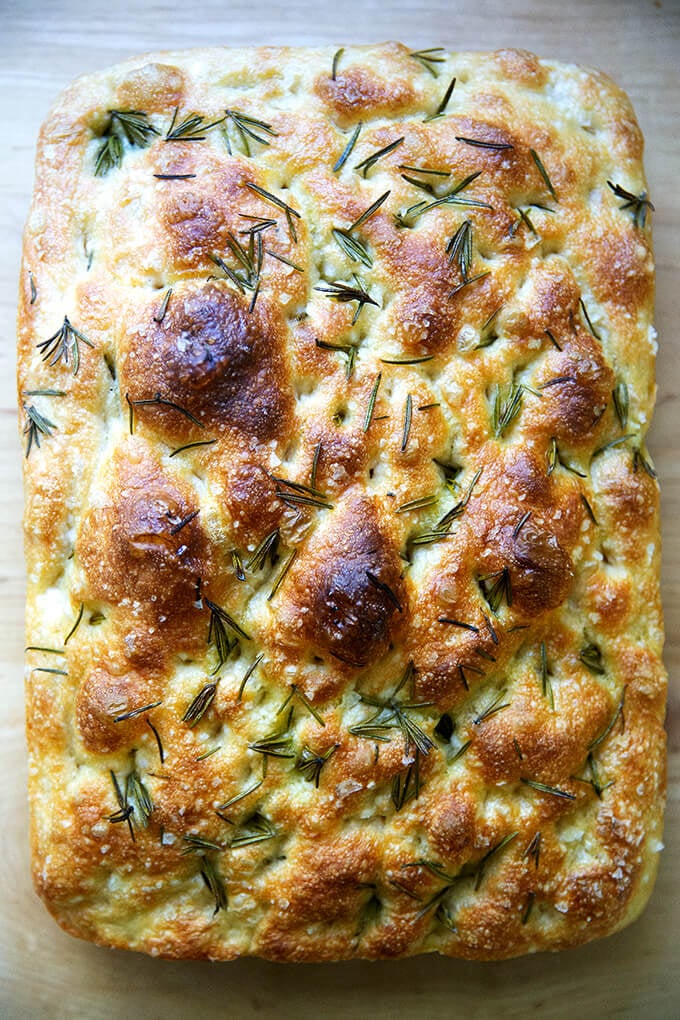
It’s hard to beat focaccia in the effort-to-reward category. If you are intimidated by bread baking, this is the recipe I suggest making first, both for its simplicity and flavor. Why?
- It’s a no-knead, 4-ingredient dough that takes 5 minutes to mix together.
- It requires no special equipment, no tricky shaping technique, and no scoring.
- If you have a 9×13-inch baking pan and your fingertips (for dimpling), you’re good to go.
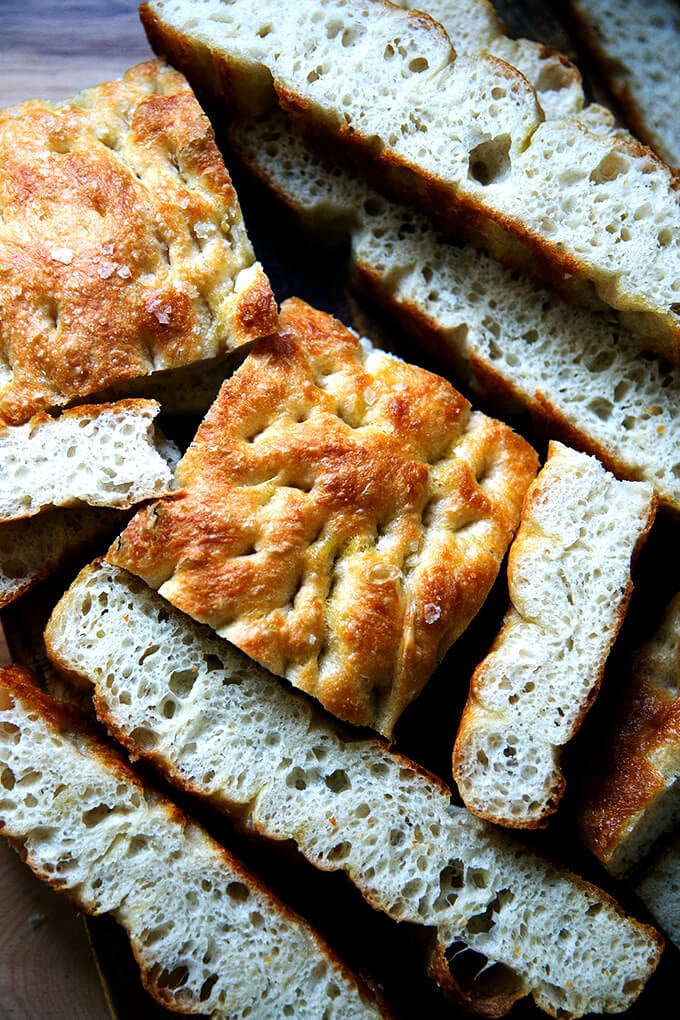
- It emerges soft and pillowy, olive oil-crusted, golden all around, and it’s completely irresistible.
Two Secrets for the Best Focaccia
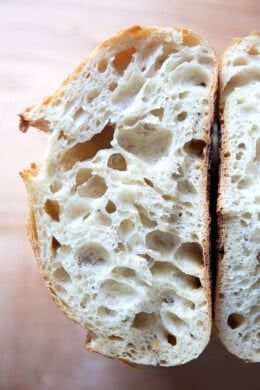
This focaccia emerges from the oven golden all around and pillowy inside, its surface dimpled with deep crevices, namely for two reasons:
- High hydration dough. This focaccia is 88% hydration.
- Long, cold, slow fermentation. This dough ferments in the fridge for at least 18 hours or for as long as three days.
Let’s explore each reason:
A high-hydration dough is a dough with a high proportion of water relative to the flour. A high proportion of water will create a light and air dough and ultimately a focaccia with beautiful air pockets throughout. (Incidentally, this is the secret to making excellent pizza dough, too.)
A long, cold fermentation is beneficial to dough because during a slow fermentation allows enzymes in both the flour and the yeast to break down the starches in the flour into simple sugars. These sugars contribute both to flavor and to browning. Cool, right?
Furthermore, a long slow fermentation strengthens gluten, which will further promote a crumb structure with lots of air pockets throughout.
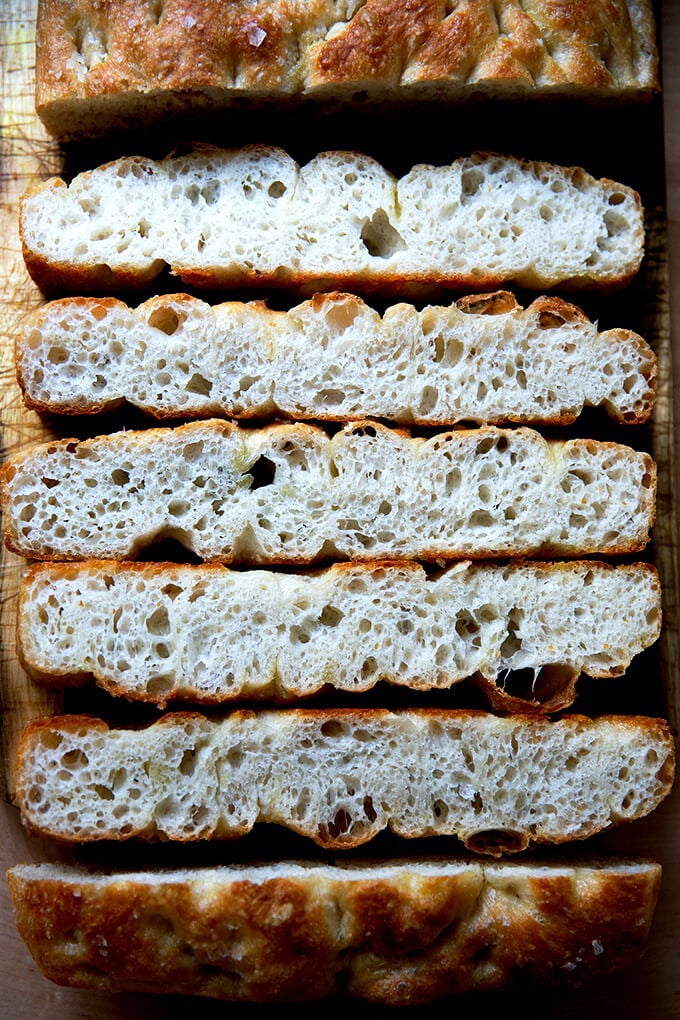
How This Focaccia Recipe Differs from Others
There are lots of focaccia bread recipes out there, so why make this one? This one differs from many of the recipes out there in two ways:
- The long, cold, refrigerator rise.
- The absence of sugar or honey or any sort of sweetener.
Why isn’t there any sweetener in this recipe? Simply stated, a sweetener is just not needed — the yeast, contrary to popular belief, does not need sugar to activate or thrive. Sugar will speed things up, but when you’re employing a long, slow rise, speed is not the name of the game.
As noted above, during the long, cold fermentation, enzymes in both the flour and the yeast will break down the starches in the flour into simple sugars, which will contribute both to flavor and to browning, rendering sugar unnecessary.
PS: Once you master this simple focaccia, try your hand at this simple sourdough bread recipe, another recipe that requires minimal effort but yields spectacular results.
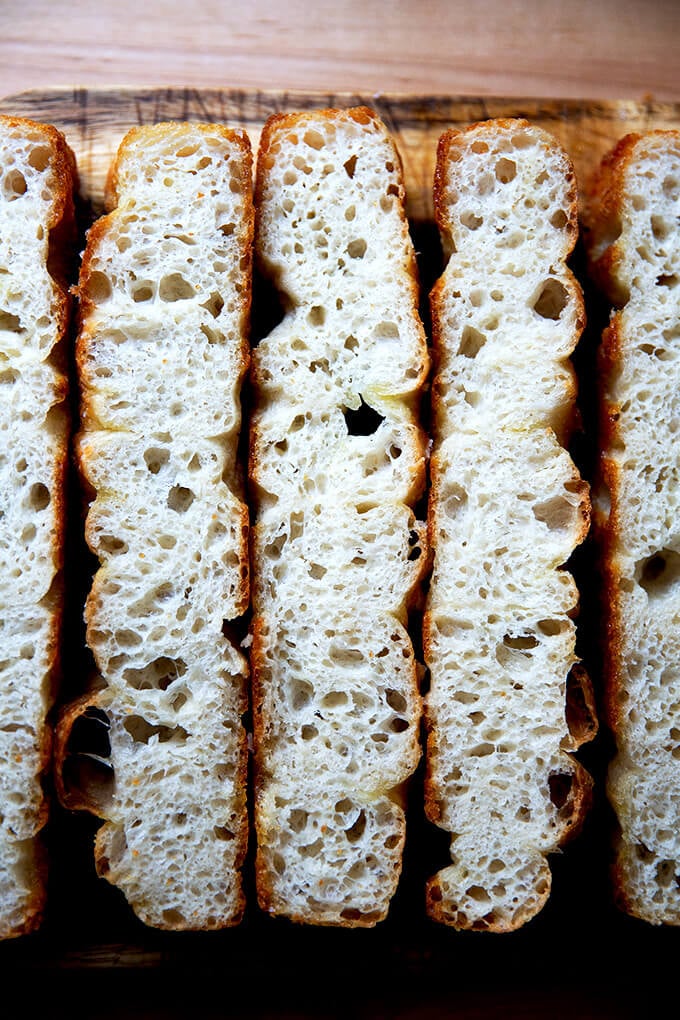
How to Make Focaccia Bread, Step by Step
Gather your ingredients: 4 cups (512 g) flour, 2 teaspoons (12 g) salt, 2 teaspoons (8 g) instant yeast (SAF is my preference), 2 cups (455 g) water:
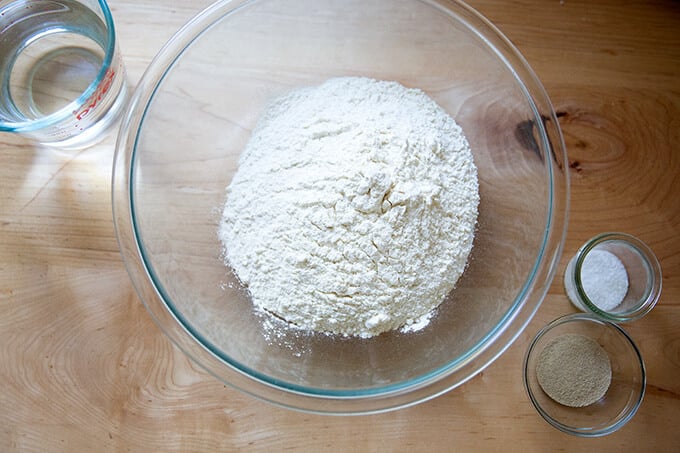
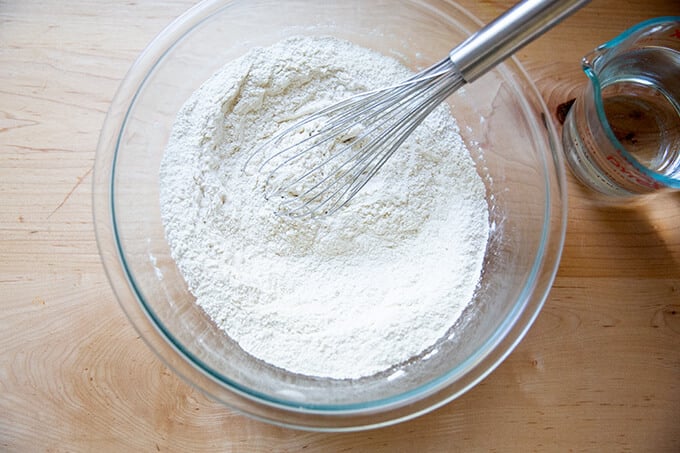
Whisk together the flour, salt, and yeast first:
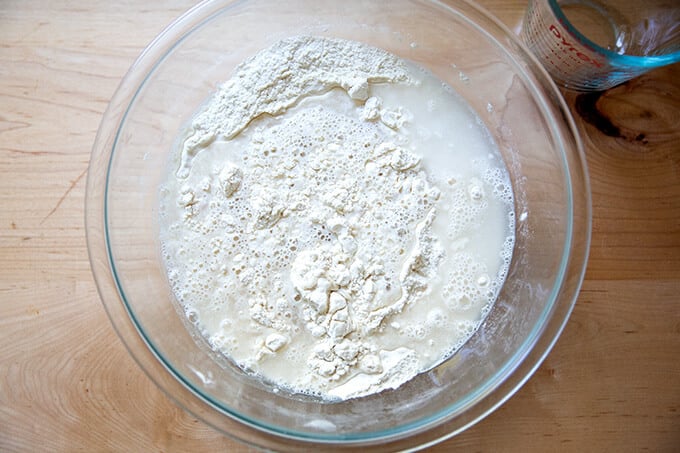
Add the water:
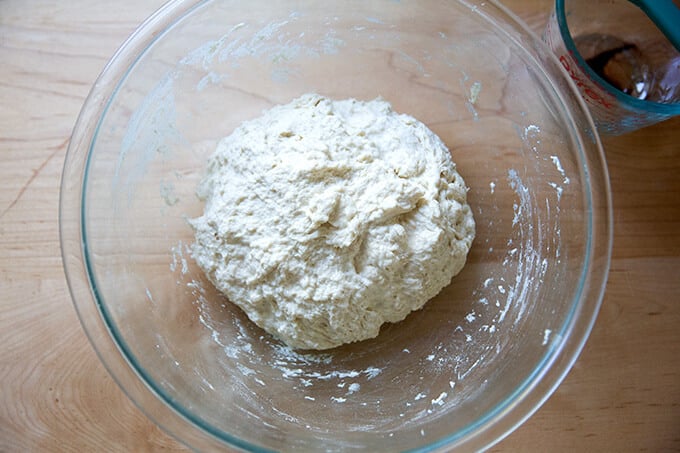
Use a spatula to stir the two together.
Slick the dough with olive oil…
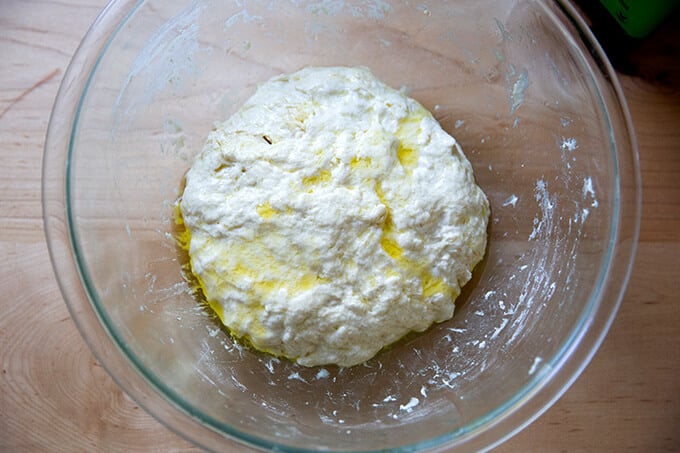
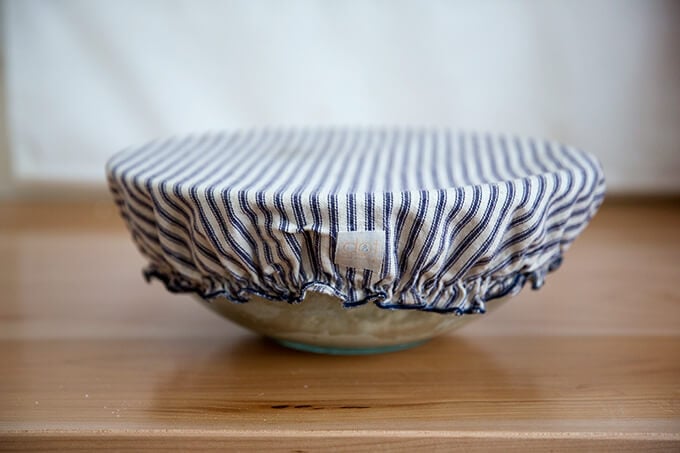
… then cover the bowl preferably with a lid. or a cloth bowl cover. Stick the bowl in the fridge immediately; leave it there to rise for 12 to 18 hours (or for as long as three days).
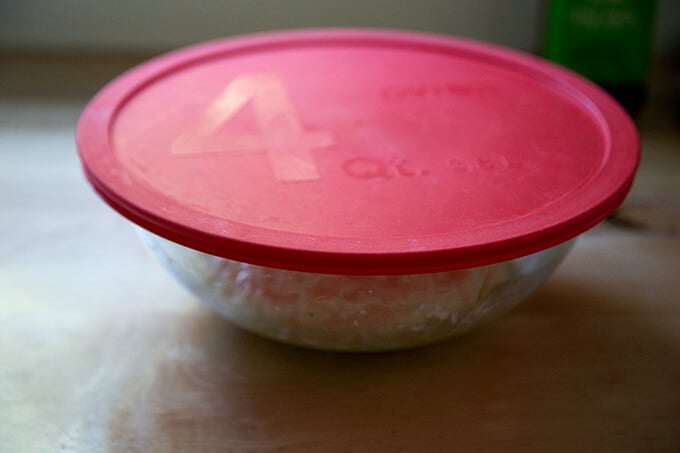
NOTE: It is important the dough really be slicked with olive oil especially if you are using a cloth bowl cover or tea towel as opposed to plastic wrap or a lid. If you are using a tea towel, consider securing it with a rubber band to make a more airtight cover. If you do not slick the dough with enough oil, you risk the dough drying out and forming a crust over the top layer.
Remove from fridge, and remove the cover:
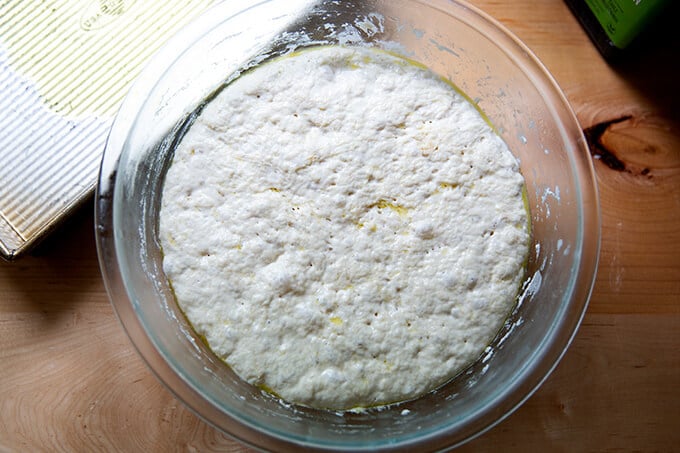
Deflate the dough and transfer to a prepared pan. I love this 9×13-inch USA pan. If you don’t have one you can use two 8- or 9-inch pie plates or something similar. If you are using glass baking dishes be sure to grease the dishes with butter before pouring a tablespoon of olive oil into each. (The butter will ensure the bread doesn’t stick.) Don’t touch the dough again for 2 to 4 hours depending on your environment.
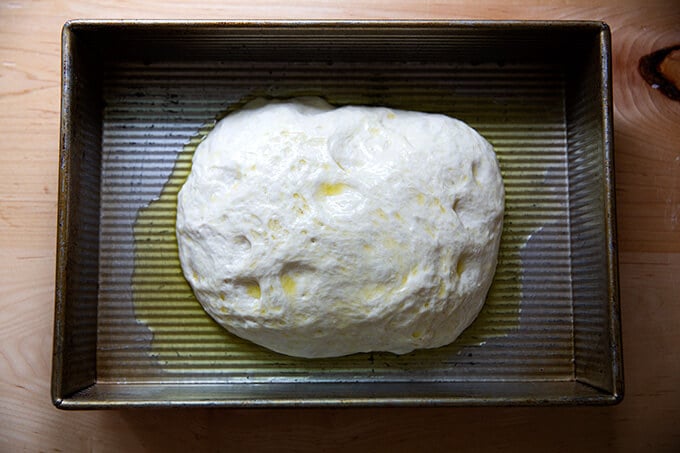
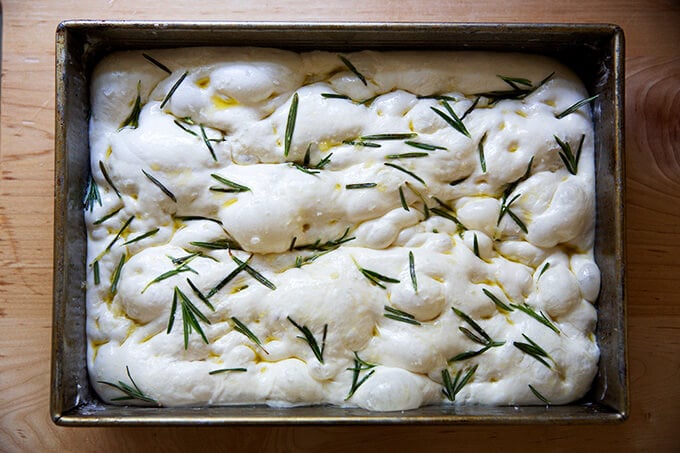
After two to four hours, or when the dough looks like this…:
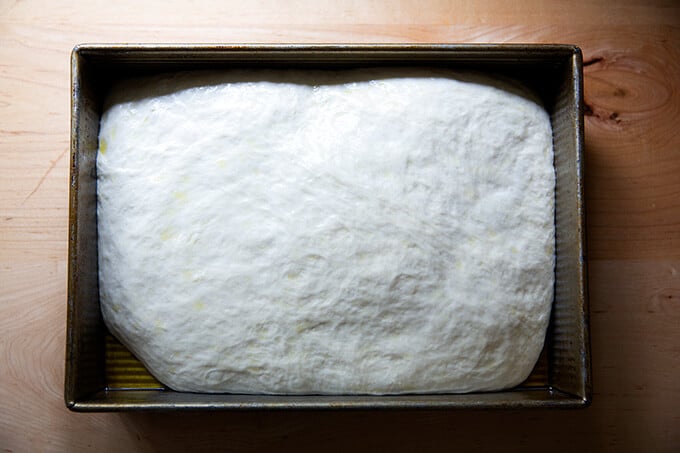
… it’s time to dimple it! You can simply use olive oil and salt — I recommend good, flaky sea salt for this. Note, the dough in the photo below spent three days in the fridge, and the dough was super bubbly!
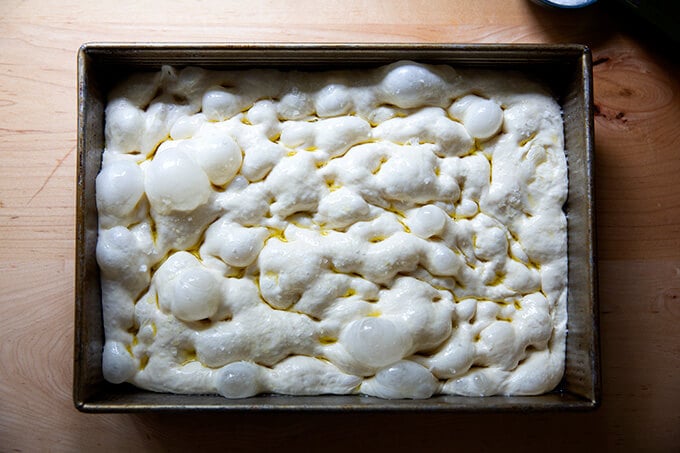
if you are using rosemary, sprinkle it over the dough. Then pour two tablespoons of olive oil over the dough, and using your fingers, press straight down to create deep dimples. Sprinkle with flaky sea salt — again, something like Maldon is great here.
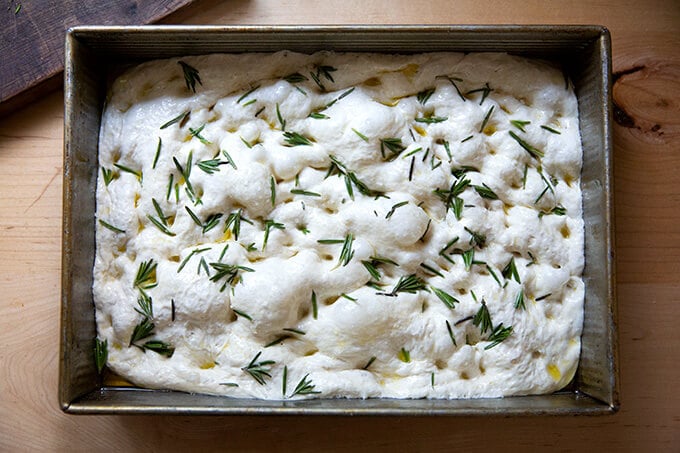
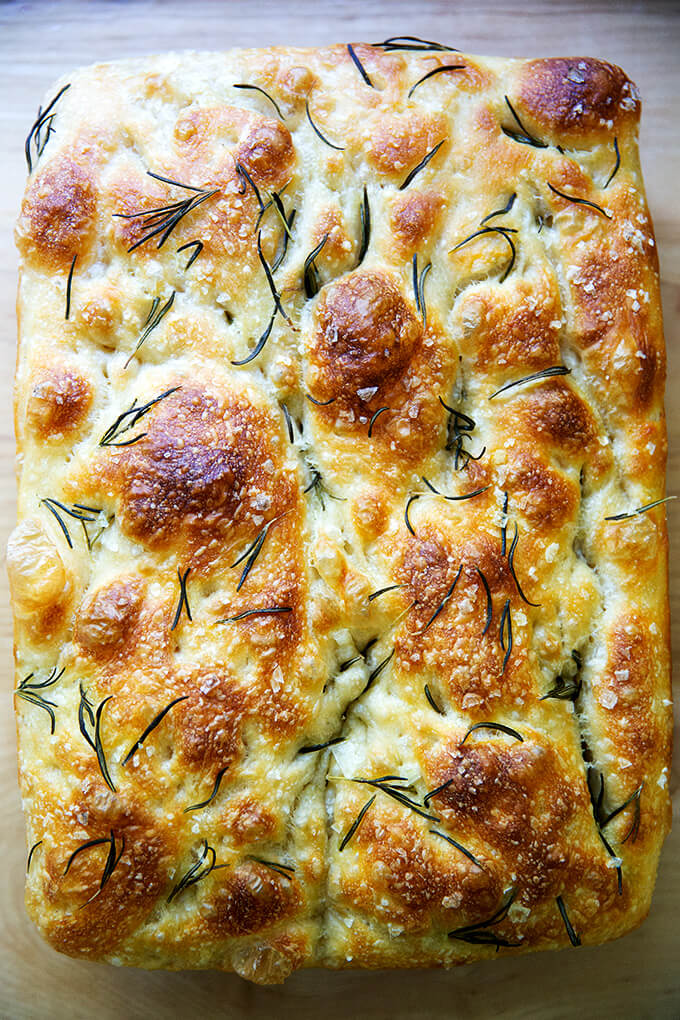
Transfer to oven immediately and bake at 425ºF for 25 minutes or until golden all around. Remove focaccia from pans and place on cooling racks.
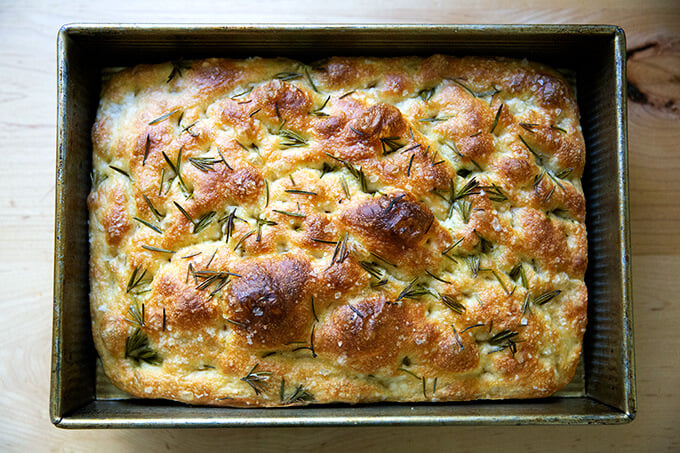

How to Incorporate Rosemary, Herbs, and Other Ingredients & Toppings into Your Focaccia Dough
One of the most frequently asked questions I get is: How can I add other toppings or ingredients to my focaccia bread? You can do this in two ways:
- Add them on top as you would rosemary or other herbs. The key is to make sure the ingredients are slicked lightly with olive oil to ensure they do not burn in the oven. I like to sprinkle the rosemary over top of the dough, then drizzle it with olive oil, then dimple the dough.
- You can add them directly to the dough. In step one, when you whisk together the flour, salt, and instant yeast, add your ingredients — chopped olives, sun-dried tomatoes, roasted garlic — to the flour and toss to coat; then add the water.
PS: How to Make Focaccia Slab Sandwiches
Can I Make this Overnight Focaccia Without the Overnight Rise?
Yes, you can. In fact, in my cookbook, Bread Toast Crumbs, I do not employ an overnight rise. Start-to-finish it can be made in about three hours. The finished bread will not be as pillowy, but it will still be light, airy, and delicious.
To skip the overnight rise, simply let the mixed dough rise at room temperature until doubled, about 1.5 to 2 hours. Then proceed with the recipe, knowing the second rise will only take about 30 minutes.
Print
The Best, Easiest Focaccia Bread Recipe
- Total Time: 18 hours 30 minutes
- Yield: 2 loaves 1x
Description
Cold, refrigerated dough is the secret to making delicious focaccia! Allowing the dough to rest for a minimum of 18 to 24 hours (or up to 3 days) in the fridge will yield extra-pillowy and airy focaccia. However, if you are pressed for time, you can make this from start to finish in 3 hours. This 4-ingredient recipe requires only 5 minutes of hands-on time. Video guidance below!
Adapted from the focaccia recipe in Bread Toast Crumbs.
A few notes:
- Plan ahead: While you certainly could make this more quickly, it turns out especially well if you mix the dough the day before you plan on baking it. The second rise, too, takes 2 to 4 hours.
- If you are short on time and need to make the focaccia tonight: Let the mixed dough rise at room temperature until doubled, about 1.5 to 2 hours. Then proceed with the recipe, knowing the second rise will only take about 30 minutes.
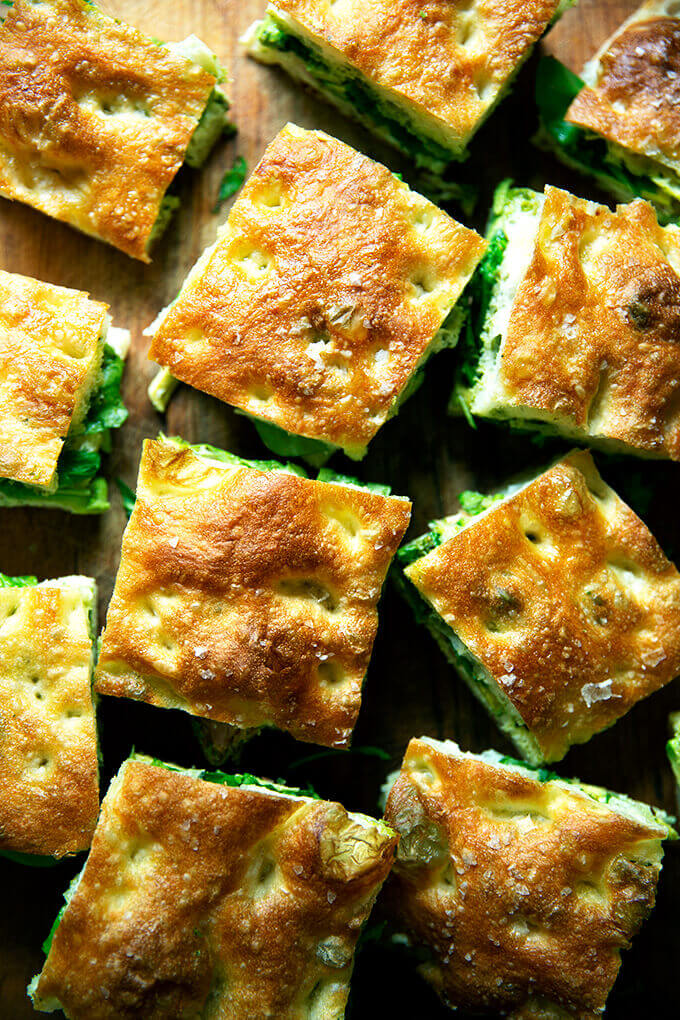
- You can use various pans to make this focaccia such as: two 9-inch Pyrex pie plates. (Use butter + oil to prevent sticking.) One 9×13-inch pan, such as this USA pan — do not split the dough in half, if you use this option, which will create a thicker focaccia . A 13×18-inch rimmed sheet pan — this creates a thinner focaccia, which is great for slab sandwiches.
- As always, for best results, use a digital scale to measure the flour and water.
- Salt: The rule of thumb with bread dough is that the weight of the salt should be 2 to 3% the weight of the flour. For this recipe, that is 10 to 15 grams. Do keep in mind that you sprinkle sea salt over the dough before baking, which adds to the saltiness. If you are sensitive to salt use 1o grams. If you are not, use 12 to 15 grams salt. I use Diamond Crystal kosher salt.
- I love SAF instant yeast. I buy it in bulk, transfer it to a quart storage container, and store it in my fridge for months. You can store it in the freezer also.
- If you are using active-dry yeast, simply sprinkle the yeast over the lukewarm water and let it stand for 15 minutes or until it gets foamy; then proceed with the recipe.
- Flour: You can use all-purpose or bread flour here with great results. If you live in a humid environment, I would suggest using bread flour. If you are in Canada or the UK, also consider using bread flour or consider holding back some of the water. Reference the video for how the texture of the bread should look; then add water back as needed.
Ingredients
- 4 cups (512 g) all-purpose flour or bread flour, see notes above
- 2 to 3 teaspoons (10 to 15 grams) kosher salt, see notes above
- 2 teaspoons (8 g) instant yeast, see notes above if using active dry
- 2 cups (455 g) lukewarm water, made by combining 1/2 cup boiling water with 1 1/2 cups cold water
- butter for greasing
- 4 tablespoons olive oil, divided
- flaky sea salt, such as Maldon
- 1 to 2 teaspoons whole rosemary leaves, optional
Instructions
- Make the dough: In a large bowl, whisk together the flour, salt, and instant yeast. Add the water. Using a rubber spatula, mix until the liquid is absorbed and the ingredients form a sticky dough ball. Cover the bowl, and let rest for 30 minutes, then stretch and fold the dough — this is an optional new step (9/17/2025), but if time permits, do it: I find it makes for an especially bubby focaccia. Fill a small bowl with water. Using a wet hand, grab an edge of the dough and pull it up and towards the center. Repeat this stretching and folding process, 8 to 10 times, moving your hand around the edge of the dough with every set of stretches and folds. As you stretch and fold, you should feel the dough transform from being sticky and shaggy to smooth and cohesive. Find video guidance here.
- Cold proof: Rub the surface of the dough lightly with olive oil. Cover the bowl with a lid (ideally) or plastic wrap and place in the refrigerator immediately for at least 12 hours or for as long as three days. (See notes above if you need to skip the overnight rise for time purposes.) NOTE: It is important the dough really be slicked with olive oil, especially if you are not using a hard lid. If you do not slick the dough with enough oil, you risk the dough drying out and forming a crust over the top layer.
- Line two 8- or 9-inch pie plates or a 9×13-inch pan (see notes above) with parchment paper or grease with butter or coat with nonstick cooking spray. (Note: This greasing step may seem excessive, but with some pans, it is imperative to do so to prevent sticking. With my USA pans, I can get away with olive oil alone; with my glass baking dishes, butter is a must.)
- Pour a tablespoon of oil into the center of each pan or 2 tablespoons of oil if using the 9×13-inch pan. Using two forks, deflate the dough by releasing it from the sides of the bowl and pulling it toward the center. Rotate the bowl in quarter turns as you deflate, turning the mass into a rough ball. Use the forks to split the dough into two equal pieces (or do not split if using the 9×13-inch pan). Place one piece into one of the prepared pans. Roll the dough ball in the oil to coat it all over, forming a rough ball. Repeat with the remaining piece. Let the dough balls rest for 3 to 4 hours depending on the temperature of your kitchen (Note: no need to cover for this room temperature rise).
- Set a rack in the middle of the oven and preheat it to 425°F. If using the rosemary, sprinkle it over the dough. Pour a tablespoon of oil over each round of dough (or two tablespoons if using a 9×13-inch pan). Rub your hands lightly in the oil to coat, then, using all of your fingers, press straight down to create deep dimples. If necessary, gently stretch the dough as you dimple to allow the dough to fill the pan. Sprinkle with flaky sea salt all over.
- Transfer the pans or pan to the oven and bake for 25 to 30 minutes, until the underside is golden and crisp. Remove the pans or pan from the oven and transfer the focaccia to a cooling rack. Let it cool for 10 minutes before cutting and serving; let it cool completely if you are halving it with the intention of making a sandwich.
- To store the focaccia: When it has completely cooled, transfer it to an airtight bag or vessel and store it at room temperature for up to 3 days. Otherwise, freeze it for up to 3 months. Always reheat it on subsequent days to revive its crust: 350ºF for 15 minutes.
Notes
To Make Muffin Tin Focaccia:
- Make the focaccia through step 3.
- Butter a muffin tin + 2 small ramekins or a crème brulée dish.
- Drizzle oil into each muffin well.
- Deflate the dough, then use two forks to portion it into small pieces, dropping the pieces into each well — each well will be 3/4 to nearly full. Drizzle with more oil. Turn each piece to coat in the oil.
- Let the dough rise again until it puffs above the rim, 30-45 minutes. Drizzle with more oil, then dimple. Sprinkle with sea salt and fresh rosemary.
- Bake at 425ºF for roughly 20-25 minutes. If necessary, brush with more oil out of the oven.
- Prep Time: 18 hours
- Cook Time: 30 minutes
- Category: Bread
- Method: Oven
- Cuisine: Italian
This post may contain affiliate links. Please read my disclosure policy.













6,815 Comments on “Overnight, Refrigerator Focaccia = The Best Focaccia Bread Recipe”
I loved this recipe! It was only my second time making bread of any kind (the first being a two ingredient bread). So easy to follow and turns out super delicious every time! Thank you for sharing. I’ve also tried this as a loaf and it tastes amazing!
So great to hear this, Giana 💕💕💕💕
it looks very good I will make it tomorrow night bake it Saturday, I will late you know
Thank you.
Hi Alexandra! Can I use dry active yeast instead? If so, would I use the same amount and just dissolve in the water first before adding to the dry ingredients? Thanks!
Yes! And yes! Do exactly what you wrote 🙂
Thanks for the quick answer!
Could I add any dried or fresh rosemary to the dough or should I just sprinkle it on top before baking?
Yes! Lots of people sprinkle fresh rosemary over top along with the sea salt just before baking. I’m sure dried would work too!
Could I add any dried or fresh rosemary to the dough or should I just sprinkle it on top before baking?
Yes! Lots of people sprinkle fresh rosemary over top along with the sea salt just before baking. I’m sure dried would work too!
made this multiple times even forgot to put it in the fridge once and it was still perfect
AMAZING thing to bring to a dinner party, currently making it again for my mothers birthday.
Wonderful to hear this, Haley!
Hi, I am new to bread making so I don’t know much but wouldn’t we need to add sugar for yeast to thrive? I’ve read so on the internet. Thanks in advance!
Hi….I add 1 tbsp of honey….not just because it helps activate the yeast but it just has a nice light taste to it. Take care
Love this idea, Kate!
when do you add the honey may I check?
Hi Sania! You don’t actually need sugar. Yeast converts the starch in flour into sugar; therefore, the flour provides yeast with a continuous food source.
Is it possible to substitute sourdough starter for the instant yeast, and if so what would be the approx proportions? I have SS, no yeast. Thanks!
I have made it with my sour dough starter and it came out great. 200 gr sourdough starter, 200 gr water, 400 gr flour.
Substitute 100 gr sourdough starter for 5 to7 gr active dry or instant yeast and reduce water and flour in the recipe accordingly.
Thanks for chiming in here, Hiva!
I forgot to mention that I used another recipe for the amount of ingredients and substitute it with SS the same way I explained in the previous post but actually used Alexandra’s technique to put in the fridge and the rest… I will try her complete recipe with SS soon
Thanks so much for the info, Hiva!!!
Hi Barbara, All of Hiva’s advise sounds great. I do have a sourdough focaccia recipe here: Simple Sourdough Focaccia
THANKS! Didn’t even occur to me to check your site for that.
Sure thing!
Best recipe hands down! Easy to make – i absolutely love it!
I will keep this recipe for a lifetime.
Wonderful to hear this!
I only have fresh yeast, so how much would I need to use?
Would I also need to use honey with the fresh yeast?
Love your recipe
Hi! No need to use honey with the fresh yeast. I would use 15 g.
This is such a delicious recipe! Before I let it rise, I added garlic salt and some minced roasted garlic. Then I topped it with some more flaky garlic salt and garlic olive oil!! We really like garlic in this household 😂 10/10!!
I love this so much 😂😂😂😂 ALL the garlic is never a bad thing 😍 Wonderful to hear this, Scarlett!
Hi, Alex,
Love your instructions! Yesterday i made a dough and put it in the fridge. Planning to bake focaccia tomorrow. Will it still be good and soft inside or is it to long for proofing? Thank you in advace
It will be fine! I’ve left it in the fridge for as long as 48 hours.
I’ve made this recipe dozens of times, an absolute staple in my house! I love to top it with flakey salt and rosemary!
This time I’m doubling the recipe to make 1 9×13 focaccia for lunch and 1 sheet pan pizza for dinner/leftovers.
Oh wonderful to hear this, Sarah! Doubling is a smart idea 😍😍😍
Did you cover the dough for the second rise? Thanks, this looks so good, can’t wait to make it.
Nope! It’s coated with oil, but no other cover.
WOW, this came out perfect and so delicious. Thank you so much for the recipe, it’s a keeper. Now off to make your pizza recipe, unfortunately the baking steel is sold out everywhere, but I do have a stone that came with my oven that I’ve never used, I’m sure it will be fine. So happy to have found your website on Pinterest.
So great to hear this, Via! A pizza stone will work great. If you really really want a steel, you could try ordering directly from Baking Steel: https://shop.bakingsteel.com/collections/steels/products/baking-steel
Your pizza recipe came out AMAZING!!!! I even made the tomato sauce, although I didn’t have any fresh tomatoes, but I did have a can of San Marzano tomatoes and just followed the recipe using that. I gotta tell you, your crust recipe is so far superior to anything I’ve been making, and I’ve been making pizza crust for 30 years. Oh and I ordered the Baking Steel and they even gave me $10 off and I should get it in a few weeks, so thanks for that and bless you sharing all your fabulous recipes.
Oh Via, awesome to hear all of this!! Homemade tomato sauce makes such a difference too … I’ve been lazy recently and using jarred, but nothing compares to fresh. I’m so happy to hear you ordered a Steel!! It is such a fun tool to have around.
I have tried your recipe 3 times already over the past 3 weeks. Its only getting better and better. The second time I had to leave the dough in the fridge for 48 hours before cooking. The result was surprisingly nice. Its getting more air pocket and the texture is more interesting. Loving the recipe. So easy for someone who has no skill like me. Thank you very much for this joyful recipe.
So wonderful to hear this, Wandee. The refrigerator is magical 😍😍😍
Sounds delicious and so easy! What adjustments should I make because I live at a high altitude of 6,000 feet?
Hi Ann,
It’s so hard to say! First: are you using a scale to measure the flour?
I would give the recipe a go as written. Something I suggest for people baking at altitude is to do an extra rise because the dough rises so quickly, but because this one rises in the refrigerator, you might not need another rise because the fridge slows down the process.
Hi there! May I know the equivalent of 2 teaspoons instant yeast in grams? Really looking forward to making this! Thanks.
Hi May! Yes: 8 g. Editing the recipe now.
Can I brush the top with tomato sauce and fresh basil before baking?
Worth a shot! I worry a little bit about the fresh basil … I feel like it will be black by the end. Could you sprinkle it on during the last 5 minutes? Or when it comes out of the oven?
What can i use instead of a cloth cover? Can i use plastic wrap?
Yes!
First time making Focaccia with this recipe. Very happy with the result. Highly recommended.
Great to hear Ravenska!
Hello!! This looks amazing! May I ask you if for instant yeast you mean the dry yeast? And is there a way to make no knead focaccia with Jim Lahey dough (not old dough as the recipe you have in your blog)?
Which recipe for focaccia would you suggest among all the ones you have here?
Thanks!
Chiara
Hi Chiara!
This is the focaccia recipe I would suggest. So easy, so good.
For instant yeast, I do mean dry yeast but it’s different than “active dry” yeast. Active dry yeast requires “activating” first, which simply means sprinkling the yeast over lukewarm water and letting it stand for 15 minutes or until it gets foamy. Then you proceed with the recipe.
Hope this helps!
Absolutely love this recipe! I’ve done it twice – once for focaccia bread and once as a test for pizza dough. My only question though, is my dough is super wet compared to your photos. All the same ingredients/amounts (except I do use regular active yeast instead) but it doesn’t hold a ball shape at all. Any suggestions? It still turns out fine, I was just surprised at the difference in your wonderful dough ball and my dough floof, lol.
I’ll also add that I haven’t done it based on weight specifically, just 4cups flour and 2cups water…so maybe next time I’ll actually use my kitchen scale and see if it makes any difference.
So nice to hear this, Malinda! I think you will be surprised what a difference a scale makes. That said, this is definitely a wet dough. Next time, use a scale since you have one, and see if it makes a difference. Or, simply use 2 scant cups water.
I just tried it again tonight with weighing the ingredients but it was still the same as before. Next time I’ll try your suggestion of adding more flour as well :). It still always tastes delicious though, even when the dough is a lot goopier.
Great! I would reduce the amount of water … I think that’s a little easier than adding more flour. Keep me posted! 😍
Thank you for posting this comment as I just started this dough today, and it looked more wet than in the video. I don’t own a kitchen scale and I aerated my flour when I measured like I typically do when I make bread…which might explain it. Encouraging to know it should still turn out okay!
Hi Both! I just wanted to point out that probably the quantity of water to use is a bit less than 2 cups, given that 1 cup equal to 240ml, therefore 2 cups would be 480ml. I think you should use more or less 2 cup minus 2 tablespoons of water but let’s see if Alexandra agrees or if I am saying something wrong and actually not helping at all, ahah 🙂
Thank you, Chiara! You are right … when I measure the water in my liquid measure, it is just below 2 cups; when I use my dry measuring cups, it is almost exactly 2 cups … this is why a scale is best. That said: it is a very forgiving recipe, and it should turn out even with a bit more water.
I think it should be fine, Megan! Next time, you can add a little more flour to eye till it looks like the photos/video, or wait to see how it turns out and then make an assessment for next time. It’s a very forgiving recipe. Let me know how it turns out!
May I ask you how I can use a normal active dry yeast in this recipe? Thanks! 😀
I mean, is the quantity the same one (8 grams)? 🙂
Hi Chiara! Yes, use the same weight. I would sprinkle the yeast over the lukewarm water and let it stand for 15 minutes before use.
would it be okay to add rosemary and roasted garlic into the flour before poofing?
Absolutely!
Hello
Looking forward to making this soon. Wonder if this can be made with gluten free flour?
I think it will take some trial and error … gf flour is so tricky, and what complicates things is that all gf flour absorbs water differently, which means the texture of the dough will vary wildly depending on what gf flour mix you use.
Thanks! Perhaps I’ll do a little trial and error.
Hello Becky,
Any news on your trials for a gluten free version ?
Thanks a lot.
Have you ever tried to send focaccia in the mail?
I have not! Are you hoping to?
I would like to try make this but largest rectangle tin i have is 11″ x 8″ otherwise i have round tins 23cm and 21cm. Am I able to use any of these instead for the recipe?
Hi Candice! I would use the 11 x 8-inch pan … it will be a little thicker, but it will still be delicious!
Absolutely love this focaccia recipe, 100% worth choosing this over a quicker method. On my first attempt at this particular bread (and only my 2nd bread making endeavor) it went perfectly. All my family loved this focaccia and agree that it’s better than any shop bought one they’ve had. Thank you very much.
So nice to hear this, Daisy 😍😍😍😍
Hi Alexandra. I made your recipe 3x. It came out delicious! The only problem I had every time I made it was 2cups of water wasn’t enough. The flour was extremely dry so I added about 1/3 cup more water to achieve the consistency in your video. Non the less it came out fantastic. I’m wondering why? I used scale measurements and also metric the result was always 2 cups of water wasn’t enough. Your thoughts?
Linda, this is so interesting! It goes to show that environment plays a role and that a scale cannot make everything foolproof. Glad you added water to feel. What type of flour are you using? And do you live in a very dry climate?
Hi Alexandra. I made your focaccia bread and it turned out wonderful. What a great recipe. I have a question. What is the best way to store the baked focaccia? I wrapped it in waxed paper then in foil and stored it on the counter. The crusty, crunchy crust got soft overnight. Any recommendations? Thank you.
Hi Toni! Unfortunately, no matter how you store it, the crusty crust will go soft. My preference is an airtight bag (like a ziplock) or an airtight container. The good news is that bread revives beautifully in either the toaster or the oven. So, with day old bread, I always recommend heating it at 350ºF for 15 minutes or so or toasting slices of it.
So glad you like this one, Toni!
Hello! Wondering if there’s a cheats option that means it doesn’t need so much rising time?
Hi! I have made this recipe start to finish in about 3-4 hours, letting it rise for 2 hours at room temperature; then turning it out into my prepared pan, then letting it rise for about 30 minutes, dimpling it and baking it. It still turns out well! It’s just best with a cold, fridge rise.