 →
→ 

Overnight, Refrigerator Focaccia = The Best Focaccia Bread Recipe
 By Alexandra Stafford
—
Last Updated: 12/13/2025
By Alexandra Stafford
—
Last Updated: 12/13/2025
This post may contain affiliate links. Please read my disclosure policy.
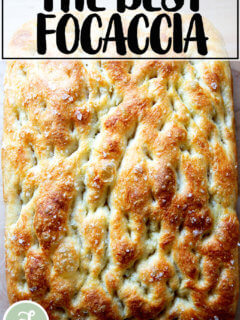
Cold, refrigerated dough is the secret to making delicious focaccia! Allowing the dough to rest 18 to 48 hours in the fridge will yield extra-pillowy and airy focaccia, though if you are pressed for time, you can make this start-to-finish in 3 hours. This 4-ingredient recipe requires only 5 minutes of hands-on time. Video guidance below!
⭐️⭐️⭐️⭐️⭐️ Review:
“Love this recipe! I’ve made this so many times that I’ve lost count. Super simple and delicious. My family loves it. Whenever someone asks me for a focaccia recipe, I always show them this one. This recipe is awesome. Thank you for sharing!” — Lucy
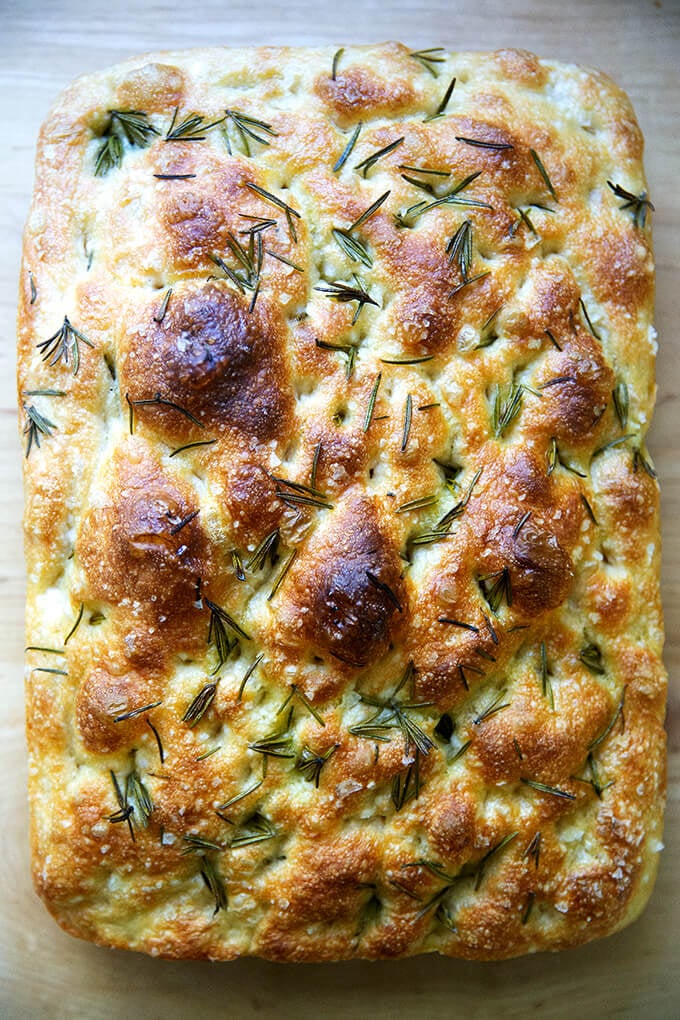
It’s hard to beat focaccia in the effort-to-reward category. If you are intimidated by bread baking, this is the recipe I suggest making first, both for its simplicity and flavor. Why?
- It’s a no-knead, 4-ingredient dough that takes 5 minutes to mix together.
- It requires no special equipment, no tricky shaping technique, and no scoring.
- If you have a 9×13-inch baking pan and your fingertips (for dimpling), you’re good to go.
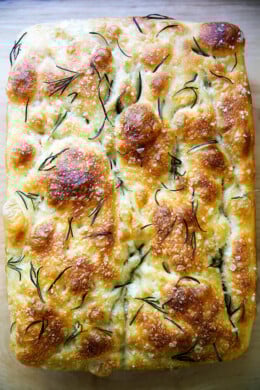
- It emerges soft and pillowy, olive oil-crusted, golden all around, and it’s completely irresistible.
Two Secrets for the Best Focaccia
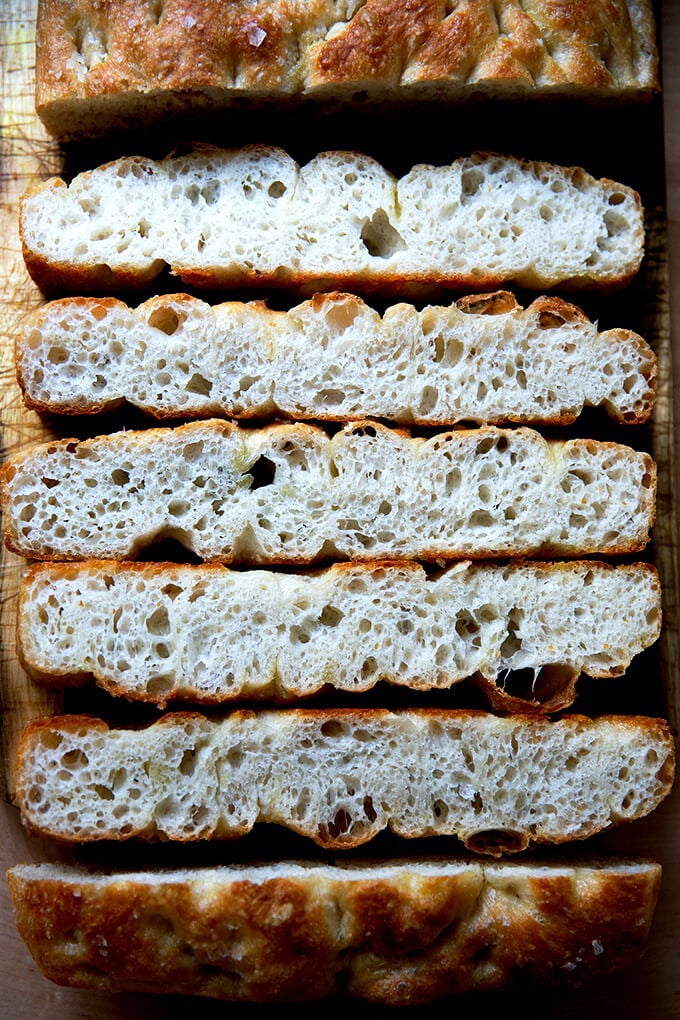
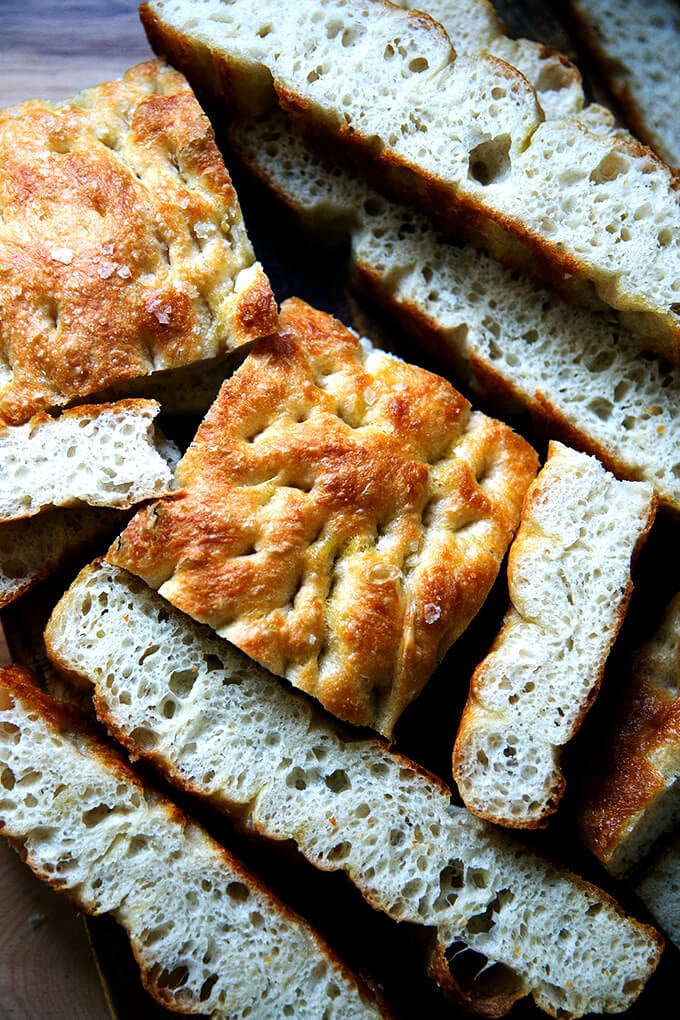
This focaccia emerges from the oven golden all around and pillowy inside, its surface dimpled with deep crevices, namely for two reasons:
- High hydration dough. This focaccia is 88% hydration.
- Long, cold, slow fermentation. This dough ferments in the fridge for at least 18 hours or for as long as three days.
Let’s explore each reason:
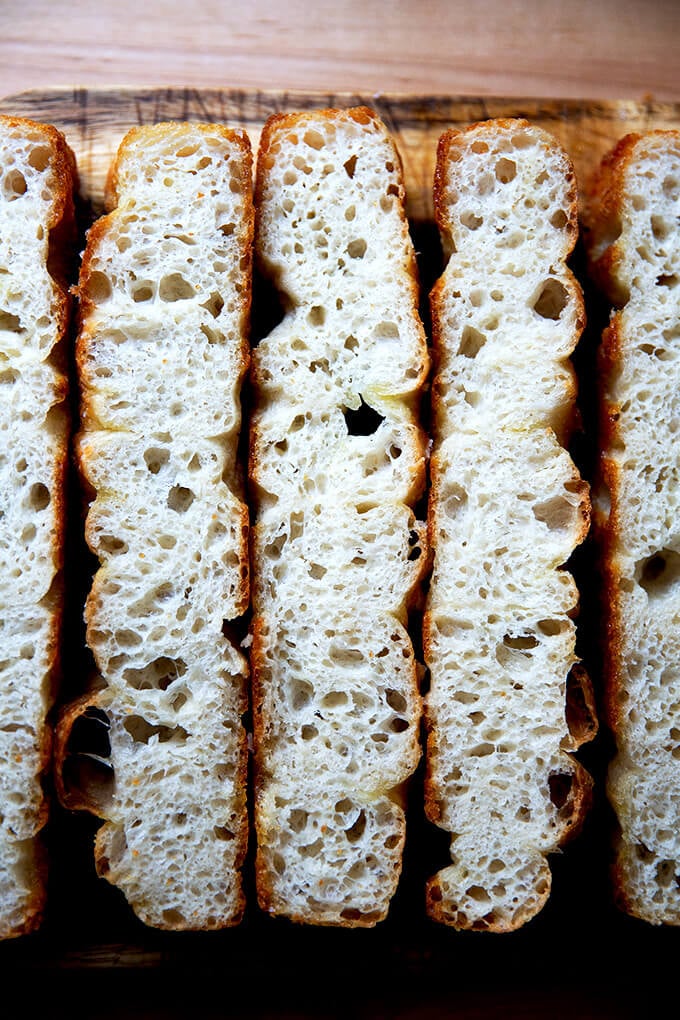
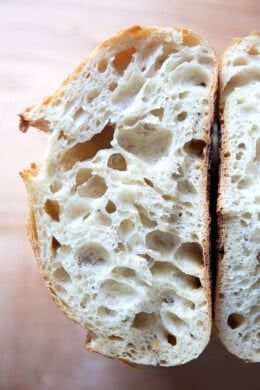
A high-hydration dough is a dough with a high proportion of water relative to the flour. A high proportion of water will create a light and air dough and ultimately a focaccia with beautiful air pockets throughout. (Incidentally, this is the secret to making excellent pizza dough, too.)
A long, cold fermentation is beneficial to dough because during a slow fermentation allows enzymes in both the flour and the yeast to break down the starches in the flour into simple sugars. These sugars contribute both to flavor and to browning. Cool, right?
Furthermore, a long slow fermentation strengthens gluten, which will further promote a crumb structure with lots of air pockets throughout.
How This Focaccia Recipe Differs from Others
There are lots of focaccia bread recipes out there, so why make this one? This one differs from many of the recipes out there in two ways:
- The long, cold, refrigerator rise.
- The absence of sugar or honey or any sort of sweetener.
Why isn’t there any sweetener in this recipe? Simply stated, a sweetener is just not needed — the yeast, contrary to popular belief, does not need sugar to activate or thrive. Sugar will speed things up, but when you’re employing a long, slow rise, speed is not the name of the game.
As noted above, during the long, cold fermentation, enzymes in both the flour and the yeast will break down the starches in the flour into simple sugars, which will contribute both to flavor and to browning, rendering sugar unnecessary.
PS: Once you master this simple focaccia, try your hand at this simple sourdough bread recipe, another recipe that requires minimal effort but yields spectacular results.
How to Make Focaccia Bread, Step by Step
Gather your ingredients: 4 cups (512 g) flour, 2 teaspoons (12 g) salt, 2 teaspoons (8 g) instant yeast (SAF is my preference), 2 cups (455 g) water:
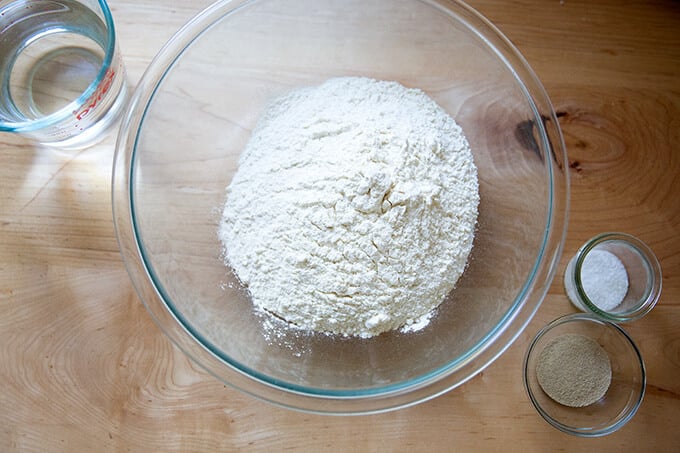
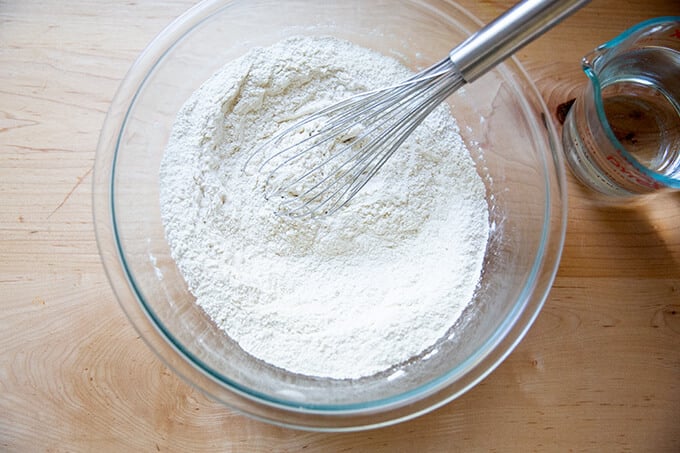
Whisk together the flour, salt, and yeast first:
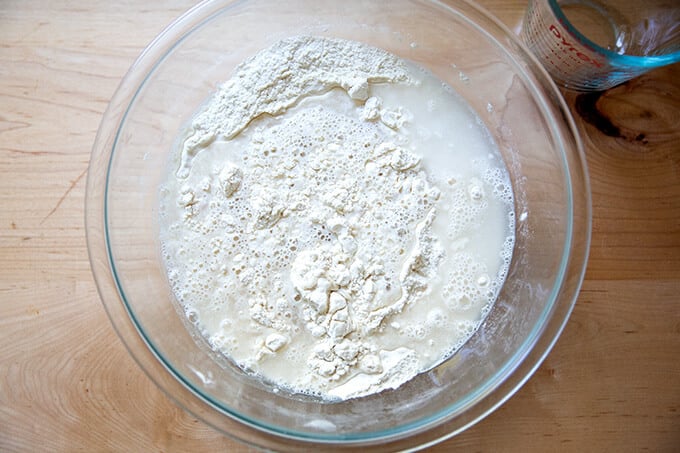
Add the water:
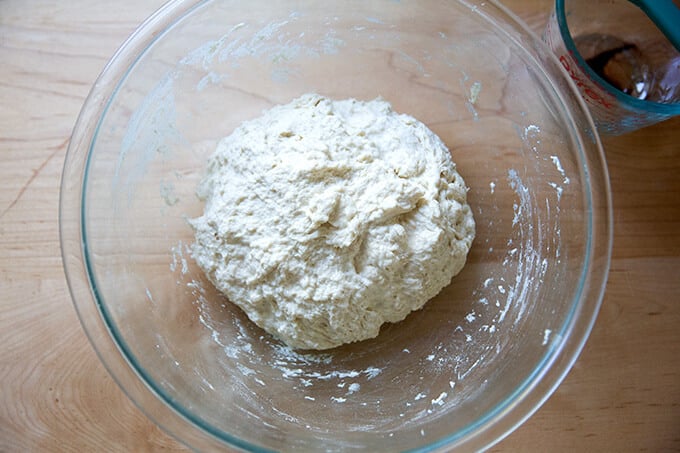
Use a spatula to stir the two together.
Slick the dough with olive oil…
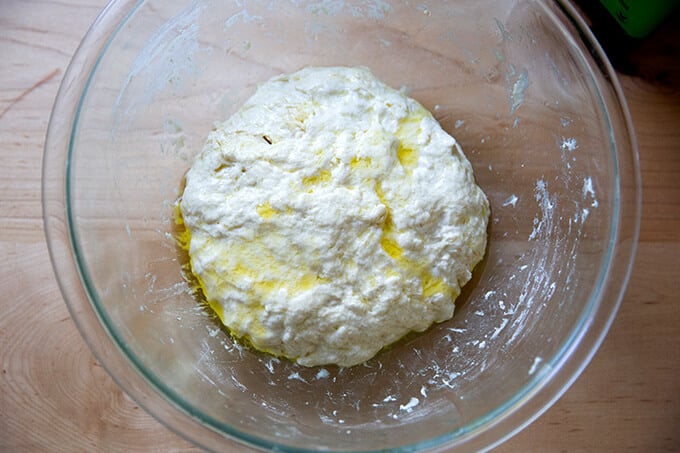
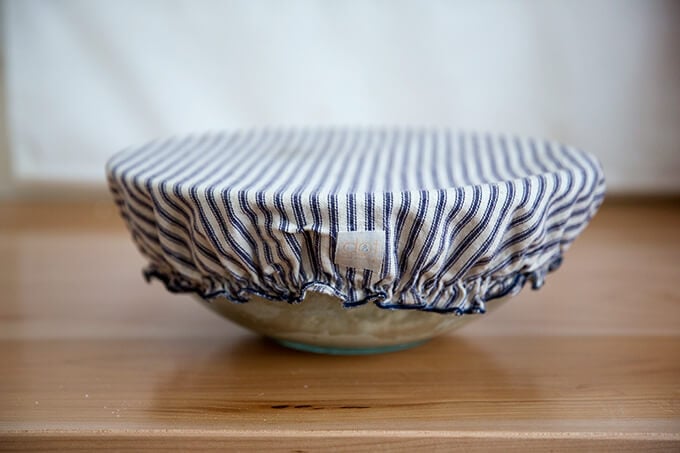
… then cover the bowl preferably with a lid. or a cloth bowl cover. Stick the bowl in the fridge immediately; leave it there to rise for 12 to 18 hours (or for as long as three days).
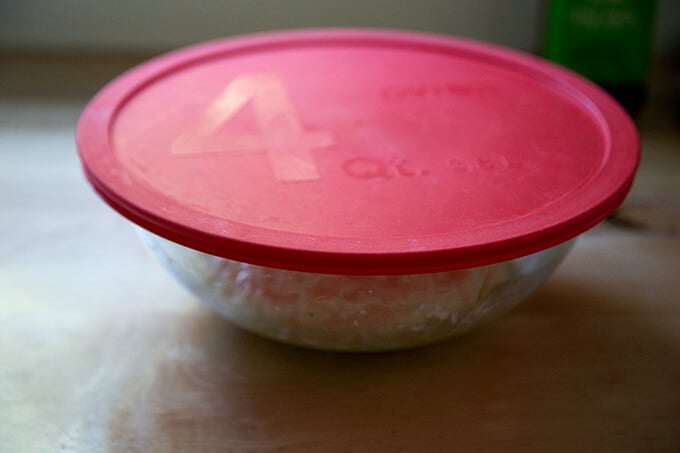
NOTE: It is important the dough really be slicked with olive oil especially if you are using a cloth bowl cover or tea towel as opposed to plastic wrap or a lid. If you are using a tea towel, consider securing it with a rubber band to make a more airtight cover. If you do not slick the dough with enough oil, you risk the dough drying out and forming a crust over the top layer.
Remove from fridge, and remove the cover:
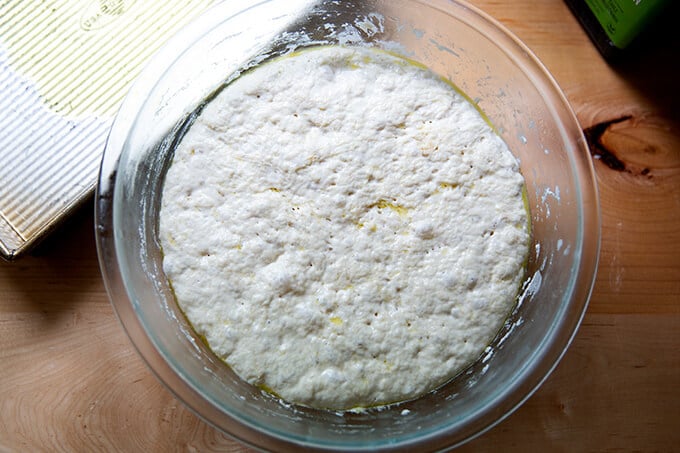
Deflate the dough and transfer to a prepared pan. I love this 9×13-inch USA pan. If you don’t have one you can use two 8- or 9-inch pie plates or something similar. If you are using glass baking dishes be sure to grease the dishes with butter before pouring a tablespoon of olive oil into each. (The butter will ensure the bread doesn’t stick.) Don’t touch the dough again for 2 to 4 hours depending on your environment.
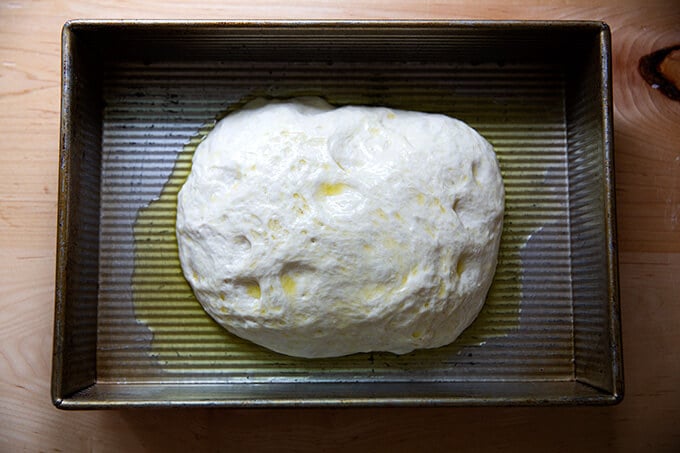
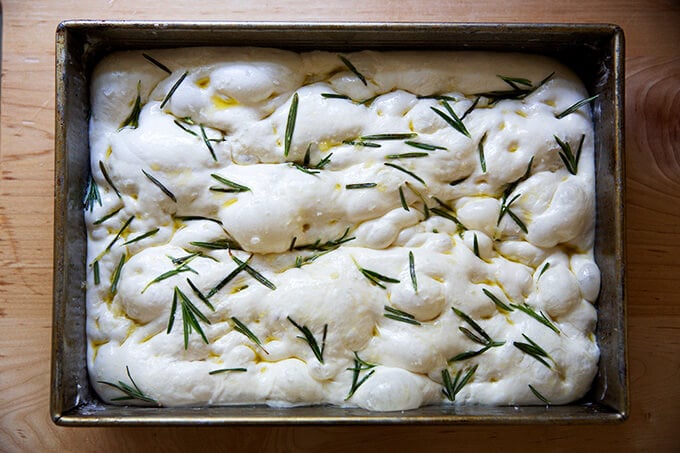
After two to four hours, or when the dough looks like this…:
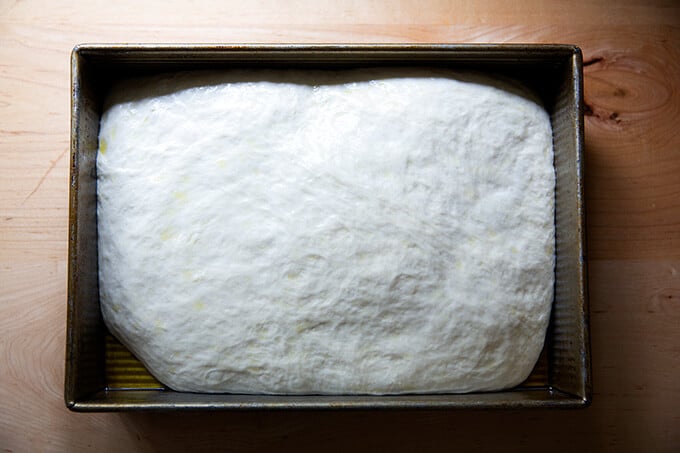
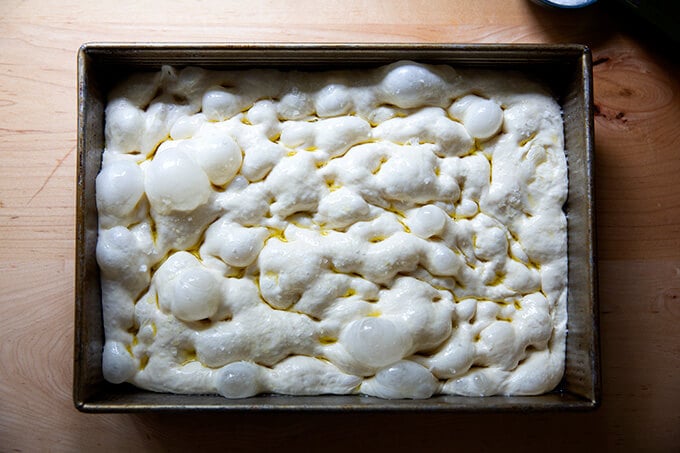
… it’s time to dimple it! You can simply use olive oil and salt — I recommend good, flaky sea salt for this. Note, the dough in the photo below spent three days in the fridge, and the dough was super bubbly!
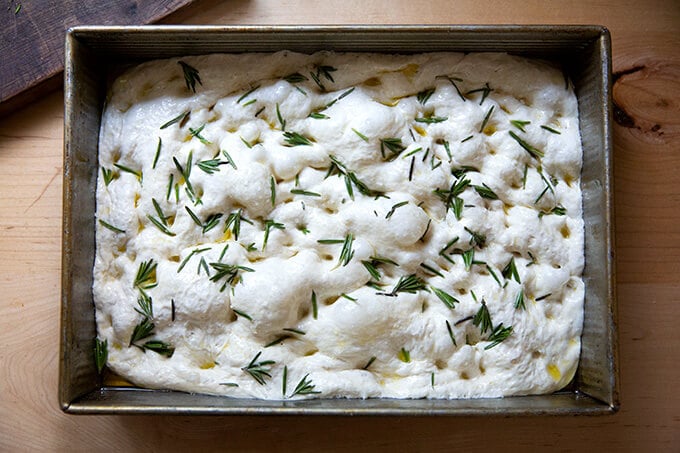
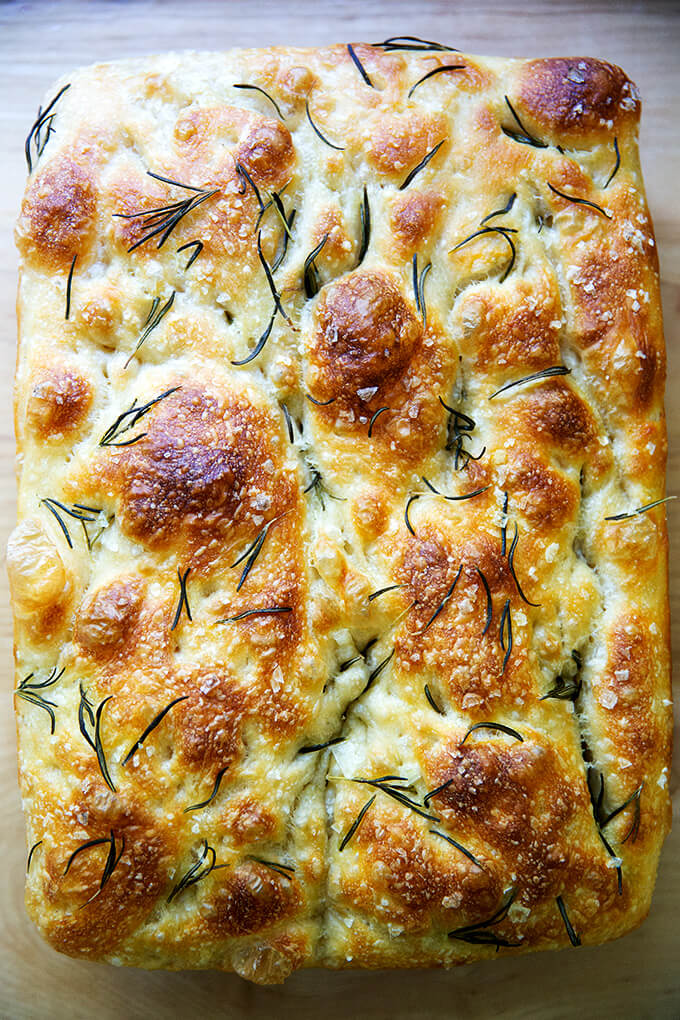
if you are using rosemary, sprinkle it over the dough. Then pour two tablespoons of olive oil over the dough, and using your fingers, press straight down to create deep dimples. Sprinkle with flaky sea salt — again, something like Maldon is great here.
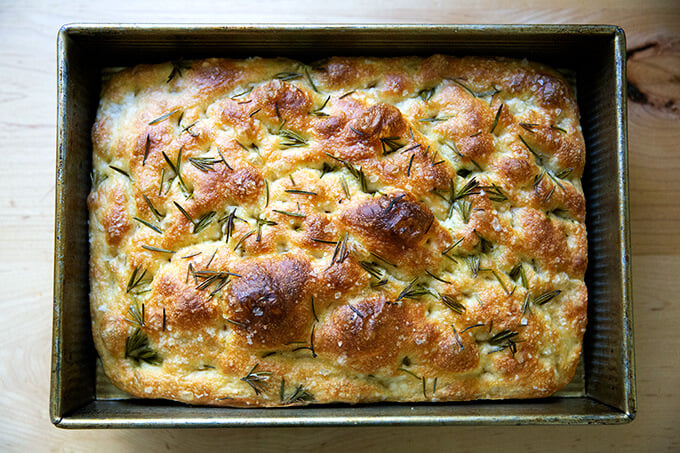
Transfer to oven immediately and bake at 425ºF for 25 minutes or until golden all around. Remove focaccia from pans and place on cooling racks.

How to Incorporate Rosemary, Herbs, and Other Ingredients & Toppings into Your Focaccia Dough
One of the most frequently asked questions I get is: How can I add other toppings or ingredients to my focaccia bread? You can do this in two ways:
- Add them on top as you would rosemary or other herbs. The key is to make sure the ingredients are slicked lightly with olive oil to ensure they do not burn in the oven. I like to sprinkle the rosemary over top of the dough, then drizzle it with olive oil, then dimple the dough.
- You can add them directly to the dough. In step one, when you whisk together the flour, salt, and instant yeast, add your ingredients — chopped olives, sun-dried tomatoes, roasted garlic — to the flour and toss to coat; then add the water.
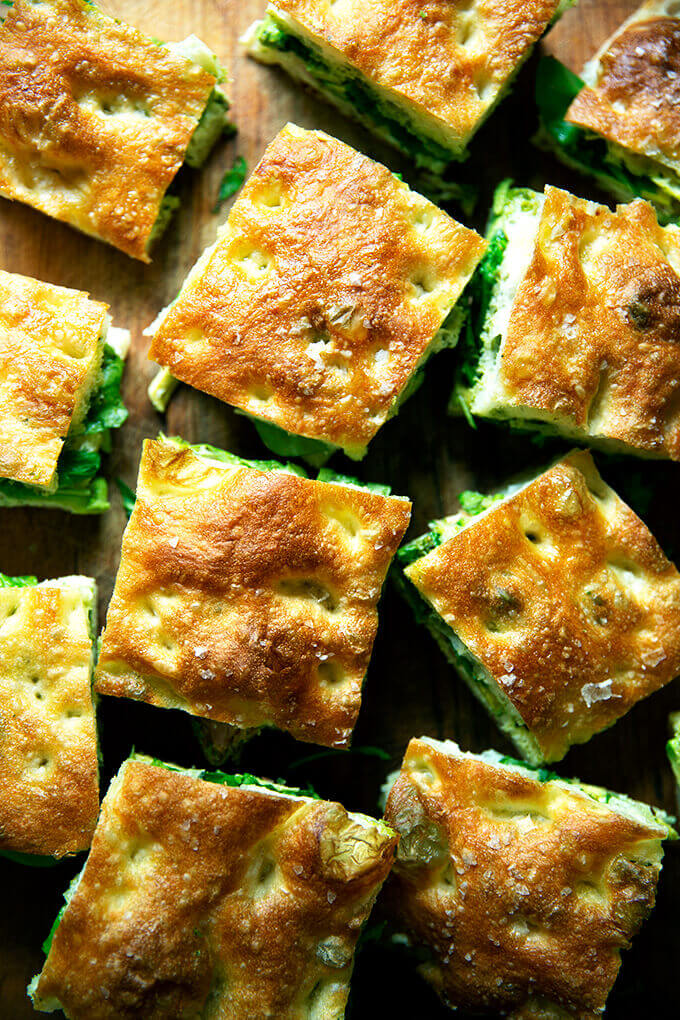
PS: How to Make Focaccia Slab Sandwiches
Can I Make this Overnight Focaccia Without the Overnight Rise?
Yes, you can. In fact, in my cookbook, Bread Toast Crumbs, I do not employ an overnight rise. Start-to-finish it can be made in about three hours. The finished bread will not be as pillowy, but it will still be light, airy, and delicious.
To skip the overnight rise, simply let the mixed dough rise at room temperature until doubled, about 1.5 to 2 hours. Then proceed with the recipe, knowing the second rise will only take about 30 minutes.
Print
The Best, Easiest Focaccia Bread Recipe
- Total Time: 18 hours 30 minutes
- Yield: 2 loaves 1x
Description
Cold, refrigerated dough is the secret to making delicious focaccia! Allowing the dough to rest for a minimum of 18 to 24 hours (or up to 3 days) in the fridge will yield extra-pillowy and airy focaccia. However, if you are pressed for time, you can make this from start to finish in 3 hours. This 4-ingredient recipe requires only 5 minutes of hands-on time. Video guidance below!
Adapted from the focaccia recipe in Bread Toast Crumbs.
A few notes:
- Plan ahead: While you certainly could make this more quickly, it turns out especially well if you mix the dough the day before you plan on baking it. The second rise, too, takes 2 to 4 hours.
- If you are short on time and need to make the focaccia tonight: Let the mixed dough rise at room temperature until doubled, about 1.5 to 2 hours. Then proceed with the recipe, knowing the second rise will only take about 30 minutes.
- You can use various pans to make this focaccia such as: two 9-inch Pyrex pie plates. (Use butter + oil to prevent sticking.) One 9×13-inch pan, such as this USA pan — do not split the dough in half, if you use this option, which will create a thicker focaccia . A 13×18-inch rimmed sheet pan — this creates a thinner focaccia, which is great for slab sandwiches.
- As always, for best results, use a digital scale to measure the flour and water.
- Salt: The rule of thumb with bread dough is that the weight of the salt should be 2 to 3% the weight of the flour. For this recipe, that is 10 to 15 grams. Do keep in mind that you sprinkle sea salt over the dough before baking, which adds to the saltiness. If you are sensitive to salt use 1o grams. If you are not, use 12 to 15 grams salt. I use Diamond Crystal kosher salt.
- I love SAF instant yeast. I buy it in bulk, transfer it to a quart storage container, and store it in my fridge for months. You can store it in the freezer also.
- If you are using active-dry yeast, simply sprinkle the yeast over the lukewarm water and let it stand for 15 minutes or until it gets foamy; then proceed with the recipe.
- Flour: You can use all-purpose or bread flour here with great results. If you live in a humid environment, I would suggest using bread flour. If you are in Canada or the UK, also consider using bread flour or consider holding back some of the water. Reference the video for how the texture of the bread should look; then add water back as needed.
Ingredients
- 4 cups (512 g) all-purpose flour or bread flour, see notes above
- 2 to 3 teaspoons (10 to 15 grams) kosher salt, see notes above
- 2 teaspoons (8 g) instant yeast, see notes above if using active dry
- 2 cups (455 g) lukewarm water, made by combining 1/2 cup boiling water with 1 1/2 cups cold water
- butter for greasing
- 4 tablespoons olive oil, divided
- flaky sea salt, such as Maldon
- 1 to 2 teaspoons whole rosemary leaves, optional
Instructions
- Make the dough: In a large bowl, whisk together the flour, salt, and instant yeast. Add the water. Using a rubber spatula, mix until the liquid is absorbed and the ingredients form a sticky dough ball. Cover the bowl, and let rest for 30 minutes, then stretch and fold the dough — this is an optional new step (9/17/2025), but if time permits, do it: I find it makes for an especially bubby focaccia. Fill a small bowl with water. Using a wet hand, grab an edge of the dough and pull it up and towards the center. Repeat this stretching and folding process, 8 to 10 times, moving your hand around the edge of the dough with every set of stretches and folds. As you stretch and fold, you should feel the dough transform from being sticky and shaggy to smooth and cohesive. Find video guidance here.
- Cold proof: Rub the surface of the dough lightly with olive oil. Cover the bowl with a lid (ideally) or plastic wrap and place in the refrigerator immediately for at least 12 hours or for as long as three days. (See notes above if you need to skip the overnight rise for time purposes.) NOTE: It is important the dough really be slicked with olive oil, especially if you are not using a hard lid. If you do not slick the dough with enough oil, you risk the dough drying out and forming a crust over the top layer.
- Line two 8- or 9-inch pie plates or a 9×13-inch pan (see notes above) with parchment paper or grease with butter or coat with nonstick cooking spray. (Note: This greasing step may seem excessive, but with some pans, it is imperative to do so to prevent sticking. With my USA pans, I can get away with olive oil alone; with my glass baking dishes, butter is a must.)
- Pour a tablespoon of oil into the center of each pan or 2 tablespoons of oil if using the 9×13-inch pan. Using two forks, deflate the dough by releasing it from the sides of the bowl and pulling it toward the center. Rotate the bowl in quarter turns as you deflate, turning the mass into a rough ball. Use the forks to split the dough into two equal pieces (or do not split if using the 9×13-inch pan). Place one piece into one of the prepared pans. Roll the dough ball in the oil to coat it all over, forming a rough ball. Repeat with the remaining piece. Let the dough balls rest for 3 to 4 hours depending on the temperature of your kitchen (Note: no need to cover for this room temperature rise).
- Set a rack in the middle of the oven and preheat it to 425°F. If using the rosemary, sprinkle it over the dough. Pour a tablespoon of oil over each round of dough (or two tablespoons if using a 9×13-inch pan). Rub your hands lightly in the oil to coat, then, using all of your fingers, press straight down to create deep dimples. If necessary, gently stretch the dough as you dimple to allow the dough to fill the pan. Sprinkle with flaky sea salt all over.
- Transfer the pans or pan to the oven and bake for 25 to 30 minutes, until the underside is golden and crisp. Remove the pans or pan from the oven and transfer the focaccia to a cooling rack. Let it cool for 10 minutes before cutting and serving; let it cool completely if you are halving it with the intention of making a sandwich.
- To store the focaccia: When it has completely cooled, transfer it to an airtight bag or vessel and store it at room temperature for up to 3 days. Otherwise, freeze it for up to 3 months. Always reheat it on subsequent days to revive its crust: 350ºF for 15 minutes.
Notes
To Make Muffin Tin Focaccia:
- Make the focaccia through step 3.
- Butter a muffin tin + 2 small ramekins or a crème brulée dish.
- Drizzle oil into each muffin well.
- Deflate the dough, then use two forks to portion it into small pieces, dropping the pieces into each well — each well will be 3/4 to nearly full. Drizzle with more oil. Turn each piece to coat in the oil.
- Let the dough rise again until it puffs above the rim, 30-45 minutes. Drizzle with more oil, then dimple. Sprinkle with sea salt and fresh rosemary.
- Bake at 425ºF for roughly 20-25 minutes. If necessary, brush with more oil out of the oven.
- Prep Time: 18 hours
- Cook Time: 30 minutes
- Category: Bread
- Method: Oven
- Cuisine: Italian
This post may contain affiliate links. Please read my disclosure policy.






6,815 Comments on “Overnight, Refrigerator Focaccia = The Best Focaccia Bread Recipe”
Hi lovely recipe! Turned out amazing!
Can I use self raising flour instead of plain flour?
Thanks
Great to hear! Not sure how to advise regarding self-raising flour because it likely already has some salt in it as well as some sort of chemical leavener — baking powder or baking soda. I worry these ingredients will affect the rising/texture.
I have made this bread over and over my family LOVES it. My sister thinks I should open a bread store lol! But the only problem I have is storing the bread and ensuring it stays fresh and not too ‘wet’ from being covered in plastic wrap left out at room temp. Do you have another way you store your focaccia ? 🙂
Hi Leah! So great to hear this 🙂 🙂 🙂
I always store in an airtight bag (like a ziplock) or an airtight vessel (like a Tupperware). The thing with day old bread is that the texture is never going to be optimal out of the bag. If you re-heat that day old focaccia however — either in a toaster oven or a regular oven at 350ºF for 15-20 minutes — it will revive beautifully.
I made this for Memorial Day to serve with some Low Country Boil and boy was it perfection! Thanks for sharing the recipe. It’s my new favorite. I topped mine with garlic, rosemary and calabrian chiles.
That sounds amazing, Michael! I love Calabrian chiles.
Want to add some roasted garlic—when I’m the process should I do that?
Hi Amy! Are you adding a paste or whole roasted garlic cloves that you would like to keep intact?
Whole
OK, you can do one of two things: you can toss them with the flour. Or if you want to keep them more intact and more visible, you can dimple them into the dough after the second rise, just before you bake, so that they’re more like a topping. I would drizzle them with more oil if you go the topping route.
Love this recipe! Super easy dough and delicious every time. Quick question: my cousin only has a convection oven and would like to make this focaccia. Any tips? Thank you!
I have a convection oven, and I use it to bake every time even though I’m not supposed to, and this turned out fantastic following the directions as written WITH the convection setting running. I personally find that my convection oven fan makes for more even baking and has none of the downsides I’ve read from others however. It makes a nice crust on bread too, I’ve found. Good luck!
Great to hear this, Kim! Thanks so much for sharing.
Thank you!!
I think, as Kim noted, it should be just fine! I would keep an eye on it just to ensure it isn’t browning too quickly because all ovens behave differently.
OK, this actually is the best focaccia ever. I’ve tried a lot of recipes over the years, and this one is a solid winner. Additionally, I screwed up because I threw it together at midnight, and misread the directions and thought I was not supposed to oil the dough prior to the fridge step. This seemed very bizarre to me, but this is my first attempt at a no knead bread, I am a much more traditional baker, so I figured it was just a new technique. Unfortunately, when I took it out of the fridge, it had developed a really hard crust. I poured some extra olive oil on it and massage it around, and threw it into the oven anyway. And it was amazing! I screwed it up, and it still turned out to be amazing. I can’t wait to actually follow the directions, and try it again. Thank you so much!
Oh I love it 🙂 🙂 🙂 Great to hear the hard crust that formed in the fridge didn’t affect the outcome! Oil will prevent the crust from forming, as will an airtight lid or plastic wrap. Hope your next go is even better!
Actually, I did have press-and-seal plastic wrap (people, don’t judge) on the mixing bowl in fridge! Still crusty! But yes, oil and a cover!
Wow, interesting, good to know! OK: oil + cover it is 🙂 🙂 🙂
Hi there! First of all I absolutely love your recipe! Thank you for sharing it! Made it many times often topped with cheddar onions and jalapeños and it’s a huge hit everywhere I bring it. But I do have question which brings me here. I want to make this recipe for a date I’m going to out of state and wanted to know if I could freeze the dough, take it with me on the plane and then defrost and bake fresh when I get there? Would it be better if i didn’t freeze it before packing it or do you recommend baking it beforehand and reheat the next day prior to going out?
Hi Anil! I love this idea! You can freeze the dough at various phases, but I would suggest freezing it after the first rise — so, when you take it out of the fridge, I would ball it up, and transfer it to an airtight container and freeze it. My only concern is about how you will transport it on the airplane? In a cooler? It’s totally fine if it thaws a little bit, but I worry about it making a mess of things.
Hi Ali, thanks for this recipe! It turned out fantastic! Yummiest focaccia I’ve ever eaten. I also halved the recipe cos I prefer thinner crusts. Going to pair it with some of your stuffed recipes.
Yay! Great to hear, Sheryl!! Thanks for writing 🙂 🙂 🙂
I absolutely love this recipe! Easy to follow and Greta pictures to help!
Can I freeze the whole loaf once made? I need to travel 5 hours by car on Friday, and have the dough in the fridge now. I was thinking to make it tomorrow and then freeze the loaf and once ready to eat, thaw and heat. Do you suggest just freezing the dough and cook on site?
Hi Brianne! Wonderful to hear this! Definitely freeze the loaf once baked! Sourdough dough doesn’t freeze as well as yeast-leavened dough, so I definitely recommend freezing the baked loaf. Hope I’m getting to you in time! Safe travels.
Love this recipe! Thank you Ali
Great to hear, Chiara! Thanks for writing 🙂 🙂 🙂
Great recipe and thank you! I’d like to make a bigger batch but will it work if I double it?
Yes, absolutely! Go for it 🙂
Mijn man is italiaan dus daarom wil ik het leren maken
Loved the recipe. I would like to know when taking out from the fridge for the second rise can I cover it with a towel or plastic wrap so it won’t form a crust. The first time I made It a crust formed on the top while it was rising to room temperature.
Thanks
Hi Marina! Yes, absolutely. Bummer to hear a crust formed. Out of curiosity, did you turn the ball of dough to coat in oil before the second rise?
Okay. I’m always skeptical of recipe titles with “THE BEST”, but this is indeed the very best. I am seriously considering hiding the rest of this (I’ve had two pieces in five mjnutes) from my husband and MIL. It’s perfect, and I was worried about how it looked in the rise(s). I’m reluctantly giving one pan to the neighbor across the street who turned 96 today. Only note: make sure your oven is up to full temp, and keep it there.
So great to hear this, Greg!! Thanks for writing 🙂 🙂 🙂
So good! Thank you for sharing your recipe!
So great to hear this, Nu! Thanks so much for writing 🙂 🙂 🙂
So good! Thank you for sharing your recipe! This is THE BEST! I have tried a few different recipe! Definitely a keeper!
Yay!! 🍞🍞🍞🍞🍞
Great recipe, used it a few times now, even non-overnight it’s super good and easy. One question/issue is that from what I’ve seen, 455g of water is slightly less than 2 cups. 2 cups seems to be more like 470g of water (depending on the website you use for conversion). I’ve had the best results using 455g instead of a full 2 cups. Maybe it’s just really humid where I am but I think 2 cups of water is maybe a little bit too much for this recipe.
Hi Adam! Yes, I always go by the grams as opposed to the cups — 470 g water would be too much for me as well. I am constantly pushing using a scale for this very reason … so much more accurate and consistent to use a scale than cups. Thanks so much for writing!
First time trying this recipe out and just wanted to ask if it would be ok to incorporate my dried herbs into the dough itself? I am slightly worried that the herbs would burn if i add it on as topping instead. Any tips from you regarding this?
Hi Belle! Apologies for the delay here. You can definitely add dried herbs to the dry ingredients. I like that method better than on top for dried. Lots of people do add fresh rosemary to the top of this recipe. Some people have had success with dried rosemary on top as well, but again I do prefer mixing the dried herbs with the dry ingredients.
Love this recipe! I’ve made this so many times that I’ve lost count. Super simple and delicious. My family loves it. Whenever someone asks me for a focaccia recipe, I always show them this one. Partly because I haven’t tried any others, but I don’t see a need to. This recipe is awesome. Thank you for sharing!
So great to hear this, Lucy! Thanks so much for writing and thanks so much for spreading the word, too 🙂 🙂 🙂 Happy Baking!
When I remove from the fridge do I just put it on the countertop or can i also turn the oven light on and put it in there?
Great question! I wouldn’t put it in the oven with the light on — the warmth of the oven light can be surprisingly hot, and it can cause the bread to proof too quickly. I would leave it on the countertop.
Sorry one more question….can I use a 14×14 pan for this or do you think it’s too big?
Yes, you absolutely can, just keep in mind, the dough will be much thinner. Not a bad thing … just depends on what you’re looking for.
I made a version of this in a bread machine and cooked the same night. And then made the version with the first rise in the fridge overnight. Such a lovely crumb, texture and flavor!!! Topped with sense seeds and fennel for one, classic rosemary and coarse salt for the other.
I experimented with whole wheat flour and bread flour and it is yummy!
My loaves didn’t brown on the top too much, but I used a toaster oven and a convection oven. Roomies loved them tho!! Thank you for your bread wisdom, Alexandra.
So nice to hear all of this, Jakob! Toaster ovens can be tricky to get right in terms of timing and temperature. So glad you had success. Thanks so much for writing!
Hello! Can I use whole wheat flour with added gluten, or spelt flour instead of the white flour?
Thanks!
Hi Stacey, You can, just keep in mind that the focaccia won’t be light and airy — it will likely be on the dense side. That said, it will still be tasty and it will still work, the texture will just be different.
Hello,
I wonder about the addition of sugar. Would it help or harm the dough in any way?
Also, can I add olives to the dry ingredients? Would it mess up the rise?
Thanks.
There’s no need to add sugar here. During the long, cold proof, enzymes in the flour and the yeast will break down the starches in the flour into simple sugars, which will provide flavor and will encourage browning. Yes, definitely add olives!
Your focaccia recipe sounds wonderfully simple but my dough was very wet and runny. I followed the directions carefully and don’t know what I did incorrectly. The end result was not at all appealing. Any advice would be appreciated — I’ve never made bread before! Thank you.
Hi Beth!
Questions for you:
Did you weigh the ingredients or use measuring cups?
What type of flour did you use?
Do you live in a humid environment?
Hi! Thank you for answering so quickly!
I used measuring cups; I used bread flour; I live in Florida (can’t get much more humid than that!!)
Beth
OK, great! It’s very likely you’re just using less flour than I am. Because you are using cups, it’s so hard to know how much you should add, but what I would suggest next time around: 1.) If you like the idea of making bread more regularly, invest in a scale — it makes all the difference. 2.) If you’re not quite ready for that, cut the water back next time by at least 1/4 cup if not more. You can always add the water in slowly until the dough resembles the texture of the dough in the video.
Thank you! I will try all your suggestions.
How much butter if needed in the recipe you never say. Or is it just for the baking pan that th3 bread does not stick
How much butter if needed in the recipe you never Mentioned
Sorry confuse
No worries! You need just about a tablespoon or so — it’s to grease the pan, which will prevent sticking. Olive oil alone in some pans will not be enough to provide a nonstick barrier.
Delicious and easy recipe. Works perfectly every time. I’ve used both bread flour and all-purpose flour and both tasted great. The leftovers freezes really well.
I’d love it if you would add instructions for when to add in flavors like rosemary or sundries tomatoes. Are they sprinkled on top like the salt, or mixed in? Thanks!
Hi Kal! Great to hear! I would mix them/toss them with the flour — this prevents them from burning. Some people like the look of adding them on top, but so often they burn, so this is the method I suggest. Thanks for writing!
hi! i have made this recipe a handful of times now and LOVE it. however – i noticed when i make it in my apartment, the center always seems to come out underbaked/stodgy. i am using a glass pyrex 9×13 pan and just baked today at 425 for 41 minutes hoping this would do the trick (after testing 32 and 38 minutes in the past). The exterior looks great – super golden and just shrinking away from the edges of the pan; however I just cut into it and it’s still under in the center! i once baked it at another house in a metal pan similar to the one in your video for about 30 minutes and it came out perfectly. could the glass pan be the issue here, despite the very increased baking time? thanks so much for any insights you can provide!
Hi! Bummer to hear this. And yes, the pan can make all the difference! I stick to my metal pans with focaccia these days for similar reasons, but mostly because I find I get a crisper bottom crust when I use metal pans.
The only other thought I have is that you could try cutting back the water slightly, which might allow you to reduce the overall baking time.
Finally: if you have a Baking Steel or pizza stone, baking the focaccia on top of that might help.
Ali, FIne to halve this right? Because it is for one person. Thanks Dina.
Yes! Apologies for the delay here! It does freeze well, too… just giving you options!