 →
→ 

Homemade Sourdough Bread, Step by Step
 By Alexandra Stafford
—
Last Updated: 07/30/2025
By Alexandra Stafford
—
Last Updated: 07/30/2025
This post may contain affiliate links. Please read my disclosure policy.
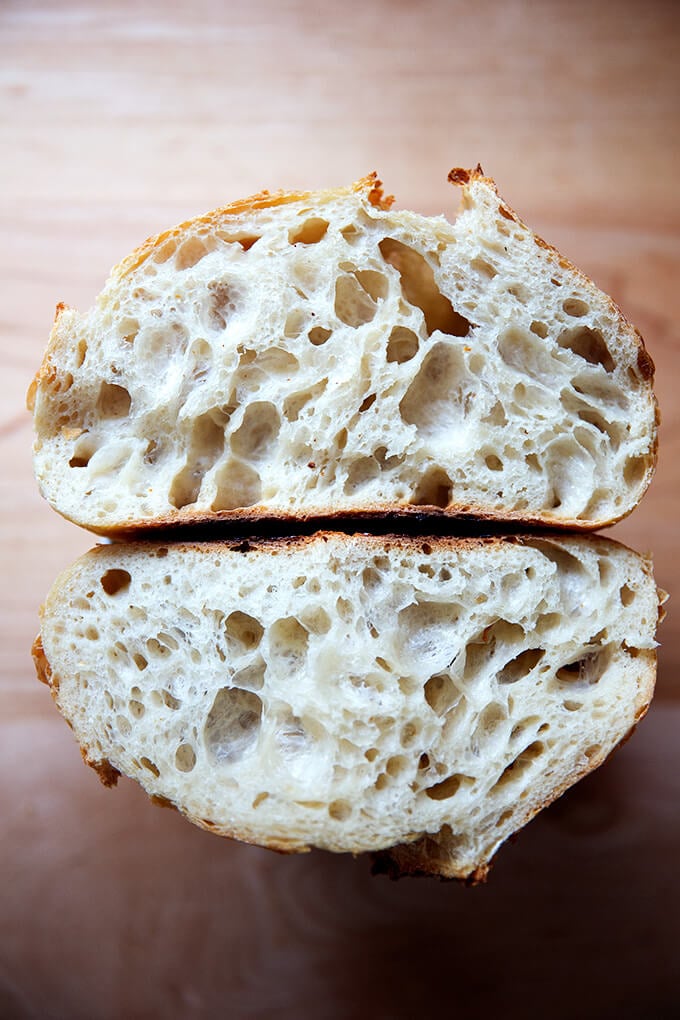
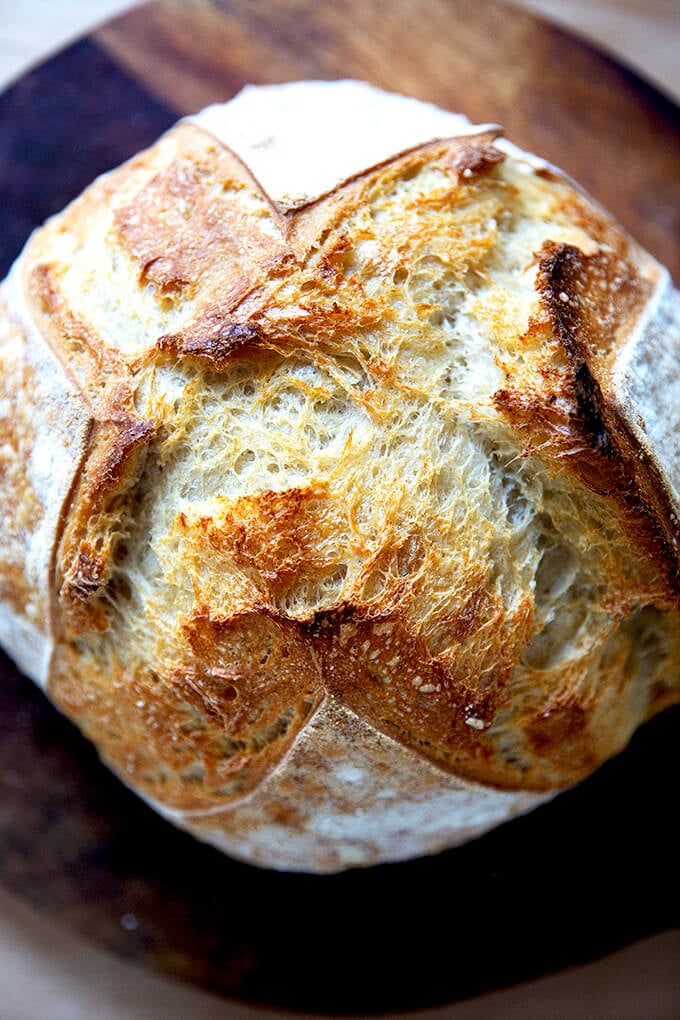
If you love fresh sourdough bread with a golden, crisp crust and a light, airy crumb, this recipe is for you. It’s one of the simplest homemade sourdough bread recipes, and one of the best, too. It requires only 25 minutes of hands-on work and no autolyse or preferment. Below you will find guidance for every step of the way. 🍞🍞🍞
⭐️⭐️⭐️⭐️⭐️ Review:
“Absolutely the best sourdough recipe EVER! I have been baking bread for years (sourdough included,) and things were many times hit or miss. Not with your recipe. You have nailed it. I thank you!” — Rosemary Patterson
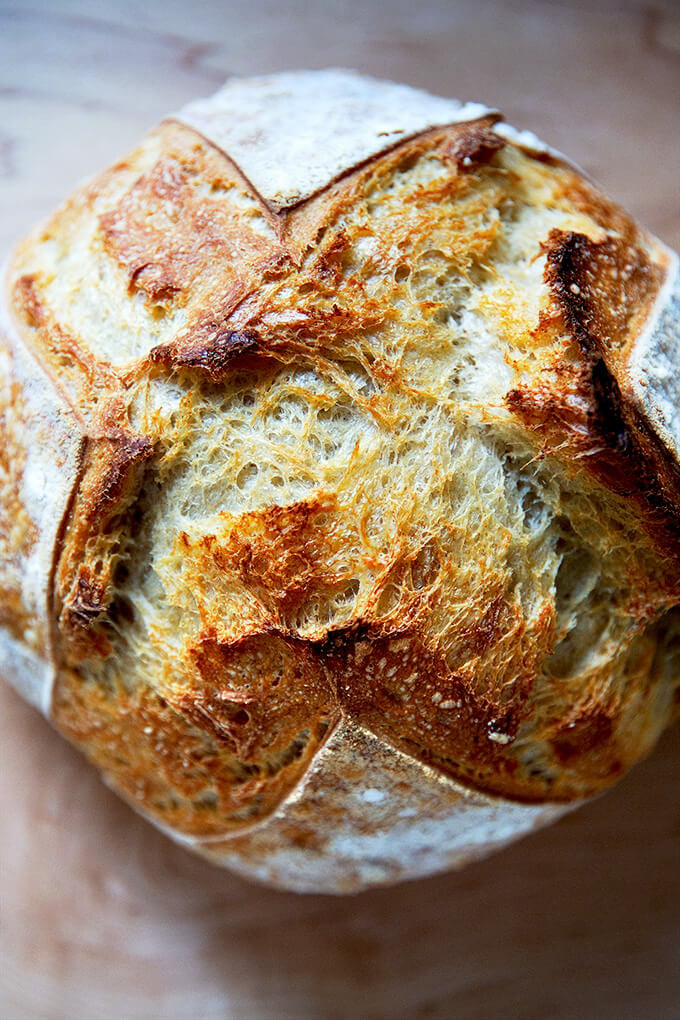
This post will show you how to make the simplest of simple sourdough breads. There is no autolyse or preferment, which means the dough itself comes together in less than five minutes.
For those intimidated by sourdough bread baking, this recipe, as well as this sourdough focaccia recipe, are the recipes I suggest making first, both for their simplicity and flavor. Another great beginner’s bread recipe to try is this overnight, refrigerator focaccia or my mother’s simple peasant bread recipe, both of which require minimal effort but yield spectacular results.
This post is divided into 13 sections:
- What is Sourdough Bread?
- What is a Sourdough Starter?
- How to Feed a Sourdough Starter
- When is My Starter Ready to Be Used?
- Equipment
- How to Make Sourdough Bread: A 5-Step Overview
- How this Sourdough Bread Recipe Differs From Others
- Simple Sourdough Bread: A Step-by-Step Guide
- #1 Sourdough Bread Baking Tip
- Troubleshooting: Where Sourdough Goes Wrong
- Sourdough Baking Resources
- Other Sourdough Bread Recipes to Make
- Sourdough Bread Baking Schedule
What is Sourdough Bread?
Sourdough bread is bread that has been leavened naturally, meaning it has been leavened by a sourdough starter as opposed to by commercial yeast or a chemical leavening agent such as baking powder or baking soda.
What is a Sourdough Starter?
A sourdough starter is a fermented mix of flour and water containing wild yeast and bacteria (lactobacilli). Provided it is healthy and active, a sourdough starter is what will make your bread rise.
You can make a sourdough starter from scratch in just about a week. I only recommend doing so if it currently is summer (or a very warm fall) where you are. While it is immensely satisfying to build a starter from scratch and subsequently use it to make a beautiful loaf of bread, I am a huge proponent of purchasing one for a few reasons, namely: when you purchase a starter, you are guaranteed to have a strong, vigorous starter from the start. In other words, you can start baking with confidence right away.
Here are three online sources for reasonably priced sourdough starters:
How to Feed a Sourdough Starter
In order to keep your starter alive, you have to feed it — it’s not unlike having a pet, but know this: caring for a sourdough starter is akin to caring for a very low maintenance pet, one that requires feeding only once every two to three weeks to stay alive, but one that requires feeding much more regularly if you like to bake frequently.
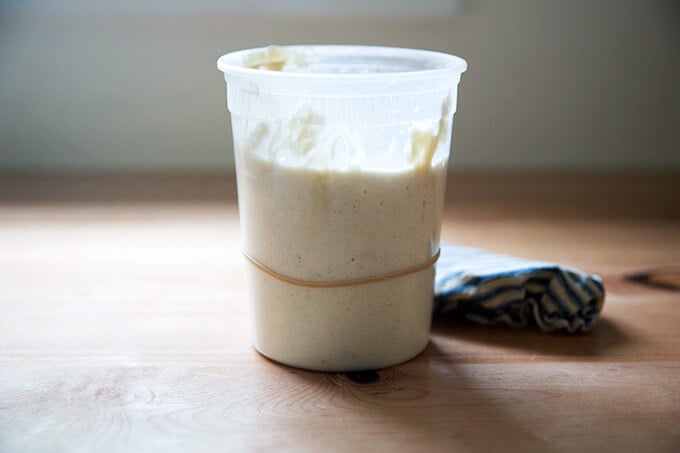
When I am not baking regularly, I store my starter in the fridge in the above-pictured vessel with its lid on. As noted above it can hang out there for 2-3 weeks (if not longer) without being touched. To wake it up or activate it, I like to feed it twice before using it. Often I’ll remove it from the fridge after dinner and feed it: this involves discarding most of it and replenishing it with equal parts by weight flour and water. (Please read this post, which explains in detail how to activate, feed, and maintain a starter.)
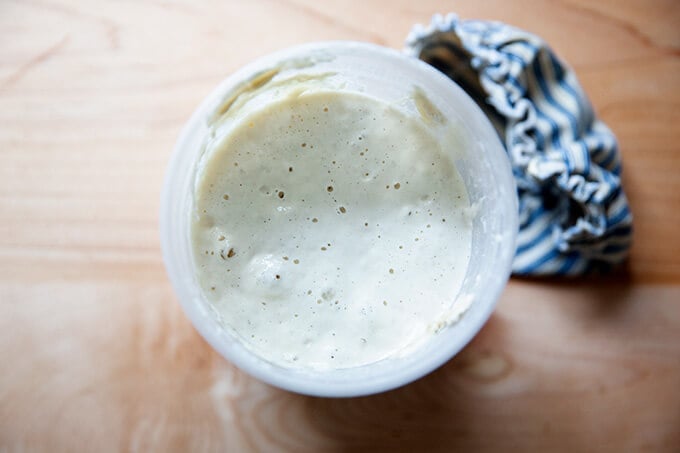
I will repeat this process in the morning — discard most of it; then replenish it with equal parts by weight flour and water. By midday, or when my starter has doubled in volume, it is ready to be used.
To store your starter, you should feed it, let it rise till it nearly doubles; then cover it and stash it in the fridge for 2 to 3 weeks until you are ready to use it again.
How Do I Know if My Starter is Ready to be Used?
If your starter doubles (or triples!) in volume within 4 to 8 hours after a feeding, it is ready to go. And ideally, you want to use your starter 4 to 8 hours after you feed it or when it has doubled. Every time I feed my starter, I place a rubber band around the vessel it is in to mark its height. This helps me see when it has doubled in volume and is, therefore, ready to be used.
If your starter is not doubling within 4 to 8 hours of feeding it, you should spend a few days strengthening it. This will involve discarding most of it — truly, don’t be afraid to be aggressive with how much you are discarding — and replenishing it with equal parts by weight flour and water. If you do this twice a day for several days, your starter will be in great shape.
What Equipment Do I Need?
At a minimum, you’ll need:
- a sourdough starter (see above)
- flour, bread flour if possible, my preference is King Arthur Flour
- salt
- water
Ideally, you’ll also have:
- digital scale
- straight-sided vessel for monitoring the bulk fementation
- bench scraper
- flour sack towels
- parchment paper
- banneton, such as this one or this one
- razor blade
- heavy lidded vessel, such as this one or this one
What is the Best Dutch Oven for Sourdough Bread?
I love my Lodge Pre-Seasoned Cast Iron Double Dutch Oven, which I’ve had for years! The Lodge is a great value at around $49, but if you like the idea of making batards, baguettes and other oblong-shaped loaves, I can’t recommend the Challenger Bread Pan enough, which costs $299. The placement of the handles makes for easy removal and closure of the lid, and it creates beautiful, crusty loaves every time.
How to Make Sourdough Bread: A 5-Step Overview
There are essentially 5 steps to making sourdough bread. Each of these steps is explained in more detail below.
- Mix the Dough: This is simply a matter of combining water, sourdough starter, salt and flour in bowl, and stirring to form a sticky dough ball.
- Bulk Fermentation: This is just a fancy name for the first rise. During the first two hours of the bulk fermentation, you’ll perform a series of stretches and folds, which will give the dough strength and elasticity.
- Shape + Bench Rest: This step ends the bulk fermentation. You’ll shape the dough, let it rest, then shape it once more.
- Proofing the Dough: In this recipe, you’ll cold proof the dough in the fridge, ideally for 24 to 48 hours, though you can get away with a shorter proof.
- Scoring + Baking the Dough: After the dough has proofed, you’ll turn it out onto a piece of parchment paper, score it; then transfer it to a preheated baking vessel.
How This Sourdough Bread Recipe Differs From Others
This recipe differs from others in three main ways:
- No Autolyse. Why? I’ve never found employing an autolyse makes a big difference in the final texture of the bread, and I find the process of doing an autoylse frankly to be kind of a pain. What is an autolyse? Autolyse is a technique that calls for mixing flour and water together and allowing them to sit for several hours before adding the salt and sourdough starter. This process allows gluten to develop in dough prior to mixing. It also makes the dough more extensible. This is due to the hydrating effects of soaking the flour, as well as — and this is getting a bit scientific — from the enzymatic activity of protease, which breaks down some of the gluten that forms as the dough hydrates. This process weakens the dough’s elasticity, in turn increasing its extensibility. If you are after a super open crumb, autolyse is something to consider.
- 50% (roughly) Increase in Volume. If you come from the yeast-leavened bread world, you are accustomed to letting your dough double in volume during the first rise. When I first got into sourdough, I was applying this same method, and while I had success, I realized I was often letting my dough overferment — I was pushing the bulk fermentation too far. As soon as I stopped the bulk fermentation when the dough increased by 50-75% in volume, I got a much better oven spring.
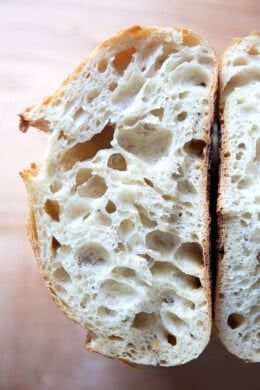
- Long Cold Proof. After the bulk fermentation, you’ll shape the dough, and store it in the fridge ideally for 24 hours but it can hang out there for 48 hours or even a bit longer. This long, cold proof will make for a much lighter, open, airy crumb. (Note: If you were to leave the dough in the fridge for 12 hours or less, which you can do, the crumb will be tighter and denser.) After you remove the dough from the fridge, you score it, and transfer it immediately to the oven — there is no need to do a room temperature proof first.
Simple Sourdough Bread: A Step-by-Step Guide
Mix the dough.
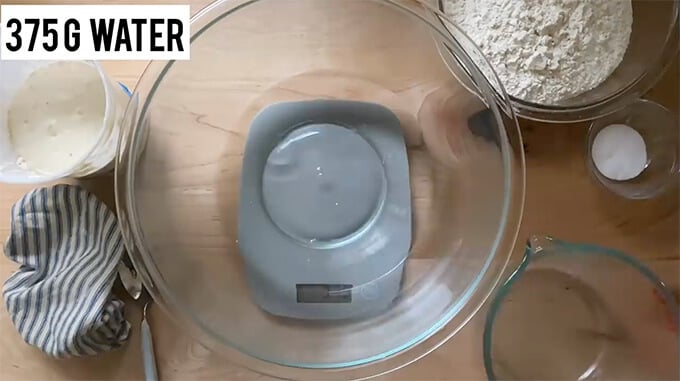
To start, pour 375 grams of water into a bowl:
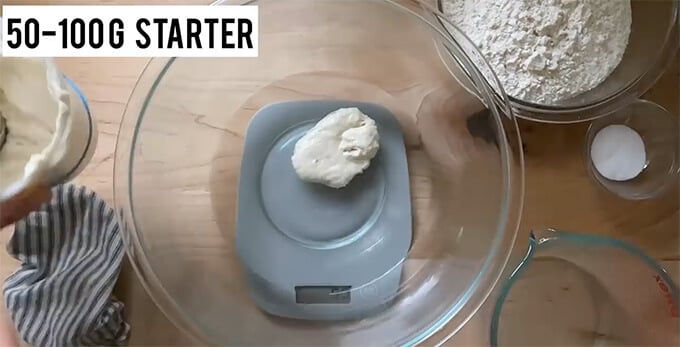
Add 50 to 100 grams of sourdough starter.
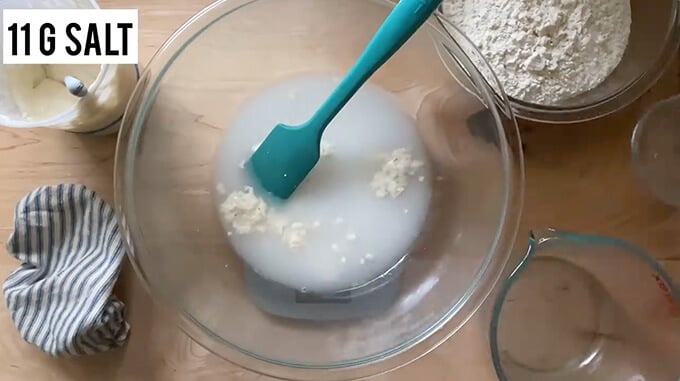
Stir to combine; then add 11 grams of salt:
Finally, add 500 grams of bread flour:
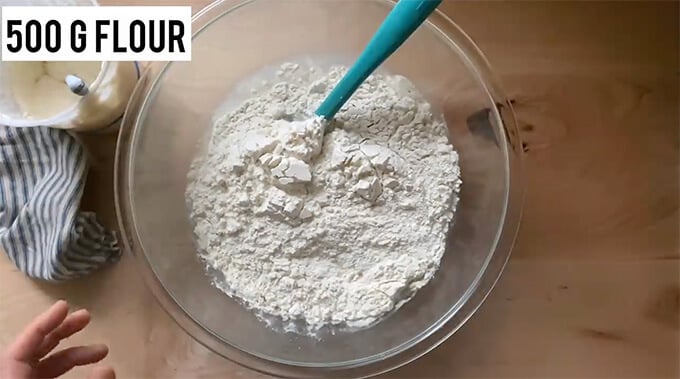
Stir to combine:
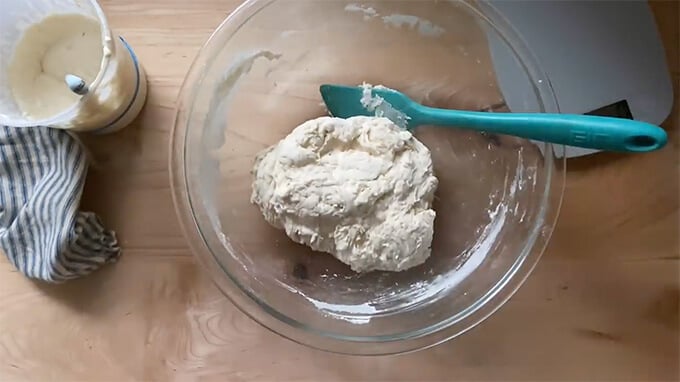
Let it Rise. (Bulk Fermentation)
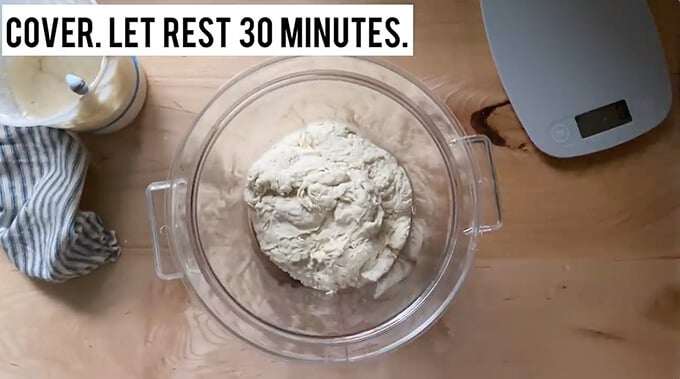
Transfer the dough to a straight-sided vessel. Cover it, and let it rest for 30 minutes.
Perform a set of stretches and folds:
If time permits, perform four total sets of stretches and folds every 30 minutes for the first 2 hours. You should notice the dough getting stronger and more elastic with every set of stretches and folds. This is the 4th set:
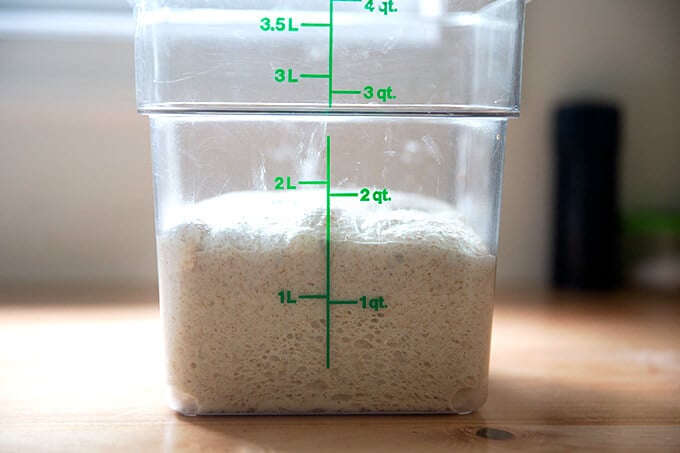
After the 4th set of stretches and folds, cover the vessel, and set it aside until it increases in volume by 50% or so.
How long should the bulk fermentation take?
The time will vary depending primarily on the strength of your starter and the temperature of your kitchen. Rather than rely on a time period, however, you should rely on visual cues.
This video shows the dough nearly doubling (increasing by 100%) in volume, but the more I bake sourdough, the more I realize I have better success when I stop the bulk fermentation when the dough increases by 50%. It may take some trial and error to know what works best for you. You may find a 75% increase in volume is best or you may find that to be too long. Sourdough is all about experimenting and adapting based on your experiences.
Shaping
Turn the dough out onto a lightly floured work surface:
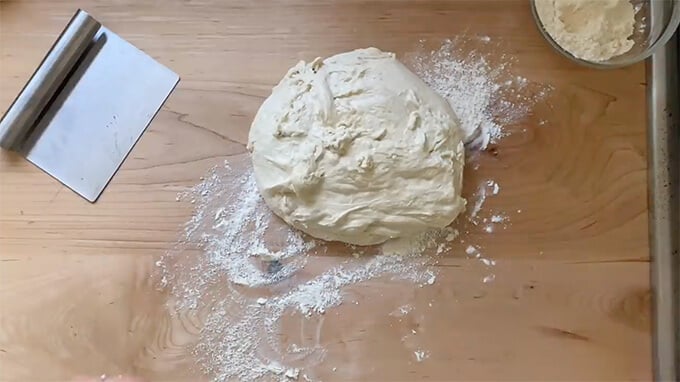
Shape the dough gently into a round and let it rest for 20-40 minutes. This is called the bench rest.
Meanwhile, prepare a bowl or banneton with a flour sack towel and rice flour.
Proofing
Shape the round again; then place in prepared bowl for proofing. Transfer to fridge for 12 to 48 hours.
Bake It.
Remove bowl from fridge, and turn it out onto a sheet of parchment paper.
Score it.
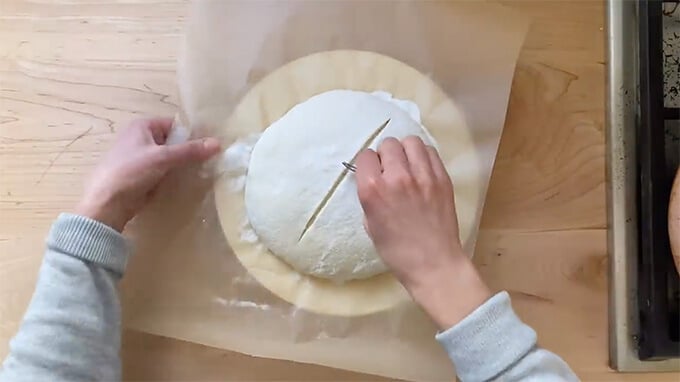
Transfer to preheated Dutch oven. Bake covered at 450ºF for 30 minutes; uncover, lower the temperature to 400ºF, and bake for 15 minutes more:
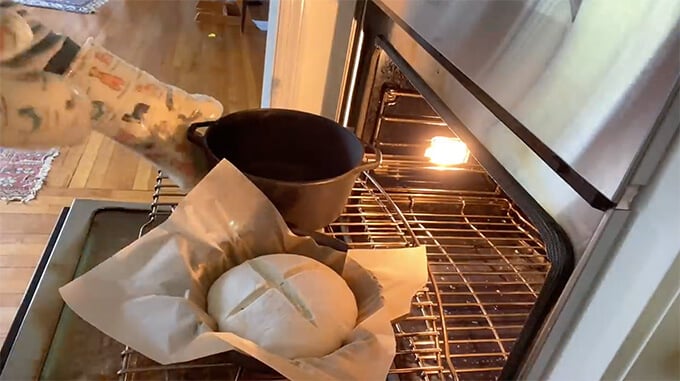
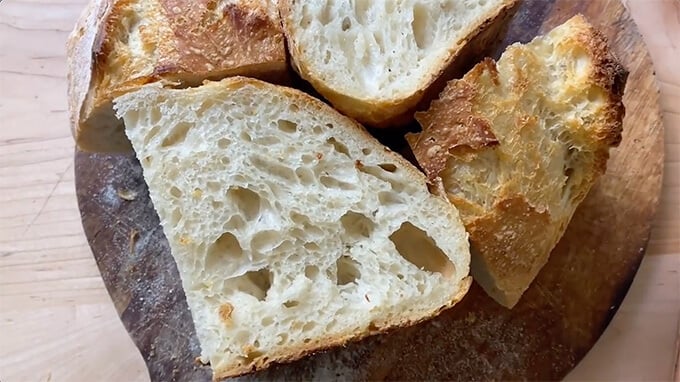
Remove from oven and let cool one hour before slicing.

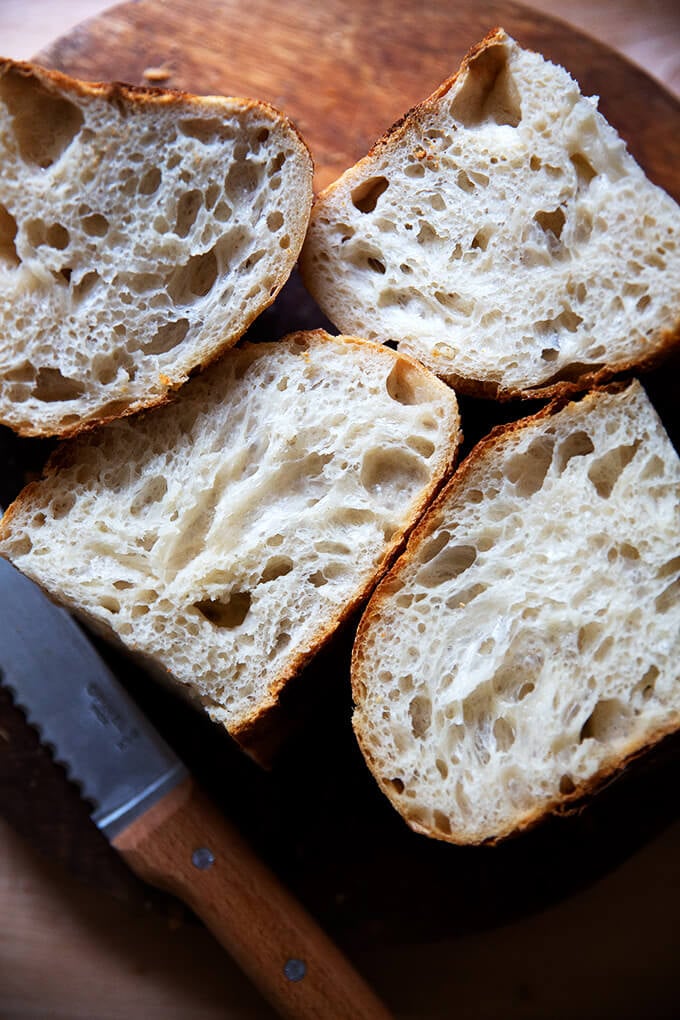
You’ll need a sharp knife (like this one or this one) when it’s time to slice:
#1 Sourdough Bread Baking Tip
The refrigerator is your friend. Use it.
The most common mistake I see people make when making sourdough bread is letting the bulk fermentation go too long. They mix the dough at night; then wake up to dough that has tripled in volume and is a sticky mess.
To prevent over fermenting your dough, use your refrigerator as needed. After you complete the 4 sets of stretches and folds, you can put your dough in the fridge at any time. If you are tired and need to go to bed, transfer the dough to the refrigerator; then pick up where you left off in the morning: remove the dough from the fridge and let it continue to rise until it increases in volume by roughly 50%.
To accurately gauge when your dough has risen to roughly 50% in volume, I highly recommend investing in a straight-sided vessel such as this 4-qt Cambro (or this one, which is BPA-free!). When dough rises in a bowl, judging when it has risen sufficiently is tricky. There’s no question with a straight-sided vessel.
Troubleshooting: Where Sourdough Goes Wrong?
If you have ever had trouble baking sourdough bread, your issues likely stem from one of four places:
- Using a weak starter or not using starter at its peak.
- Using too much water relative to the flour.
- Over fermentation: letting the bulk fermentation (first rise) go too long.
- Using too much whole wheat flour, rye flour, or freshly milled flour.
I address each of these issues in this post: Why is my sourdough so sticky? 4 Common Mistakes, so please give it a read if you’ve had trouble with sourdough bread baking.
Sourdough Resources
- Sourdough Troubleshooting: This post addresses 4 common mistakes people make when baking sourdough bread and answers many FAQ’s as well.
- The Nutritional Benefits of Sourdough Bread + 6 Healthy Toast Topping Ideas
- Feeding Your Sourdough Starter
- Essential Equipment For Sourdough Bread Baking
- A tip for getting a more open crumb? Shape a batard as opposed to a round:
Other Sourdough Bread Recipes to Make
- Simple Sourdough Focaccia
- Sourdough Bread, Whole Wheat-ish
- Simple Sourdough Pizza
- Sourdough Detroit-Style Pizza
- Simple Sourdough Sandwich (or Toasting) Bread
- Sourdough Ciabatta
- Two Sourdough Discard Recipes: Sourdough Flour Tortillas & Irish Soda Bread
Sourdough Bread Baking Schedule
If you are new to sourdough bread baking, the timing of it all may feel overwhelming — you may find yourself asking: How can I do this without baking at midnight?
It’s a very good question! As noted above, your biggest friend when it comes to sourdough bread baking is your refrigerator. If after you’ve performed your stretches and folds, you don’t have time to stay up for the dough to complete the bulk fermentation, stick the vessel in the fridge and pick up where you left off the next day or the day after that.
Here is a rough schedule I like to follow. Adapt it to work for you:
Wednesday Evening: Remove starter from fridge. Feed it by discarding most of it and replenishing it with equal parts by weight flour and water.
Thursday Morning: Feed starter by discarding most of it and replenishing it with equal parts by weight flour and water.
Thursday Afternoon: Mix dough, let it rise. On Thursday evening, when the dough has completed the bulk fermentation, I’ll shape it and stick it in the fridge to proof. (As noted: If the dough hasn’t completed the bulk fermentation, I’ll stick the vessel in the fridge, and pick up where I left off the following day.)
Friday Evening or Saturday Morning: Score and Bake it. There is no need to let the dough come to room temperature before baking it. Simply remove it from the fridge, turn it out, score it, and bake it!
Print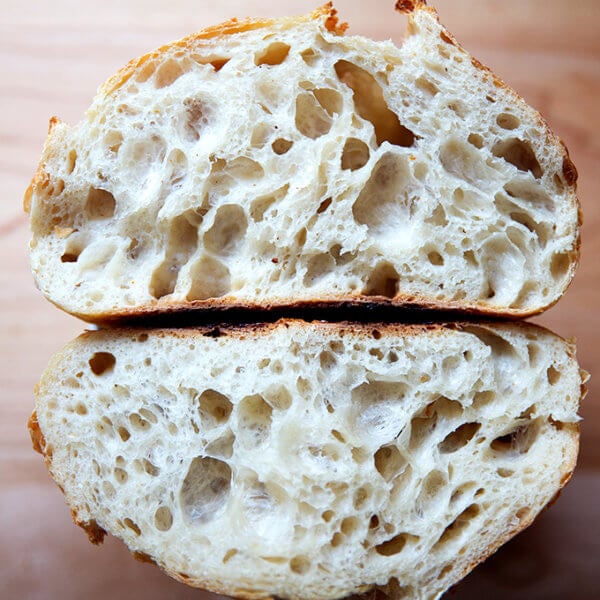
Homemade Sourdough Bread, Step by Step
- Total Time: 18 hours 45 minutes
- Yield: 1 loaf 1x
Description
If you love fresh sourdough bread with a golden, crisp crust and a light, airy crumb, this recipe is for you. It’s one of the simplest homemade sourdough bread recipes, and one of the best, too. It requires only 25 minutes of hands-on work and no autolyse or preferment. Below you will find guidance for every step of the way. 🍞🍞🍞
Inspired by The Clever Carrot
If you are new to sourdough, watch the step-by-step video here: Simple Sourdough Bread or in the post above.
Troubleshooting: If you have issues with your dough being too sticky, please read this post: Why is my sourdough so sticky? The 4 common mistakes.
Notes:
- You need an active sourdough starter. I have had success activating starters from:
- As always, I highly recommend investing in a digital scale before beginning any bread baking adventure.
- This is the Dutch Oven I use for sourdough bread. I used this Dutch oven for years, and it’s a great one, too.
- Flour sack towels are a great investment because they ensure your dough will not stick while it is proofing.
- I love using rice flour for dusting (as opposed to ap or bread flour) because it doesn’t burn. When you use a flour sack towel, however, you don’t need to use any flour.
- Find all of my sourdough essentials here: Essential Equipment For Sourdough Bread Baking
- I love a high-hydration dough, and I have great success using 380 grams of water in this recipe, so feel free to play around and push the hydration here.
- Salt: I have had success using both kosher salt and fine sea salt here. When I use kosher salt, I use the Diamond Crystal brand. When I use sea salt, I use the Baleine Fine brand. Regardless of the brand, I use 12 grams.
- Shaping: If you’re looking to get a more open crumb, try shaping a batard (as opposed to a round). Watch this video for guidance. Also: The recipe below follows the traditional shape once, rest, then shape again method. I often skip the preshape now and simply shape the dough once. I still get a nice open crumb.
- Adding Other Ingredients: If you’d like to add cheese, herbs, jalapeños, or other seasonings, do so before the third set of stretches and folds. Consider adding a fifth set of stretches and folds to ensure the ingredients are evenly incorporated into the dough.
How much Sourdough Starter to Use?
- Because my kitchen is cold for much of the year, I like using 100 g (1/2 cup) of starter as opposed to 50 g (1/4 cup). When determining how much starter to use, consider a few things: If you live in a warm, humid environment, 50 g should suffice. If you plan on doing an overnight rise, 50 g also should suffice. If you want to speed things up or if you live in a cold environment, consider using 100 g starter. Note: If you use 100 g of starter, your dough may rise more quickly, so keep an eye on it. As always, rely on the visual cues (increasing in volume by 50%) when determining when the bulk fermentation is done.
- A straight-sided vessel makes monitoring the bulk fermentation especially easy because it allows you to see when your dough has truly doubled.
Ingredients
- 50 – 100 g (1⁄4 – 1/2 cup) bubbly, active starter — I always use 100 grams, see notes above
- 375 g (1 1/2 cups plus 1 tbsp) warm water, or more, see notes above
- 500 g (4 cups plus 2 tbsp) bread flour
- 9 to 12 g (1.5 – 2.5 teaspoons) fine sea salt, see notes above
Instructions
- Make the dough: Whisk the starter and water together in a large bowl with a fork or spatula. Add the flour and salt. Mix to combine, finishing by hand if necessary to form a rough dough. Cover with a damp towel and let rest for 30 minutes.
- Stretch and fold: After 30 minutes, grab a corner of the dough and pull it up and into the center. Repeat until you’ve performed this series of folds 4 to 5 times with the dough. Let dough rest for another 30 minutes and repeat the stretching and folding action. If you have the time: do this twice more for a total of 4 times in 2 hours. Note: Even if you can only perform one series of stretches and folds, your dough will benefit. So don’t worry if you have to run off shortly after you mix the dough.
- Bulk Fermentation (first rise): Cover the bowl with a towel and let rise at room temperature, about 8 to 10 hours at 70°F (21°C) or even less if you live in a warm environment. The dough is ready when it has increased by 50% in volume, has a few bubbles on the surface, and jiggles when you move the bowl from side to side. (UPDATE: In the past I have recommended letting the dough rise until it doubles in volume. If you’ve had success with this, continue to let the dough double. Recently, I have been stopping the bulk fermentation when the dough increases by 50% in volume, and I feel I am actually getting better oven spring in the end.) (Note regarding timing: If you are using 100 g of starter, the bulk fermentation may take less than 8 to 10 hours. If you live in a warm, humid environment, the bulk fermentation may take even less time. In the late spring/early summer, for example, my kitchen is 78ºF and the bulk fermentation takes 6 hours. It is best to rely on visual cues (increase in volume by roughly 50%) as opposed to time to determine when the bulk fermentation is done. A straight-sided vessel makes monitoring the bulk fermentation especially easy because it allows you to see when your dough has truly increased in volume by 50%.)
- Shape (See notes above): Coax the dough onto a lightly floured surface. Gently shape it into a round: fold the top down to the center, turn the dough, fold the top down to the center, turn the dough; repeat until you’ve come full circle. If you have a bench scraper, use it to push and pull the dough to create tension.
- Rest: Let the dough rest seam side up rest for 30 minutes. Meanwhile, line an 8-inch (20-cm) bowl or proofing basket with a towel (flour sack towels are ideal) and dust with flour (preferably rice flour, which doesn’t burn the way all-purpose flour does). Using a bench scraper or your hands, shape it again as described in step 4. Place the round into your lined bowl, seam side up.
- Proof (second rise): Cover the dough and refrigerate for 1 hour or for as long as 48 hours. (Note: I prefer to let this dough proof for at least 24 hours prior to baking. See video for the difference in the crumb of a loaf that has proofed for 6 hours vs one that has proofed for 24 hours. If you choose to proof the dough in the fridge for an extended period of time, you may want to tuck it into a loosely tied bag — produce bags from the grocery store are great for this purpose — to ensure the dough does not dry out. The original recipe calls for a 1-hour rise, and if you have had success doing that, by all means, keep doing it.)
- Place a Dutch oven in your oven, and preheat your oven to 550°F (290°C). Cut a piece of parchment to fit the size of your baking pot.
- Score: Place the parchment over the dough and invert the bowl to release. Using the tip of a small knife or a razor blade, score the dough however you wish — a simple “X” is nice. Use the parchment to carefully transfer the dough into the preheated baking pot.
- Bake: Lower the oven to temperature to 450ºF (230ºC). Carefully cover the pot. Bake the dough for 30 minutes, covered. Remove the lid, lower the temperature to 400ºF (200ºC) and continue to bake for 10 – 15 minutes more. If necessary, lift the loaf out of the pot, and bake directly on the oven rack for the last 5 to 10 minutes. Cool on a wire rack for 1 hour before slicing.
- This loaf will stay fresh up to 3 days stored at room temperature in an airtight plastic bag or container. It freezes beautifully, too.
Notes
- This recipe has been adapted from Artisan Sourdough Made Simple. Changes I have made to the original recipe include:
- Using 11 g salt as opposed to 9 g.
- Performing 4 stretch and folds during the first 2 hours of the bulk fermentation, which build strength in the dough.
- Doing a cold proof for at least 24 hours before baking, which produces a lighter airier crumb. In the video, you can see the difference between the crumb of a loaf that has proofed for only 6 hours vs a loaf that has proofed for 24 hours.
- Finally, I like preheating my Dutch oven, which makes a crisper crust.
- Prep Time: 18 hours
- Cook Time: 45 minutes
- Category: Bread
- Method: Oven
- Cuisine: American
This post may contain affiliate links. Please read my disclosure policy.















5,723 Comments on “Homemade Sourdough Bread, Step by Step”
Finally 100% success every single time! The recipe and instructions are spot on!!!
Great to hear, Molly! Thanks for writing 🙂
I am so glad I found this recipe after having a couple failed attempts being a newbie to sourdough. I just baked my loaf and it came out perfect!! Thank you for the step-by-step instructions to make this literally fool-proof. I already have another starter getting ready for the next loaf!
Great to hear, Tanya! Thanks so much for writing and sharing this — so encouraging for others 🙂
I’ve made this twice and turned out great. Can I double the recipe?
Great to hear, Christine! Yes, you can double it 🙂
I love using this recipe for plain sourdough and as a base for inclusion loafs! I’ve tried many recipes and they just never seemed to work out just right. This recipe turns out wonderful every time!
Great to hear, Jackie! Thanks so much for writing and sharing this 🙂
I could not make your “Easy Sourdough” work but this recipe was AMAZING
Great to hear, Della!
Hi! First-timer here, and this feels a bit overwhelming—so I may be overthinking things. I’m hoping for some guidance. I started my sourdough starter on Friday at 5:30 p.m. and I’m using the counter method, feeding it every 24 hours for 7-8 days.
If I feed it again the following Friday at 5:30 p.m., I’d like to begin preparing the dough on Saturday and then refrigerate it for 24 hours (based on your recommendation), which would mean baking on Sunday. My confusion is around timing: what time can I feed the starter on Saturday if it won’t be exactly at the 24-hour mark? I want to be able to have it bulk ferment and then shape it before placing in fridge for 24 hours.
Ideally, I’d like to prep the dough and refrigerate it for 24 hours, but that seems to push baking to around 10 p.m. on Sunday, which is pretty late and not ideal. What would you recommend I do?
Hi! Can you first tell me how you are feeding your starter so I get an understanding of your process there?
Regardless, you could try feeding your starter Thursday night, letting it rise overnight, and feeding it again Friday morning. Then by Friday midday or mid afternoon, you would be ready to mix your dough. If at any time during the bulk fermentation, you need to go to be, just stick your vat of dough in the fridge and pick up on Saturday where you left off. Finish the bulk fermentation on Saturday, shape your loaf and get it into the fridge. Bake it the following day, ideally at least 18 hours later, or the following day — the shaped loaf can stay in the fridge for 48 hours.
Hi, I am feeding it1:1:1 (50 g starter/flour/water). I, unfortunately, am using bleached as I wasn’t aware about unbleached flour…but it honestly seems to be doing great, rises and bubbles just fine.
Thanks so much for your reply! So it seems like I don’t actually have to feed it every 24 hours, it could be earlier or later based on my needs. Appreciate it!
Hi! You might want to try a 1:2:2 ratio with your feedings. I think you will find unbleached flour gets you even better results, but it’s great to hear about your success already using the flour you have on hand.
Thanks, I did 1:2:2 yesterday since it’s very runny. Can I switch to unbleached flour since I already began with bleached…or will it cause disruption? Wondering if I need to start over by just using unbleached
You can definitely switch to unbleached flour!
Why do you leave the pre-shaped loaf seam side up instead of seam side down? Thanks!
Just my process! I keep the smooth side down for the bench rest. Then when I shape it again, the smooth side is already down so I can get straight to shaping it.
I used this recipe as my first go with my sourdough starter and it came out great. The instructions are easy to follow and takes a lot of the well-intended-but-ultimately-overwhelming advice/noise out of it all.
I will continue to use it as a starting off recipe for sourdoughs to follow!
So nice to read this, Kaitlyn! Thanks so much for writing and sharing your experience. So glad your sourdough journey is off to such a positive start — very encouraging for others 🙂
LOVE- Thank you! I never leave reviews, but this recipe is amazing. I have had many artisan sour dough loaves and this is by far better! I accidently skipped the bench rest and it still turned out delicious after 8 hours in the fridge. On the second time I made three loaves at once (one kitchen clean up) and baked off one the next day to give to a coworker. Will bake the other two loaves over the next two days.
Great to hear, Leanne! Thanks so much for writing and sharing this. I often skip the bench rest when I am pressed for time, and I don’t find it makes a big different. Enjoy your loaves!!
Hello
I have tried this recipe so many times and the dough does not retain the shape…. It just turns into a flat blob. I am using king arthur bread flour. That is the only difference between your recipe and mine.
The bread tastes good, but I am having an impossible time to get it as crusty and hold its shape.
Thoughts?
Do you use a scale to measure? Do you live in a humid environment? Do you use a straight-sided vessel for the bulk fermentation?
Hi!
I have used this recipe so many times and I LOVE it! Thank you!
I do have a question about pausing bulk fermentation in the fridge. When I bring it out of the fridge in the am and let it finish rising until I see an increase of 50-75% I will shape it like usual. My question is if I should still refrigerate for 24-48 hours once shaped even if I paused bulk fermentation in the fridge over night?
Great to hear! And yes, ideally you should 🙂 The cold fermentation of the shaped loaf really helps make for a lighter crumb and loftier loaf.
My oven doesn’t reach 290°. Only 250° Fan forced. What would you recommend adjustments to be?
250ºF will be fine! Just be sure to preheat your Dutch oven sufficiently — I shoot for 30 minutes.
Thank you, temperature is 250°C not Fahrenheit. Is this ok?
My bad! I meant to write 250ºC… that’s roughly 480ºF, which is plenty hot for preheating the pot. You’ll lower the temperature to 230ºC once you put your dough in the pot. Good luck with it!
Do you only start measuring the percentage of rise after the stretch and folds are done? My plan was to keep the dough in a bowl until the series of folds were done, and then transfer to a straight-sided container to measure the rise. I know that means I’m not accounting for any rise during those first two hours though. Thanks for laying things in such a straightforward manner, it really helps boost the confidence of us sourdough newbies. I’ll report back with a rating once I’ve tried it!
Hi Eric, yes I start monitoring the growth after I transfer the dough to the straight-sided vessel. You won’t see much growth in the first two hours during those 4 sets of stretches and folds. Good luck with it! Let me know if there is anything else 🙂
I just started ,my dough is in the fridge, I made one mistake, I add 150 starter, unsure what my dough will look like in 24 hours, i will update you once i finish bake it, as for now I had lots of fun, i will wait and see the finish product
Should be fine! Just push on. Good luck with it 🙂
I am newer to sourdough. I’ve been trying to perfect my sourdough for months. It finally happened! I love this recipe and really worked for me. Thank you!
Great to hear, Kristina! Thanks so much for writing and sharing this 🙂
Love this recipe, have made my first two loaves following this and they’ve turned out beautifully. If I want to make two smaller loaves, would I just cut in half, and bake for a shorter amount of time? What would be the best way for this?
Great to hear, Shea! Yes, divide the dough in half after the bulk fermentation, then proceed as usual with the recipe. When it’s time to bake, reduce the baking time at each phase (covered and uncovered) by 5 minutes, but ultimately keep the loaf in the oven until it is browned to your liking.
I did not know it took 3 days to make sourdough bread. Difficult to follow steps when I work 45 hrs/week. I was not successful.
I work the same hours, what I do is feed my starter in the morning, get home an make the dough and get other stuff done in between the folding and then bake the next day when I get home from work!
Thanks for this, Shea! It’s really encouraging for others to hear that sourdough can be worked into a busy schedule. What I love about this recipe especially for busy people, is that the shaped loaf can be stashed in the fridge for 2 days and then baked on demand — in some ways it’s easier than yeasted breads in that sense.
Denise: just know that you can use your fridge at any step of the process. If during the bulk fermentation you need to leave or go to bed, just stick your dough vessel (covered) in the fridge and pick up when you have time.
I love this recipe! I have been using it for quite a while now and my family is obsessed! I wanted to ask though, have you tried to bake it in a loaf pan with another pan on top rather than a Dutch oven? If so, would I use the same amount from the recipe and can I let it proof in the loaf pan/let sit in it in fridge too?
Hi Caterina! Great to hear. I have not tried this method. Question for you first: are you simply trying to make a loaf of sourdough sandwich bread?
I wanted to see id it would come out the same (cook time and such) in that shape. I have used other recipes with that pan method and find it cuts easier for me but your recipe is my favorite so I’m trying to make it work. I planned to give it a try this weekend but figured I’d ask you as well! Is there another recipe you may use for sandwich bread, that may better suit it?
Got it! I like a higher hydration dough for sandwich bread, so this is the one I would recommend: Easy Sourdough Sandwich Bread
I’m sure your method would work fine with this recipe, but I guess I worry about it being a little heavy/dense if it’s not baked in a preheated vessel. But I’ve never tried, so give it a go if you’ve had success with the method!
This has become my go-to sourdough recipe! Come out perfect every time.
Great to hear, Patty! Thanks so much for writing 🙂
Hi, I love this recipe and your instructions are great. I followed the recipe closely and it produced a beautiful boule. However, the crust is tough and chewy instead of crunchy. I am new to this. Any suggestions?
Hi! Questions:
Are you using a scale to measure?
What type of flour are you using?
What baking vessel?
Thanks for your reply. I am using a scale to measure. My flour is King Arthur unbleached bread flour and I’m baking in an enameled cast iron Dutch oven.
OK, great. It sounds as though you’re doing everything right. Are you new to sourdough? Did the loaf get nice and lofty during the bake? My next suggestions really pertain to practice: making sure your starter is strong and healthy — it should be doubling in volume within 6 hours of feeding it; using a straight-sided vessel for the bulk fermentation to ensure you are not over-fermenting your dough; cold proofing for at least 24 hours before baking.
As a seasoned baker and cook I tried making sourdough bread and after several failed attempts I was about to give up and decided to try one more time following your recipe and directions to a tee and finally PERFECTION! It came out great. Thank you so much for the step-by-step it really helped me get it right FINALLY!!!
Great to read this, Mary! Thanks so much for writing and sharing. I’m so happy to hear about your success 🙂
This recipe is amazing! I had never made sourdough before and every loaf I have made using this recipe has turned out great! Thank you so much for sharing!
Great to hear, Kelly! Thanks so much for writing and sharing this 🙂
This is the best recipe I have found, especially since it is so concise and has video snippets of each step so you know what the dough and the bread are supposed to look like. totally new to this after being gifted some starter. I’ve got my third loaf following these directions in the oven now.
It’s so nice to read this, Lisa! Thanks so much for taking the time to write and share this 🙂
Made this once and it was amazing!! Going to try again but I wanted to know about feeding my starter prior to making. How many hours should it be between feeding and starting the recipe? If I feed my starter early in the week, can I still make the recipe later in the week or should I do another feed night before starting?
Hi Deanna,
You should be feeding your starter about 6 hours before you plan on using it — during those 6 hours it should double in volume; if it doesn’t, you may need to spend a few days strengthening it. I like to feed my starter at night before bed and let it rise over night during which time it will more than double and be on the verge of collapse; then I feed it again in the morning, let it rise another 6 hours or until it doubles; then I use it.
My go to sourdough! I have used this recipe countless times and this is the recipe I forward to friends when I share my starter.
Great to hear, Lynne! Thanks so much for writing and sharing this. Thanks for spreading the sourdough recipe love, too 🙂
I am new to sourdough and find your website is the most helpful for me. I have tried other methods but always come back to yours. I have a question. I would like to make 2 loaves of sourdough. Should I just double the recipe? Or make it in 2 separate batches? Is there any hint you can give me for doing this? I get so nervous when I deviate from your very clear instructions! 😳
It’s so nice to read this, Nancy. Thank you 🙂 You can definitely double the recipe — no need to make two separate batches; just split the dough in half after the bulk fermentation. Ideally you are using a scale to measure. Good luck with it!
Last week I baked a brick. Your recipe was my last shot. I told myself if yours didn’t work, I was throwing out the starter and giving up.
IT WORKED! My husband and I ate 3/4 of the loaf that day. My second loaf is in the oven right now! Thank you!
Hooray! I’m so happy to read this, Jessica. Thanks so much for writing and sharing this. Sourdough is a journey! Glad you’ve found a promising path 🙂
Hi, I’m not sure why I can’t find it (because I thought I had read it somewhere on your site), I love this recipe, but was wondering if you had suggestions for when using all purpose flour for this recipe. Should I change the amount of water? Thank you!!
If you live in a humid environment, you could consider using slightly less water. Otherwise, I would just as soon keep the recipe the same. The dough might be slightly wetter when made with all-purpose flour, but it shouldn’t be unmanageable.
I’m not a big reviewer, but this was the recipe that finally worked for me! Thank you so much 🤍
Great to hear, Elizabeth! Thanks so much for writing and sharing this 🙂
Hi Alexandra!! I’m trying sourdough again. After a long list of failures, I came across your recipe. Well, it just came out of the oven and if it tastes as good as it looks, I finally have success. Thank you so much. Bernie
Awww, so nice to hear this, Bernie! I hope the taste matched the beauty! Thanks so much for writing and sharing this.
I questioned myself and my dough throughout the entire process until it came out of the oven. So I must say, trust the process. It was my first time making this and I had incredible results.
Great to hear, Sarah! Thanks so much for writing and sharing this 🙂