 →
→ 

Homemade Sourdough Bread, Step by Step
 By Alexandra Stafford
—
Last Updated: 07/30/2025
By Alexandra Stafford
—
Last Updated: 07/30/2025
This post may contain affiliate links. Please read my disclosure policy.
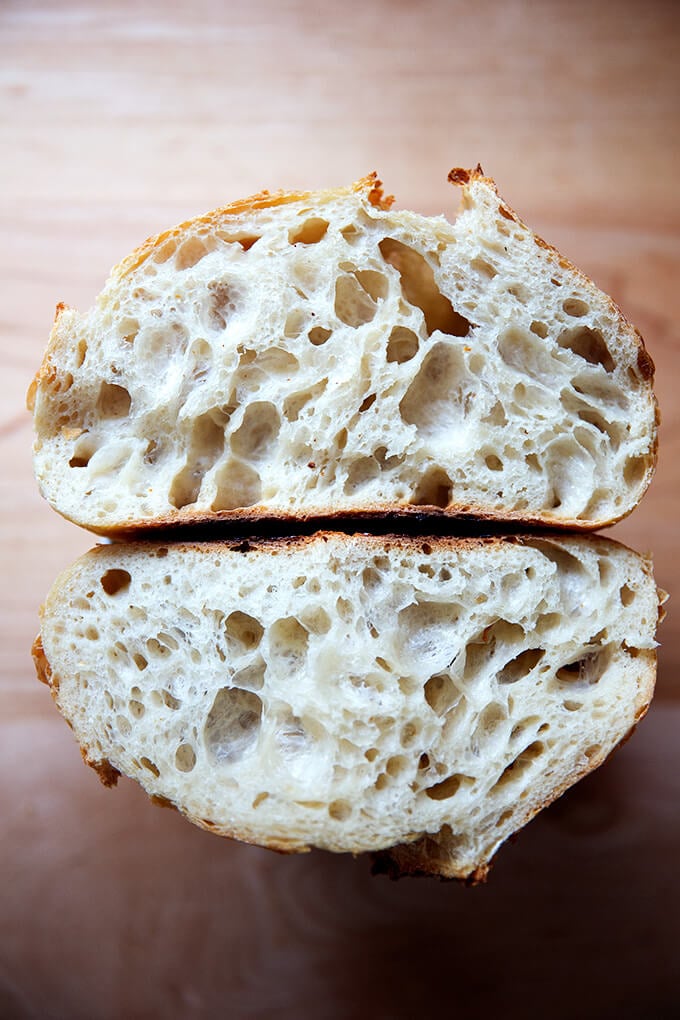
If you love fresh sourdough bread with a golden, crisp crust and a light, airy crumb, this recipe is for you. It’s one of the simplest homemade sourdough bread recipes, and one of the best, too. It requires only 25 minutes of hands-on work and no autolyse or preferment. Below you will find guidance for every step of the way. 🍞🍞🍞
⭐️⭐️⭐️⭐️⭐️ Review:
“Absolutely the best sourdough recipe EVER! I have been baking bread for years (sourdough included,) and things were many times hit or miss. Not with your recipe. You have nailed it. I thank you!” — Rosemary Patterson
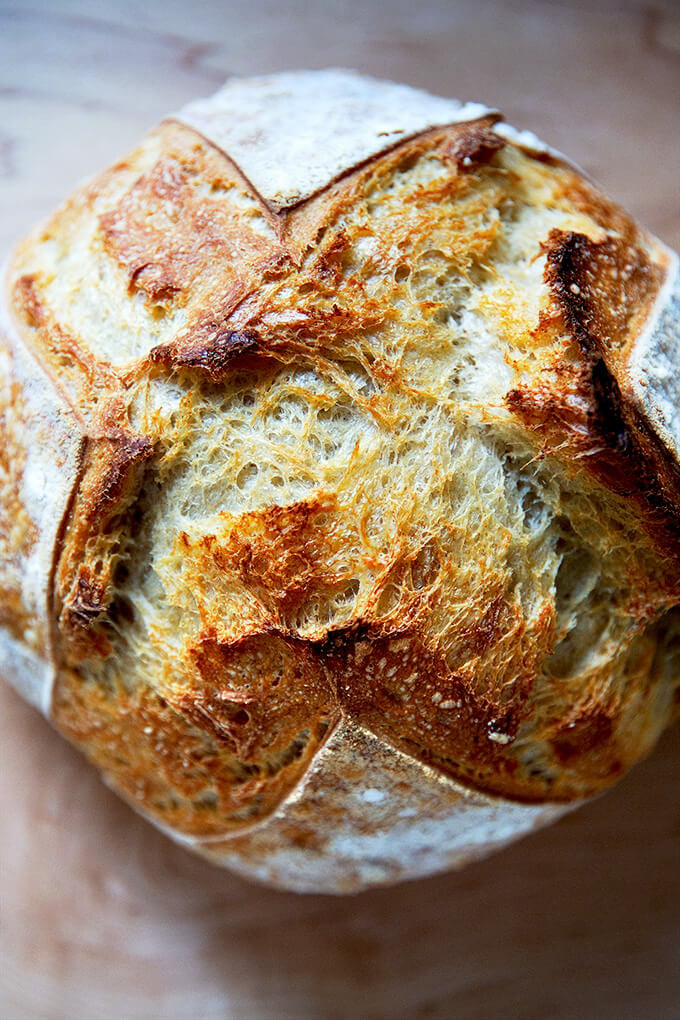
This post will show you how to make the simplest of simple sourdough breads. There is no autolyse or preferment, which means the dough itself comes together in less than five minutes.
For those intimidated by sourdough bread baking, this recipe, as well as this sourdough focaccia recipe, are the recipes I suggest making first, both for their simplicity and flavor. Another great beginner’s bread recipe to try is this overnight, refrigerator focaccia or my mother’s simple peasant bread recipe, both of which require minimal effort but yield spectacular results.
This post is divided into 13 sections:
- What is Sourdough Bread?
- What is a Sourdough Starter?
- How to Feed a Sourdough Starter
- When is My Starter Ready to Be Used?
- Equipment
- How to Make Sourdough Bread: A 5-Step Overview
- How this Sourdough Bread Recipe Differs From Others
- Simple Sourdough Bread: A Step-by-Step Guide
- #1 Sourdough Bread Baking Tip
- Troubleshooting: Where Sourdough Goes Wrong
- Sourdough Baking Resources
- Other Sourdough Bread Recipes to Make
- Sourdough Bread Baking Schedule
What is Sourdough Bread?
Sourdough bread is bread that has been leavened naturally, meaning it has been leavened by a sourdough starter as opposed to by commercial yeast or a chemical leavening agent such as baking powder or baking soda.
What is a Sourdough Starter?
A sourdough starter is a fermented mix of flour and water containing wild yeast and bacteria (lactobacilli). Provided it is healthy and active, a sourdough starter is what will make your bread rise.
You can make a sourdough starter from scratch in just about a week. I only recommend doing so if it currently is summer (or a very warm fall) where you are. While it is immensely satisfying to build a starter from scratch and subsequently use it to make a beautiful loaf of bread, I am a huge proponent of purchasing one for a few reasons, namely: when you purchase a starter, you are guaranteed to have a strong, vigorous starter from the start. In other words, you can start baking with confidence right away.
Here are three online sources for reasonably priced sourdough starters:
How to Feed a Sourdough Starter
In order to keep your starter alive, you have to feed it — it’s not unlike having a pet, but know this: caring for a sourdough starter is akin to caring for a very low maintenance pet, one that requires feeding only once every two to three weeks to stay alive, but one that requires feeding much more regularly if you like to bake frequently.
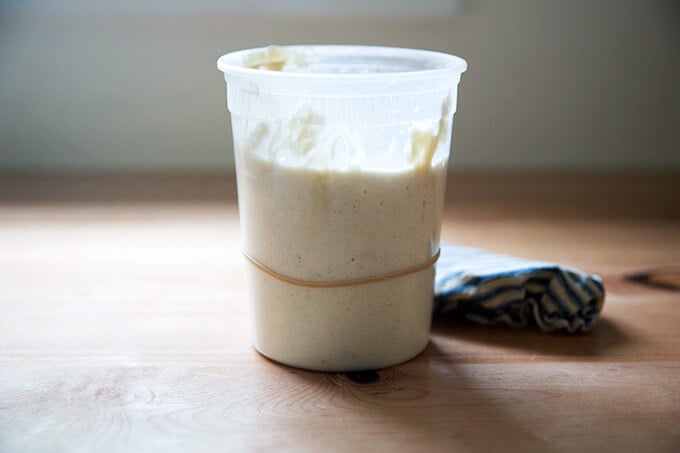
When I am not baking regularly, I store my starter in the fridge in the above-pictured vessel with its lid on. As noted above it can hang out there for 2-3 weeks (if not longer) without being touched. To wake it up or activate it, I like to feed it twice before using it. Often I’ll remove it from the fridge after dinner and feed it: this involves discarding most of it and replenishing it with equal parts by weight flour and water. (Please read this post, which explains in detail how to activate, feed, and maintain a starter.)
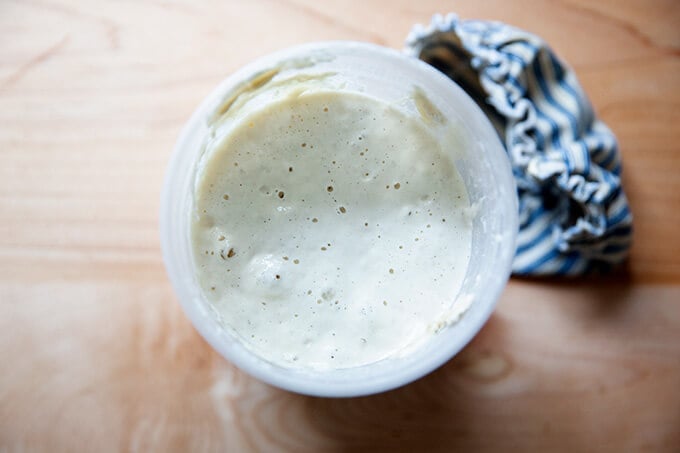
I will repeat this process in the morning — discard most of it; then replenish it with equal parts by weight flour and water. By midday, or when my starter has doubled in volume, it is ready to be used.
To store your starter, you should feed it, let it rise till it nearly doubles; then cover it and stash it in the fridge for 2 to 3 weeks until you are ready to use it again.
How Do I Know if My Starter is Ready to be Used?
If your starter doubles (or triples!) in volume within 4 to 8 hours after a feeding, it is ready to go. And ideally, you want to use your starter 4 to 8 hours after you feed it or when it has doubled. Every time I feed my starter, I place a rubber band around the vessel it is in to mark its height. This helps me see when it has doubled in volume and is, therefore, ready to be used.
If your starter is not doubling within 4 to 8 hours of feeding it, you should spend a few days strengthening it. This will involve discarding most of it — truly, don’t be afraid to be aggressive with how much you are discarding — and replenishing it with equal parts by weight flour and water. If you do this twice a day for several days, your starter will be in great shape.
What Equipment Do I Need?
At a minimum, you’ll need:
- a sourdough starter (see above)
- flour, bread flour if possible, my preference is King Arthur Flour
- salt
- water
Ideally, you’ll also have:
- digital scale
- straight-sided vessel for monitoring the bulk fementation
- bench scraper
- flour sack towels
- parchment paper
- banneton, such as this one or this one
- razor blade
- heavy lidded vessel, such as this one or this one
What is the Best Dutch Oven for Sourdough Bread?
I love my Lodge Pre-Seasoned Cast Iron Double Dutch Oven, which I’ve had for years! The Lodge is a great value at around $49, but if you like the idea of making batards, baguettes and other oblong-shaped loaves, I can’t recommend the Challenger Bread Pan enough, which costs $299. The placement of the handles makes for easy removal and closure of the lid, and it creates beautiful, crusty loaves every time.
How to Make Sourdough Bread: A 5-Step Overview
There are essentially 5 steps to making sourdough bread. Each of these steps is explained in more detail below.
- Mix the Dough: This is simply a matter of combining water, sourdough starter, salt and flour in bowl, and stirring to form a sticky dough ball.
- Bulk Fermentation: This is just a fancy name for the first rise. During the first two hours of the bulk fermentation, you’ll perform a series of stretches and folds, which will give the dough strength and elasticity.
- Shape + Bench Rest: This step ends the bulk fermentation. You’ll shape the dough, let it rest, then shape it once more.
- Proofing the Dough: In this recipe, you’ll cold proof the dough in the fridge, ideally for 24 to 48 hours, though you can get away with a shorter proof.
- Scoring + Baking the Dough: After the dough has proofed, you’ll turn it out onto a piece of parchment paper, score it; then transfer it to a preheated baking vessel.
How This Sourdough Bread Recipe Differs From Others
This recipe differs from others in three main ways:
- No Autolyse. Why? I’ve never found employing an autolyse makes a big difference in the final texture of the bread, and I find the process of doing an autoylse frankly to be kind of a pain. What is an autolyse? Autolyse is a technique that calls for mixing flour and water together and allowing them to sit for several hours before adding the salt and sourdough starter. This process allows gluten to develop in dough prior to mixing. It also makes the dough more extensible. This is due to the hydrating effects of soaking the flour, as well as — and this is getting a bit scientific — from the enzymatic activity of protease, which breaks down some of the gluten that forms as the dough hydrates. This process weakens the dough’s elasticity, in turn increasing its extensibility. If you are after a super open crumb, autolyse is something to consider.
- 50% (roughly) Increase in Volume. If you come from the yeast-leavened bread world, you are accustomed to letting your dough double in volume during the first rise. When I first got into sourdough, I was applying this same method, and while I had success, I realized I was often letting my dough overferment — I was pushing the bulk fermentation too far. As soon as I stopped the bulk fermentation when the dough increased by 50-75% in volume, I got a much better oven spring.
- Long Cold Proof. After the bulk fermentation, you’ll shape the dough, and store it in the fridge ideally for 24 hours but it can hang out there for 48 hours or even a bit longer. This long, cold proof will make for a much lighter, open, airy crumb. (Note: If you were to leave the dough in the fridge for 12 hours or less, which you can do, the crumb will be tighter and denser.) After you remove the dough from the fridge, you score it, and transfer it immediately to the oven — there is no need to do a room temperature proof first.
Simple Sourdough Bread: A Step-by-Step Guide
Mix the dough.
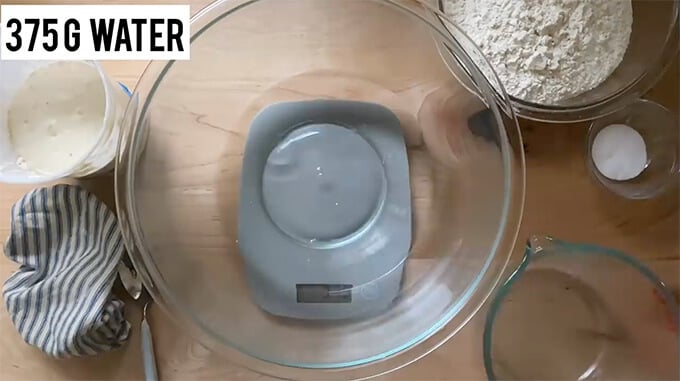
To start, pour 375 grams of water into a bowl:
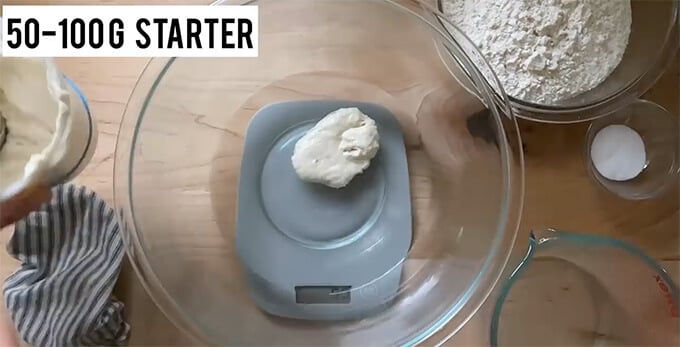
Add 50 to 100 grams of sourdough starter.
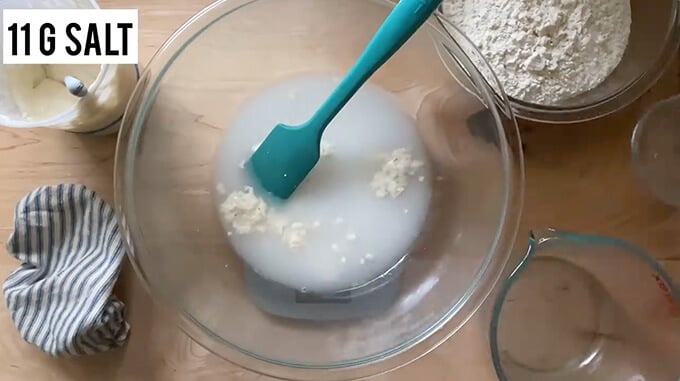
Stir to combine; then add 11 grams of salt:
Finally, add 500 grams of bread flour:
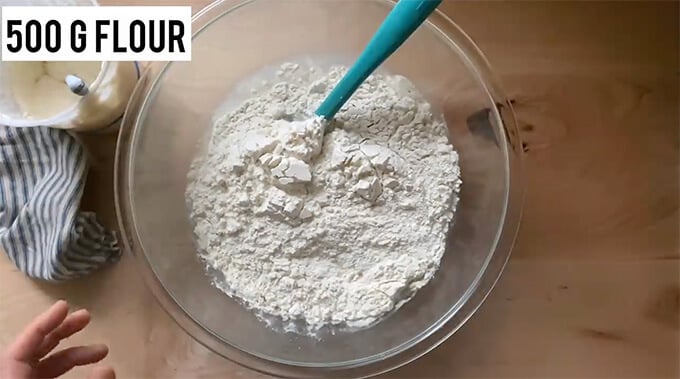
Stir to combine:
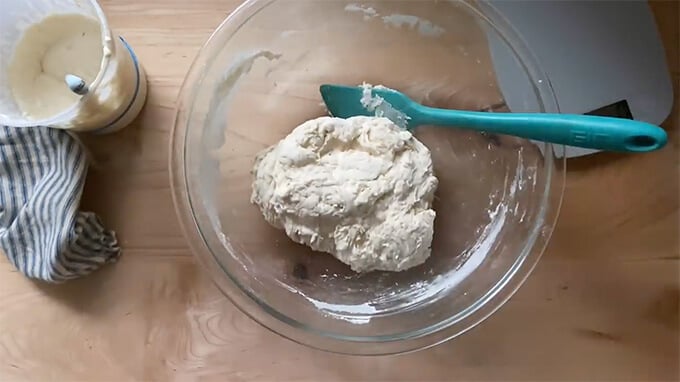
Let it Rise. (Bulk Fermentation)
Transfer the dough to a straight-sided vessel. Cover it, and let it rest for 30 minutes.
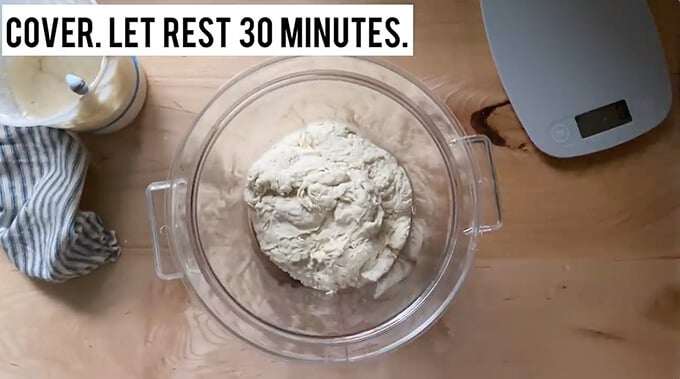
Perform a set of stretches and folds:
If time permits, perform four total sets of stretches and folds every 30 minutes for the first 2 hours. You should notice the dough getting stronger and more elastic with every set of stretches and folds. This is the 4th set:
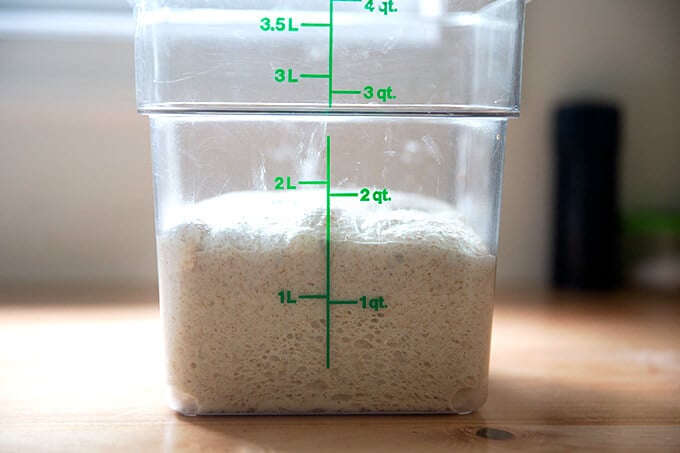
After the 4th set of stretches and folds, cover the vessel, and set it aside until it increases in volume by 50% or so.
How long should the bulk fermentation take?
The time will vary depending primarily on the strength of your starter and the temperature of your kitchen. Rather than rely on a time period, however, you should rely on visual cues.
This video shows the dough nearly doubling (increasing by 100%) in volume, but the more I bake sourdough, the more I realize I have better success when I stop the bulk fermentation when the dough increases by 50%. It may take some trial and error to know what works best for you. You may find a 75% increase in volume is best or you may find that to be too long. Sourdough is all about experimenting and adapting based on your experiences.
Shaping
Turn the dough out onto a lightly floured work surface:
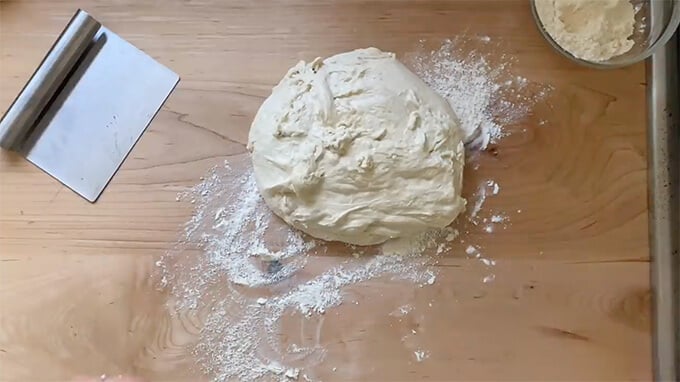
Shape the dough gently into a round and let it rest for 20-40 minutes. This is called the bench rest.
Meanwhile, prepare a bowl or banneton with a flour sack towel and rice flour.
Proofing
Shape the round again; then place in prepared bowl for proofing. Transfer to fridge for 12 to 48 hours.
Bake It.
Remove bowl from fridge, and turn it out onto a sheet of parchment paper.
Score it.
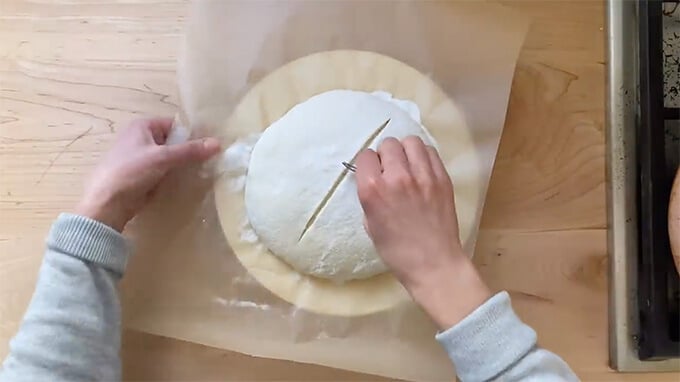
Transfer to preheated Dutch oven. Bake covered at 450ºF for 30 minutes; uncover, lower the temperature to 400ºF, and bake for 15 minutes more:
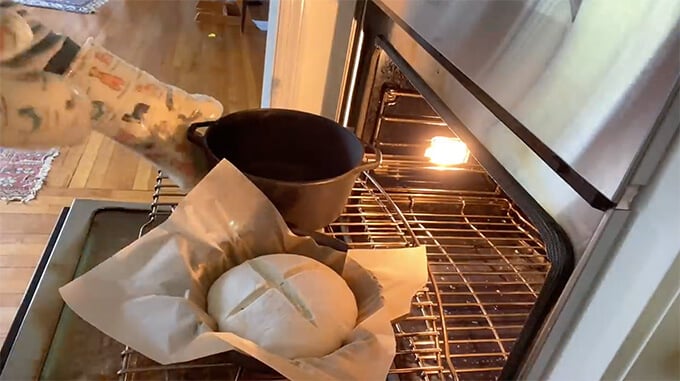
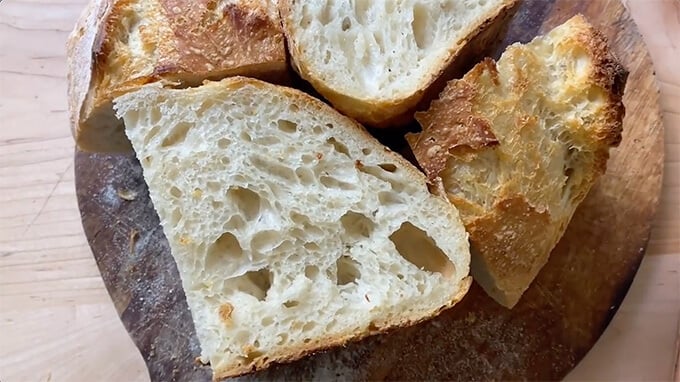
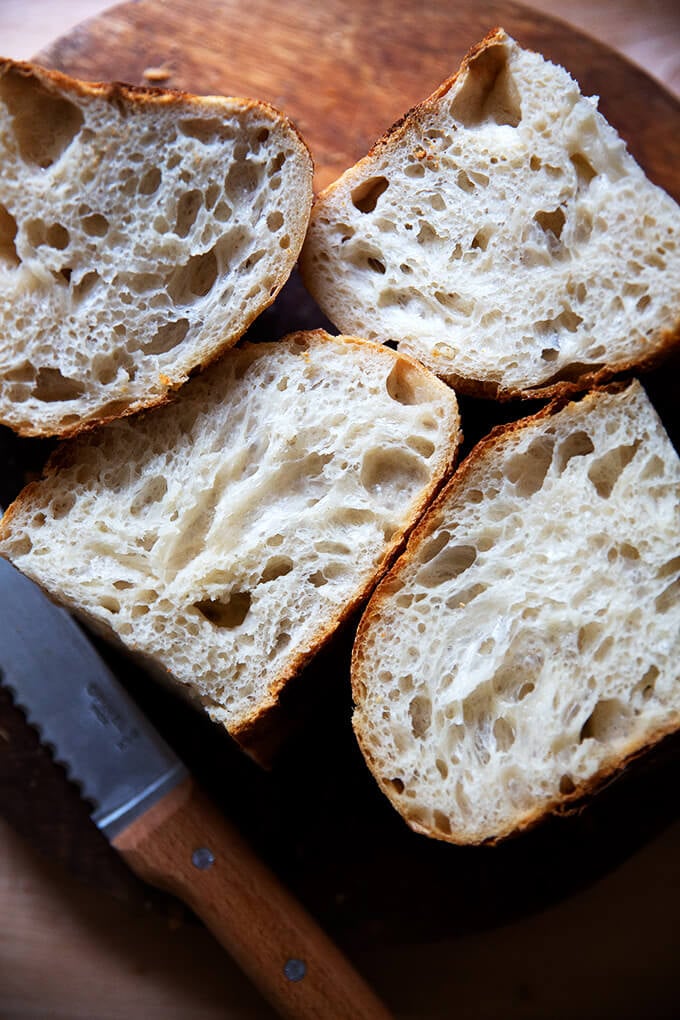
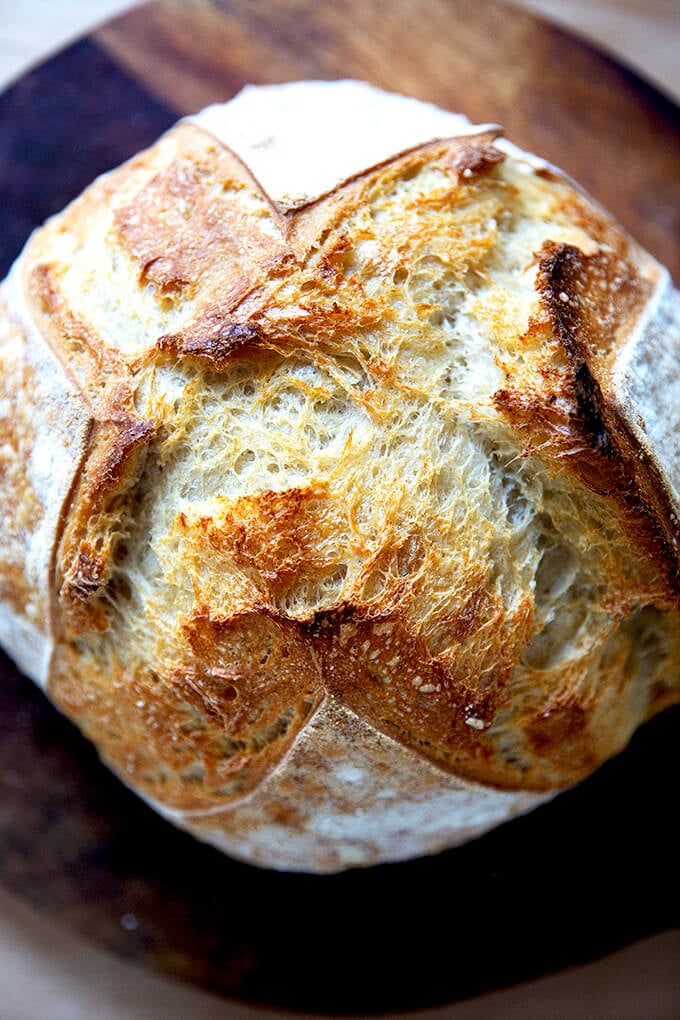
Remove from oven and let cool one hour before slicing.

You’ll need a sharp knife (like this one or this one) when it’s time to slice:
#1 Sourdough Bread Baking Tip
The refrigerator is your friend. Use it.
The most common mistake I see people make when making sourdough bread is letting the bulk fermentation go too long. They mix the dough at night; then wake up to dough that has tripled in volume and is a sticky mess.
To prevent over fermenting your dough, use your refrigerator as needed. After you complete the 4 sets of stretches and folds, you can put your dough in the fridge at any time. If you are tired and need to go to bed, transfer the dough to the refrigerator; then pick up where you left off in the morning: remove the dough from the fridge and let it continue to rise until it increases in volume by roughly 50%.
To accurately gauge when your dough has risen to roughly 50% in volume, I highly recommend investing in a straight-sided vessel such as this 4-qt Cambro (or this one, which is BPA-free!). When dough rises in a bowl, judging when it has risen sufficiently is tricky. There’s no question with a straight-sided vessel.
Troubleshooting: Where Sourdough Goes Wrong?
If you have ever had trouble baking sourdough bread, your issues likely stem from one of four places:
- Using a weak starter or not using starter at its peak.
- Using too much water relative to the flour.
- Over fermentation: letting the bulk fermentation (first rise) go too long.
- Using too much whole wheat flour, rye flour, or freshly milled flour.
I address each of these issues in this post: Why is my sourdough so sticky? 4 Common Mistakes, so please give it a read if you’ve had trouble with sourdough bread baking.
Sourdough Resources
- Sourdough Troubleshooting: This post addresses 4 common mistakes people make when baking sourdough bread and answers many FAQ’s as well.
- The Nutritional Benefits of Sourdough Bread + 6 Healthy Toast Topping Ideas
- Feeding Your Sourdough Starter
- Essential Equipment For Sourdough Bread Baking
- A tip for getting a more open crumb? Shape a batard as opposed to a round:
Other Sourdough Bread Recipes to Make
- Simple Sourdough Focaccia
- Sourdough Bread, Whole Wheat-ish
- Simple Sourdough Pizza
- Sourdough Detroit-Style Pizza
- Simple Sourdough Sandwich (or Toasting) Bread
- Sourdough Ciabatta
- Two Sourdough Discard Recipes: Sourdough Flour Tortillas & Irish Soda Bread
Sourdough Bread Baking Schedule
If you are new to sourdough bread baking, the timing of it all may feel overwhelming — you may find yourself asking: How can I do this without baking at midnight?
It’s a very good question! As noted above, your biggest friend when it comes to sourdough bread baking is your refrigerator. If after you’ve performed your stretches and folds, you don’t have time to stay up for the dough to complete the bulk fermentation, stick the vessel in the fridge and pick up where you left off the next day or the day after that.
Here is a rough schedule I like to follow. Adapt it to work for you:
Wednesday Evening: Remove starter from fridge. Feed it by discarding most of it and replenishing it with equal parts by weight flour and water.
Thursday Morning: Feed starter by discarding most of it and replenishing it with equal parts by weight flour and water.
Thursday Afternoon: Mix dough, let it rise. On Thursday evening, when the dough has completed the bulk fermentation, I’ll shape it and stick it in the fridge to proof. (As noted: If the dough hasn’t completed the bulk fermentation, I’ll stick the vessel in the fridge, and pick up where I left off the following day.)
Friday Evening or Saturday Morning: Score and Bake it. There is no need to let the dough come to room temperature before baking it. Simply remove it from the fridge, turn it out, score it, and bake it!
Print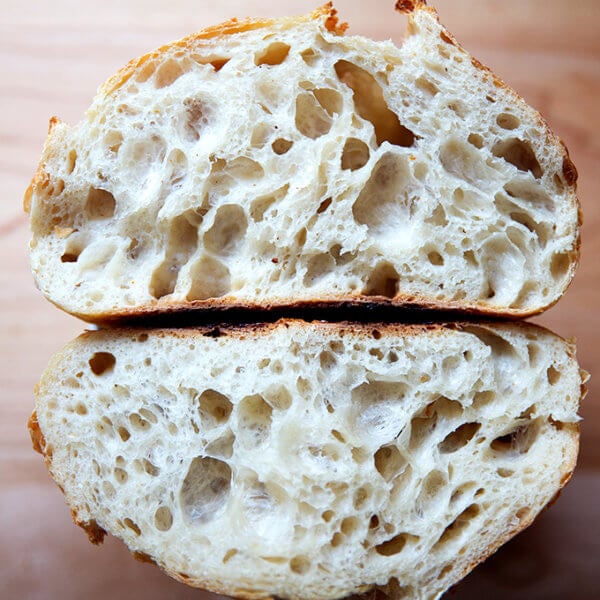
Homemade Sourdough Bread, Step by Step
- Total Time: 18 hours 45 minutes
- Yield: 1 loaf 1x
Description
If you love fresh sourdough bread with a golden, crisp crust and a light, airy crumb, this recipe is for you. It’s one of the simplest homemade sourdough bread recipes, and one of the best, too. It requires only 25 minutes of hands-on work and no autolyse or preferment. Below you will find guidance for every step of the way. 🍞🍞🍞
Inspired by The Clever Carrot
If you are new to sourdough, watch the step-by-step video here: Simple Sourdough Bread or in the post above.
Troubleshooting: If you have issues with your dough being too sticky, please read this post: Why is my sourdough so sticky? The 4 common mistakes.
Notes:
- You need an active sourdough starter. I have had success activating starters from:
- As always, I highly recommend investing in a digital scale before beginning any bread baking adventure.
- This is the Dutch Oven I use for sourdough bread. I used this Dutch oven for years, and it’s a great one, too.
- Flour sack towels are a great investment because they ensure your dough will not stick while it is proofing.
- I love using rice flour for dusting (as opposed to ap or bread flour) because it doesn’t burn. When you use a flour sack towel, however, you don’t need to use any flour.
- Find all of my sourdough essentials here: Essential Equipment For Sourdough Bread Baking
- I love a high-hydration dough, and I have great success using 380 grams of water in this recipe, so feel free to play around and push the hydration here.
- Salt: I have had success using both kosher salt and fine sea salt here. When I use kosher salt, I use the Diamond Crystal brand. When I use sea salt, I use the Baleine Fine brand. Regardless of the brand, I use 12 grams.
- Shaping: If you’re looking to get a more open crumb, try shaping a batard (as opposed to a round). Watch this video for guidance. Also: The recipe below follows the traditional shape once, rest, then shape again method. I often skip the preshape now and simply shape the dough once. I still get a nice open crumb.
- Adding Other Ingredients: If you’d like to add cheese, herbs, jalapeños, or other seasonings, do so before the third set of stretches and folds. Consider adding a fifth set of stretches and folds to ensure the ingredients are evenly incorporated into the dough.
How much Sourdough Starter to Use?
- Because my kitchen is cold for much of the year, I like using 100 g (1/2 cup) of starter as opposed to 50 g (1/4 cup). When determining how much starter to use, consider a few things: If you live in a warm, humid environment, 50 g should suffice. If you plan on doing an overnight rise, 50 g also should suffice. If you want to speed things up or if you live in a cold environment, consider using 100 g starter. Note: If you use 100 g of starter, your dough may rise more quickly, so keep an eye on it. As always, rely on the visual cues (increasing in volume by 50%) when determining when the bulk fermentation is done.
- A straight-sided vessel makes monitoring the bulk fermentation especially easy because it allows you to see when your dough has truly doubled.
Ingredients
- 50 – 100 g (1⁄4 – 1/2 cup) bubbly, active starter — I always use 100 grams, see notes above
- 375 g (1 1/2 cups plus 1 tbsp) warm water, or more, see notes above
- 500 g (4 cups plus 2 tbsp) bread flour
- 9 to 12 g (1.5 – 2.5 teaspoons) fine sea salt, see notes above
Instructions
- Make the dough: Whisk the starter and water together in a large bowl with a fork or spatula. Add the flour and salt. Mix to combine, finishing by hand if necessary to form a rough dough. Cover with a damp towel and let rest for 30 minutes.
- Stretch and fold: After 30 minutes, grab a corner of the dough and pull it up and into the center. Repeat until you’ve performed this series of folds 4 to 5 times with the dough. Let dough rest for another 30 minutes and repeat the stretching and folding action. If you have the time: do this twice more for a total of 4 times in 2 hours. Note: Even if you can only perform one series of stretches and folds, your dough will benefit. So don’t worry if you have to run off shortly after you mix the dough.
- Bulk Fermentation (first rise): Cover the bowl with a towel and let rise at room temperature, about 8 to 10 hours at 70°F (21°C) or even less if you live in a warm environment. The dough is ready when it has increased by 50% in volume, has a few bubbles on the surface, and jiggles when you move the bowl from side to side. (UPDATE: In the past I have recommended letting the dough rise until it doubles in volume. If you’ve had success with this, continue to let the dough double. Recently, I have been stopping the bulk fermentation when the dough increases by 50% in volume, and I feel I am actually getting better oven spring in the end.) (Note regarding timing: If you are using 100 g of starter, the bulk fermentation may take less than 8 to 10 hours. If you live in a warm, humid environment, the bulk fermentation may take even less time. In the late spring/early summer, for example, my kitchen is 78ºF and the bulk fermentation takes 6 hours. It is best to rely on visual cues (increase in volume by roughly 50%) as opposed to time to determine when the bulk fermentation is done. A straight-sided vessel makes monitoring the bulk fermentation especially easy because it allows you to see when your dough has truly increased in volume by 50%.)
- Shape (See notes above): Coax the dough onto a lightly floured surface. Gently shape it into a round: fold the top down to the center, turn the dough, fold the top down to the center, turn the dough; repeat until you’ve come full circle. If you have a bench scraper, use it to push and pull the dough to create tension.
- Rest: Let the dough rest seam side up rest for 30 minutes. Meanwhile, line an 8-inch (20-cm) bowl or proofing basket with a towel (flour sack towels are ideal) and dust with flour (preferably rice flour, which doesn’t burn the way all-purpose flour does). Using a bench scraper or your hands, shape it again as described in step 4. Place the round into your lined bowl, seam side up.
- Proof (second rise): Cover the dough and refrigerate for 1 hour or for as long as 48 hours. (Note: I prefer to let this dough proof for at least 24 hours prior to baking. See video for the difference in the crumb of a loaf that has proofed for 6 hours vs one that has proofed for 24 hours. If you choose to proof the dough in the fridge for an extended period of time, you may want to tuck it into a loosely tied bag — produce bags from the grocery store are great for this purpose — to ensure the dough does not dry out. The original recipe calls for a 1-hour rise, and if you have had success doing that, by all means, keep doing it.)
- Place a Dutch oven in your oven, and preheat your oven to 550°F (290°C). Cut a piece of parchment to fit the size of your baking pot.
- Score: Place the parchment over the dough and invert the bowl to release. Using the tip of a small knife or a razor blade, score the dough however you wish — a simple “X” is nice. Use the parchment to carefully transfer the dough into the preheated baking pot.
- Bake: Lower the oven to temperature to 450ºF (230ºC). Carefully cover the pot. Bake the dough for 30 minutes, covered. Remove the lid, lower the temperature to 400ºF (200ºC) and continue to bake for 10 – 15 minutes more. If necessary, lift the loaf out of the pot, and bake directly on the oven rack for the last 5 to 10 minutes. Cool on a wire rack for 1 hour before slicing.
- This loaf will stay fresh up to 3 days stored at room temperature in an airtight plastic bag or container. It freezes beautifully, too.
Notes
- This recipe has been adapted from Artisan Sourdough Made Simple. Changes I have made to the original recipe include:
- Using 11 g salt as opposed to 9 g.
- Performing 4 stretch and folds during the first 2 hours of the bulk fermentation, which build strength in the dough.
- Doing a cold proof for at least 24 hours before baking, which produces a lighter airier crumb. In the video, you can see the difference between the crumb of a loaf that has proofed for only 6 hours vs a loaf that has proofed for 24 hours.
- Finally, I like preheating my Dutch oven, which makes a crisper crust.
- Prep Time: 18 hours
- Cook Time: 45 minutes
- Category: Bread
- Method: Oven
- Cuisine: American
This post may contain affiliate links. Please read my disclosure policy.















5,723 Comments on “Homemade Sourdough Bread, Step by Step”
Delicious recipe! Do you have a recommendation for a non toxic parchment paper? And oven proof to 550? Mine is burning and sticking to the dough. Or better yet, is there another option for Dutch oven? Iv heard of corn meal …TY!!
Hi! I love the IF YOU CARE brand. It never sticks and it will char lightly. I have good results with Reynolds, too.
Thanks so much!
I always feel intimidated by the process of makin sourdough. After my first attempt of baking one years ago, I decided buying a loaf is a lot easier.
However, after I stumbled upon your recipe and it happened that I just been given sourdough starter recently, I decided to give it a go. It’s a huge success!!! So happy with my first loaf. Thank you so much for the recipe and the tips. 😊😊😊
Great to hear, Emer! Thanks so much for writing and sharing all of this 🙂
I make this recipe regularly for my son and husband. They cant seem to live without it! Best sourdough recipe I’ve tried yet!!!
Great to hear, Amanda! Thanks so much for writing 🙂 Love this.
Is the dough supposed to be extremely sticky during the first set of stretch and folds? Mine was so I’m not sure what I did.
Yes! By the 2nd or 3rd rounds of stretch and folds in this recipe the dough transforms from a sticky goo ball to a beautiful elastic dough. I always lightly wet my hand before the first round or two of stretch and folds so it is less sticky! I was concerned too, but it’s perfect.
Thanks for chiming in AJ!
Yes, it’s definitely sticky, and using a wet hand should help. Did you use a scale to measure? What type of flour are you using?
This is the only recipe I use now. It never fails me. It makes absolutely beautiful loaves with the perfect sourdough taste.
Great to hear, Janet! Thanks for writing 🙂
Thank you for FINALLY making me feel successful with sourdough!! You are amazing!!!
So happy to read this, Mary 🙂 Thanks for writing.
I’ve made this a few times and appreciate the detailed steps! Two questions: 1) in one note it says 11g of salt and another it says 12g. Which is better? 2) is there a temp range that’s best for the warm water?
Hi! It all depends on tastes. The rule of thumb with bread and pizza dough is that the weight of salt should be 2% to 3% the weight of the flour. For this recipe that is 10 to 15 grams. I prefer using 12 to 15 grams of salt because I like a well seasoned bread. The texture of the bread is not affected by using 11 or 12 grams of salt.
Regarding warm water, anything around 75º-80ºF is fine. Truthfully, I simply use tap water or room temperature water that has been sitting in my water pitcher. The temperature of the dough quickly adjusts to the temperature of the room, and because it’s such a long slow rise, that initial temperature of the water doesn’t matter so much (unless it’s too hot).
I’m a newbie to sourdough, and this recipe has made taking the leap from keeping a starter alive (which was a challange in itself) to actually making a loaf much easier! They turn out beautifully every time! I do have a question. Can I make this is a 13x4x4 Pullman pan? My kiddo LOVES this bread, bit won’t eat an odd shaped sandwich. Lol!
Hi! And you can, but you might want to make this recipe instead which is slightly higher hydration and better for sandwiches/toast: Easy Sourdough Sandwich Bread
If you have your heart set on this one though, go for it 🙂 Are you planning on baking it lidded?
I don’t know yet. Like I said, I new to bread making. The texture, crust, and crumb of this recipe are perfect. I guess I wasn’t sure if the measurements would need to be adjusted.
I think if you use this recipe, it will be a somewhat squatter/shorter loaf. I might make 1.5x the recipe for that size pan.
I just started on my sourdough journey and have read a lot. This guide helped me immensely. The step by step instructions, photos, videos and tips were incredibly helpful. My bread has turned out amazing! I was especially glad to find the long proofing time in the fridge as my daughter and I are gluten sensitive. We can eat this bread with no issues! Thanks so much for the guidance.
Great to read all of this, Jeanne! Thanks so much for writing and sharing this. Wonderful to hear you and your daughter can enjoy this bread!
I did everything correctly but it was over proofed after 18 hours in the fridge. It passed the poke test at hour 6 though. What went wrong? My fridge is 30 degrees F. I wrapped the banneton in a plastic bag too. Did everything per your recipe. Help 😕😕
Hi! Questions:
Did you use a scale to measure?
What type of flour are you using?
How long was the bulk fermentation?
Is this your first loaf of sourdough?
1. Always. Measured everything to a T. 🙂
2. King Arthur Bread Flour
3. Bulk ferment was about 10 hrs (my kitchen is 68 degrees). It had risen by 50%.
4. Yes, this is my first loaf and I use a lot of your recipes in general so I wanted to use your sourdough one, as well. 🙂
One thing I didn’t do (which others have told me I should have) was to let it sit at room temp for about an hour after the last shaping, but that wasn’t in the recipe so I didn’t. Thoughts?
Great to hear 🙂 OK, we’ll get to the bottom of it.
I never find the 1-hour bench rest makes that much of a difference, but you can add that step in if you like.
More questions:
Are you using a straight-sided vessel for the bulk fermentation?
How much did the dough increase in volume?
Are you confident in the strength of your starter? Does it double in volume after 6-8 hours of feeding it?
Finally: how do you know that it overproofed? From the poke test or from how it baked?
Unfortunately, I don’t have a straight sided vessel yet but I’m ordering one. I see the importance of it now. I used a bowl with fairly straight-ish sides. It doesn’t flare out the way most bowls do. I marked the bowl with a dry erase marker, which is how I ascertained that it had risen by about 50%.
My starter usually doubles in volume/peaks in about 6-7 hrs. And it always passes the float test.
My dough was jiggly, bubbly and looked and acted just like yours (and other videos I have seen) does once it’s done fermenting and ready to be shaped. It passed the poke test after 6 hrs in the fridge and was looking good. I went to bed but the next morning, it had deflated and was dense and looked like a weird frisbee. It baked terribly. Although I scored it, it cracked all over and the interior was dense and gummy. I couldn’t even chew it. The birds got that loaf.
Well, again, it sounds as though you are doing everything right. I think the straight-sided vessel will help you better determine when to end the bulk fermentation. End the bulk fermentation when the dough has increased in volume by 50-75%. Then proceed. Good luck with your next attempt!
Update … after trying two more times with the same outcome, I think what is happening is it’s over fermenting, not over proofing. I always hold off on shaping bc it doesn’t rise by 50%, only rises by about 25% after 8 hrs. So I guess I’m waiting too long to shape? But why isn’t is rising? My starter is active and strong. She peaks/doubles within 5 hrs. My house is on the colder side, 68 degrees.
My straight sided vessel,is coming tomorrow! Yay!
I’m sure the cold weather is playing a role. You can try the warm-oven trick: turn it on, then shut it off 1 minute later. Don’t leave the light on for the bulk fermentation bc this can create a too-warm environment. The warm-oven trick should just provide a cozy, draft-free spot to give your dough a boost. Use your straight-sided vessel and just be patient… let it get to 50% in volume; then proceed.
Shawna; sorry to hear about the continuing problems. I noticed that you initially said your fridge is 30 degrees F. Is that a mistake (since it’s below freezing) or, if that’s really the temperature, could that low temp possibly be part of the problem?
Eric, great catch! I somehow missed that. Freezing the dough definitely could causing some of the issues.
Made this recipe three times now and it’s been a huge success each time! I really appreciate all the details for a newbie like me, especially about how to feed the starter. Thank you!
Great to hear, Jenny! Thanks so much for writing 🙂
Super recipe!! Thank you so much! Turns out every time!
Great to hear, Christine! Thanks so much for writing 🙂
I cannot wait to try this! When taking out of the fridge, does it need to come to room temp before feeding?
Hi Haley! Can you clarify… do you mean, does it need to come to room temperature before baking? If that’s you question, then no, it does not 🙂
Yes, sorry! When you say Wednesday evening take starter out of fridge, discard most and feed. Does that need to come to room temperature before doing that? Thanks!
Nope! Take the cold starter out of the fridge, discard most of it, feed it with fresh flour and water; then let it sit at room temperature until it doubles. Good luck!
Can I use AP flour in this recipe? I’m out of bread flour.
Yes! The dough might be slightly wetter, but it will work just fine in the end.
Hello! I’ve come back to this recipe since the pandemic and have had great results as a novice sourdough baker! Question for you- if I incorporate whole wheat flour, do I need to change the amount of water. I am currently giving this a go, experimenting with only 30g of whole wheat out of the 500g, but didn’t change the amount of water. What are your thoughts? Thank you!!
You couldn’t have to with that amount of flour! Typically, whole wheat flour can be a little “thirstier” meaning you might need to add more water, but every brand/variety of whole wheat is different, so it’s hard to know until you give it a go. Some whole wheat flours behave exactly the same as bread flour, so I always recommend making the recipe as written; then adjust with more water next time around based on your results 🙂
Thank you for sharing! This recipe helped ease my anxiety about attempting a sourdough loaf. One question though. The directions say – If necessary, lift the loaf out of the pot, and bake directly on the oven rack for the last 5 to 10 minutes. What would constitute “necessary”?
Or, how would you know if that extra step is needed?
Thanks again!
Hi Adam! That’s only if you wish to get a darker color on your loaf. Sometimes the deep sides of a Dutch oven prevent the sides from getting as browned as some people would like. Baking it on the racks allows air to completely circulate the loaf.
Just made my first sourdough ever using the recipe and it came out amazing! Wish I could attach pictures of it!
Great to hear, Jamie! Thanks for writing 🙂
Hi. First time trying this recipe. It’s just gone into the oven. It felt firm when I took it out of the fridge but spread flat when it went onto the parchment. Wondering if the water quantity is for 50g starter. 😊
Hi! I use the same amount of water regardless if I use 50 or 100 grams of starter. It sounds as though it may have over proofed slightly in the fridge.
Questions:
How long did the bulk fermentation go and how much did the dough increase in volume? Are you using a straight-sided vessel for the bulk fermentation?
When you shaped the dough before placing it in the fridge, did it feel strong and elastic?
Morning from Auz, bulk ferment on the bench 6 hours in covered bowl, increase close to 50%, then fridge 11 hours, around 25%. This was visual, no markers. I think I need to get more technical.
It was delicious all the same and crumb was spot on.
Hi,
Been a chef for 30+ years. Like what I read and it turned out awesome.
I am recommending to all that will listen.
David Lewis
Stoney Creek, Ontario, Canada
Great to hear, David! Thanks for writing 🙂
Hi! Am I supposed to put it straight from the fridge into the oven or let it come up to room temperature?
Straight into the oven (after scoring, of course). No need to bring it to room temperature.
Started my sourdough journey a few weeks ago. Followed this recipe and it turned out great for me. Would make again!
Great to hear, Lindsay! Thanks so much for writing 🙂
Made my first loaf of sourdough with this recipe and it was amazing! I left my dough for way too long in the bulk ferment stage (I fell asleep lol). By the time I woke up it had tripled in size, if not quadrupled. But since I had already put so much time into it, I decided to just continue on and see what happened. And I’m so glad I did! I didn’t have much hope but when I pulled the lid off and saw a perfect load of bread, I was so excited. Just used it to make a grilled cheese and it was perfect. Thank you! Next up, sourdough pizza crust!
Wonderful to hear this, Kendall! Thanks so much for writing and sharing all of this — it’s encouraging for others to know how forgiving this dough can be 🙂
My very first attempt at sourdough and it turned out beautifully! And delicious of course. Thank you!
Great to hear, Alexis! Thanks for writing 🙂
I used your recipe to make my first ever loaf of sourdough. It turned out great thanks to your detailed instructions, tips, and video. I can’t wait to make more!
Great to hear, Jen! Thanks so much for writing 🙂
I’ve tried making sourdough one time before with a different recipe, it was very dense and not great. I just followed this recipe closely and cooking loaf in oven now after an *almost* 24 hour cold proof. It was about 20 hours total. I also only bulk fermented for about 4 hours since it reached 50%-75% increase in that time (I had wood stove going so it was very warm). It was just barely sticky when shaping, but still easy to shape so hopefully I didn’t overferment or get it too warm! I took it out of the fridge a bit early since it was starting to just barely get a little hard around the edge. I will come back and post a picture of the outcome! Fingers crossed it worked! My main concerns are bulk fermenting too fast, although my dough seemed the perfect texture/consistency. I also used a starter that had started to go back down after being very active, doubling in about 6 hours. It was about an inch under its highest point when I used it, hopefully that was ok too. I used Bobs artisan bread flour as that’s all I had! I’m excited to see how it looks!
Hi there! I am baking this bread in a loaf pan. How will the cooking time/temp differ? Thanks!
Hi Blair, you’ll want to let the dough proof at room temperature after the fridge proof until the dough crowns the rim of the pan. To bake: Heat oven to 425ºF. Transfer pan to the oven and bake for about 20 minutes. Reduce heat to 375ºF. Bake for 20 to 25 minutes more or until golden all around.
For future reference, I have a sourdough sandwich recipe: Easy Sourdough Sandwich Bread
This is my go to recipe for delicious easy sourdough bread. I share this with beginners, it’s a great all around recipe! The longer the final fermentation in the refrigerator the better, is my experience.
Great to hear, Lynne! Thanks so much for writing and sharing this 🙂
Is it possible to make tiny loaves with this? Can you advise what size and temperature for an open bake? Thank you!
Hi Hannah,
With an open bake, you won’t get the same crust or crumb structure because there will be no steam. That said, you can make smaller loaves: after the bulk fermentation, divide the dough up into as many portions you wish to bake, ball them up, place them on your baking dish, cover them with plastic wrap or an overturned pan to protect them from drying out as they proof at room temperature. The length of the room temperature proof will depend on the temperature of your kitchen but you can test the balled up portions with the poke test. The baking time will depend on the size of the loafs, but I would bake them at 400ºF for 25-30 minutes or until browned to your liking.
Hi! Do I need to adjust the amount of water relative to the starter? Or it’s just 375g regardless of 50g starter or 100g starter?
No need to adjust!
Thank you!! It turned out perfect! Any suggestions for how to add flavor? I was thinking about a rosemary/olive.
Great to hear! And yes, you can add rosemary and olives just before the third set of stretches and folds. Consider adding a 5th set of stretches and folds to ensure the flavorings are evenly incorporated.
Has anyone ever used a clay pot? My husband bought me one at our thrift store and am dying to try it. Just finished my first S&F. So far so good, this is my first loaf with new starter(I killed Geeter Doughne at xmas 😞 )
Hi! I have not. Definitely google the instructions for using a clay pot before you use… I think you have to soak it in water. I’d hate for it to crack on you!
Has anyone ever used a clay pot? My husband bought me one at our thrift store and am dying to try it. Just finished my first S&F. So far so good, this is my first loaf with new starter(I killed Geeter Doughne at xmas 😞 )
Hi! I have not. Definitely google the instructions for using a clay pot before you use… I think you have to soak it in water. I’d hate for it to crack on you!