 →
→ 

Roasted Butternut Squash Pie (AKA The Best Pumpkin Pie)
 By Alexandra Stafford
—
Last Updated: 11/11/2025
By Alexandra Stafford
—
Last Updated: 11/11/2025
This post may contain affiliate links. Please read my disclosure policy.
Here me out: the best pumpkin pie does not start with a can. It’s made from homemade roasted and puréed butternut squash, which takes barely any effort. I promise you this roasted butternut squash pie will be the best pumpkin pie you ever make.
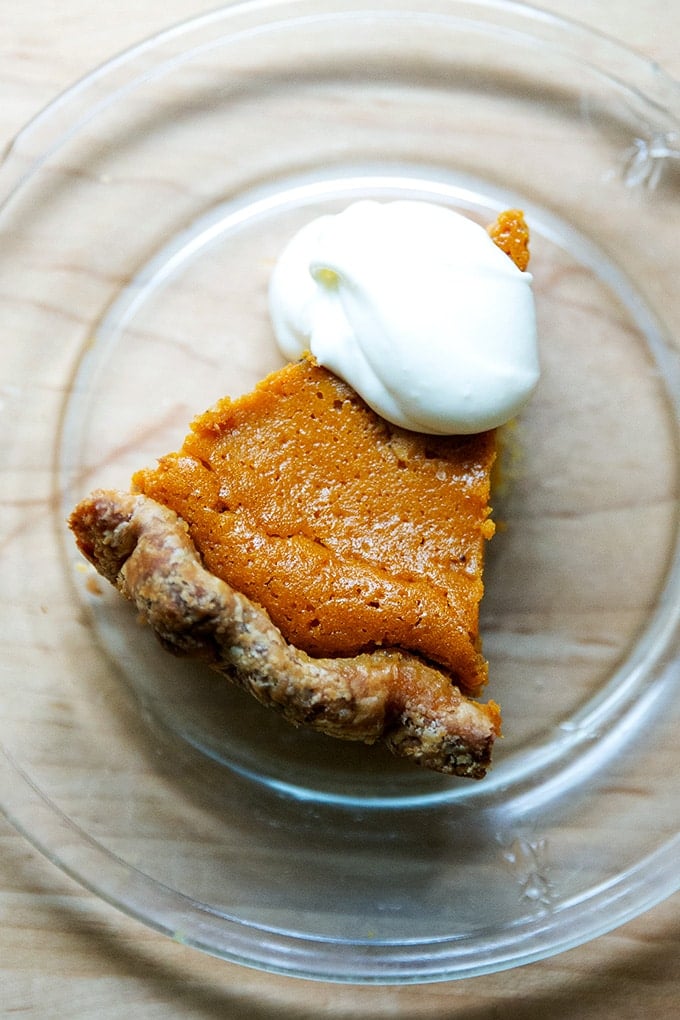
In Kristin Kimball’s The Dirty Life, Kristin writes: “Pumpkin shmumpkin, winter squash has more flavor and better texture.”
So true. I have been making this squash pie with butternut squash for nearly a decade now, and it always receives rave reviews.
Are you skeptical about switching up your pumpkin pie routine?
Consider this: Would you agree that butternut squash makes the silkiest soup and the creamiest pasta sauce? For these same reasons, it makes the most custardy “pumpkin” pie.
Don’t let the work of roasting a butternut squash deter you. Dare I say it? It’s easy as pie! How many times do you roast a squash over the course of a winter? You can do it in your sleep.
I promise you: If you forget the pumpkin this year, you won’t be disappointed.
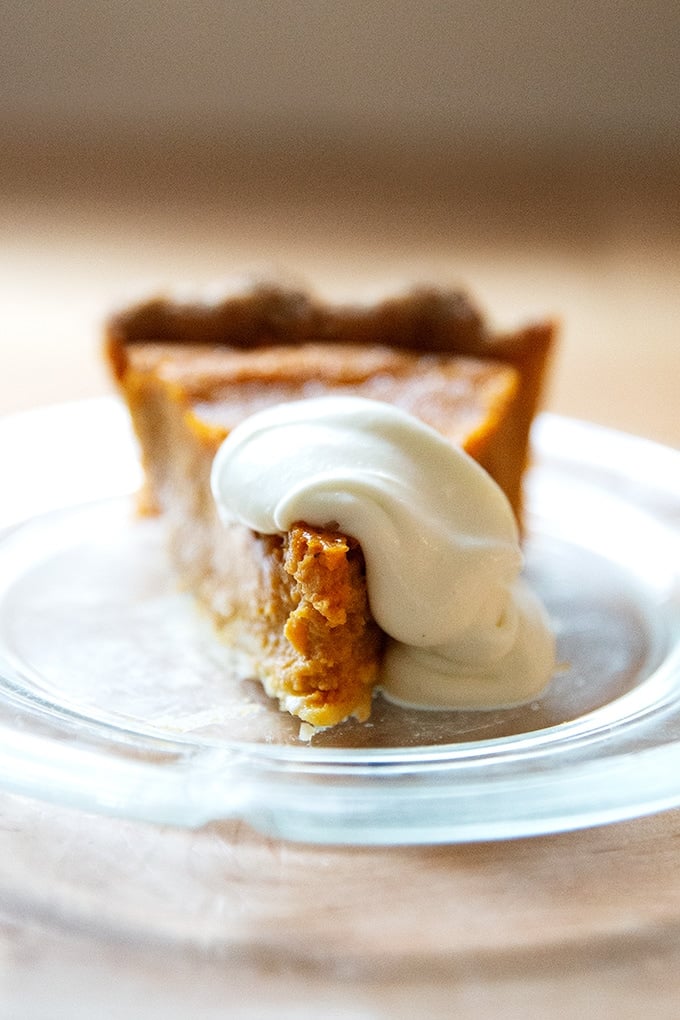
How to Make Roasted Butternut Squash Pie, Step by Step
First, you’ll need to roast the butternut squash:
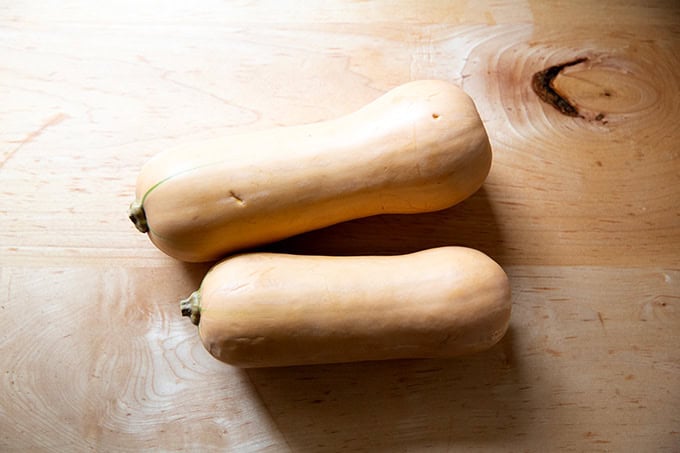
Halve one to two lengthwise, scoop out the seeds, rub the cut surface lightly with olive oil, and place on a parchment-lined sheet pan:
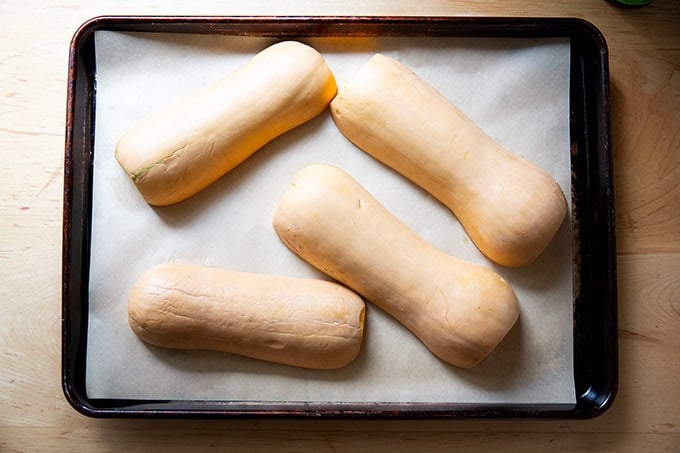
Roast until the flesh is knife tender, 45-60 minutes depending on the size of the squash:
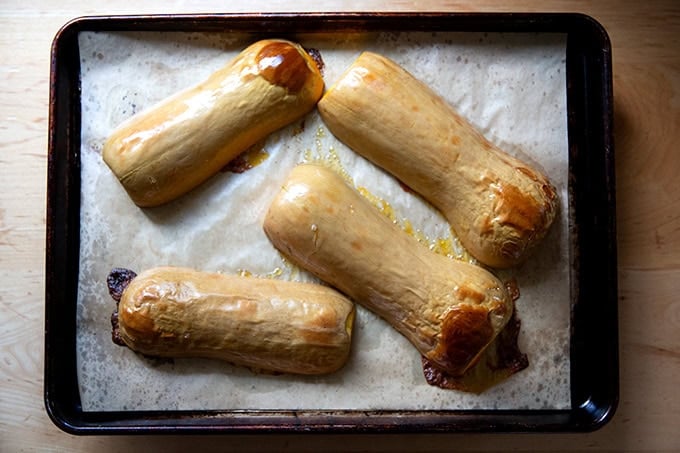
Let cool briefly, then scoop the flesh into a food processor:
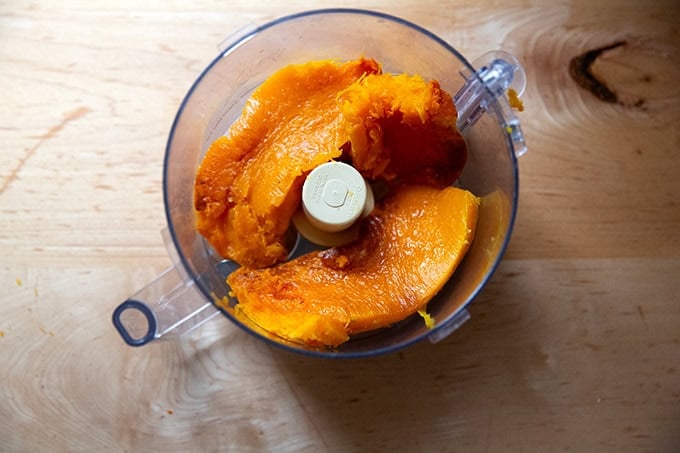
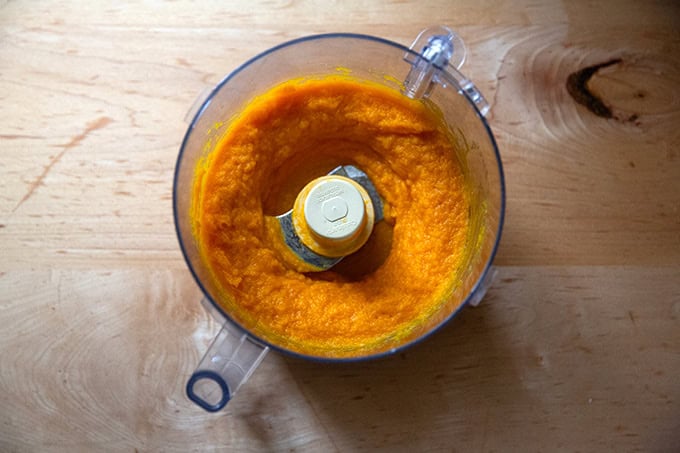
Purée until smooth:
I make the filling, combine eggs, sugar, heavy cream, salt, and spices in a large bowl:
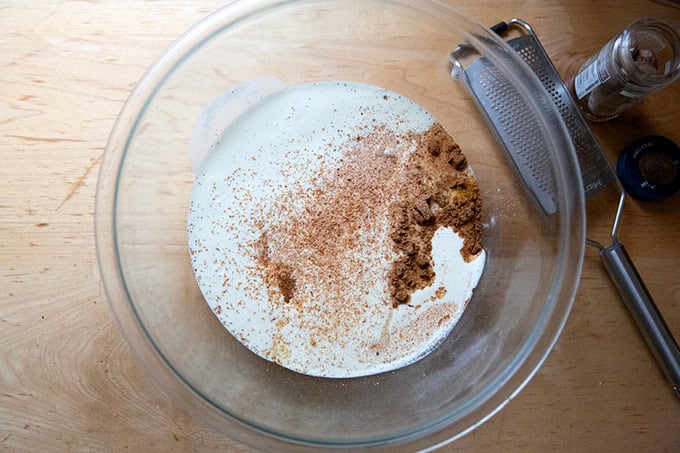
Whisk until smooth:
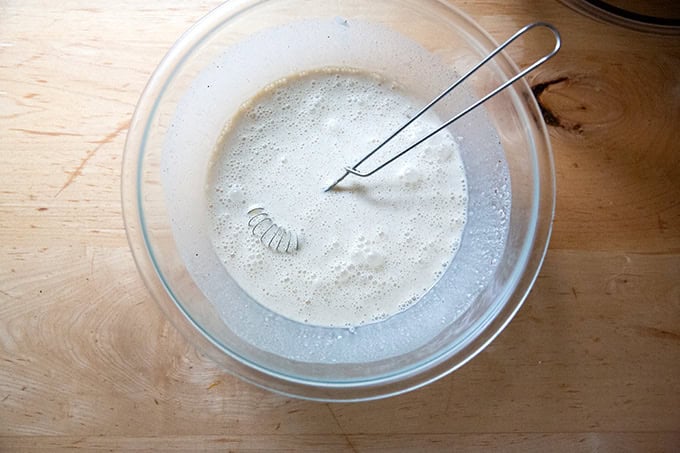
Then add 2 cups of the butternut squash purée:
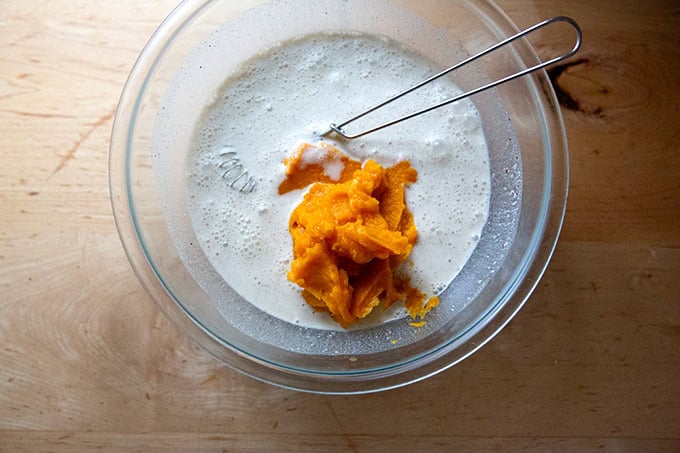
Whisk again until smooth:
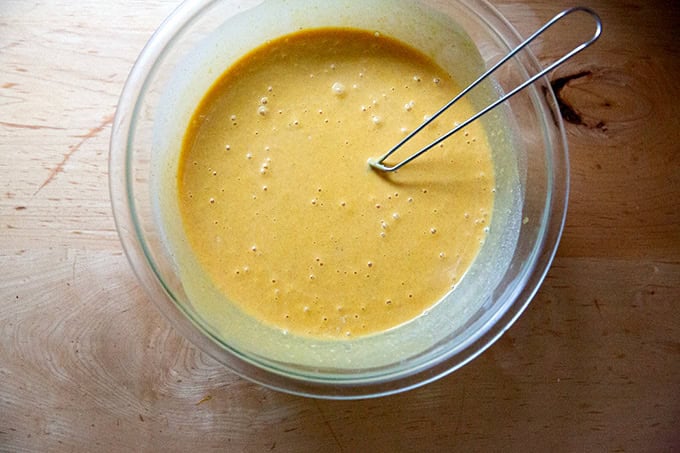
For this pie, you’ll need one parbaked pie crust. See this recipe post for a how-to:
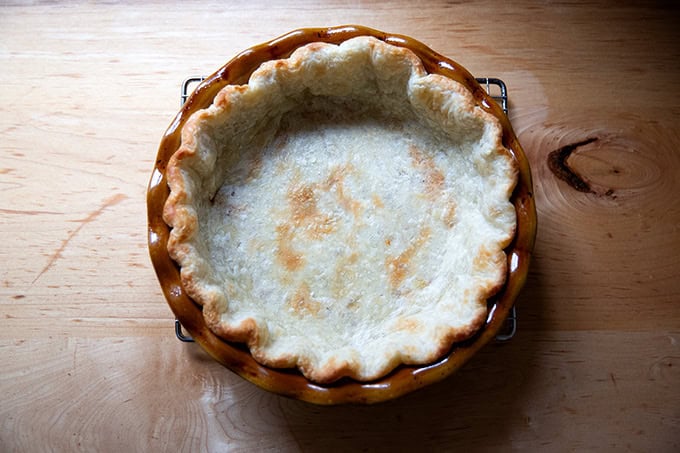
Place the pie crust on a parchment-lined sheet pan and pour in the butternut squash filling:
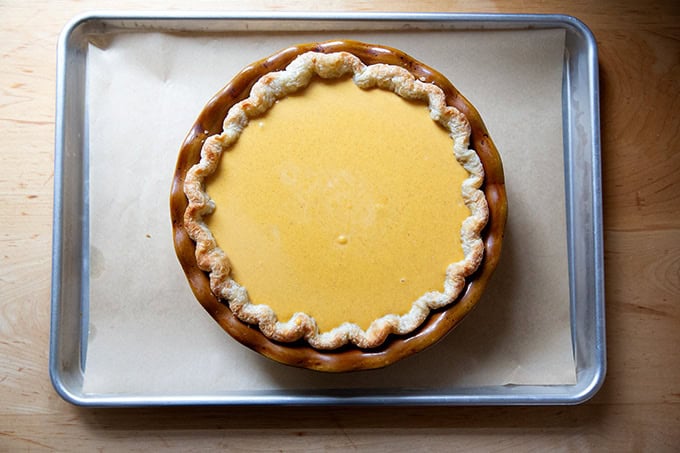
Bake for about an hour or until the edges feel set and the center feels slightly jiggly:

Let cool completely… see recipe box regarding cracks:
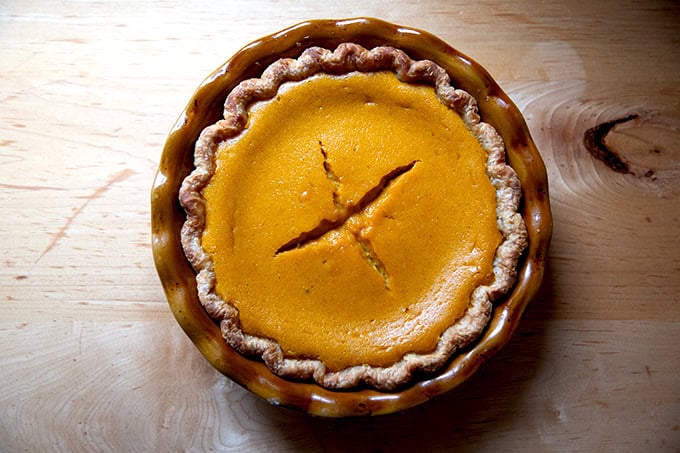
Decorate with pie crust cookies, if you wish:
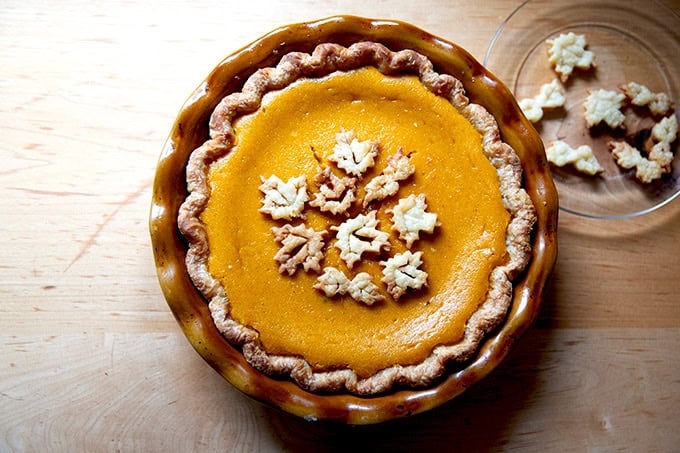
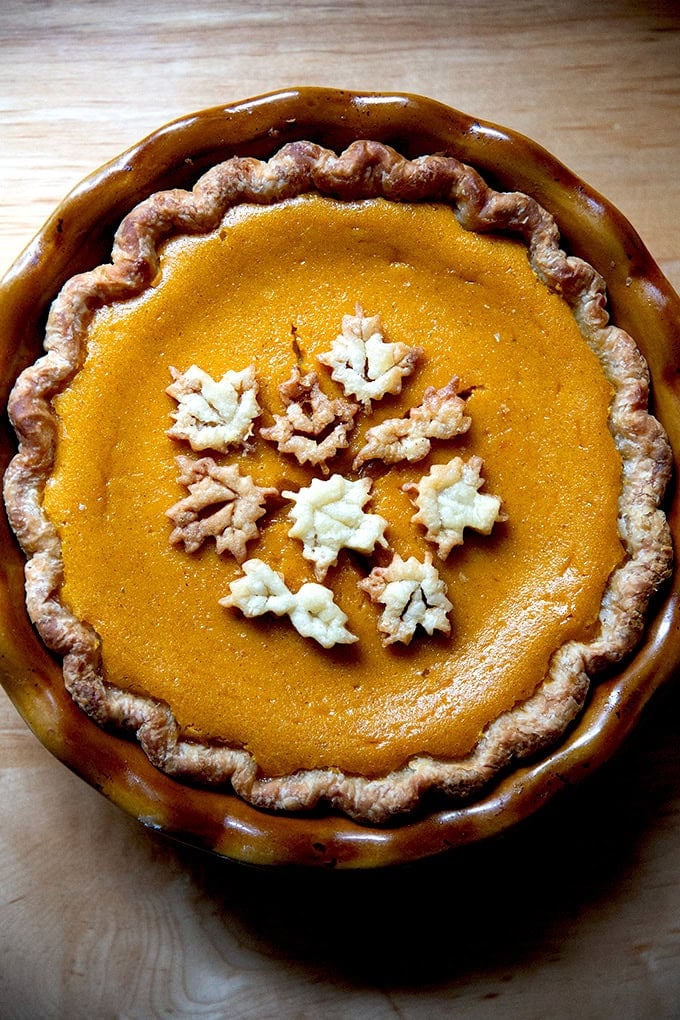
Cut and serve.
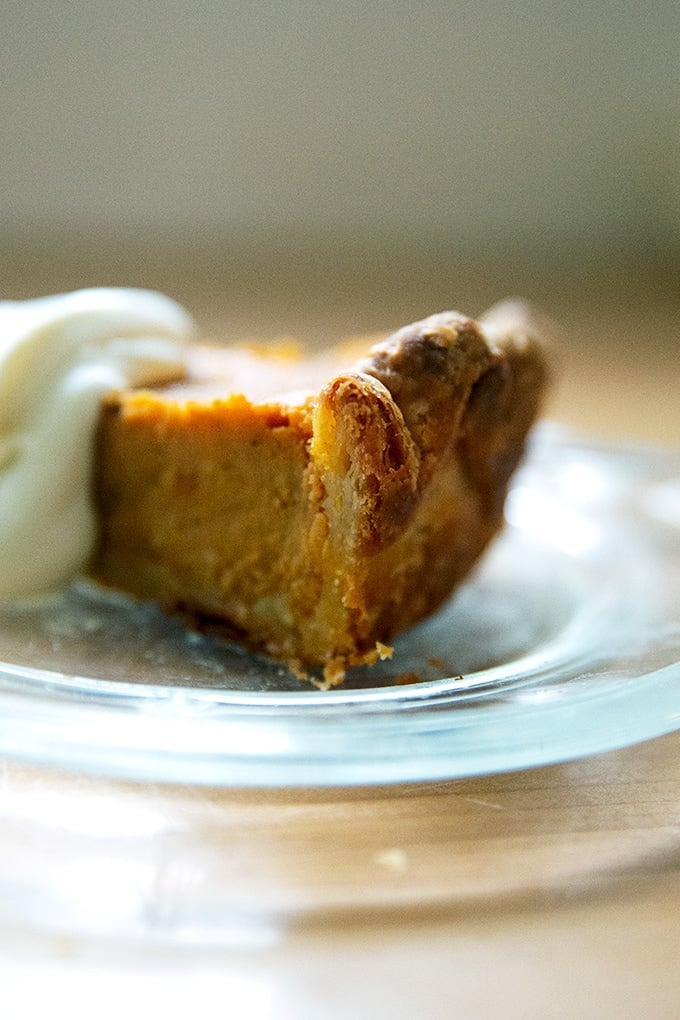
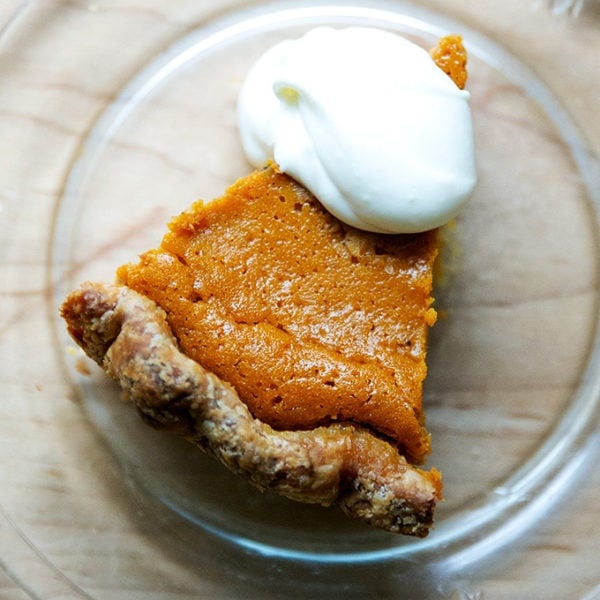
Roasted Butternut Squash Pie
- Total Time: 2 hours 10 minutes
- Yield: Serves 10 1x
Description
Pumpkin shpumpkin! A roasted butternut squash purée makes the silkiest, smoothest, tastiest pumpkin pie you can imagine.
Notes:
- For a more visual guide to making the pie dough, rolling it out, and crimping the edges, watch the video below.
- I love my Emile Henry pie plate (similar to this one).
- Also, if you cannot muster the energy to roast a butternut squash — but please please try…you won’t be disappointed — you can use one 15-oz can of pumpkin purée in place of the 2 cups of squash purée.
- One medium butternut squash (2 lb. 10oz) yields about 3 cups purée.
- On Cracking: More often than not, my butternut squash pie will crack after it has finished baking. I have researched why this happens and consistently have found two answers: overcooking and cooling too quickly. The solutions? Do not over-bake the pie; do not let it cool too quickly. I have tried both: I test the custard with an instant-read thermometer and end the baking when it reaches 175ºF. I turn the oven off after the pie has reached 175ºF, crack the oven door, and let the pie cool slowly. No matter what I do, the pie cracks. My solution:
- Pie Crust Cookies
Ingredients
For the pie crust:
- Homemade Pie Dough (one parbaked shell)
For the pie:
- 1 medium butternut squash, about 2.5 lbs or enough to yield 2 cups of purée, see notes above
- 1 1/2 cups heavy cream
- 3 eggs, beaten
- 3/4 cup sugar
- 1 teaspoon cinnamon
- 1/2 teaspoon ginger
- 1/2 teaspoon salt
- 1/2 teaspoon freshly ground or powdered nutmeg
- 1/8 teaspoon ground cloves (I omit)
For the whipped cream:
- 1 cup heavy cream
- confectioners’ sugar
- flaky sea salt, such as Maldon
Instructions
- Preheat the oven to 400ºF.
- Halve and clean the butternut squash, rub the flesh lightly with olive oil, and bake on a parchment-lined baking sheet, cut-side down, until very soft, about an hour (but start checking after 45 minutes).
- Lower the oven temperature to 350ºF.
- When the squash is cool enough to handle, scoop out the flesh, transfer it to a food processor, and puree until smooth. Measure out 2 cups. In a large bowl, whisk together the eggs, cream, salt, sugar, and spices. Whisk in the squash.
- Place the parbaked pie shell on a parchment-lined baking sheet. Add the squash mixture to the pie shell and bake at 350ºF for 55 to 65 minutes or until the center is barely set. Let cool completely before serving.
- To make the salted whipped cream: Whip heavy cream in the bowl of a stand mixer until soft peaks begin to form. (You can do this by hand, too, with a bowl and whisk.) Add confectioner’s sugar — start with 1/4 cup and add more to taste. Add a big pinch of sea salt and beat until the peaks begin getting firmer. Taste — the mixture should be slightly sweet and the salt should be noticeable, though the whipped cream should not taste salty.
- Prep Time: 25 minutes
- Cook Time: 1 hours 45 minutes
- Category: Dessert
- Method: Bake
- Cuisine: American
This post may contain affiliate links. Please read my disclosure policy.




124 Comments on “Roasted Butternut Squash Pie (AKA The Best Pumpkin Pie)”
I grew several very large Candy Roaster squash this year. They’re similar to butternut but a bit sweeter and drier. I am definitely going to try making a Candy Roaster pie using this recipe. Thanks.
Hope it turns out well, Gaye!
Trying homegrown winter squash as well. We had a bumper crop this year of Tokyo Blue, 2 types of buttercup, and kabocha. Baked them today and blended them smooth in the food processor – very tasty. I am optimistic this will work as a replacement for butternut.
It will be delicious!!! Enjoy 🙂
Hi, can I roast the squash ahead of time and keep in fridge until ready to make the filling? Thank you!
Yes! You can roast it days ahead of time. I mixed all the fillings for my pies last year on the Tuesday before Thanksgiving.
Great recipe! I made it as written and everyone loved it. Some said it was the best “pumpkin” pie they’ve had. 😆 Thanks!
Woohoo! So nice to hear this, Kate 🙂 Thanks for writing and Happy Thanksgiving!
Made this as written and everyone raved! I rolled the bottom crust a little too thin and it stuck to the pan, but there were no complaints. Some people found it a little sweet, ironically (since other commenters said it wasn’t sweet enough.) Thank you!
Great to hear Amy! Thanks for writing. Finding the right thickness for the pie crust definitely takes a little practice. Glad there were no complaints 🙂
How can I make this recipe into a deep dish pie
Hi Bob! So sorry just seeing this. I think this dough will work fine in a deep dish pie plate. How many inches deep is it?
Thank you for sharing this recipe and so many helpful details!
Do you leave the pizza stone in the oven when you bake the pie?
My pleasure, Erica 🙂 And yes, I do!
Thank you! I will try that next time. I really liked how this crust worked, although there was some moisture on the crust after I removed the parchment and pie weights.
I am now thinking about par baking the crust for Yossy Arefi’s pear pie with creme fraiche caramel. Have you tried this crust with a pie that has a lattice top?
Hi Erica! A little bit of moisture is normal — it’s from the butter bubbling out of the crust.
I have not used this recipe for a lattice-topped or double-crust pie. I think it will work but I do think adhering unbaked pie dough to baked pie dough might be a little problematic… but totally worth a shot. That pie sounds outstanding! I love Yossy. I’ll look it up 🙂
Thanks so much for letting me know that the moisture was normal – very reassuring!
I also appreciate your feedback on using a par baked crust with a lattice topped pie. I won’t do that, but I will use your pie crust recipe, which worked really well. Thank you again!
My pleasure, Erica!
Re cracking – I believe the cause may be that pumpkin pie filling is really a custard. Cheesecake often cracks and is usually cooked at a lower temperature than pie, or cooked in a water bath, similar to creme brulee. Obviously, a water bath wouldn’t work well here with the crust, but perhaps the temperature should be lowered. I think cheesecakes are often cooked as low as 300 or 325. I’m not sure that would work here but think it’s worth trying a lower temp. (These observations / suggestions come from following Rose Levy Beranbaum author of the Cake Bible who came up with cooking her cheesecake in a water bath.)
Judy, thank you! I think this is a really good call. I don’t think I have it in me to make another one of these pies before Thanksgiving only because I don’t want to ruin Thanksgiving — I so look forward to this pie! — but when I bake this one on Thankgiving morning, I’m going to try the 300ºF-325ºF range. So appreciate you writing and sharing this 🙂
In spite of your comment on the water bath, I’ve had good luck with it preventing cracking without affecting the flakiness of the crust. Just remove the pan of water when you turn the stove off and let the pie finish as the oven cools. The combination works pretty well.
OK! Great to hear, Chris. Thanks for writing and sharing. I did in fact make one more squash pie adding 2 tablespoons of flour to the custard, and I felt the additional flour took away from the creaminess of the custard. So water bath might be my best option! Thanks for sharing this 🙂
Ali, I’ve been following you for ages — have your pizza book and adore it. Have made so many of your recipes and never had a bad one. Love your pasta sauces. I cannot tolerate heavy cream. Would Califia Farms Toasted Coconut Almond blend or any other nut-based blend work? I would love to make this pie. Thanks so much, Diana
Thank you, Diana! You are too kind. It means a lot to read all of this.
I just did some googling, and it sounds as though you can, but it sounds as though you might also need to add some sort of thickener to ensure that the custard sets up, due to the Califia Farm product being a little lighter/less fatty. This is what I found from the Internet:
To compensate for the lower fat content and prevent a runny pie, incorporate an extra thickening agent, such as 1-2 teaspoons of cornstarch or 1 teaspoon of tapioca starch into the filling mixture.
Mixing in an additional egg yolk, which adds richness and structure to the custard.
Hope that helps!
been adding a tablespoon of cornmeal to my pie since I saw it in a recipe in the 70’s-plain flour or cornstarch will work too but I like the texture of the cornmeal. works great for cheesecake too (flour or cornstarch). I’d also like to suggest a T or so of molasses in the pie-deepens the flavor!
Do you add the cornmeal to the crust or the filling? Assuming the molasses is added to the filling?
I am nearly positive she is suggesting adding both to the filling, but hopefully she’ll circle back to confirm 🙂
I think I’m going to try flour! I use cornmeal in this Salted Maple Pie recipe, which is a take on Chess pie, which I believe includes molasses… love that idea!
Hi, I add the cornmeal to pumpkin or squash pie filling. I use flour or corn startch for cheesecake fillings. I owned a bakery for several years and was a baker in various restaurants. The cornmeal adds a really nice (minor) texture to a squash pie-think indian pudding. Good luck.
Awesome, thanks so much!
Can’t wait to try this. I will let you know. As always I love your writing, ideas and the results. Thank you Ali.
Hope you love it, Kate! Thank you for your kind words 🙂
Forgot to mention and no water bath needed.
Re: cracking
I have always added 2 tabs of molasses to my pumkin pie as did my mom. Bake at 325*. No cracks. I’m at altitude and very dry climate. Don’t know if this will work for you.
Happy Thanksgiving
Thank you, PattiAnn! Love the molasses idea… someone else suggested that too, and I love the lower temperature idea, too. I am trying that for sure. Thanks so much for writing!
Hi Ali! Read your comment about cracking and wanted to pass you this link to a pumpkin pie recipe I use every year with great success – no cracks! The author states that flour in the filling helps stabilize it and prevent cracks; might be worth a try? Happy thanksgiving!
https://www.onceuponachef.com/recipes/perfect-pumpkin-pie.html#search
Natalie, thank you!! I just looked at the recipes and the ratios are very very similar… I am definitely going to try the flour! I have my hopes up. She also bakes at a lower temperature, which I am going to try. I wasn’t going to do another test run before Thanksgiving, but I am feeling so inspired. Thanks again for writing and sharing this.
I wonder if the fact that you purée the squash in the food processor is, at least in part, what’s causing the pie to crack. Several years ago I read that over mixing was often a factor in cracking custard based pies, cheesecakes, etc.. Too much air gets incorporated into the batter, causing it to puff up while cooking, and then crack when quickly cooled (lending credence to the slow cooling in the oven technique). After that I started mixing those types of recipes by hand just until ingredients are incorporated. Now, 95% of time I get crack-less results. I don’t know if you’d get the squash smooth enough if you put it through a ricer instead of a food processor, but perhaps it’s worth a try? That or prepping the squash a day or so ahead and letting it sit overnight in the fridge to compact.
That is a great thought, Sarah! And definitely a possibility. I do have a ricer, and it makes my potatoes especially smooth, and I imagine it would do the same for my butternut squash, which is smoother than potatoes by nature. Thank you for writing and sharing this!
Try preheating the oven to 400 and turn it down to 325 instead of 350. It looks like the edge of your pie is getting done too quickly. I make pumpkin pies and haven’t experienced any cracking, but I use these temperatures. Hope that helps. I also only use 2 eggs, but add 1 tbsp of flour to the filling, which I mix with the spices before adding to the pumpkin.
Thank you, Carol! I agree about the edges of my pie. I am going to try baking at 325ºF, and I am going to try adding flour to the custard… I think that is going to be key. I’m feeling so inspired by all of these suggestions. Thank you!
Consider baking at 400 degrees for 10 minutes, then 300 degrees for 20 to 30 minutes till you hit 175 degrees. I have achieved no cracks this way.
I never make pie, so they all seem overwhelming to me. Is it possible to use store bought crust? If so, is there a difference between any of them that I should be looking for? Do you know if I prepare them a certain way that would work with your squash recipe? Thank you so much!
Hi Ori! I am afraid I do not any advice here. I would google “best store-bought pie crusts” … wish I could help more 🙂
Hahaha, I haven’t figured out the trick to make an un-cracked pumpkin pie either. I love the topping idea! I also love this hack with a butternut squash, by the way. Canned pumpkin is nearly impossible to find in Spain!
I think I might try a water bath this year, Katie! Though I’m still trying to figure out if I care about the cracks or not. I did try adding 2 tablespoons of flour to the custard, and I think it altered the texture… it wasn’t as custardy/creamy. I hope you give it a go with butternut squash — so much more flavor, such better texture. It’s my favorite Thanksgiving pie.
Happy Thanksgiving! Thank you for all your wonderful recipes! I am making two of your recipes for TG this year: the focaccia, and the butternut squash pie, which is now in the oven. I used plugra butter for the crust and did quite load up the shell in beans before baking, getting them into all the nooks and crannies, but I still experienced shrinkage. Could it have been the plugra? Because of the shrinkage, all the filling would not fit into the shell. So, I put the leftover filling into some ramekins and will bake them in a water bath tomorrow-waste not want not! Thanks again for all your lovely recipes, and the feedback that you always are so willing to share!
Hi Lisa! Great to hear and Happy Thanksgiving to you! It is definitely possible that the Plugra caused the shrinkage due to its higher butter fat percentage, but I have never used it, so I can’t speak from experience. How long did you chill the pie dough itself after making it? And did you chill the crust for 30 minutes after you fit it into the pie plate?
Yes and Yes! I guess sometimes shrinkage just happens! By the way, the extra filling was great as a little pumpkin soufflé ish puddings this morning, with leftover piecrust cookies on top. Maybe even better than the pie last night! Thanks again- everyone loved the pie and the focaccia 🙂
Pumpkin soufflé topped with piecrust cookies… so fun. Love this idea. Great to hear re pie and focaccia. Regarding the shrinkage, I suppose my only suggestion next time around would be to try something like Cabot butter and see if perhaps it is the difference in butter fat this is making the difference. Thanks for circling back with your results!
This turned out amazing and you are so right that it is more flavorful than pumpkin! This was a first family gathering in a while and I used so many of your recipes this Thanksgiving that made our meal amazing (and me a star chef!) that I included you in my list of gratitudes! (This pie recipe, no knead rolls, make ahead gravy, buttermilk mashed potatoes). Thank you for sharing your talent with us!
Awww, Cynthia, this means so much 🥰🥰🥰 Thanks so much for writing and sharing this. Love hearing it all. Happy Thanksgiving to you and your family!
I wanted to comment on the cracking, because I’ve been making a pumpkin cheesecake every year successfully with no cracks. I was taught that the cracks can also form because there’s too much air in the batter. So in addition to using the cooling in the oven trick, I always gently mix my batters by hand with a rubber spatula rather than using a mixer. I hope this helps you!
Thank you, Amanda! I appreciate your insights here. I do wonder if using the food to purée the squash whips too much air into it. Someone suggested using a ricer, and I might have to give that a go. Apart from the food processor for the squash, I do use a whisk/spatula to mix the batter. Thanks for writing!