 →
→ 

My Mother’s Peasant Bread: The Best Easiest Bread You Will Ever Make
 By Alexandra Stafford
—
Last Updated: 02/11/2026
By Alexandra Stafford
—
Last Updated: 02/11/2026
This post may contain affiliate links. Please read my disclosure policy.
This is the no-knead bread recipe my mother has been baking for 45 years. Start to finish, it can be ready in three hours. It bakes in well-buttered Pyrex bowls — no need to preheat a baking vessel for this recipe — and it emerges golden and crisp with a soft, tender crumb. 🍞🍞🍞🍞🍞
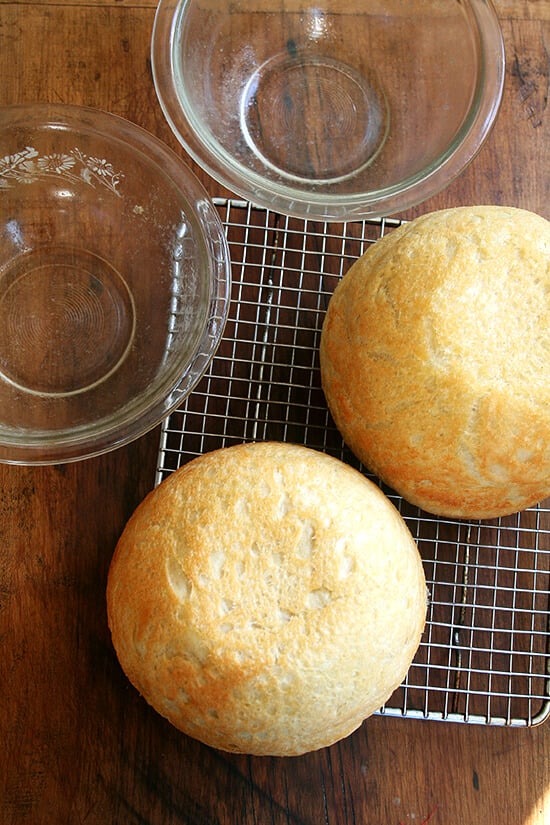
When I tell you that, if forced, I had to pick one and only one recipe to share with you that this — my mother’s peasant bread — would be it, I am serious. I would almost in fact be OK ending the blog after this very post, resting assured that you all had this knowledge at hand. This bread will change your life.
The reason I say this is simple. People go insane over homemade bread. Not once have I served this bread to company without being asked, “Did you really make this?” And questioned: “You mean with a bread machine?” But always praised: “Is there anything more special than homemade bread?”
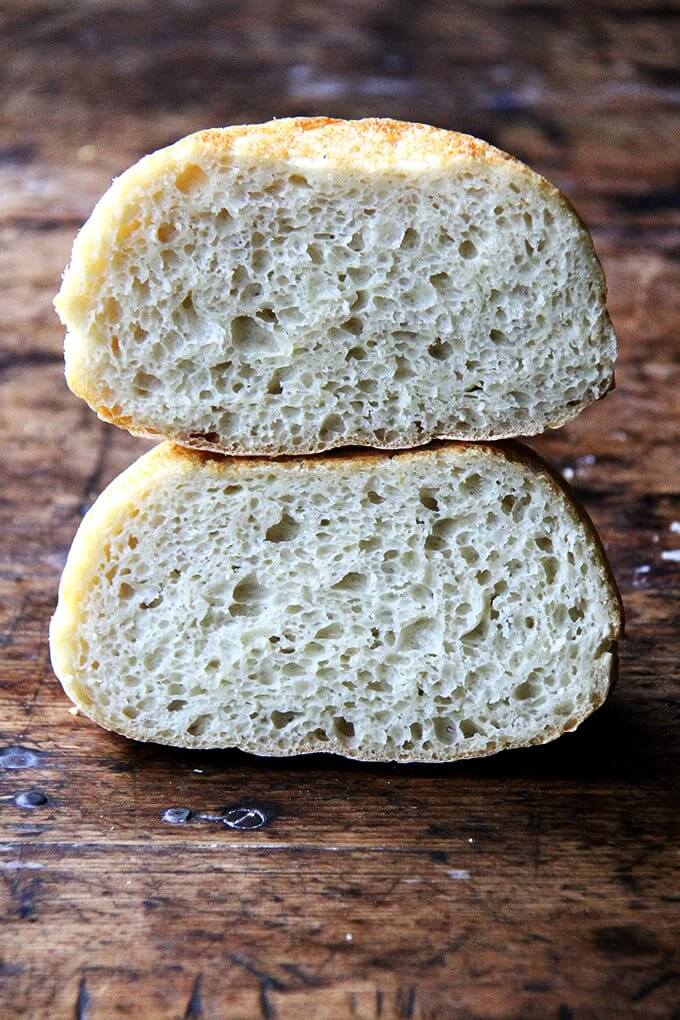
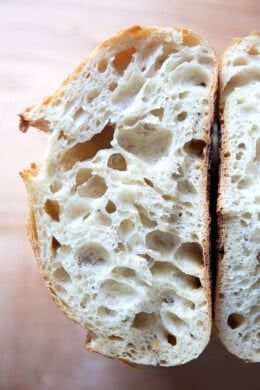
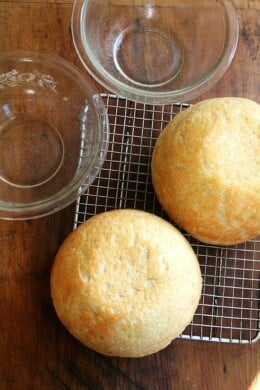
So what makes this bread so special? For one, it’s no-knead. But unlike other no-knead breads, you can start this one at 4:00 pm and turn it out onto the dinner table at 7:00 pm. It bakes in well-buttered Pyrex bowls — there is no pre-heating of the baking vessels in this recipe — and it emerges golden and crisp without any steam pans or water spritzes. This is not artisan bread, nor is it trying to be. It is peasant bread, spongy and moist with a most delectable buttery crust.
Genuinely, I would be proud to serve this bread at a dinner party attended by the bread Gods: Jim Lahey, Mark Bittman, Peter Reinhart, Chad Robertson, Jeff Hertzberg, and Zoe Francois. It is a bread I hope you will all give a go, too, and then proudly serve at your next dinner party to guests who might ask where you’ve stashed away your bread machine. And when this happens, I hope you will all just smile and say, “Don’t be silly. This is just a simple peasant bread. Easy as pie. I’ll show you how to make it some day.”
Bread Toast Crumbs
Love the peasant bread? There’s now a book filled with 40 simple bread recipes plus 70 recipes to use up every crumb of every loaf you bake.
How to Make Peasant Bread, Step by Step
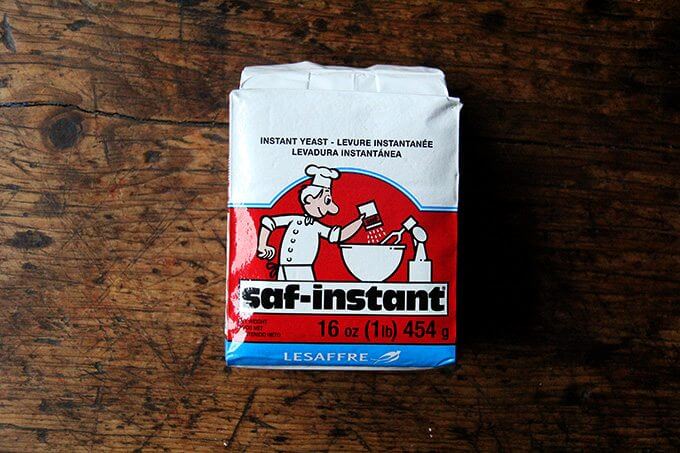
First: You need yeast. I love SAF Instant Yeast. Instant yeast can be whisked directly into the flour without blooming or proofing. If you want to stick to active-dry yeast, there are instructions in the recipe notes on how to do so. Red Star yeast is great.
Whisk together flour, salt, sugar, and instant yeast. Add lukewarm water.
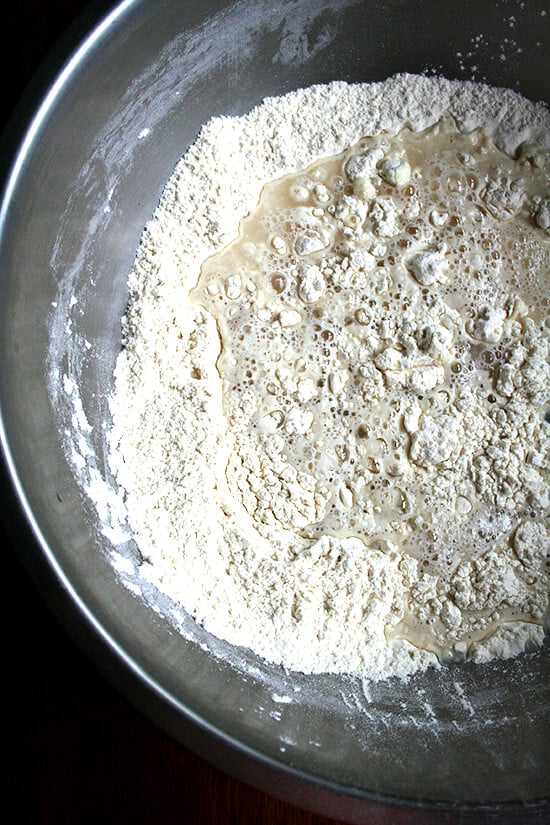
Mix until you have a sticky dough ball. Let it rise for 1.5 to 2 hours…
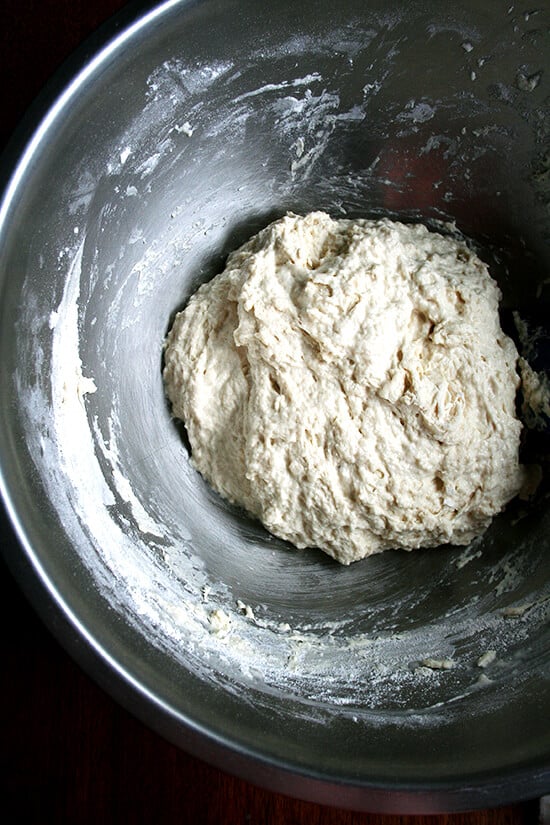
… or until it looks like this:
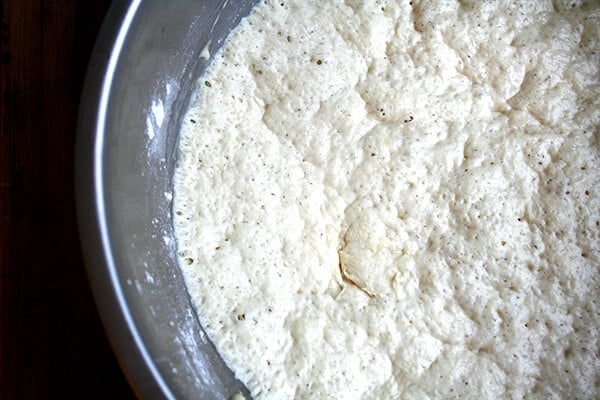
Punch down the dough using two forks.
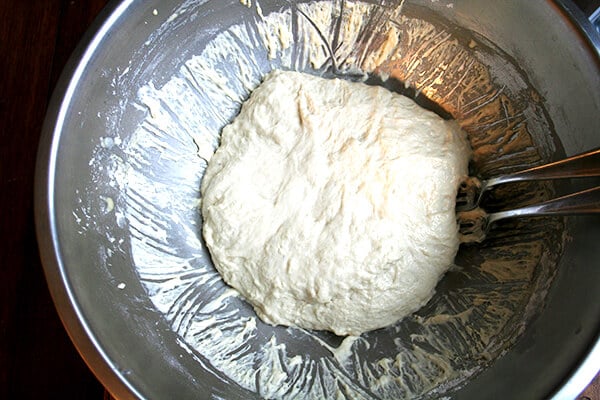
Then split the dough down the middle again using the two forks.
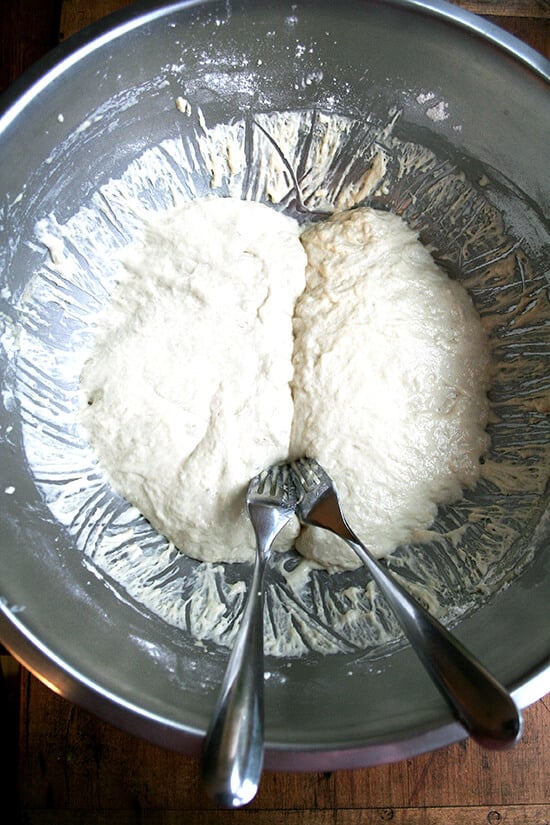
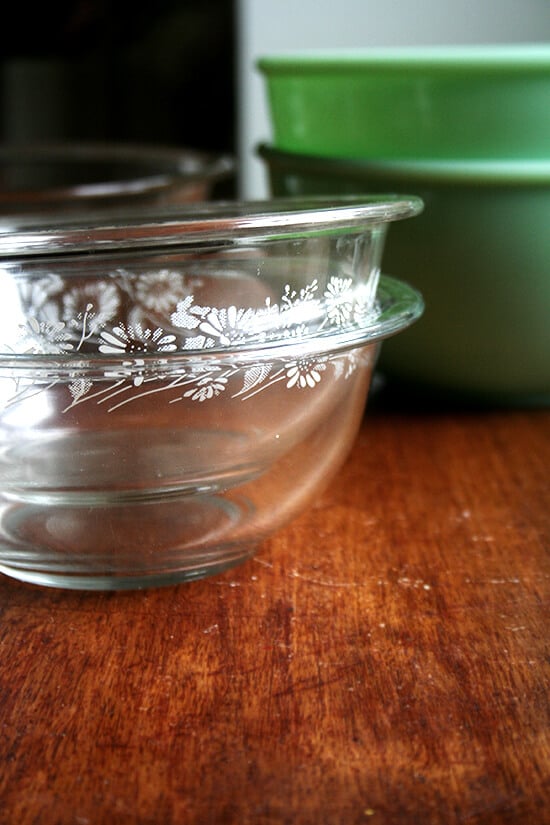
Because this is a very wet dough, it must be baked in an oven-proof bowl. I am partial to the Pyrex 1L 322 size, but any similarly sized oven-proof bowl will work.
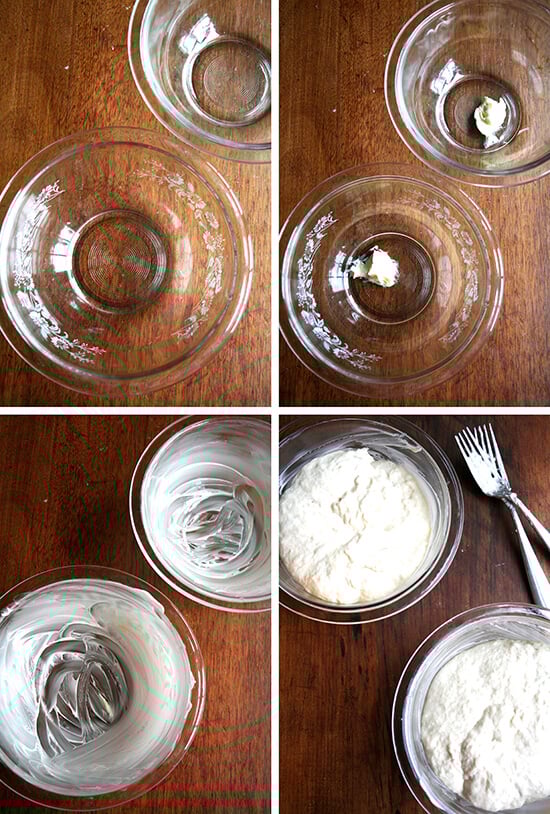
Butter the bowls well; then transfer half of the dough to each prepared bow.
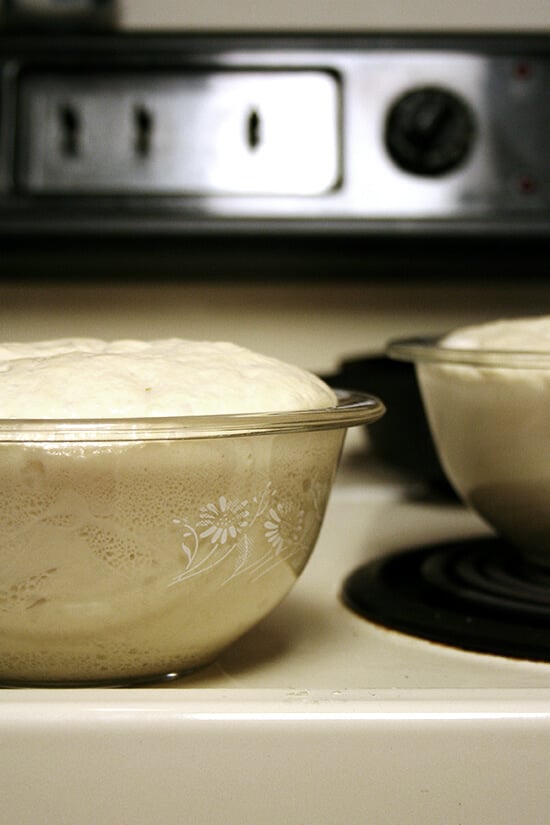
Let the dough rise again until it crowns the rim of the bowl, about 30 minutes.
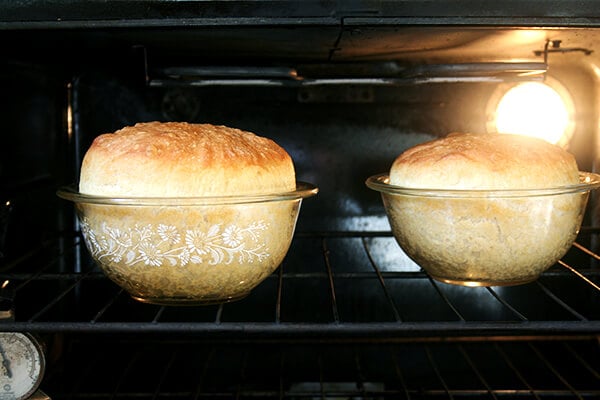
Transfer the bowls to the oven to bake:
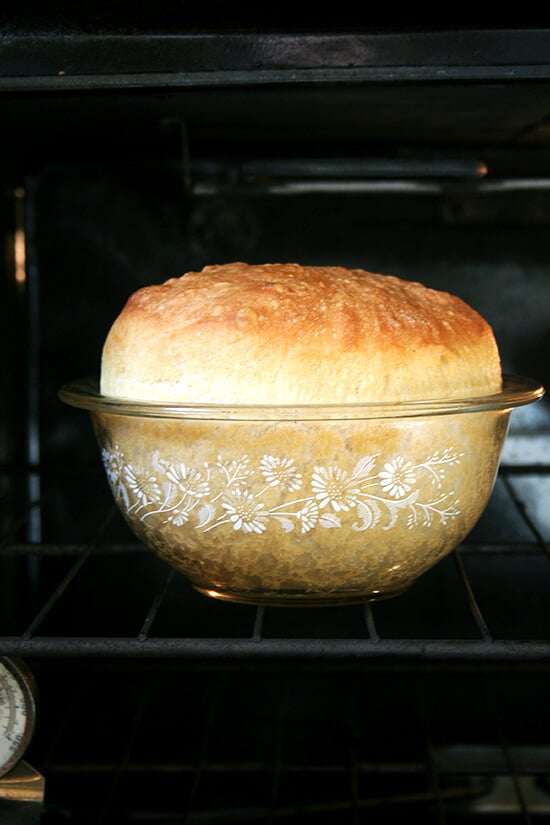
This bread is irresistible when it’s freshly baked, but it also makes wonderful toast on subsequent mornings as well as the best grilled cheese and sandwiches of all kinds.
My Mother’s Peasant Bread: The Best Easiest Bread You Will Ever Make
- Total Time: 2 hours 27 minutes
- Yield: 2 loaves 1x
Description
Notes:
This is a sticky, no-knead dough, so, some sort of baking vessel, such as pyrex bowls (you need two 1-qt bowls) or ramekins for mini loaves is required to bake this bread. See notes below the recipe for sources. You can use a bowl that is about 2 qt or 2 L in size to bake off the whole batch of dough (versus splitting the dough in half) but do not use this size for baking half of the dough — it is too big.
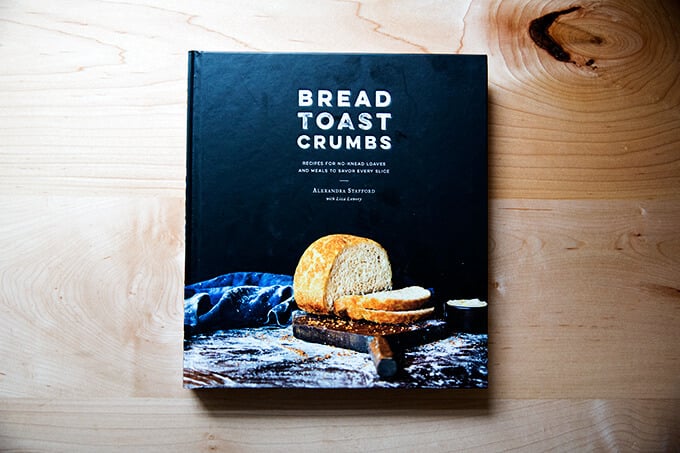
Peasant Bread Fans! There is a book: Bread Toast Crumbs, a loaf-to-crumb bread-baking book, filled with tips and tricks and answers to the many questions that have been asked over the years. In the book you will find 40 variations of the master peasant bread recipe + 70 recipes for using up the many loaves you will bake. Learn more about the book here or buy it here.
Ingredients
- 4 cups (512 g) unbleached all-purpose or bread flour
- 2 teaspoons (10 g) kosher salt
- 2 cups (454 g) lukewarm water (made by mixing 1.5 cups cold water with 0.5 cup boiling water)
- 2 teaspoons (8 g) sugar
- 2 teaspoons (8 g) instant yeast, I love SAF Instant Yeast, see notes below
- room temperature butter, about 2 tablespoons
Instructions
- Mixing the dough: In a large mixing bowl, whisk together the flour, salt, sugar, and instant yeast (I love SAF Instant Yeast). Add the water. Mix until the flour is absorbed. (If you are using active dry yeast, see notes below.)
- Let it rise. Cover bowl with a tea towel or plastic wrap and set aside in a warm spot to rise for at least an hour. (In the winter or if you are letting the bread rise in a cool place, it might take as long as two hours to rise.) This is how to create a slightly warm spot for your bread to rise in: Turn the oven on at any temperature (350ºF or so) for one minute, then turn it off. Note: Do not allow the oven to get up to 300ºF, for example, and then heat at that setting for 1 minute — this will be too hot. Just let the oven preheat for a total of 1 minute — it likely won’t get above 100ºF. The goal is to just create a slightly warm environment for the bread.
- Preheat the oven to 425ºF. Grease two 1-qt or 1.5-qt oven-safe bowls (see notes below) with about a tablespoon of butter each. Using two forks, punch down your dough, scraping it from the sides of the bowl, which it will be clinging to. As you scrape it down try to pull the dough toward the center (see video below for guidance). You want to loosen the dough entirely from the sides of the bowl, and you want to make sure you’ve punched it down. Then, take your two forks and divide the dough into two equal portions — eye the center of the mass of dough, and starting from the center and working out, pull the dough apart with the two forks. Then scoop up each half and place into your prepared bowls. This part can be a little messy — the dough is very wet and will slip all over the place. Using small forks or forks with short tines makes this easier — my small salad forks work best; my dinner forks make it harder. It’s best to scoop it up fast and plop it in the bowl in one fell swoop. Some people like to use flexible, plastic dough scrapers for this step.
- Let the dough rise again for about 20 to 30 minutes on the countertop near the oven (or near a warm spot) or until it has risen to just below or above (depending on what size bowl you are using) the top of the bowls. (Note: Do not do the warm-oven trick for the second rise, and do not cover your bowls for the second rise. Simply set your bowls on top of your oven, so that they are in a warm spot. Twenty minutes in this spot usually is enough for my loaves.)
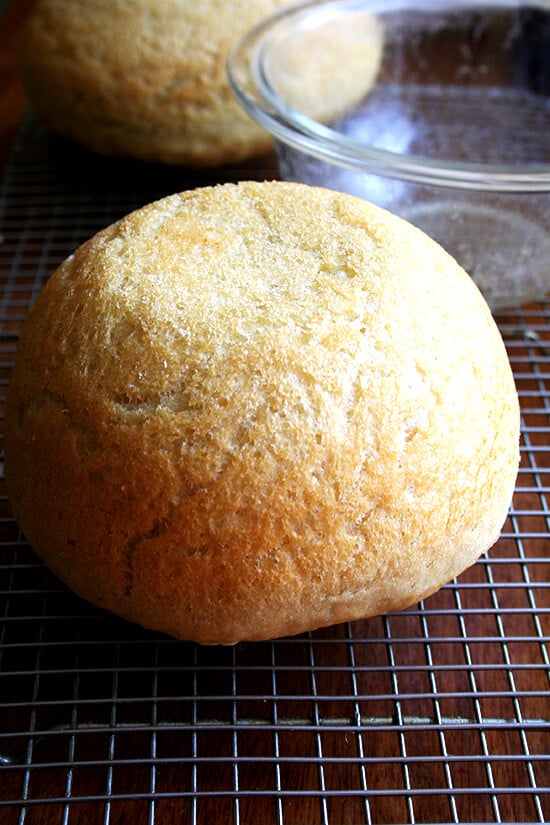
- Bake it. Bake for 15 minutes. Reduce the heat to 375º and bake for 15 to 17 minutes longer. Remove from the oven and turn the loaves onto cooling racks. If you’ve greased the bowls well, the loaves should fall right out onto the cooling racks. If the loaves look a little pale and soft when you’ve turned them out onto your cooling racks, place the loaves into the oven (outside of their bowls) and let them bake for about 5 minutes longer. Remove from oven and let cool for 10 minutes before cutting.
Notes
- The bowls: The cheapest, most widely available 1-qt bowl is the Pyrex 322. Update: These bowls are becoming harder to find and more expensive. Here’s another option: the Pyrex 3-piece set. You can split the dough in half as always (see recipe) and bake half in the 1-quart bowl and half in the 1.5 quart bowl. The loaves will not be the same shape, but they will be delicious nonetheless. This Anchor Hocking set is another great option.
- Yeast: I buy SAF Instant Yeast in bulk from Amazon I store it in my fridge or freezer, and it lasts forever. If you are using the packets of yeast (the kind that come in the 3-fold packets), just go ahead and use a whole packet — It’s 2.25 teaspoons. I have made the bread with active dry, rapid rise, and instant yeast, and all varieties work. The beauty of instant yeast is that there is no need to “proof” it — you can add the yeast directly to the flour. I never use active-dry yeast anymore.
- If you have active-dry yeast on hand and want to use it, here’s how: In a small mixing bowl, dissolve the sugar into the water. Sprinkle the yeast over top. There is no need to stir it up. Let it stand for about 10 to 15 minutes or until the mixture is foamy and/or bubbling just a bit — this step will ensure that the yeast is active. Meanwhile, in a large bowl, whisk together the flour and salt. When the yeast-water-sugar mixture is foamy, stir it up, and add it to the flour bowl. Mix until the flour is absorbed.
- Troubleshooting: You can find step-by-step video instruction here.
- Several commenters have had trouble with the second rise, and this seems to be caused by the shape of the bowl they are letting the dough rise in the second time around. Two hours for the second rise is too long. If you don’t have a 1-qt bowl, bake 3/4 of the dough in a loaf pan and bake the rest off in muffin tins or a popover pan. The second rise should take no more than 30 minutes.
- Also, you can use as many as 3 cups of whole wheat flour, but the texture changes considerably. I suggest trying with all all-purpose or bread flour to start and once you get the hang of it, start trying various combinations of whole wheat flour and/or other flours.
- The single most important step you can take to make this bread truly foolproof is to invest in a digital scale. This one costs under $10. If you are not measuring by weight, do this: scoop flour into the measuring cup using a separate spoon or measuring cup; level off with a knife. The flour should be below the rim of the measuring cup.
- Here’s a printable version of this recipes that’s less wordy: Peasant Bread Recipe, Simplified
- How to Bake the Peasant Bread in a Dutch Oven: Preheat a Dutch Oven for 45 minutes at 450ºF. Dust a clean work surface with flour. After the first rise, turn the dough out onto the floured surface and shape it into a ball: I like to fold it envelope style from top to bottom, then side to side; then I flip it over and use the pinkie edges of my hands to pinch the dough underneath and create some tension. Transfer the dough to a sheet of parchment paper. Let rest for 20 minutes. If you feel your dough is spreading too much you can lift up the sheet of parchment paper, dough and all, and place it in a bowl of a similar size. After the 20 minutes, transfer the dough, parchment paper and all to the Dutch oven. Carefully cover it. Bake 30 minutes. Uncover. Bake 15 minutes more.
- To bake the peasant bread in a loaf pan: If you are using an 8.5×4.5-inch loaf pan or a 9×5-inch loaf pan, you can bake 3/4 of the dough in it; bake off the rest of the dough in ramekins or other small vessels … the mini loaves are so cute. You can also make 1.5x the recipe, and bake the bread in 2 loaf pans. If you have a large loaf pan, such as a 10×6-inch loaf pan, you can bake off the entire batch of dough in it. For loaf pans, bake at 375ºF for 45 minutes.
- How to Bake at Hight Altitude:
- First try the original recipe as written (preferably with a scale). You may not need to make any adjustments. One commenter, who lives at 9200 ft finds the original recipe to work just fine as is.
- If the original recipe doesn’t work, try adding a little bit more water because it rises fast and it is so dry: about a quarter cup for every 512 g of flour.
- Try decreasing the yeast to 1.5 teaspoons.
- If your dough is especially gooey, try decreasing the water by 1/4 cup. But, if you aren’t using a scale, my first suggestion would be to buy a scale and weigh the flour, and make the bread once as directed with the 2 cups water and 512 grams flour, etc.
- Punch the dough down twice before transferring it to the buttered Pyrex bowls. In other words, let it rise for 1-1.5 hours, punch it down, let it rise again for about an hour, punch it down, then transfer it to the buttered bowls.
- Variations:
- #1. Cornmeal. Substitute 1 cup of the flour with 1 cup of cornmeal. Proceed with the recipe as directed.
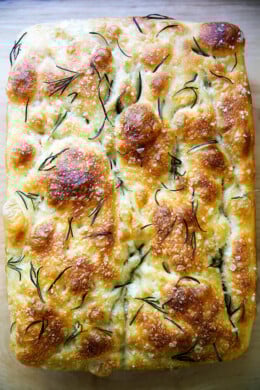
- #2. Faux focaccia. Instead of spreading butter in two Pyrex bowls in preparation for baking, butter one 9×9-inch glass baking dish and one Pyrex bowl or just butter one large 9×13-inch Pyrex baking dish. If using two vessels, divide the dough in half and place each half in prepared baking pan. If using only one large baking dish, place all of the dough in the dish. Drizzle dough with 1 tablespoon of olive oil (if using the small square pan) and 2 tablespoons of olive oil (if using the large one). Using your fingers, gently spread the dough out so that it fits the shape of the pan. Use your fingers to create dimples in the surface of the dough. Sprinkle surface with chopped rosemary and sea salt. Let rise for 20 to 30 minutes. Bake for 15 minutes at 425ºF and 17 minutes (or longer) at 375ºF. Remove from pan and let cool on cooling rack.
- #3. Thyme Dinner Rolls
- #4 Gluten-free
- #5. Everything Bagel Seasoning Bread. Simply coat the buttered bowls with everything bagel seasoning. Other seeds and seed mixes work, too, like sesame seeds and dukkah.
- #6: Whole Wheat Peasant Bread. Use as much as 50% whole wheat flour.
- Prep Time: 5 minutes
- Cook Time: 32 minutes
- Category: Bread
- Method: Baked
- Cuisine: American
This post may contain affiliate links. Please read my disclosure policy.





7,129 Comments on “My Mother’s Peasant Bread: The Best Easiest Bread You Will Ever Make”
Any idea if this can be done with a good gluten-free flour blend? I miss bread soooo much since I had to go gluten-free.
Mere — A few people have tried but without much success. I have been meaning to try with c4c flour — I will report back if I make any discoveries.
This recipe is awesome!! It is great with some dill weed mixed it or cracked pepper and a little shredded cheddar! Also good with some Italian spices mixed in! Used this recipe to make treat baskets for several friends for Christmas, it was greatly appreciated since most people give cookies and sweets for the holidays!! My baskets contained a large loaf of this wonderful bread, a cheese ball, and a hickory farms beef stick!! Thanks so much for this wonderful recipe!!
Melissa — so happy to hear this! Love all of your variations as well as the sound of your gift baskets. I think non-sweet treats are always a welcomed change at the holidays!
I am making this bread as I type this and I am kinda worried that it won’t turn out right. Because when I mixed the water mixture with the flour the dough wasn’t “wet”. I had to hand knead it to get all the flour to absorb with the liquid. The dough looked really dry to me.
I am hoping I am worrying for nothing but if this doesn’t turn out do you have any tips for making the dough wetter? Should I have added more water? I followed your instructions to a T.
Heidi — this has happened to a number of people — your four cups measured using dry measuring cups is probably more flour than the four cups I measure using my scale. What I have suggested to others is to measure 4 scant cups of flour, or to measure 3 cups of flour and to slowly incorporate the last cup of flour after you have mixed the water-yeast-sugar mixture with the flour-salt mixture. Others have added a few additional tablespoons of water to make the dough a little wetter, and that has worked for them. Hope this turned out for you!
Made this bread and LOVE it. I’ve been enjoying it with just a little basil pesto spread on it (not toasted). Amazing, already referred three friends to your recipes! Thanks so much for sharing.
Lisa — wonderful to hear this and thank you so much for referring friends — you are too kind! Love the idea of basil pesto on this. Seriously, in the summer, this bread, with a little pesto, a ripe tomato, some fresh mozzarella…heaven!
googleBaked cornbread today, rose nicely, but doesn’t’ look like it rose to the same height before baking. How large are your bowls, perhaps chipmakers a difference. Haven’t had a taste yet, but it smells good.
Marianne — Hi, and I see your note about peasant bread vs. corn bread… no worries. I use 1 qt Pyrex bowls. What size did you use?
I have done a lot of no-knead sourdough baking. It is just too cold in my kitchen right now to support the mother. This is a welcome and delightful substitute. My house smells wonderful and my guys are happy. The crust is just crispy enough and the crumb is not too dense! I used a 11/2 qt corningware casserole and a 11/2 qt pyrex bowl.
Amy — wonderful to hear this! Love a house that smells like bread baking 🙂
Did not mean corn bread, but peasant bread.see previous note.
I’m currently making this and added two table spoons of honey! Hoping it doesn’t mess it up. I was just really craving honey haha
OMG! I have tried so many times to make bread without any luck… but this one turned out great! we are only 2 in my house so I cut the recipe in half and it turned out great… I had the same issue of the dough not looking “wet” but after the first rise it got much better! Thank you for the oven idea!!!
Thanks for your answer, mint were 2 quart Pyrex. Think I willful all dough in 1 next time.
Any word on the freezing?
April, hi, did you ask a question about freezing? So sorry if I missed it. I replied to Vicky’s questions a few days late:
Vicky — I haven’t tried freezing the dough, but I think it’s worth a shot. After you punch down the dough (after the first rise), I would wrap one half in plastic wrap and stick it in the freezer. When you are ready to bake it, I would grease your bowl very well with butter, plop in the frozen dough, and let it rise in a warm spot until it’s just below the rim. Report back if this works out for you. The bread does freeze well after you bake it, too. I always slice up one of the loaves and wrap it in plastic wrap and stick it in a ziplock bag. It toasts up really nicely. Hope that helps!
I read through the comments and I’m sorry if anybody has asked this, but I have never seen bowls like these before that you can put in the oven. Do you know where I can buy them? Thank you!
Hey Nicole — I think almost all Pyrex bowls are ovensafe, but it usually says so on the bottom of the bowl (although mine doesn’t say either way) so check first. These bowls can be found at places like Bed, Bath and Beyond, and Amazon and Ebay and flee markets. One REader passed along this link, too: https://www.shopworldkitchen.com/pyrex/mixing-bowl-5302485 Hope this helps!
I just wanted to say thank you… I was very hesitant to make it but decided to give it a shot anyways. I didn’t realize my flour was bleached however. That doesn’t change the fact that this bread is DELICIOUS!!! I had to make it again to verify I wasn’t going crazy. Its so simple yet so yummy! My husband every requested I make it again. I’m the kind of person who has to eat like a pound of butter on my bread… I prefer this bread plain with nothing on it… so thank you again!!!!!!!!!
Alexa — I am so so happy to hear this! I don’t know why my bleached flour variations didn’t turn out so well… I might have to try a different brand of bleached flour and then modify my notes, bc people should know that bleached flour will in fact work. Thanks for writing in! So glad the husband approves of the bread too!
Just had a thought as I was eating my toast, your toast!, with homemade blood orange marmalade this morning…what a great gift it would be: a pyrex bowl, a pound of graham flour, the recipe, and maybe a cute flour sack towel. A gift I would love to receive! I am making this bread every Sunday afternoon and just love it. Thanks again for sharing it.
Shannon — that is a great idea! I might have to do a giveaway sometime with that little package. Thanks so much for writing in!
Try a grilled cheese with this bread! Or toast. It gets so crunchy and yummy. This is the best bread Ive ever made. And super easy. Two of us ate a loaf each in 5 days. I made two more loaves today.
Janie — so happy to hear this!
Hi!
I made the bread today. It came out beautiful on top. When I turned it out, the bottoms were not browned yet so I put them back in the oven, upside down for 5 minutes. While in the oven, the bottoms sank in…I was so sad! They had such promise. Any idea what I did wrong?
Thanks so much!
Leah
Leah — so sorry to hear this. I think, unfortunately, and I am sure you followed the instructions regarding the time, so you are not to blame, that you turned them out a little too early. I would have done exactly what you had done — placed them upside down directly on the rack — and let them cook for 5 to 10 minutes longer, so your instincts were right. Recently, I have had better luck achieving a nice golden exterior on all sides by baking them loaves for 15 minutes at 425F and then 17 to 18 min at 375. If you feel like giving the recipe another shot, try that timing, and if you turn the loaves out and they still look underdone, place them back in their bowls and continue baking them in their bowls for about 5 to 10 min longer. Sorry for the trouble. I do hope you try the recipe again.
I am so excited! My first two loaves are in the oven now! Cant wait to see if they taste as good as you say! I used 2 of my smaller loaf pans, I dont have the appropriate size bowls yet. But will be looking for some this week!
Kendall — I hope they turned out well for you!
I just made cinnamon monkey bread with this recipe and it was fantastic. Before the second rise, I buttered 2 loaf pans. I also melted a stick of butter in the microwave in one bowl with approximately a tsp of vanilla and mixed cinnamon sugar in another. I separated the dough into 2 even pieces as your recipe directed. I started pulling half dollar size pieces of dough off and then rolled them in the butter and cinnamon sugar. It only made about 2 layers in each pan but they rose almost to the top after an hour for the second rise. I baked as directed and then pored the remaining butter over each loaf when they were done. Yummy!
Moon Mama — OMG, you are making me drool. Seriously. I have never made monkey bread, and your recipe just sounds too fantastic. I have to make that soon. Thanks for the detailed instructions. If I new I could have used my mother’s peasant bread for monkey bread all these years, monkey bread would probably be a staple in our house 🙂 yum!
I’ve been trying recipes for no knead breads. They are turning out just “OK”, not great.
I am anxious to try this recipe, but am wondering about not using bleached all purpose flour. Will it make a big difference in how it turns out?
Erma — well, I made that note about bleached flour bc I wasn’t happy with two loaves that I made using bleached flour, but a recent commenter said that she’s use bleached flour twice now with great success. So, I don’t really know how to advise. I suppose if you are used to using bleached flour, then go for it, but if you are not, then stick to using unbleached flour. I seem to have the best results with King Arthur unbleached bread or all-purpose flour.
We love it. We started making this bread about a month ago, and have made it several times. We stick a thermometer in it and ensure that the inside of the bread is at about 200 degrees before taking it out.
Andi — wonderful to hear this! And I am so impressed by your thermometer usage. I need to invest in a good thermometer — I’ve been meaning to do so for a long time.
Alexandra, thanks for the reply regarding the type of flour. i did get the unbleached. I made the bread and it turned out SOOOOOO good. Thanks for a wonderful recipe. Now, I’m wondering what is the best way to store the bread. IF there is any left to store. Do you use plastic bags or a cloth bread bag? I’ve read that with the artisan no knead bread that it is best in a cloth bag or wrapped in a tea towel. I’m curious what you use.
Erma — wonderful to hear this! I actually just use ziplock bags. When I freeze the bread, I slice it (once it is completely cool), and then wrap 5 or 6 pieces together in plastic wrap and stick the bundles of wrapped slices in a ziplock bag and then stick the bag in the freezer. If I think it will get eaten within a couple of days (which it usually does), I just keep the loaves whole (unsliced) and store them in ziplocks on the counter. Hope that helps!
I have never made bread before. I have always been too intimidated with bread recipes because they always seemed too vague. Your recipe and pics made it seem possible that I could attempt to be a bread maker. I just took my second batch of your bread out of the oven! It is really good. I feel like like I have made a major accomplishment. lol. My teenage daughter is really impressed too. Thanks for posting this!!
Do you think it would make a difference if I used Bread flour (that I have for my bread machine recipes)? I also have bread machine yeast, but I don’t think I would bother with that for your recipe.
Also, have you tried any “mix-ins” ie. cranberries & orange zest or cheeses and rosemary-or is it better left as a good white bread.
Love this recipe-can’t wait for the weekend to try it!!!!
Thank you!
DeerPark Mama — is bread flour for bread machines any different than regular brad flour found in the baking aisle? If it isnt, then go for it, otherwise I don’t know how to advise. I’m not familiar with. Wad machines 🙁
And while I have not tried any mix-ins, lots of commenters have, and the mix-ins have ranged from herbs and cheese to jalapeños and dried fruit, so all of the ideas you are thinking about sound wonderful! Have fun with it!
Hi !!
I came across your bread recipe 3 days ago and couldn’t wait to make a batch of my own. I tried the bread yesterday and I’m a fan !!!
I love the bread….my husband refuses to buy any more bread from the market :)….we all love it sooo much !!!
Thank you for sharing this wonderful recipe.
Cheers !!
Gauri — wonderful to hear this! So glad you like it. Happy baking!
This has become my new go-to bread recipe. My hubby pouts if we run out! He doesn’t want me to buy bread anymore, which is fine, because this bread is so delicious and so easy to make!! Thanks for sharing – I’m sure we’ll be eating this bread for years to come.
I just had to write another post to thank you again for sharing this recipe. I have used it so many times since finding it. Today, I am making the cornmeal variation to go with a ham and corn chowder. As I was reading about the variation, I found your suggestion about measuring flour. I had read that a couple of times but didn’t quite “get it” until I saw a video on the King Arthur’s flour website about how to measure flour. I always had to add more water to this recipe as it was never sticky. Anyhow…I see you already explained that to me and it just didn’t click. I kept seeing the “level off with a knife” and I was doing that! I guess I am visual. When I saw the video, I had a huge aHA! moment. Also, your tip about the perfect temp water is priceless!!! I have since become a baker. I am no longer afraid of yeast. You are brilliant.
This bread is amazing but every time I make it I have to add more water because there’s not even enough liquid to soak up all the flour, I’m using 4 cups flour and 2 cups water like you state, any tips??
I literally just got done making this bread, it was also my very first time making bread. And oh my goodness was it good! It came out perfect and looked exactly like the pictures. Thanks for the recipe!
I.Love.Your.Bread — so happy to hear this. Really. Nothing could make me happier.
OMG!! i made this bread today and it is the best bread i have ever made! i have made some fairly good recipes that i have taken from Pinterest but this has to be the best recipe i have found and made yet!! thank you!! i will definitely be making it again. i also need to add that it is so easy, too..
I’ve tried a few no-knead recipes, and this one is our new favorite! Thank you for sharing!!! 🙂
Wonderful to hear this, Megan!