 →
→ 

Jim Lahey’s No-Knead Bread
 By Alexandra Stafford
—
Last Updated: 01/30/2026
By Alexandra Stafford
—
Last Updated: 01/30/2026
This post may contain affiliate links. Please read my disclosure policy.
Crusty, airy, bakery-style bread in your home kitchen? Yes. You. Can. This dough takes 5 minutes to stir together, and from there, time does the work. If you love a rustic boule for dipping in your soup or toasting and slathering with butter and jam for breakfast, this recipe is for you.
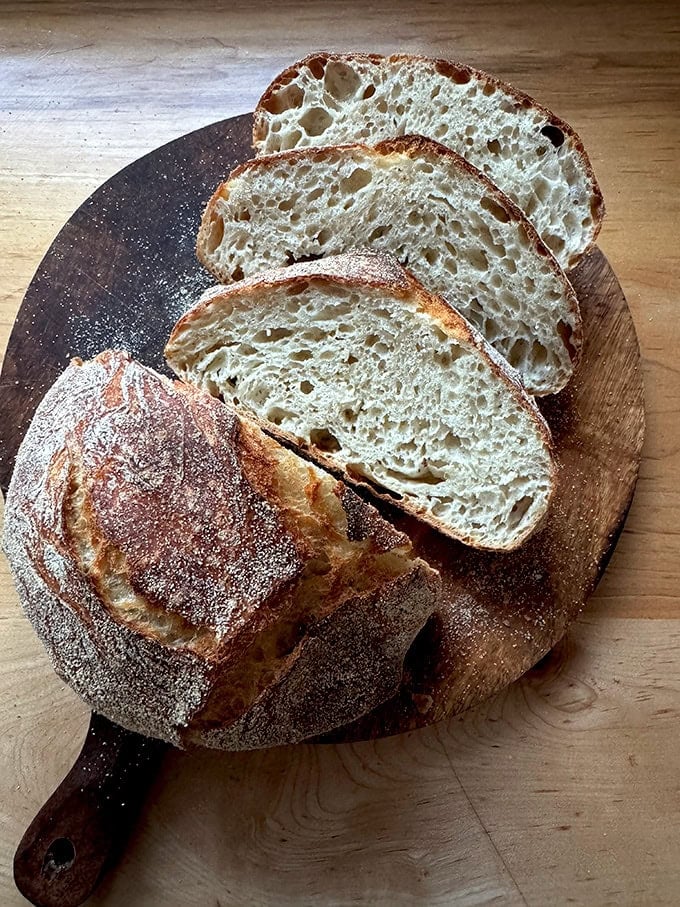
If you’ve spent any time toiling over a loaf of sourdough bread, making Jim Lahey’s no-knead bread will feel like a breath of fresh air. This recipe calls for a very simple mixing and shaping process, requiring little equipment and skill.
The bread emerges crusty and cornmeal-dusted, with a light, airy crumb. Why does this recipe work?
First: time. During the long, slow rise, both gluten and flavor develop.
Second: the baking method. This dough bakes in a Dutch oven, covered first, then uncovered. When the pot is covered, water in the dough evaporates and transforms into steam. Both the carbon dioxide gas in the dough and the steam push against the gluten structure, causing the dough to spring. During the last 15 minutes of baking, when the lid is removed, and the bread is exposed to dry heat, the gelatinized surface of the dough dries out, forming a crackly crust. The cornmeal further promotes a crunchy exterior.
How to Make Jim Lahey’s No-Knead Bread, Step by Step
First gather your ingredients: flour (bread or all-purpose), salt, instant yeast (SAF is my preference), and water:
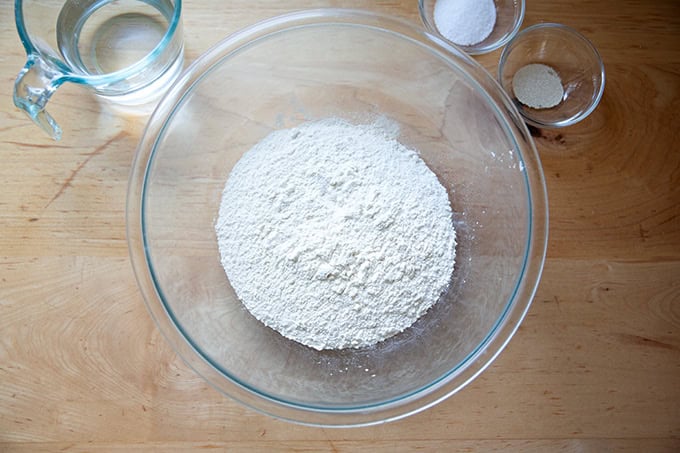
Combine the flour, yeast, and salt:
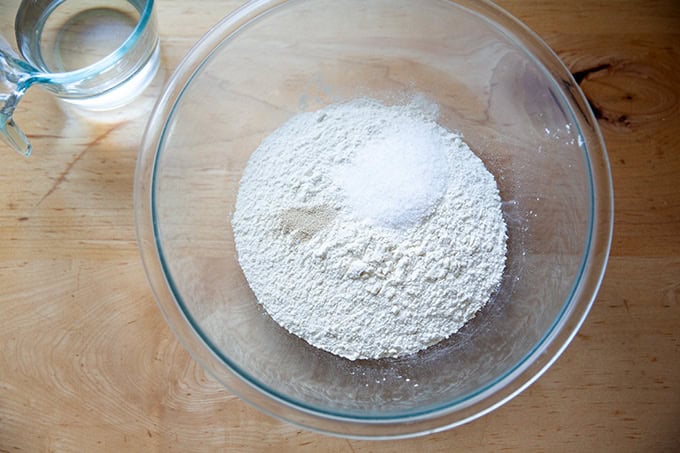
Whisk to combine, then add the water:
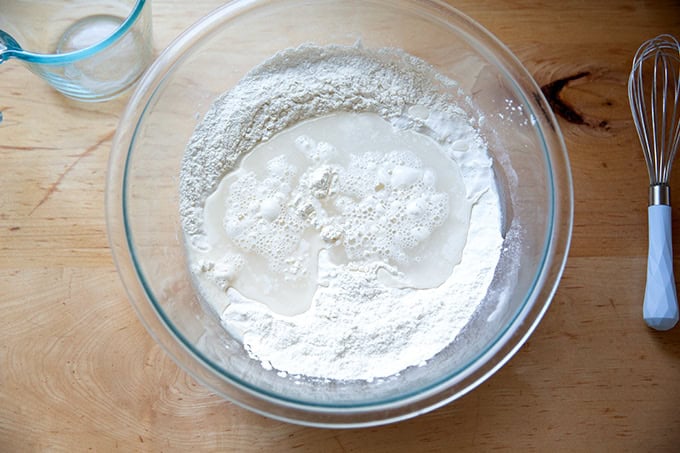
Stir until you have a sticky dough ball:
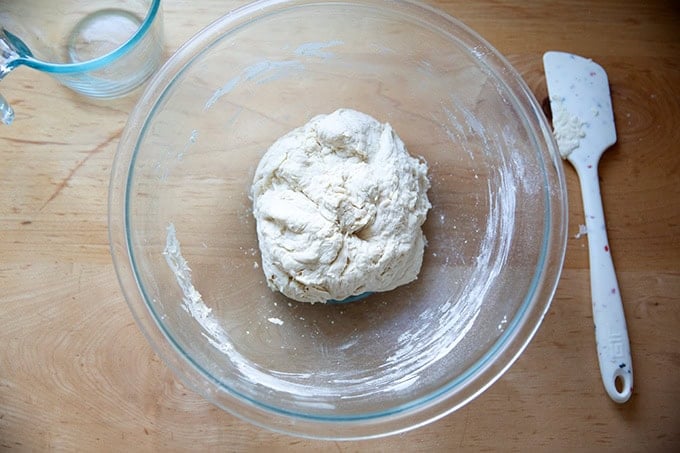
Cover the bowl. At this point, you can leave the dough untouched for 18 hours. Or, if time permits, in 15 to 20 minutes, you can perform one set of stretches and folds: simply grab an edge of the dough using a wet hand and stretch it up and in. Repeat this 8 to 10 times, grabbing a different edge each time. I find even performing just one set of stretches and folds gives my dough the teensiest bit more strength and ultimately a bit more loft.
Compare the difference between this dough after 18 hours, which experienced no stretches and folds:
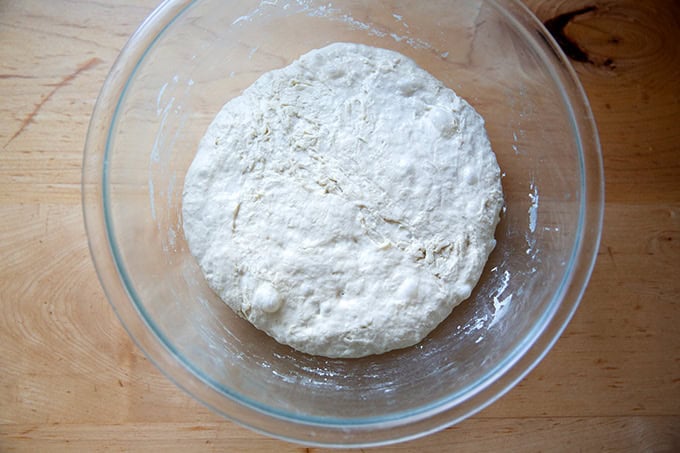
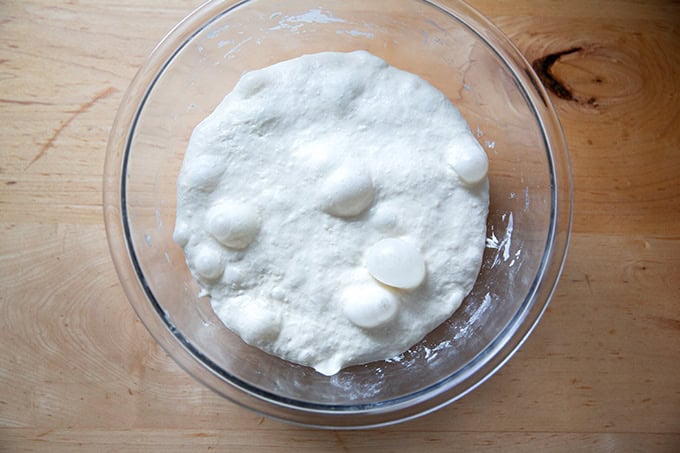
And this dough, also after 18 hours, which experienced one set of stretches and folds:
Turn the dough out onto a lightly floured work surface:
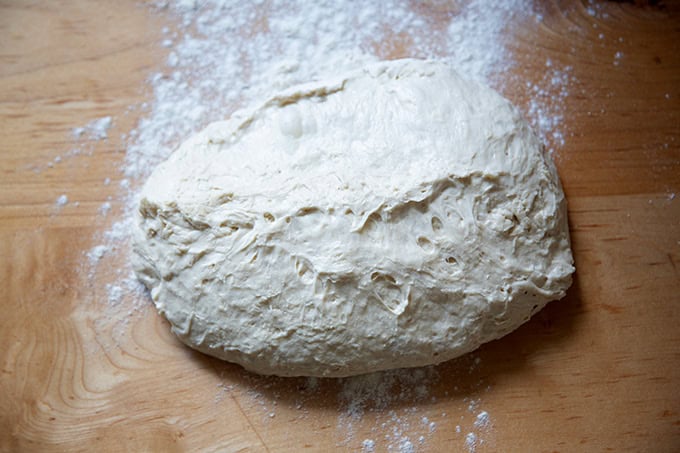
Then fold it into a rough ball:
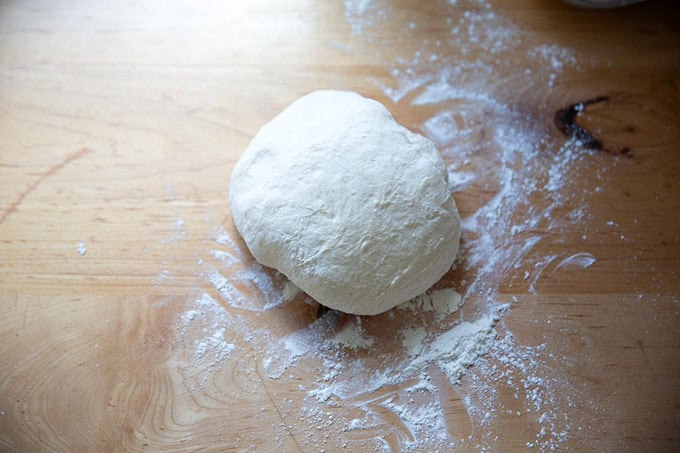
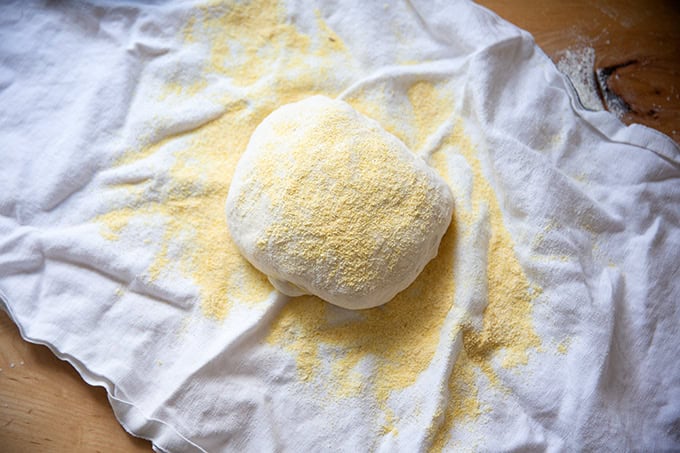
Lightly dust a tea towel or flour sack towel (I love these Flour Sack Towels) with cornmeal and place the shaped round cut side down on the towel. Sprinkle with more cornmeal:
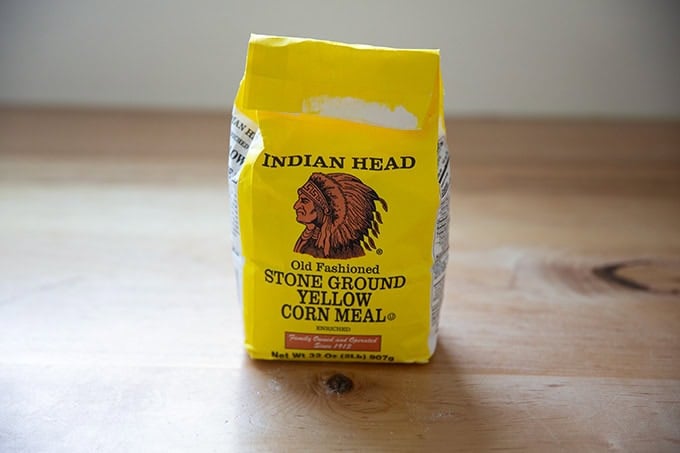
Incidentally, this is the cornmeal I buy:
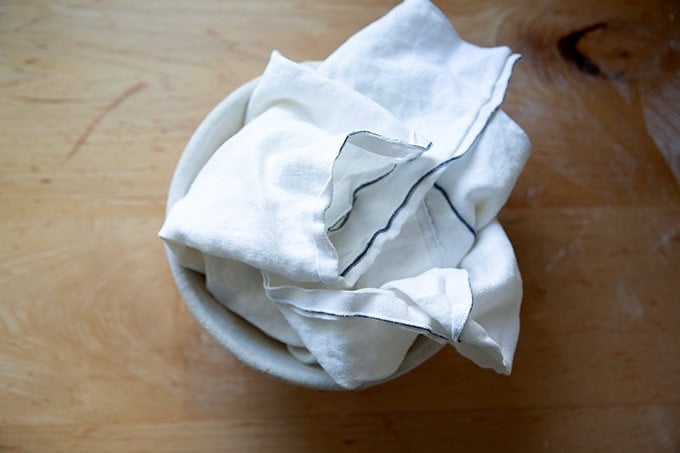
Wrap into a bundle and set in a small bowl (an 8-inch banneton or Pyrex bowl or anything similar) will work. Set aside to rise for 2 hours.
Forty-five minutes before you plan on baking, place a Dutch oven in your oven and preheat it to 450ºF. I’ve used my 5-Qt Lodge and my Challenger Bread Pan here with success.
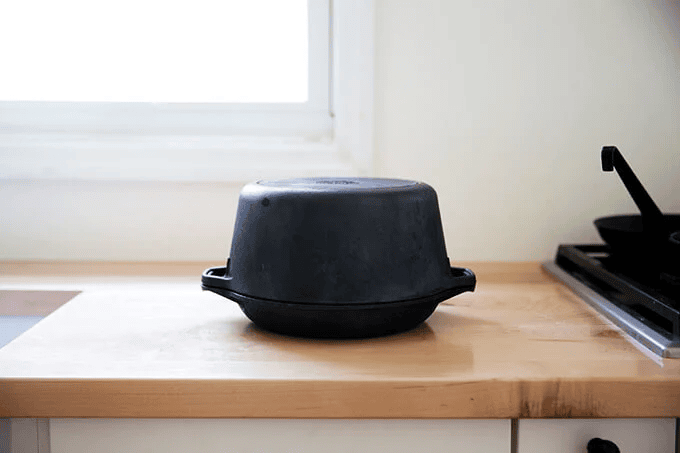
When you are ready to bake, open the towel, and remove the bowl.
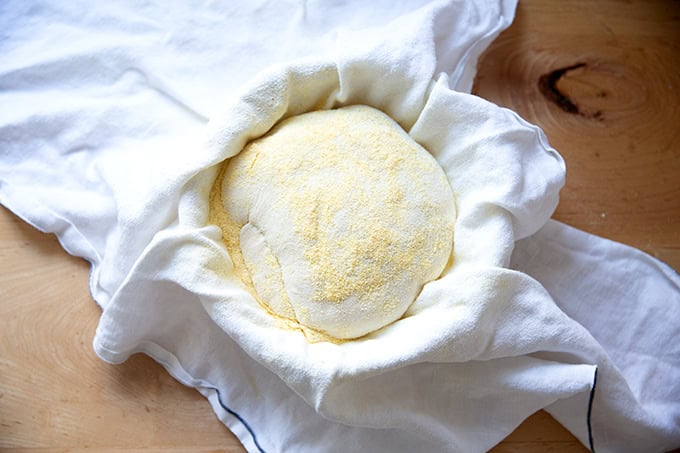
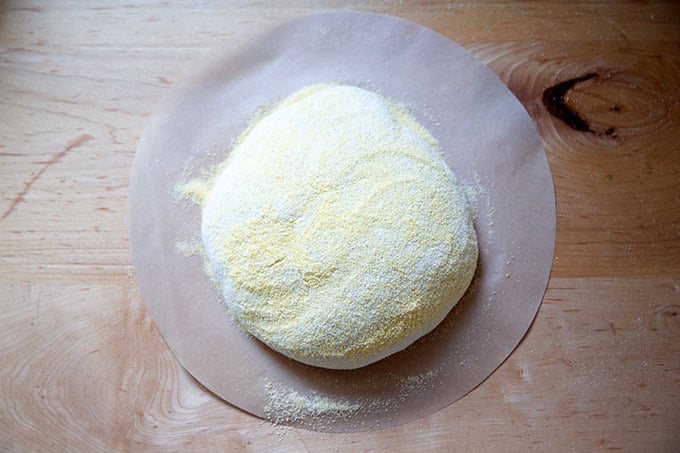
Lay a round of parchment over the top of the dough and lay one hand on top; then slide your other hand underneath the towel, and carefully flip the round onto the parchment, so that the seam side is up. (Note: The seam will be hard to see, but it will open up in the oven.) This will make a mess of cornmeal everywhere… simply sweep it away. I love these parchment rounds for both pizza and this bread.
Remove the Dutch oven from the oven and set it on a cooling rack. Remove the lid and carefully lower the bread, parchment paper and all into the pot:
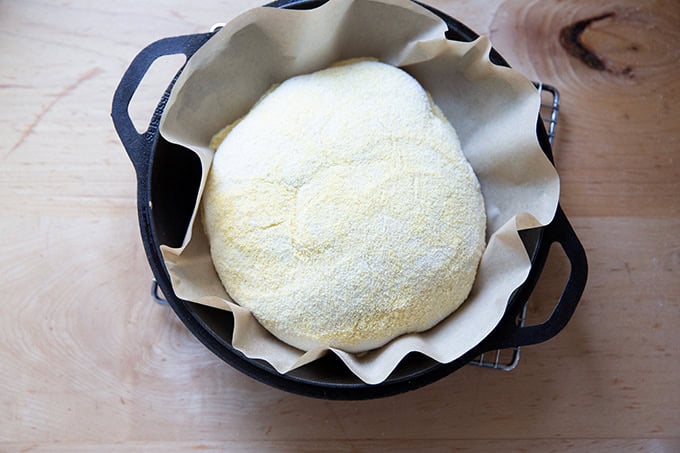
Cover the pot and transfer to the oven for 30 minutes. Then remove the lid:
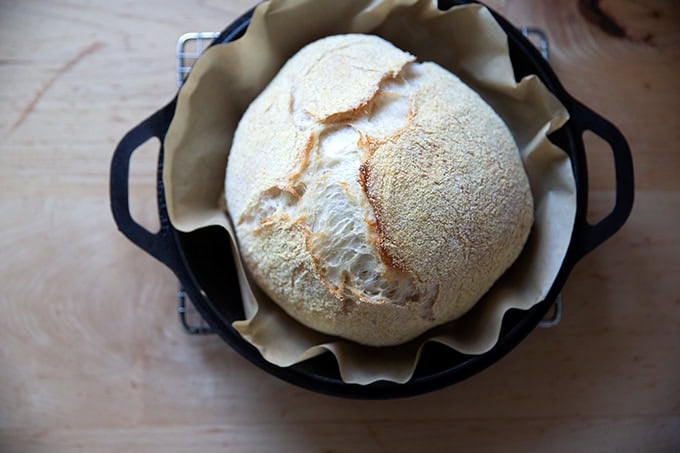
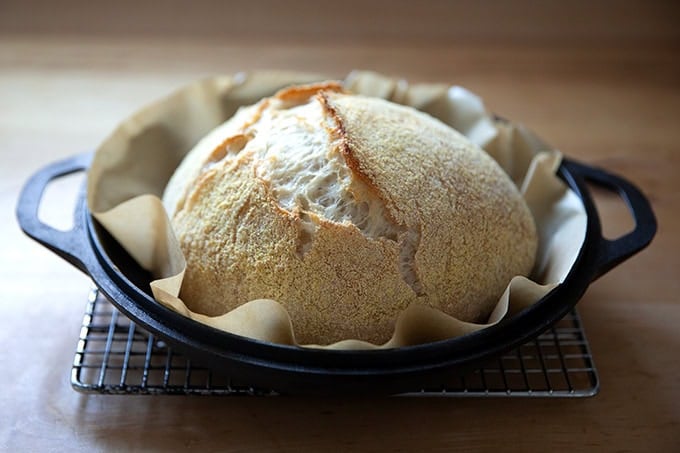
Return the pan to the oven for another 15 minutes or until browned to your liking:
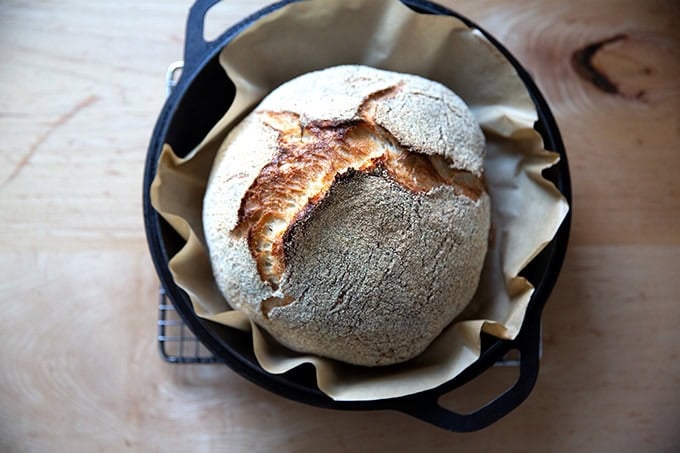
Transfer bread to a cooling rack and let cool for at least 30 minutes before slicing.
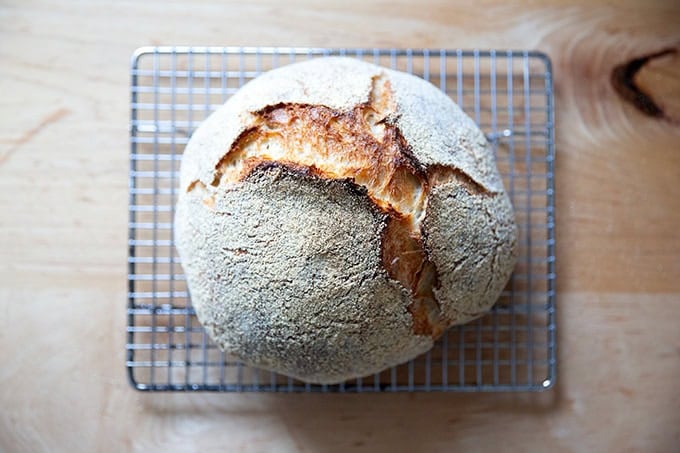
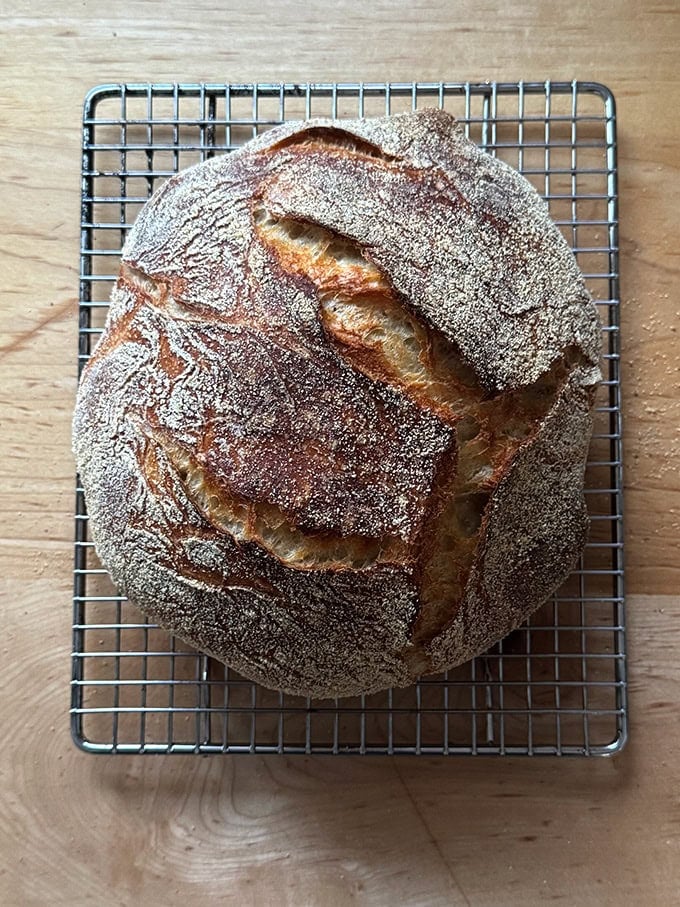
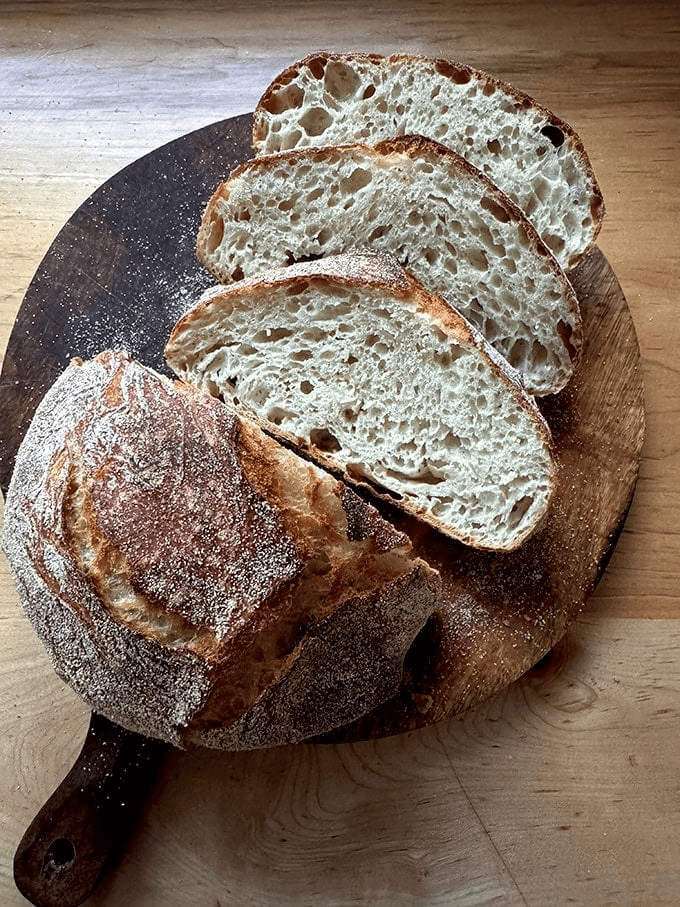
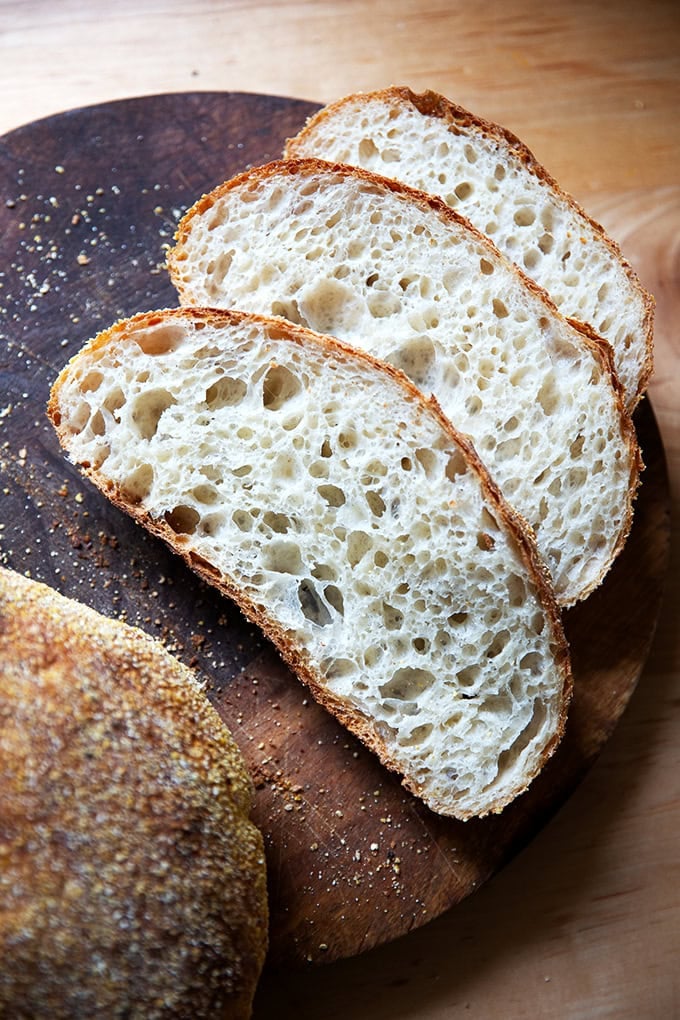
Look at that light airy crumb:
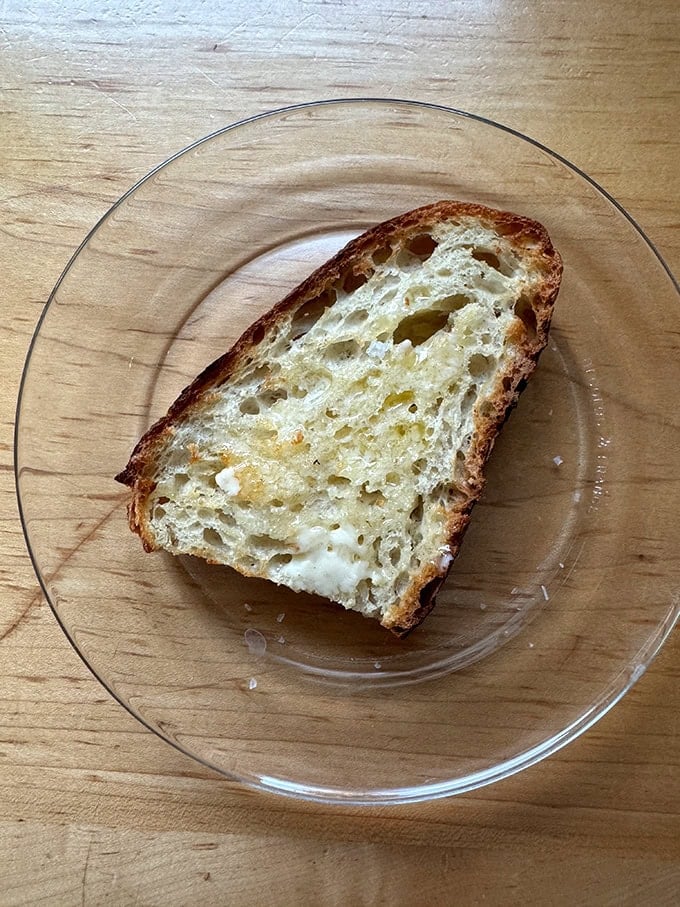
The no-knead loaf will feed a crowd but should you find yourself with leftovers, it makes delicious toast and freezes beautifully:
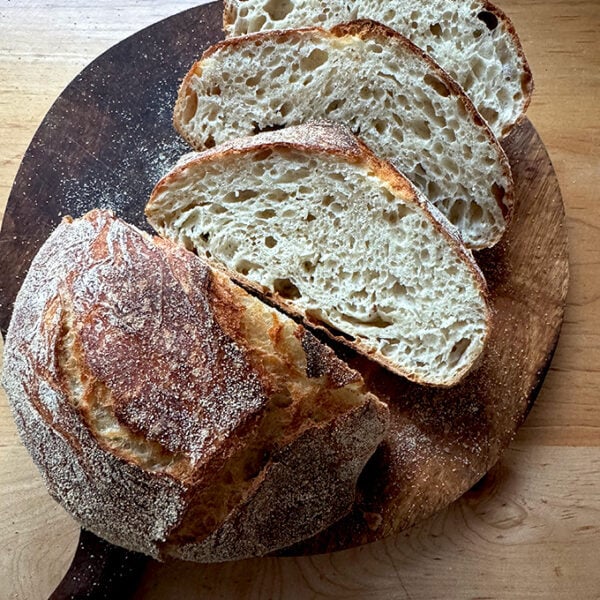
Jim Lahey’s No-Knead Bread
- Total Time: 22 hours
- Yield: 1 loaf 1x
Description
Crusty, airy, bakery-style bread in your home kitchen? Yes. You. Can. This dough takes 5 minutes to stir together, and from there, time does the work. If you love a rustic boule for dipping in your soup or toasting and slathering with butter and jam for breakfast, this recipe is for you.
Adapted from Mark Bittman’s “The Minimalist” column in The New York Times: Dining In November 8, 2006 / Recipe from Jim Lahey
Notes:
Flour/Salt: I’ve adjusted the recipe by adding a touch more salt than suggested in the article and converting the recipe to grams. The key here is to use roughly an 80% hydration dough, so regardless of how much flour you use, be sure the water amount is roughly 80% the amount of flour. Similarly, the salt should be roughly 2 to 3 % the weight of the flour, which for this recipe is 7 to 11 grams.
Time: Be sure to read the recipe through entirely before endeavoring to make this bread: you need 12-18 hours initially in rising time and 2 more hours subsequently for a second rise.
Equipment: You’ll need a lidded vessel to bake this loaf. I use my 5-qt Lodge Double Dutch Oven for this one. Parchment paper is helpful as well for transferring the dough from the towel to the preheated Dutch oven.
Ingredients
- 385 grams (about 3 cups) bread flour, plus more for dusting
- 1 gram (¼ teaspoon) instant yeast
- 11 grams (about 2 teaspoons) kosher salt
- 308 grams (about 1 5/8 cups) water
- Cornmeal, wheat bran, or oat bran as needed
Instructions
- In a large bowl, combine the flour, yeast, and salt. Add the water, and stir until blended. The dough will be sticky. Cover the bowl with plastic wrap and let rest for 12-18 hours at room temperature. (Note: Optional Step: If time permits, 15 to 20 minutes after you cover the bowl, perform one set of stretches and folds: simply grab an edge of the dough using a wet hand and stretch it up and in. Repeat this 8 to 10 times, grabbing a different edge each time. I find performing a set of stretches and folds gives my dough the teensiest bit more strength and ultimately a bit more loft. See photos in the post above.)
- After the 12 to 18 hours, or when the surface of the dough is dotted with bubbles, lightly flour a work surface and place the dough on it. Sprinkle a little more flour on the dough and fold it over on itself once or twice. Cover loosely with plastic wrap and let rest for about 15 minutes.
- Meanwhile, lay a clean kitchen towel (not terry cloth) on a counter or tabletop in a draft-free area. Generously coat it with cornmeal, wheat bran, oat bran, or any combination of the three. After the 15 minutes, using as much flour as necessary to keep the dough from sticking to your fingers and the work surface, quickly shape the dough into a ball and place seam side down in the center of the prepared towel. Dust with more cornmeal, wheat bran, or oat bran. If the towel is large enough, fold the sides up over the bread so that it is completely covered. Otherwise, cover it with another towel. Let rise for another 2 hours. (I like to set my towel-wrapped dough into a bowl or banneton to provide a little more support during these 2 hours.)
- Forty-five minutes before the dough is ready, preheat the oven to 450°F. Place a 6- to 8-quart heavy-covered pot (I use this Lodge Double Dutch Oven) in the oven while it heats. When the dough is ready, carefully remove the pot from the oven. Slide your hand under the towel and turn the dough over into the pot, seam side up. This is tricky — I find that parchment paper helps: open your towel, lay a sheet of parchment paper over the dough, place your hand on the parchment paper and carefully flip the dough over so that the seam side is up and the dough is resting on the parchment paper. Use the overhanging parts of the parchment paper as handles, then lay the bread, parchment paper and all, into the Dutch oven.
- Cover with the lid and bake for 30 minutes. Remove the lid and bake for another 10 to 15 minutes or until it sounds hollow when tapped. Remove from oven, and turn out onto a cooling rack.
- Prep Time: 5 minutes
- Cook Time: 45 minutes
- Category: Bread
- Method: Dutch Oven
- Cuisine: American
This post may contain affiliate links. Please read my disclosure policy.








194 Comments on “Jim Lahey’s No-Knead Bread”
Your no-knead bread sounds fabulous. I will make it as soon as the Emile Henry double oven arrives. I plan on making the bread for Christmas gifts. Your site is simply unbelievable and of course, it is bookmarked.
A
This is seriously the best bread ever. It is the first time my bread comes out the way i wanted it. I was worried about the second rise after reading the other comments, but had no problems. I did the second rise in the oven (twin eyelevel oven). It is also very hot here in South Africa at the moment so maybe that helped. Thank you so much for posting this recipe.
Marilize — so happy to hear this worked out for you! I wish it were as warm here as in South Africa! I’m not a winter person 🙂
Oops and now i see i posted this commented on the wrong recipe. Wanted to comment on the bread made in the Pyrex bowl. 🙂
I want to use whole wheat flour. Can I replace the bread flour 100% with whole wheat flour?
Appreciate a reply.
Thank you!
Hi Kathy! The dough will be very dense unfortunately. You could replace some of the flour with whole wheat flour (like a cup), but if you replace all of the flour, I think you will be disappointed.
I came late to this post. But it’s worth knowing that the method found on The Fresh Loaf website works just as well. It eliminates dealing with a schorching hot pot. You just put the loaf into a cold dutch oven for its final rise. When it’s risen, cover the pot and put it in a preheated oven. The loaf will rise abundant bake just as well as trying to get it into a hot pot. It will work well with your mother’s artisan bread too, and give it a crisp crust.
Jane, thank you for this!! What a smart idea to let the loaf make its second rise in the cold pot … can’t wait to try.
So good. So easy. Thanks for sharing this one. Next stop…the famous peasant bread!
Woohoo!! Makes me happy 🙂 🙂 🙂
I don’t have the types of pots mentioned – can I use a stainless steel pot?
I think as long as it’s oven safe and has a lid, you’re good to go!
A wonderful bc rusty bread and super easy!
My first rise was for 12 hours but would make it 18-24 hours next time. Added some fennel seeds for flavour and would try freshly cut rosemary next time. I didn’t use a cloth, I used parchment paper. I cooked it in my stainless steel big pot (with a baking sheet underneath) would use a slightly smaller pot next time to maintain the shape.
So happy to hear this, Deepa!
Hi. I am late to this site. But I tried your refrigeration technique for focaccia and it came out beautifully. Thank u for that! I am in Singapore and weather is always warm. Do u think it is ok to put this dough in fridge overnight and continue the first rise next day? Not sure how that affects total proofing time for first rise.
Yes, absolutely! I would increase the yeast to 1 teaspoon yeast if you are going to stick it in the fridge.
Why do flour the top of the dough before folding it onto itself? Seems like this would make it harder to stick it to itself and would add unnecessary flour to the center of rhe loaf??
It’s just to minimize the stickiness … you don’t have to do it if you are comfortable handling sticky dough.
I remember when the Lahey/Bittman article was published, I was so excited and set out to try it immediately. I had the same seam side flop but got a decent result. The hot pot idea always bothered me because I tended to get burned when I forgot I was a hot pot (during the pandemic I realized that came with not being a seasoned cook/Baker and now I rarely burn or cut myself by accident). Your peasant bread helped me get to a place that when I tried this again, I felt more comfortable with every step and had much better success. Bittman was my go to guy back then.
Bittman was my guy for soooo long. It was so sad when he left. Alas. Anyway, so great to hear you had success with this and that the peasant bread played a role in that. Somewhere, tucked in some cookbook no doubt, I still have that Wednesday New York Times food section featuring this recipe. Such a good one. Thanks for writing, Frank!
This recipe is so easy to make and so very delicious. I make it for people and share it with friends all the time. Everybody likes the taste and the consistency. Best recipe ever!
So nice to hear this, Jean 🙂 🙂 🙂 Thanks for writing!
Tried this twice and make bread often. Not enough yeast in recipe. I had to add 1 1/2 teaspoons??
Are you using instant or active dry yeast?
hello, thanks for the clear directions! I made this loaf and it came out really nice but i was not able to get an ear on it. It is about 80% hydration…
I did the first rise for 15 hours at room temp, then shaped it and proofed for 1.5 hours, then shaped it one more time and was able to form more tension the second time, and let this proof again for 1.5 hours. I scored the bread with a razor blade but it felt kind of pointless because it felt like a very wet dough and it was kind of warm. The bread came out nicely in my dutch oven and i got something like a very tiny micro-ear lol. I am really wanting to get an ear. Is 80% hydration too high to get an ear? Or should i incorporate the refrigerator at any point to help with firming up the dough before scoring? how would you alter the recipe/process if i wanted to end up with an ear? Thank you so much for your help
Also, if i want to incorporate the refrigerator at any point during this recipe, how should i do that? so i can have more control over the temperature if it is super hot/humid in my house during the summer, etc. how would this affect the amount of yeast / and timing of each step? Thank you!!
I think incorporating the fridge is your best bet. I would transfer the shaped bread to the fridge immediately after shaping it. I might consider lining a bowl or storage vessel with a sheet of parchment paper, placing the shaped round on it, covering it tightly — it should be air tight to prevent it from drying out — then on baking day (24 hours later or so), remove it once your oven has preheated, score it, and bake it immediately. In other words, score it cold, then bake it immediately… no room temperature rise after it comes out of the fridge.
Ok thank you so much for your very clear explanation, i will do it exactly how you said. by the way, in the summers my house gets super hot and humid. instead of a 12 hour rise at RT is there a way to make this dough and put it straight into the fridge for the first rise? Is there any way i can do an entirely fridge or at least mostly fridge bread? and then perhaps the final proof at RT? You have been the only source that i trust for making bread for years now! Lol. thanks again.
Hi! I think you potentially could do the rises in the fridge, but it is a much smaller amount of yeast (as opposed to my focaccia recipe) so the first rise will likely take much longer. If you’re OK with that go for it. I worry about the final proof at RT only because it might be hard to score. The beauty of scoring cold dough is that it’s easy to score and you might get a better ear.
Thanks for your kind words!
Question, I tried to focaccia bread recipe and it is amazing. I’m blown away, so I’m feeling a little more confident and I want to try this recipe for the best for per bread but I don’t need a loaf that feeds 10 people. It will go bad before it could possibly get used up in this house could I make half a recipe which clearly I could but how long would you bake it
I would bake it covered for 20 minutes; then uncovered for 15 to 20 minutes.
Hello, Alexandra and thank you for your website. I have been baking my own bread, rolls, and pizza dough since 1967 and then happened upon Jim Lahey’s recipes a few years ago (see his book, My Bread). It changed my entire way of baking bread. It also seems that this revolutionary approach (slow, no knead) has been adopted by every serious bread baker, whether using yeast or sour dough. Did Jim Lahey start this method or has it been around for hundreds or thousands of years? In any case, he does not add any sugar to his recipes (unless a sweet loaf) and neither have I. My breads rise wonderfully every time and the sugar is not needed. The simplicity of his approach and explanations, and the simplicity of his equipment, makes bread baking approachable and affordable for everyone who loves bread.
Agreed! I should revisit this recipe and omit the sugar — I never use sugar anymore with my slow-rise breads or sourdough breads. I don’t think Jim Lahey invented the slow-rise method, but he (and Mark Bittman) certainly popularized it.
Hi Ali….good morning from Broadstairs in Kent, UK. I sent a message yesterday about the wetness of the cinnamon brioche dough but baked it this morning. Wow! How fantastic! We loved every last crumb though we didn’t finish it all as it was too much for us. I take back the 3 stars and give it a definite 5, likewise this recipe for Jim Lahey’s bread which I’m about to put in the oven (second time around. the first time I made half quantity just to be sure and that’s all gone!) Love your website and have tried most of your bread recipes, all have been great! So just wanted to say thank you and keep up the good work. All the best, Jackie
Hi! And no worries at all — that brioche dough is very wet and can be tricky to handle. Also, I do think the UK flour absorbs water differently. When I’ve troubleshooted with people in the UK about bread recipes, so often the solution has been to hold back some of the water. So even though those brioche buns turned out well for you — which I’m so happy to hear! — you might still be able to hold back some of the water, which will make the process easier for you and will likely not affect the outcome noticeably. Thank you for your kind words 🙂 🙂 🙂 I’m goin to post your comment over on the cinnamon brioche recipe, too, as well as this response.
Hi Ali,
I’m wondering if instead of bread flour you could use the Petra 0102 in this recipe for Jim Lahey’s no knead bread. And if so would you still use 385 grams of flour
Yes! Just did this earlier this week. The dough is slightly wetter than when made with bread flour, but it works beautifully. Go for it!
Wondering if you’re familiar with or have used the Brod and Taylor Baking Shells and what you think of them.
I almost bought them when I learned about them, because last summer/fall I went through a baguette-making phase, and I was using an overturned disposable foil pan to create a steamy environment. Loved the idea of having a sturdier version of the lid I was using. When I read some of the reviews of the B&T shells, I decided to hold off, because they sounded too small. I’m hoping B&T create a larger size to accommodate larger loaves.
Do you think this could be adjusted to use sourdough starter instead of yeast, Alexandra??
Hi! I would use this recipe instead: Homemade Sourdough Bread, Step by Step
Thanks !
Will any other flours work such as whole wheat, einkorn, etc?
Hi! And yes, just manage your expectations about the texture: the more whole wheat flour you use, the denser the loaf is going to be. Einkorn flour may require an adjustment to the amount of water — it tends to need a little bit more because is absorbs water at a slower rate — but I would make the recipe once as written before making adjustments because this is a relatively high hydration dough as it is. My guess is that you will not need to add more water.
Actually, I made the rosemary-lemon no-knead bread from Williams Sonoma site. It wqs nearly a duplicate of this one, except added chopped rosemary and lemon zest. So you could say I followed both recipes.
It came out great. I will see what my next herbal/flavor addition will be.
Thanks for reminding me bread making is easy.
Great to hear, Susan! Thanks for writing 🙂
Hi Ali,
When letting the dough rise, what size bowl should be used?
I only have a 5 quart Staub dutch oven. Can I bake this bread in it?
Thanks for all you do.
Susan L Fried
Hi Susan! Anything that will allow it to fit somewhat snugly — I have an 8-inch banneton that works well but also a shallow 8-inch (1.5 qt) Pyrex that also works well.
And yes, I have seen many people bake bread in their Staub Dutch ovens… I don’t have one so you may want to check with the manufacturer but again, I’ve seen it done many times. 5 quarts is perfect!
Hi, this looks great! What temperature should the water be and do you have a brand of salt you recommend? Thanks!
Room temp or even cold water is great. I always use Diamond Crystal kosher salt for baking. Fine sea salt is also a good option here. Whatever you use, be sure to use 11 grams for best results as opposed to the volume measurements.
Can I use semolina flour instead of cornmeal?
Yes!
Made this loaf today. It is amazing. I love making sourdough bread but this recipe is great because you can make anytime. It’s really terrific!
Great to hear! My sentiments exactly: I love sourdough, but this is similar for a fraction of the effort 🙂
I’ve been making your peasant bread forever! Just ran into this and loved the result. I thought it was slightly too salty for my taste though. What do you think of 9 grams of salt ?
Hi Sally! Yes, 9 grams of salt will work 🙂 Glad you loved this method and thanks for writing!
Can I ask how warm the water should be? Like around 100-110 as usual?
Thanks.
I actually just use room temperature water or cold water from the tap… it’s such a long, slow rise that cold water is fine.
Ali: Can you please double check the grams of salt called for in the bread? Two teaspoons equals about 6-7 grams, not the 11 grams called for! I was afraid to add 11 grams! Thank you!
Hi Marti! It’s accurate. The rule of thumb for salt in bread is that the salt should weigh roughly 2 to 3% the weight of the flour, which for this recipe is 7 to 11 grams. I always use 11 grams because I like a well-seasoned bread, but any amount in the 7-11 gram range will work.
Hi, I have two other questions for you regarding this bread
1. What would happen if you added more yeast?
2. Is there another time that you recommend after the 15 minutes to do another stretch and fold to get even better results?
Thanks!
If you add more yeast, the dough will rise faster. I have never done more than one set of stretches and folds, but you could add two or three more sets of stretches and folds every 30 minutes if you wanted to — I do this with sourdough. Again, I don’t know that this extra work will necessarily pay off in the end because I haven’t tried, but if you have the time, go for it 🙂 And please report back if you do!