Description
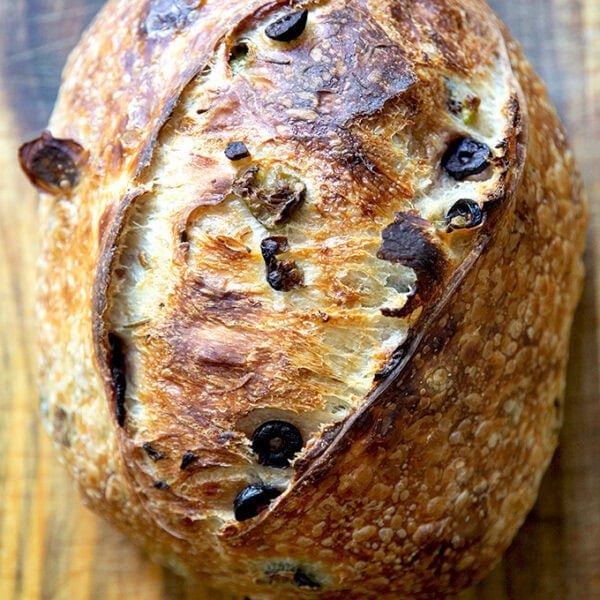
Loaded with olives, scented with rosemary, this sourdough loaf is so flavorful and fragrant, perfect for serving as an appetizer alongside good olive oil or, of course, with dinner. This recipe employs a lamination method to incorporate the olives and rosemary into the dough, which helps them disperse evenly.
Method adapted from What’s Stephanie Baking?
Notes:
- For best results, please use a scale to measure.
- Salt: The rule of thumb with bread is that the weight of the salt should be 2 to 3% the weight of the flour. For this recipe, the amount is 10 to 15 grams. I find 12 grams of salt here to be perfect, given that the olives lend a bit of saltiness to the loaf. Finally, I always use Diamond Crystal kosher salt, but you can use fine sea salt or whatever salt you like.
- Sourdough Starter: You need an active sourdough starter. You can make one from scratch or you can buy one. I have had success activating starters from:
- I loved these two-quart vessels for the bulk fermentation.
- This is the Dutch Oven I use for sourdough bread. I used this Dutch oven for years, and it’s a great one, too.
- I love these Flour Sack Towels.
- For proofing, I use an oval banneton. You need something roughly 10 inches in length. You can use a circle one, too, if you are shaping your loaf into a round.
- Sharp knife: This one is reasonably priced.
Ingredients
- 375 g (about 1 1/2 cups) room temperature water
- 12 g (2.5 teaspoons) salt, see notes above
- 100 g (1/2 cup) bubbly, active starter, see notes above
- 500 g (4 cups plus 2 tbsp) bread flour
- extra-virgin olive oil, for drizzling
- 5 ounces pitted olives, any variety (I use a mix of Castelvetrano and Kalamata), sliced
- 2 tablespoons fresh rosemary
Instructions
- Make the dough: Place the water in a large bowl. Stir in the salt followed by the sourdough starter, using a spatula to incorporate — it’s OK if the starter is not fully incorporated. Add the flour and mix with a spatula until you have a sticky dough ball. Cover the bowl and let the dough rest for 30 minutes.
- Stretch and fold: Using a wet hand, grab a corner of the dough and pull it up and into the center. Repeat until you’ve performed this series of folds 8 to 10 times with the dough. As you stretch and fold, you should feel the dough transform from shaggy and rough to smooth and elastic. Slapping and folding the dough helps here, too. (Watch the video for guidance.) Cover the bowl and let the dough rest for one hour.
- Laminate the dough: Lightly oil a large area of a work surface. Uncover the bowl and drizzle oil around the edge of the dough. Use a flexible bench scraper, if you have one, to release the dough from the sides of the bowl, turning it out onto your prepared work surface, reserving the bowl. (Use your hands if you do not have a scraper.) Spread the dough, using lightly oiled hands if necessary to prevent sticking, into a large thin rectangle, roughly 15×20 inches. Spread 4 ounces of the olives over the surface of the dough, followed by 1.5 tablespoons of the rosemary. Gently press the rosemary and olives into the dough, then fold the dough envelope-style style starting from the right shorter edge: fold the right edge of the dough toward the left to cover two-thirds of the dough; then fold the left edge of the dough to the right to cover it completely. Sprinkle the remaining olives and rosemary over the bottom two-thirds of the dough, then fold it again envelope-style, starting from the top edge: fold it down to cover two-thirds of the dough, then fold the bottom edge over to completely cover the top. Lift up your folded bundle and return it to the bowl. Cover the bowl and let the dough rest for one more hour.
- Stretch and Fold one last time: Using two wet hands, gently lift the dough up from the center stretching it long, allowing the edges to fold underneath it. (See video for guidance.) Fold the dough in half once or twice more, again see video for guidance, ultimately forming the dough into a rough ball.
- Bulk Fermentation (first rise): Transfer the dough to a straight-sided vessel to rise. Cover the vessel and let the dough rise at room temperature until it has increased by 50% to 75% in volume, has a few bubbles on the surface, and jiggles when you move the bowl from side to side. Depending on the time of year and the temperature of your kitchen, this will take more or less time (anywhere from 5 to 10 hours). Rely on the visual cues as opposed to the hours it has risen.
- Shape and Rest: Coax the dough onto a clean work surface — I prefer to do this without flour, but lightly flour the work surface if the dough is sticking to it or your hands. Gently shape the dough into a round: fold the top down to the center, turn the dough, fold the top down to the center, turn the dough; repeat until you’ve come full circle. If you have a bench scraper, use it to push and pull the dough to create tension. Lightly flour part of your work surface, if you haven’t already, and let the dough rest seam side up for 30 to 60 minutes.
- Proof the dough: Line a 10-inch banneton, see notes above, with a flour sack towel. If you are not using a flour sack towel and are worried the dough might stick, lightly dust it with flour or rice flour. If you are shaping your dough into a round, using a bench scraper or your hands, shape it again as described in step 6. Place the round into your lined bowl, seam side up. If you are shaping it into a batard, please watch this video. Once your shaped loaf is in your banneton with the seam side up, using lightly floured hands, pinch the seam closed as best you can, then fold the towel over the dough to cover it. Place the whole bundle into an airtight bag (such as a produce bag or a 2-gallon ziptop bag), and transfer it to the fridge, ideally for at least 24 hours or for as long as 48 hours. You can get away with less time in the fridge if necessary.
- Prepare the oven: Forty-five minutes before you plan on baking, place a Dutch oven in your oven, and preheat it to 450°F. Cut a piece of parchment to fit the size of your loaf/baking pot.
- Score: Remove your bundle from the fridge, unwrap the towel, and place the parchment paper over the dough, securing it with your hand. Invert the banneton to release the dough onto the parchment paper and onto your countertop. Using the tip of a small knife or a razor blade, score the dough however you wish — a simple slash is always nice. Use the parchment to carefully transfer the dough into the preheated baking pot.
- Bake: Bake the loaf for 30 minutes, covered. Remove the lid, lower the temperature to 400ºF, and continue to bake for 10 – 15 minutes more or until the loaf is browned to your liking. Cool on a wire rack for 30 minutes before slicing.
- Store the bread: This loaf will stay fresh up to 3 days stored at room temperature in an airtight plastic bag or container. It freezes beautifully, too.
- Prep Time: 2 days
- Cook Time: 45 minutes
- Category: Bread
- Method: Sourdough/Natural Leavening
- Cuisine: American